

GCSE Economics Extra Reading: How Much Is Enough?
GCSE economics extra reading need not take hours. Learn what to read, how often to read it, and when exam practice or maths revision deserves priority.
A newspaper can make GCSE Economics feel impossibly large. One article mentions inflation, another reports unemployment figures, and a third assumes you already understand interest rates. Suddenly, revising a finite specification feels like trying to understand the entire world.
The reassuring answer is that GCSE economics extra reading does not need to take hours. For most students, one or two short, purposeful reading sessions each week is enough. Around 151515 to 303030 minutes per session can help you build current examples and practise applying economic ideas. Beyond that, exam questions, feedback and core subject knowledge usually deserve more of your time.
Extra reading is useful. It is not the main event.
The short answer: how much reading should you do?
Use this checklist as a starting point:
- Read one or two relevant economic stories each week.
- Spend roughly 303030 to 606060 minutes in total, rather than reading every day.
- Choose stories connected to your specification.
- Record the economic concept, groups affected and possible consequences.
- Return quickly to recall, data skills and exam-style questions.
- Reduce the reading if it starts displacing maths revision or required homework.
There is no nationally prescribed number of extra-reading hours for GCSE Economics. The official subject requirements focus on understanding economic concepts, applying them to contexts, analysing evidence and making reasoned judgements. Current and historical issues matter because they provide contexts in which those skills can be used. They are not a separate body of news that you must memorise.
Your teacher may set particular articles, programmes or case studies, so follow that guidance first. Exam-board specifications also differ. Check whether you study AQA, Pearson Edexcel or OCR and use the exact specification supplied by your school.
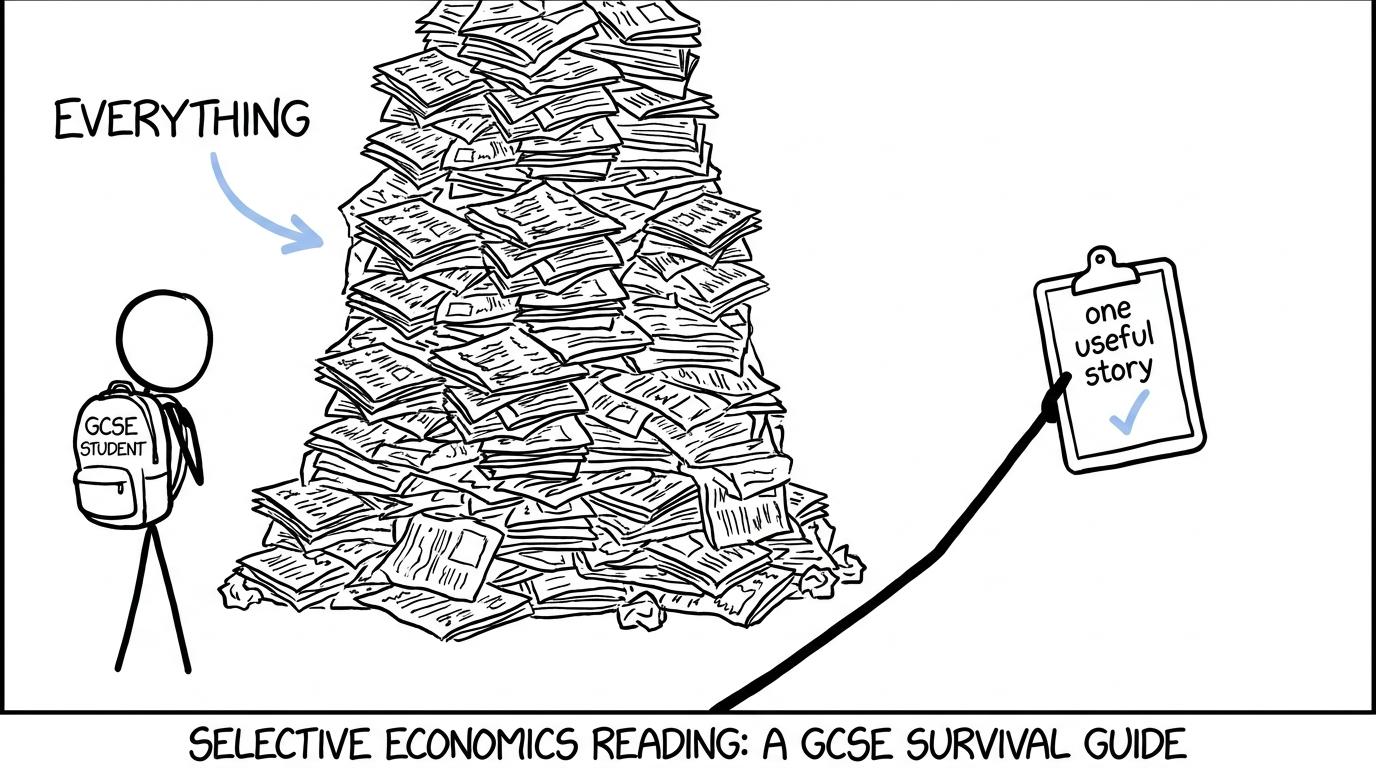 A student chooses one useful economics story instead of an impossible mountain of newspapers
What extra reading actually does for GCSE Economics
Good reading makes abstract ideas easier to apply. Inflation is no longer only a definition when you can connect it to household purchasing power, business costs, saving and interest rates. A report about a tax becomes a chance to consider incentives, government revenue and possible unintended consequences.
That supports three broad abilities assessed in GCSE Economics:
- knowledge and understanding;
- application to an economic context;
- analysis, evaluation and judgement.
Across regulated GCSE Economics qualifications, these assessment objectives are weighted at 35%35\%35%, 35%35\%35% and 30%30\%30% respectively. That balance explains why memorising definitions alone is insufficient. It also explains why reading without practising written answers is insufficient. Knowing a story does not automatically mean you can use it economically.
The most useful article is therefore not necessarily the longest or most sophisticated. It is the one that helps you answer questions such as:
- Which part of the specification does this illustrate?
- Who gains, who loses and why?
- What might happen next?
- Is there evidence for that conclusion?
- What other factor could change the outcome?
If you cannot connect a story to an economic concept, it may be interesting without being useful revision.
A practical GCSE economics extra reading routine
Choose a narrow theme
Begin with a topic you have recently covered in class. Suitable themes might include demand and supply, competition, labour markets, inflation, unemployment, economic growth, government policy, international trade or exchange rates.
This keeps reading attached to your course. Searching broadly for “economics news” creates too much choice and too little direction.
Read for the argument, not every detail
A short, reliable summary is often enough. Identify:
- what changed;
- the likely cause;
- the people, firms or governments affected;
- the data used as evidence;
- one short-term and one possible long-term consequence.
Be careful with opinion pieces. They can reveal arguments worth evaluating, but an assertion is not automatically evidence. Ask who produced the information, when it was published and whether the data measure what the writer claims.
Compress the story into useful notes
Write no more than three or four bullets. A sensible note might contain the topic, context, relevant chain of reasoning and one limitation. Include the publication date because economic conditions change.
Do not copy entire paragraphs. Copying feels productive because the page fills up, but it does not test whether you understand the idea. Close the article and explain it from memory instead.
Use the story in an exam task
Finish by planning or answering one relevant question from your teacher, textbook or exam-board materials. The purpose is not to force a news story into every response. It is to practise selecting evidence when the context genuinely fits.
This follows the same principle as effective maths revision: learn, practise, check and repair. The GCSE maths revision hub provides lessons, questions and papers organised by exam board, while the GCSE one-month revision plan shows how short active sessions can fit into a wider timetable.
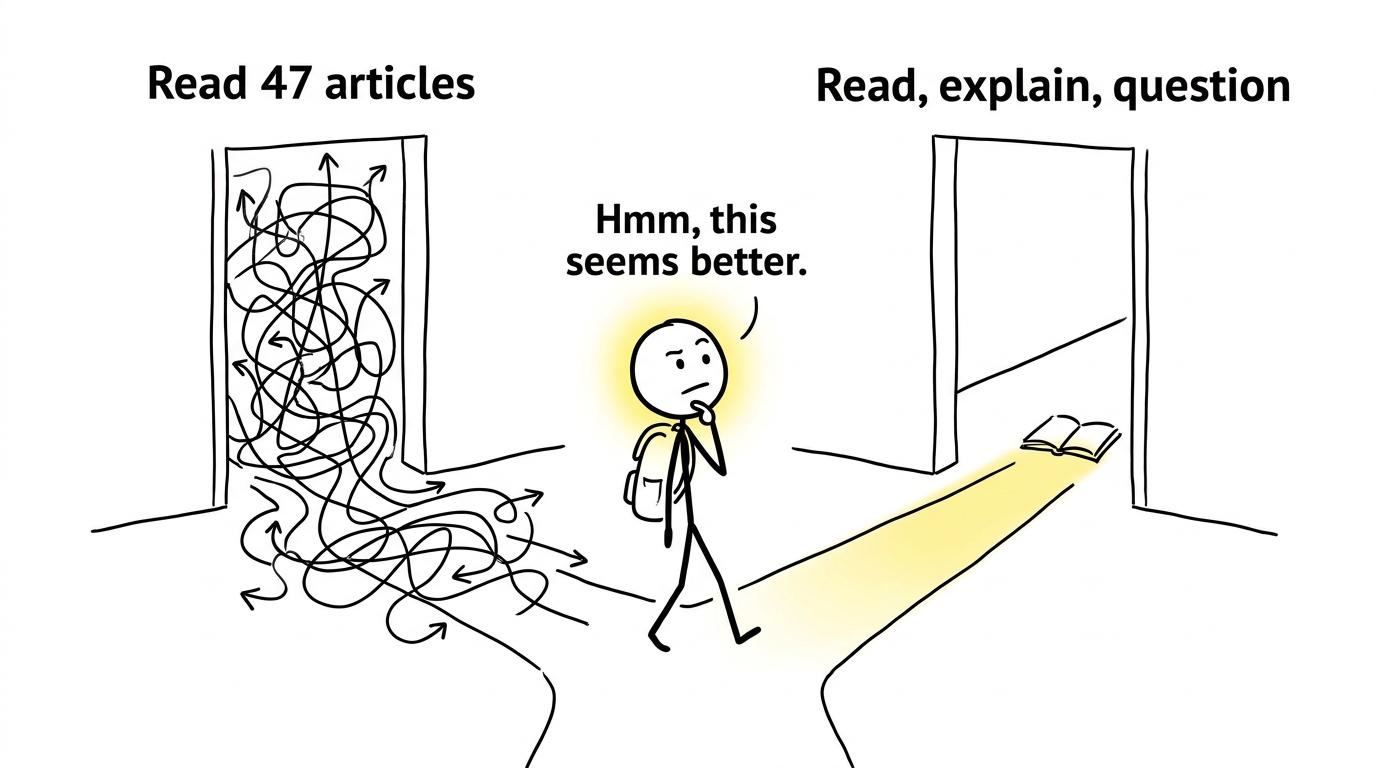 A student chooses a short read-explain-question path instead of a maze of articles
Where your time is often better spent
Extra reading has diminishing returns. The first well-chosen article can make a concept concrete. The tenth article on the same issue may add little if you still cannot define the concept, interpret the data or structure an answer.
Learning the specification content
Reading cannot replace secure knowledge. You need accurate meanings, relationships and diagrams before a current example becomes useful. If you cannot explain why a demand curve might shift, another article about prices is unlikely to solve the underlying gap.
Use your specification as a boundary. It tells you what can be assessed; headlines do not.
Retrieval and exam-question practice
After learning a topic, put away your notes and reconstruct the key ideas. Then attempt questions and compare your response with the mark scheme or teacher feedback.
This produces information that passive reading cannot provide. You discover whether you used the correct terminology, applied it to the stated context, developed a logical chain and reached a supported judgement.
MathsGenie's advice on starting GCSE past papers explains why paper practice is most valuable when there is still time to repair the weaknesses it exposes. The same principle applies to Economics.
Quantitative skills
Official GCSE Economics requirements state that at least 10%10\%10% of the total qualification marks must reward quantitative skills at no lower than Key Stage 333 demand. These skills are assessed in economic contexts rather than as isolated maths exercises.
Required skills include:
- percentages and percentage changes;
- averages;
- revenue, cost and profit totals;
- gross and net income;
- constructing graphs from data;
- interpreting charts and economic statistics.
Useful relationships include:
percentage change=new value−original valueoriginal value×100\text{percentage change}=\frac{\text{new value}-\text{original value}}{\text{original value}}\times 100percentage change=original valuenew value−original value×100and
profit=total revenue−total cost.\text{profit}=\text{total revenue}-\text{total cost}.profit=total revenue−total cost.You need more than a correct calculation. Economics questions may require you to interpret what the result means for consumers, businesses or government decisions.
If these skills are uncertain, use MathsGenie's percentage revision lessons, percentage practice questions and averages lessons. Choose resources matching your maths exam board where possible, although the underlying numerical skills also transfer to Economics.
How to divide limited revision time
Think in priorities rather than rigid quotas. A useful Economics session could contain:
- 101010 minutes recalling definitions or drawing diagrams;
- 202020 minutes answering a question;
- 101010 minutes marking and correcting it;
- 101010 minutes reading a linked current story.
That is a planning model, not an official rule. If a mock reveals weak calculations, move more time towards numerical practice. If your knowledge is secure but your answers lack application, a relevant article may deserve a larger share.
Students preparing for GCSE maths exams must also consider opportunity cost, appropriately, an economic idea. An extra hour spent following news is an hour unavailable for algebra, percentages or timed paper practice. Use a weekly timetable that protects your highest-priority subjects and weakest topics. The MathsGenie revision timetable guide can help you build that structure.
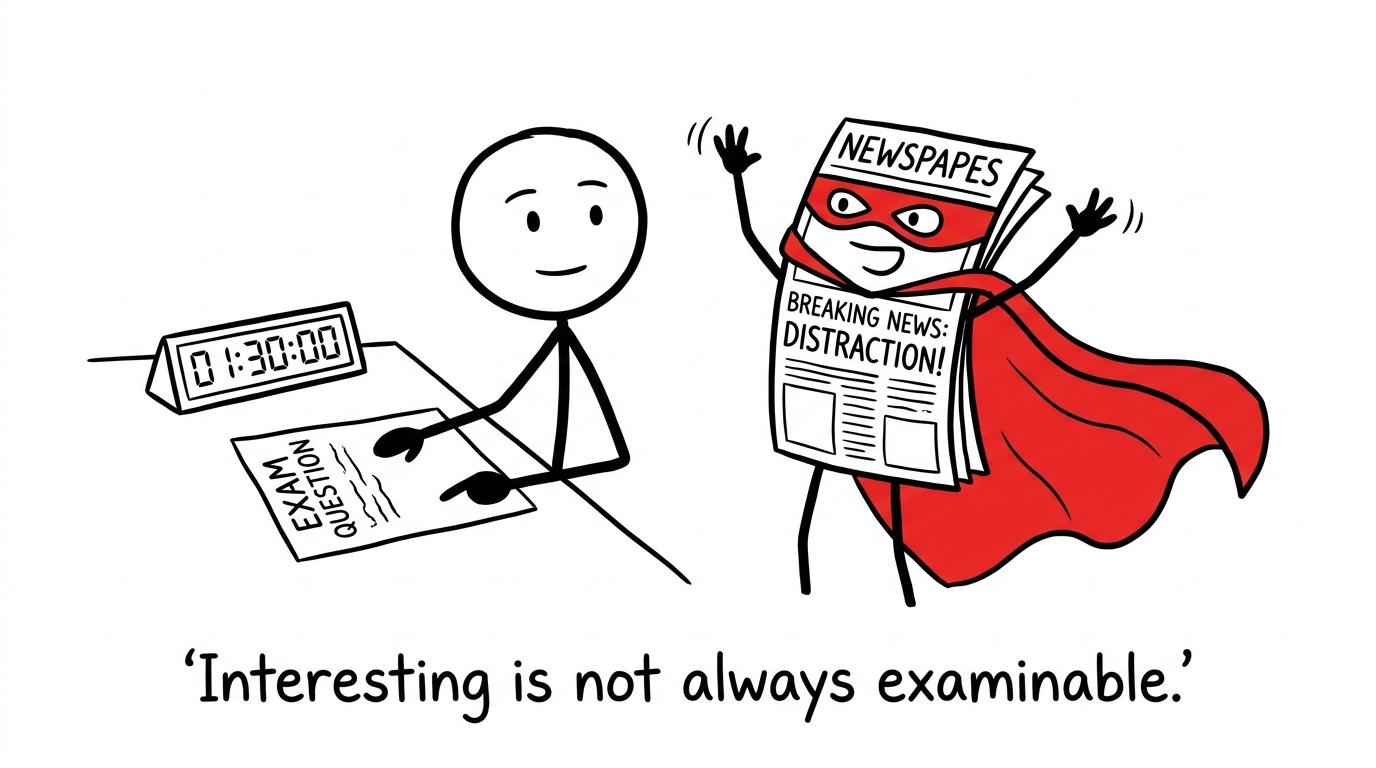 A dramatic newspaper fails to distract a student from purposeful exam practice
Common mistakes with Economics extra reading
Reading too widely
Trying to follow every major story creates anxiety rather than understanding. Select one theme connected to your current unit and ignore unrelated detail.
Collecting examples without learning concepts
A folder full of articles cannot compensate for insecure definitions or diagrams. Learn the economics first, then use a story to deepen it.
Treating every headline as reliable evidence
Headlines simplify. Check the date, source, unit, time period and what any graph actually measures. Correlation does not by itself establish causation.
Memorising statistics without context
Economic figures are revised and quickly become outdated. Unless your teacher advises otherwise, focus on the direction, scale and significance of change rather than building a large bank of fragile numbers.
Reading instead of answering questions
Recognition is not recall. If most of a session is spent highlighting, end by explaining the argument without the article and applying it to a question.
Neglecting the maths
A student may understand the story but lose marks through an incorrect percentage change, poor graph reading or missing units. Use Edexcel GCSE maths worksheets or the relevant exam-board resources to repair specific gaps.
Make reading serve the exam
The best extra reading habit is modest and repeatable: one relevant story, a few careful notes and one attempt to use the idea. You are not training to become a live economic news service. You are learning to think clearly about evidence, incentives, consequences and competing viewpoints.
When time is limited, protect the work that most directly changes performance: specification knowledge, retrieval, quantitative skills, exam questions and feedback. Reading should support that system, not quietly replace it.
For your maths preparation, start at the free GCSE maths revision hub. Use revision lessons and practice questions to repair weak topics, then test your progress with mark schemes, video solutions, mini tests, past papers and GCSE predicted papers. Read selectively. Practise deliberately. Let every session earn its place.











