

GCSE Economics Exam Day Kit: What to Pack
GCSE economics exam day kit essentials: pack the right pens, calculator and stationery, avoid prohibited items, and follow a calm night-before checklist.
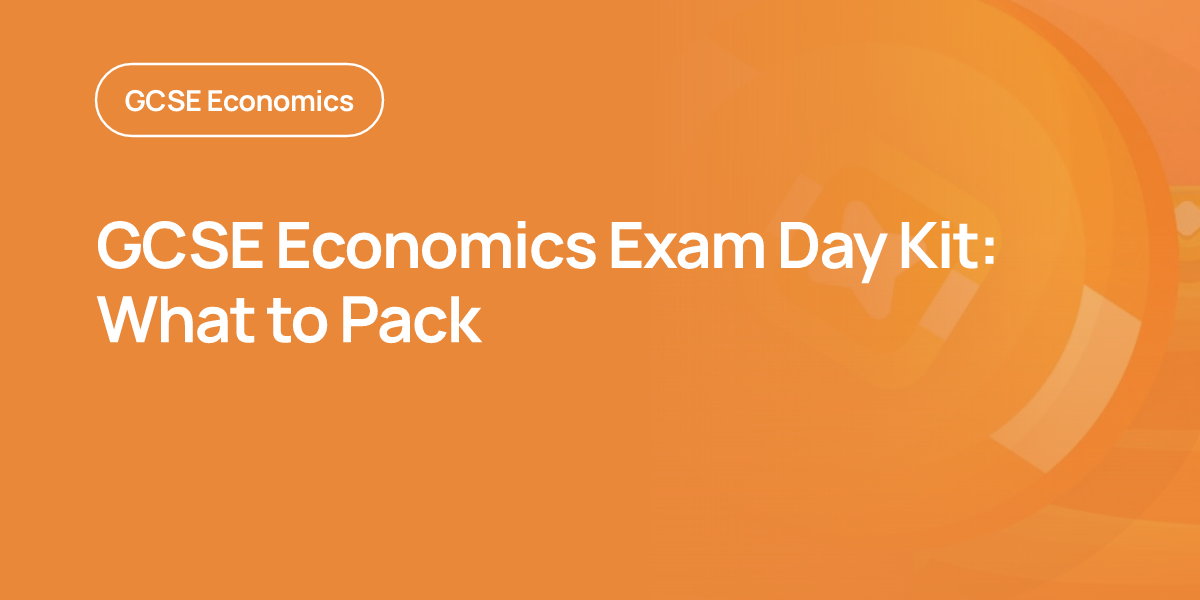
The night before an exam has a strange way of making ordinary objects feel important. A black pen is no longer just a pen. A calculator with a fading battery becomes a crisis waiting to happen. And the phone you carry everywhere suddenly becomes something that must stay far away from your desk.
A reliable GCSE economics exam day kit is simple: at least two black pens, a pencil, ruler, eraser, permitted calculator and clear pencil case. You should also confirm the paper time, location and any arrangements made by your school. Pack everything the night before so that exam morning is reserved for arriving calmly, not searching through drawers.
This guide focuses on GCSE Economics, but the preparation habits are equally useful for GCSE maths students. Economics papers can involve percentages, averages, revenue, costs, graphs and data interpretation. The knowledge is economic; the accuracy often depends on familiar numerical skills.
Your GCSE economics exam day kit checklist
Use this as your final packing list. Your school’s instructions and the information printed on the question paper always take priority.
- At least 222 working black ballpoint pens
- A spare black pen
- A sharpened pencil for diagrams, graphs and rough notes
- A ruler with clear markings
- An eraser
- A permitted scientific calculator
- A transparent pencil case
- A clear, label-free water bottle, if your centre allows one
- Any candidate card or identification requested by your school
- Details of the exam date, start time, room and seating arrangements
- Approved access-arrangement equipment, where applicable
Do not add equipment simply because it might be useful. An exam kit is not a survival backpack. Its purpose is to remove uncertainty.
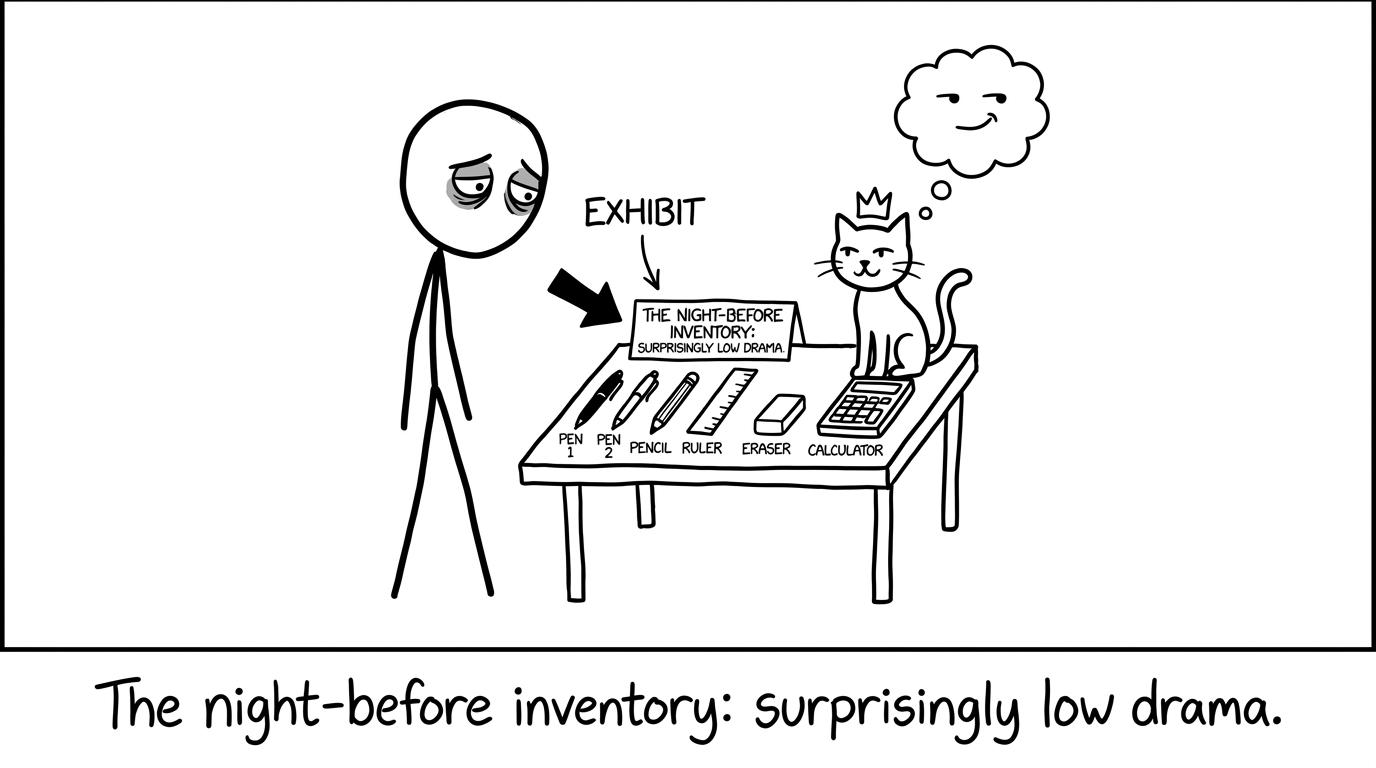 A student calmly arranging an exam kit while a cat guards the calculator
The stationery you will actually need
Black pens and a sensible spare
Current JCQ instructions say that candidates must write clearly in black ink. Pack at least 222 black ballpoint pens and test both before putting them in your clear pencil case.
Avoid erasable pens, gel pens and correcting fluid or tape. Highlighters may sometimes be used on the question paper or supplied extracts, but not in your answers. If you make a mistake, cross it out neatly with a single line and continue.
A spare pen is a small form of insurance. It solves a predictable problem without requiring an invigilator or breaking your concentration.
Pencil, ruler and eraser
A pencil is useful when drawing or completing supply and demand diagrams, labelling axes or making rough notes. A ruler helps you produce clear axes and straight lines.
Economic diagrams are arguments expressed visually. If a line shifts, the direction and labels must be unambiguous. Pack a sharpened pencil rather than assuming there will be a sharpener available.
You usually will not need the full geometry set associated with GCSE maths. Compasses and a protractor are unlikely to help in an Economics paper unless your school or paper instructions specifically say otherwise. Carrying unnecessary equipment only creates clutter.
A transparent pencil case
JCQ rules require any pencil case taken into the exam room to be see-through. A clear case allows invigilators to check its contents quickly.
Remove revision cards, scraps of paper and stationery carrying notes. Even an old formula slip that you forgot was there can count as unauthorised material. Empty the case completely, then rebuild it using the checklist above.
Check your calculator before exam morning
AQA and OCR GCSE Economics permit calculator use, subject to JCQ regulations. Nevertheless, you should confirm the requirements for your exact specification and read the front of the question paper. Instructions on the paper take priority.
The night before, check that your calculator:
- switches on immediately
- has a reliable battery
- has no prohibited stored information
- has no case or cover printed with formulae or instructions
- is a model permitted under the current regulations
- is familiar enough that you can use brackets, percentages and negative values confidently
JCQ rules do not permit calculators that provide prohibited stored text, symbolic algebra manipulation, symbolic differentiation or integration, or communication with other devices or the internet. A phone calculator is not an acceptable substitute. You also cannot borrow a calculator from another candidate during the examination, although an invigilator may be able to provide a replacement.
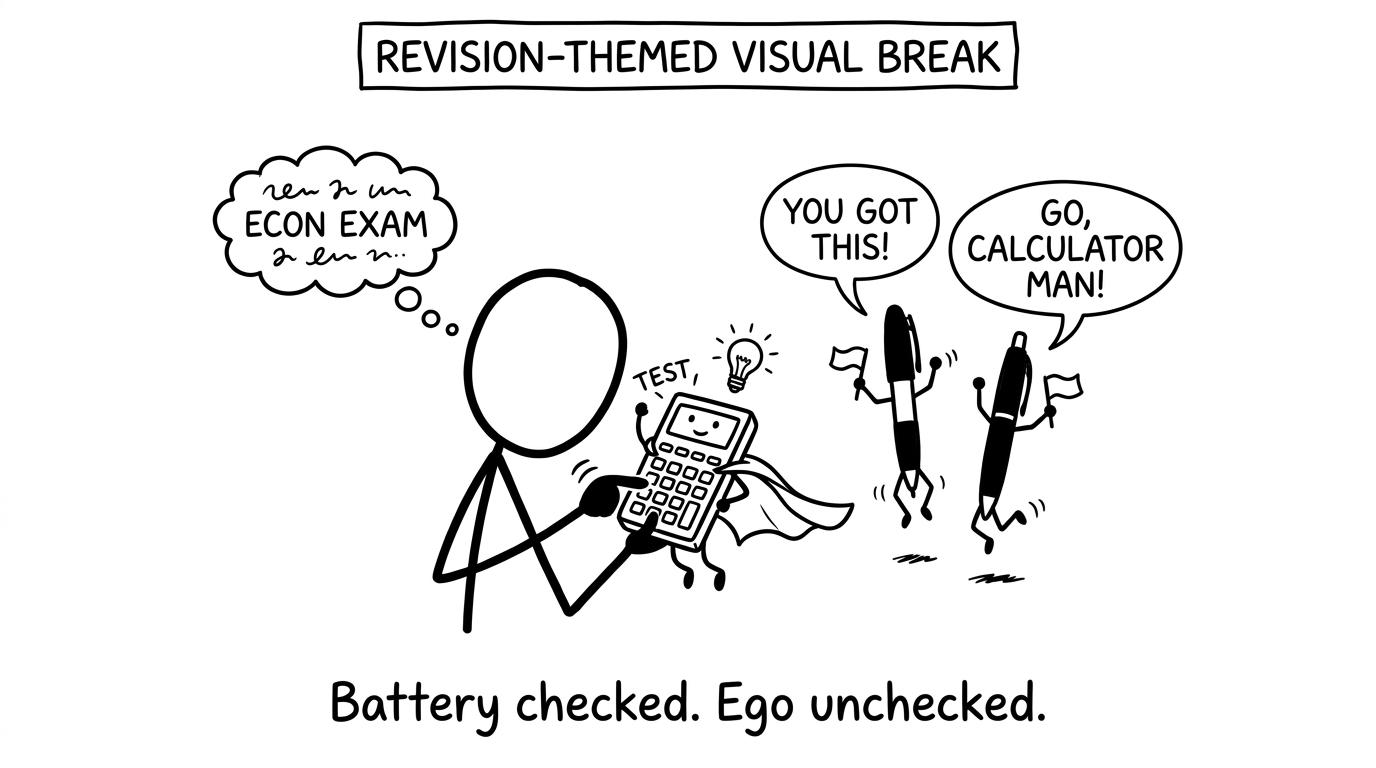 A calculator in a superhero cape being checked by two spare pens
Calculator confidence matters because GCSE Economics includes quantitative skills. AQA identifies skills such as calculating percentage changes, averages, totals, revenue, costs, profit and income, as well as constructing and interpreting graphs.
For example, you should recognise the structure of percentage change:
percentage change=changeoriginal value×100\text{percentage change}=\frac{\text{change}}{\text{original value}}\times 100percentage change=original valuechange×100You do not need to turn the night before into a long maths session. If numerical work feels uncertain, use MathsGenie’s percentage change revision resources for a focused refresher. The broader GCSE maths revision hub also brings together lessons, practice questions, worksheets and revision tools across the main exam boards.
What must stay outside the exam room
The safest approach is not merely to switch prohibited devices off. Leave them at home or hand them in according to your school’s procedure before entering the room.
Under current JCQ written-exam rules, prohibited items include:
- mobile phones
- watches of any kind, including analogue and smart watches
- earbuds, earphones and similar devices
- revision notes or flashcards
- smart glasses and other communication devices
- calculator instructions or prepared programs
- correcting fluid, correcting tape and erasable pens
Possessing unauthorised material can break the rules even if you never intend to use it. The forgotten note in a pocket is therefore more dangerous than the fact you have not read it.
Check every pocket. Check the clear pencil case. Then check once more.
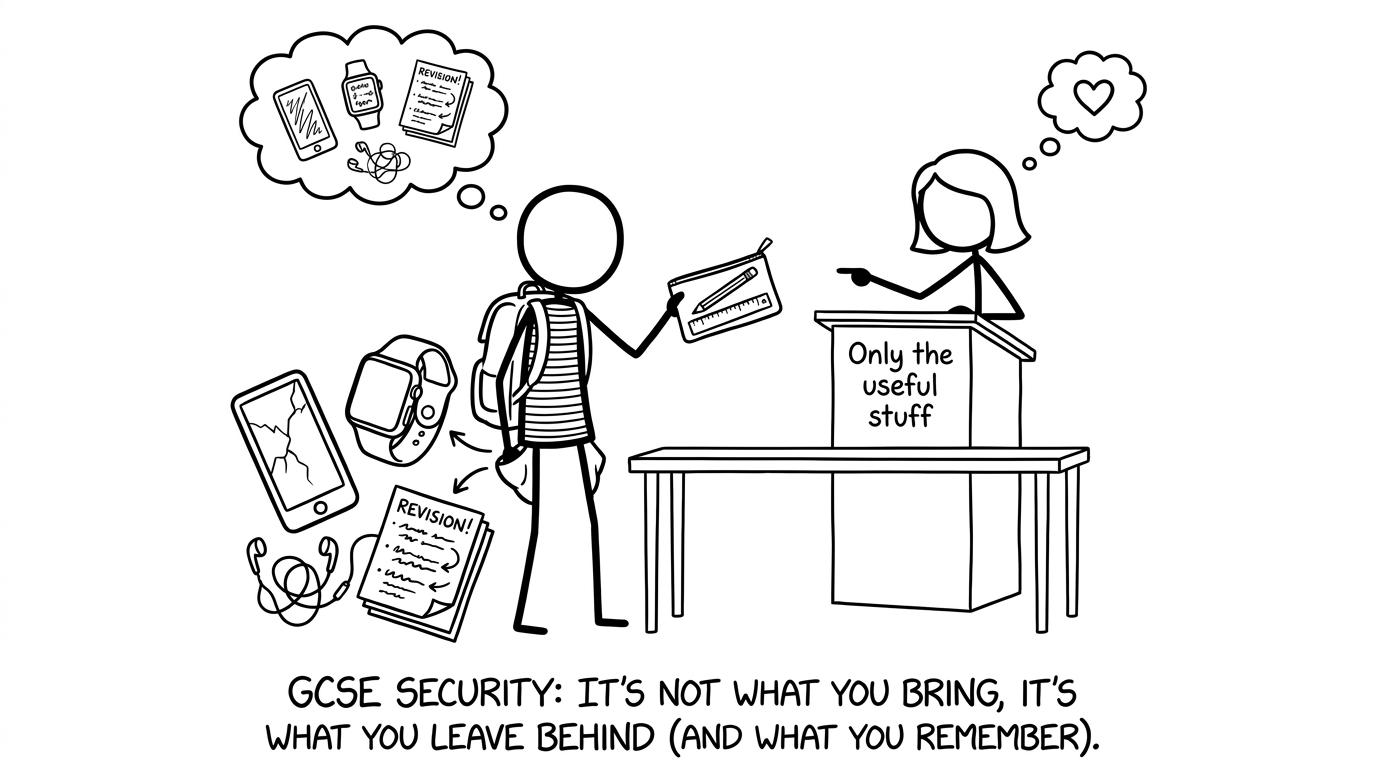 A student removing prohibited gadgets before entering the exam room
Confirm the exam details rather than guessing
Equipment is only one part of being ready. Write down the following information from your official timetable or school communication:
- the correct date
- the published start time
- the exam room
- your seat or candidate details, if supplied
- the GCSE Economics paper or component
- the person to contact if you are delayed or unwell
AQA GCSE Economics has separate papers covering how markets work and how the economy works. OCR also uses two written components, covering introductory economics and national and international economics. Make sure you know which paper you are sitting; do not rely on what a friend remembers.
Aim to arrive at the time specified by your school. If transport is unpredictable, plan an earlier journey and keep the school’s emergency contact details available outside the exam room. If something genuinely goes wrong, contact the school rather than deciding for yourself that it is too late.
Your night-before preparation routine
A good final evening is deliberately uneventful. You are not trying to rebuild an entire specification. You are trying to protect what you already know.
Early evening: complete one short review
Choose one contained task: review your error list, complete a small set of data questions, or revisit one weak area. Stop after the planned task rather than following anxiety into another hour of unfocused reading.
MathsGenie’s free revision resources include mini tests, practice materials and predicted papers for maths preparation. If you are balancing Economics with an upcoming maths paper, the GCSE one-month revision plan can help keep the wider workload organised.
Pack the kit in one place
Lay out every item and test it. Put the clear pencil case and calculator directly into your bag. Set out suitable clothes and prepare anything you need for the journey.
This is more effective than telling yourself you will remember in the morning. Memory works poorly when several small decisions arrive at once.
Check the timetable and set alarms
Read the official details yourself. Set an alarm with enough time to eat, get ready and travel without rushing. A second alarm can provide reassurance, but it should not replace a realistic bedtime.
For a structured final evening before a maths paper, follow the GCSE maths night-before plan. Its central idea applies across subjects: do a short, purposeful review, fix a small number of mistakes, pack and stop.
Wind down
Once the kit is packed, move away from intensive revision. Do not take notes to bed or stay awake chasing the feeling of being completely prepared. That feeling rarely arrives. A finished checklist is a better stopping signal.
Economics equipment and exam technique work together
A calculator can produce a number, but it cannot decide what the number means. A ruler can draw an axis, but it cannot choose the correct label. Equipment supports judgement; it does not replace it.
When reading economic data:
- check the units and time period
- distinguish totals from percentage changes
- show enough calculation to make your method clear
- interpret the result in its economic context
- label diagrams precisely
- use evidence from the question when making a judgement
Students preparing for GCSE maths can build these habits through timed paper practice. MathsGenie explains when to start using GCSE past papers and how to turn each lost mark into a specific revision action. Predicted papers can then provide fresh practice, but they should complement rather than replace genuine past papers and specification coverage. The Edexcel GCSE maths predicted papers include mark schemes and worked support for checking your methods.
Common exam-day kit mistakes
Packing blue pens instead of black
Use black ink unless the paper explicitly instructs otherwise. Test every pen and include a spare.
Assuming any calculator is acceptable
A familiar-looking calculator can still contain prohibited features or stored information. Check compliance, clear stored material where required and remove printed covers.
Leaving a phone or watch in a pocket
Turning a device off is not the same as removing it. Follow your school’s collection procedure or leave it securely outside the exam room.
Bringing notes inside a calculator case
Remove calculator lids or covers containing instructions or formulae. Check for revision slips tucked inside the case or pencil case.
Packing too much
Extra stationery does not create extra knowledge. Keep the case clear, visible and limited to permitted essentials.
Revising until the moment the paper begins
Last-minute reading can make familiar ideas feel unstable. Complete a short review, then put notes away before entering the exam area.
Forgetting to check the exact paper
Do not assume that every GCSE Economics board uses identical paper titles, timing or instructions. Check your official timetable, specification and question-paper front cover.
Pack once, then trust your preparation
A good GCSE economics exam day kit will not earn marks by itself. What it does is quieter and more valuable: it prevents small, avoidable problems from occupying the attention you need for the paper.
Pack two working black pens, a pencil, ruler, eraser and compliant calculator in a clear pencil case. Remove prohibited devices and notes. Confirm the time and room. Then stop preparing the equipment and let the kit do its job.
For the maths skills that support Economics and your wider GCSE programme, use MathsGenie as your free revision base. Start with revision lessons and targeted practice questions, check your progress with mini tests, and then move to past papers and predicted papers under timed conditions. Use the mark schemes and video solutions to understand every lost mark. The final evening should not be about doing everything; it should be about knowing that the important things are ready.











