

GCSE Design and Technology Grade 8 Meaning
GCSE Design and Technology grade 8 meaning explained: discover the ability it represents, how it compares with old grades and what strong work involves.
A grade can look like a simple number until it belongs to you. Then it becomes a question about ability, effort and what comes next.
The gcse design and technology grade 8 meaning is straightforward: it represents an exceptionally strong performance in the qualification, broadly within the territory once associated with the old A* grade. It sits below grade 999, the highest grade available, and above grade 777, which broadly aligns with the old grade A.
But a grade 888 does not merely mean that a student can make an attractive product. It indicates high-level performance across designing, technical knowledge, practical development, analysis, evaluation and mathematical application. The final grade reflects both the written examination and non-exam assessment (NEA), according to the requirements of the relevant exam board.
Grade 8 meaning at a glance
A student achieving grade 888 in GCSE Design and Technology will typically have demonstrated:
- detailed knowledge of materials, processes and technical principles;
- effective investigation of users, contexts and design problems;
- creative ideas developed through testing and iteration;
- a well-made prototype suited to its intended purpose;
- justified decisions rather than unsupported opinions;
- perceptive analysis and evaluation;
- confident use of measurements, scale, proportion and other mathematical skills;
- consistently strong performance across the written paper and NEA.
There is no permanent grade 888 mark or fixed percentage. Grade boundaries are set for each examination series and can change according to the demand of the assessments. Your raw marks are combined and compared with the boundary published by your exam board.
How does grade 8 compare with the old letter grades?
The numbered GCSE scale is not a perfect relabelling of A* to G. Ofqual established key comparison points, including grade 777 broadly aligning with the old grade A. Grade 999 was introduced to distinguish the very highest performances more sharply.
A useful broad comparison is:
| Current GCSE grade | Broad comparison with old grades |
|---|---|
| Grade 999 | Above the old A* threshold at the very top of performance |
| Grade 888 | Broadly within old A* territory |
| Grade 777 | Broadly comparable to an old grade A |
| Grade 444 | Broadly comparable to an old grade C |
| Grade 111 | Broadly comparable to an old grade G |
This table should be treated as a guide, not an exact conversion. The specifications, assessments and grading structures changed when reformed GCSEs were introduced. It is therefore safer to say that grade 888 signals performance between grades 777 and 999, rather than assigning it a precise historical letter.
That distinction matters. A grade 888 is not an A with a few extra marks, nor is it a failed attempt at grade 999. It is a high grade in its own right.
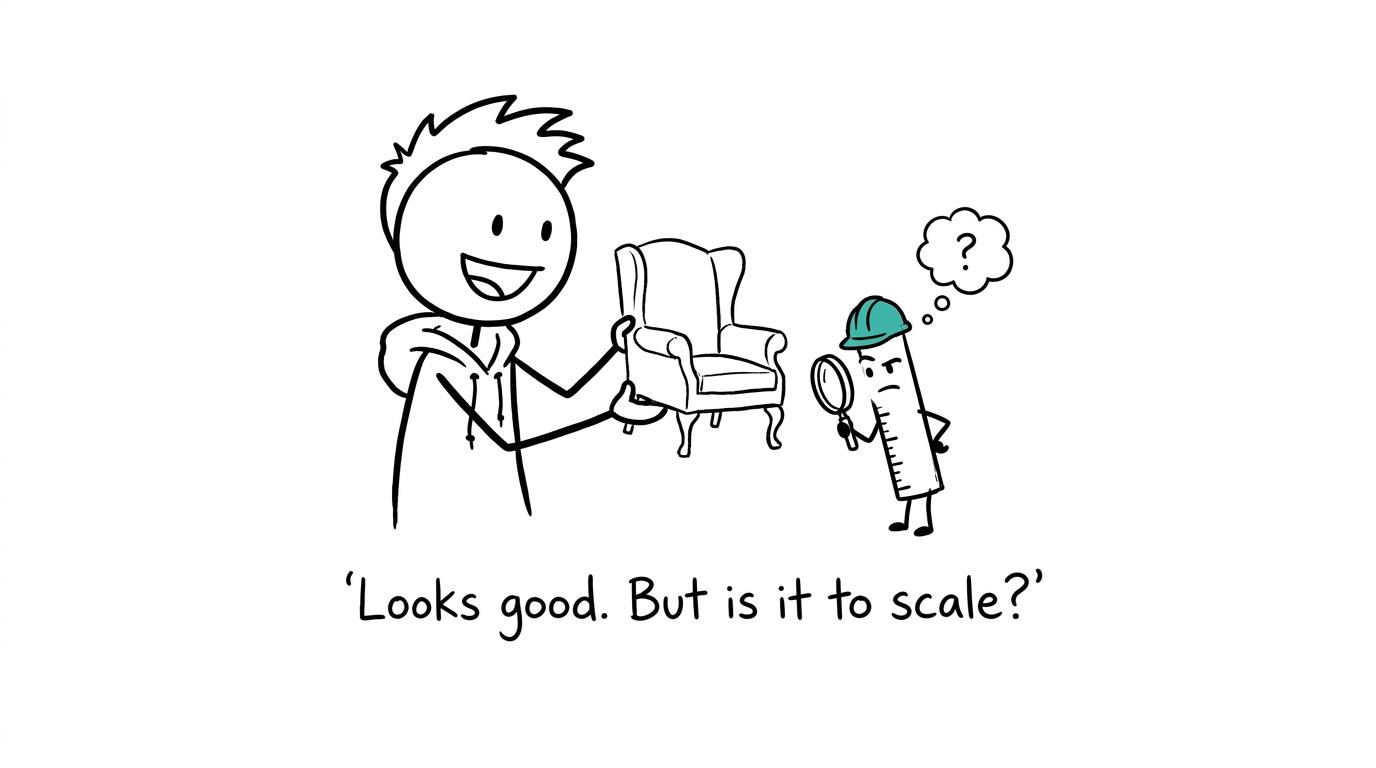 A ruler character inspecting a student's designed chair and asking whether it is to scale
What ability does a grade 8 actually represent?
Design and Technology rewards connected thinking. A strong student must understand how a product works, why it is needed, how it should be made and whether the eventual outcome succeeds.
Technical knowledge that can be applied
Grade 888 performance normally goes beyond recalling isolated facts. A student may know the properties of timbers, metals, polymers, papers and boards, textiles or electronic components, but the more important skill is applying that knowledge.
For example, material selection should be connected to function, durability, manufacture, cost, environmental impact and user needs. A high-level response explains why a choice is appropriate in the given context and may compare it with realistic alternatives.
The same principle applies to mechanisms, energy, modern materials, production methods and sustainability. Knowledge earns its value when it supports a reasoned decision.
Purposeful designing and development
An early idea is rarely the finished answer. Grade 888 work generally shows that ideas have been explored, modelled, tested and improved.
Development should be visible. Feedback or testing leads to a specific alteration; the alteration is justified; and its effect is evaluated. This is iterative design rather than producing several drawings that say roughly the same thing.
The strongest evidence remains relevant to the design brief and specification. It shows how decisions respond to real needs rather than decorating a portfolio.
Accurate practical work
A sophisticated folder cannot hide a prototype that does not function. Equally, an impressive prototype cannot replace the evidence needed to explain how it was developed.
High performance can involve accurate manufacture, appropriate tools and processes, suitable finishes, quality control and safe working. The outcome does not need to resemble a factory-made product, but it should demonstrate control, independence and a clear relationship with the intended user and purpose.
Analysis rather than description
Description tells an examiner what is present. Analysis explains why it matters.
A grade 888 student is likely to examine the consequences of design choices, recognise limitations and use evidence to judge success. Evaluation is more convincing when it refers to tests, measurements, user feedback and specification criteria.
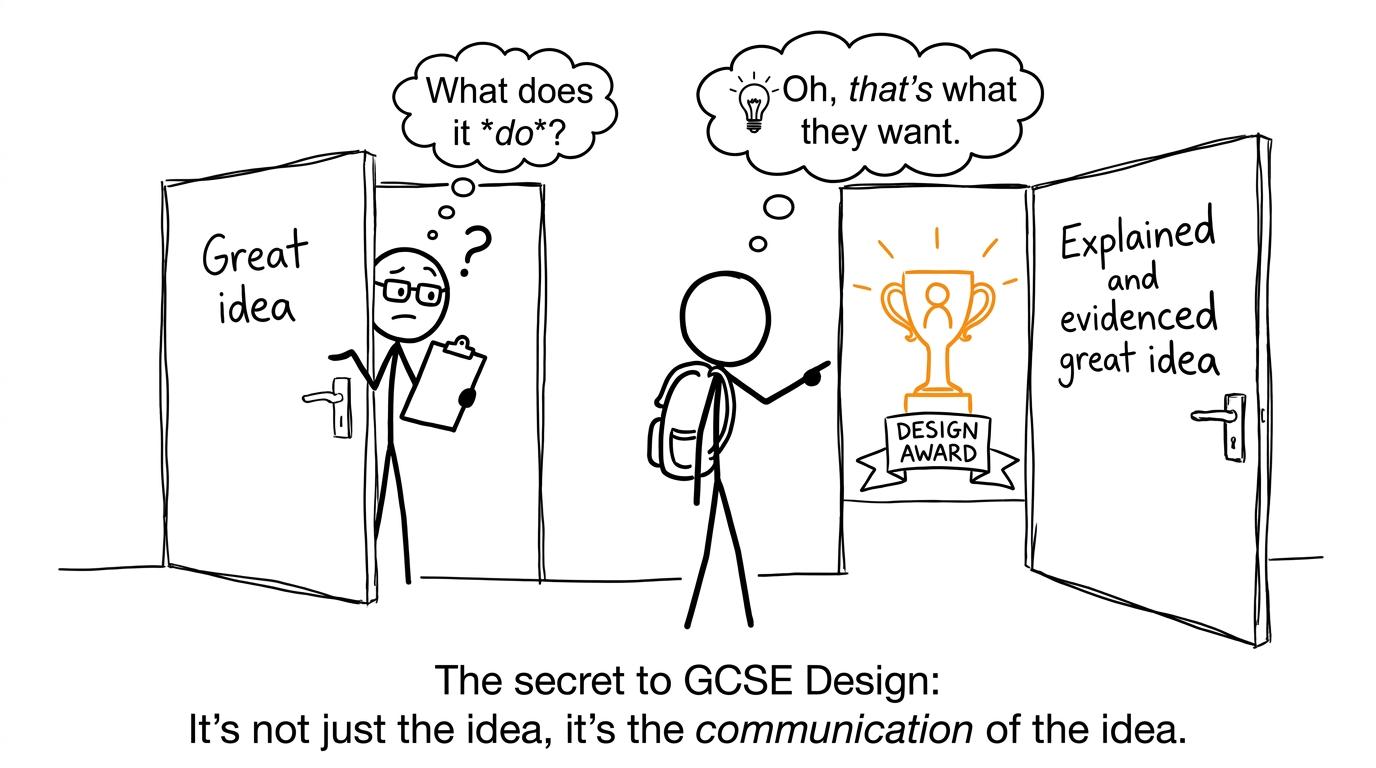 A student choosing between a great idea and a great idea supported by explanation and evidence
How the written exam and NEA contribute
Current GCSE Design and Technology qualifications offered by boards such as AQA, Pearson Edexcel, OCR and Eduqas combine a written assessment with NEA. The precise paper structure and terminology vary, so students should always check their own specification.
The qualification is generally divided equally:
Written assessment weighting=50%\text{Written assessment weighting}=50\%Written assessment weighting=50% NEA weighting=50%\text{NEA weighting}=50\%NEA weighting=50%This balance has an important consequence: grade 888 is an overall qualification grade. A student does not normally need to reach a notional grade 888 standard in each component separately. Strong NEA marks can support the overall total, but they cannot make the written paper irrelevant. The reverse is also true.
For AQA, for example, the assessment objectives cover investigating design possibilities, designing and making prototypes, analysis and evaluation, and the application of technical knowledge. Its written examination and NEA are each worth 100100100 raw marks, creating a total of 200200200 before the relevant grade boundaries are applied.
NEA work is marked by teachers and moderated by the exam board. This is why teacher feedback, assessment criteria and authentic evidence matter more than trying to guess a particular percentage.
Why maths matters in GCSE Design and Technology
Design turns ideas into dimensions, quantities and constraints. That makes mathematics part of the subject, not an optional extra.
GCSE Design and Technology written assessments include mathematical skills. These can involve:
- fractions, decimals, ratios and percentages;
- area, surface area and volume;
- unit conversions;
- scale drawings and scale factors;
- tolerances and limits;
- material quantities and waste;
- interpreting charts, tables and production data;
- forces, motion and mechanical advantage where required by the specification.
A student aiming for grade 888 should be able to choose and apply these methods within a design context. The difficulty is often not the calculation alone. It is identifying which information matters, selecting the correct method and attaching an appropriate unit.
MathsGenie's GCSE maths revision hub provides free lessons, questions and papers across the major exam boards. If you are unsure which skills to repair first, the GCSE maths topics by exam board and tier guide offers a clear map of number, ratio, geometry and measures.
Unlike GCSE Maths, GCSE Design and Technology is not normally divided into foundation and higher tiers. You may nevertheless need mathematical skills associated with several areas of the GCSE Maths curriculum. The best order for learning GCSE maths topics can help you rebuild those foundations in a logical sequence.
How to work towards grade 8
A grade 888 target becomes more useful when it is translated into actions. The number itself cannot tell you what to do on Tuesday evening. A revision system can.
Learn your assessment criteria
Read the specification and NEA assessment criteria for your exam board. Notice the command words and the difference between identifying, explaining, analysing, evaluating and justifying.
For the written paper, use official past questions and mark schemes supplied through your school or exam board. Record whether each lost mark came from missing knowledge, weak application, imprecise terminology, incomplete reasoning or a mathematical error.
Make revision active
Reading notes can create familiarity without reliable recall. Close the book and retrieve information instead. Sketch a process from memory, compare materials for a stated purpose, explain a mechanism or plan an answer to an extended-response question.
Then check what you missed. That moment of correction is where revision becomes useful.
Protect the mathematical marks
Use short, focused practice for calculations involving percentages, ratio, scale and measures. MathsGenie's one-month GCSE revision plan shows how to combine retrieval, topic work and timed practice without trying to revise everything at once.
Past papers should come after some topic repair, not instead of it. The guide to using GCSE Maths past papers properly explains how to mark, diagnose and revisit errors. The same attempt, mark, fix cycle can strengthen D&T calculations.
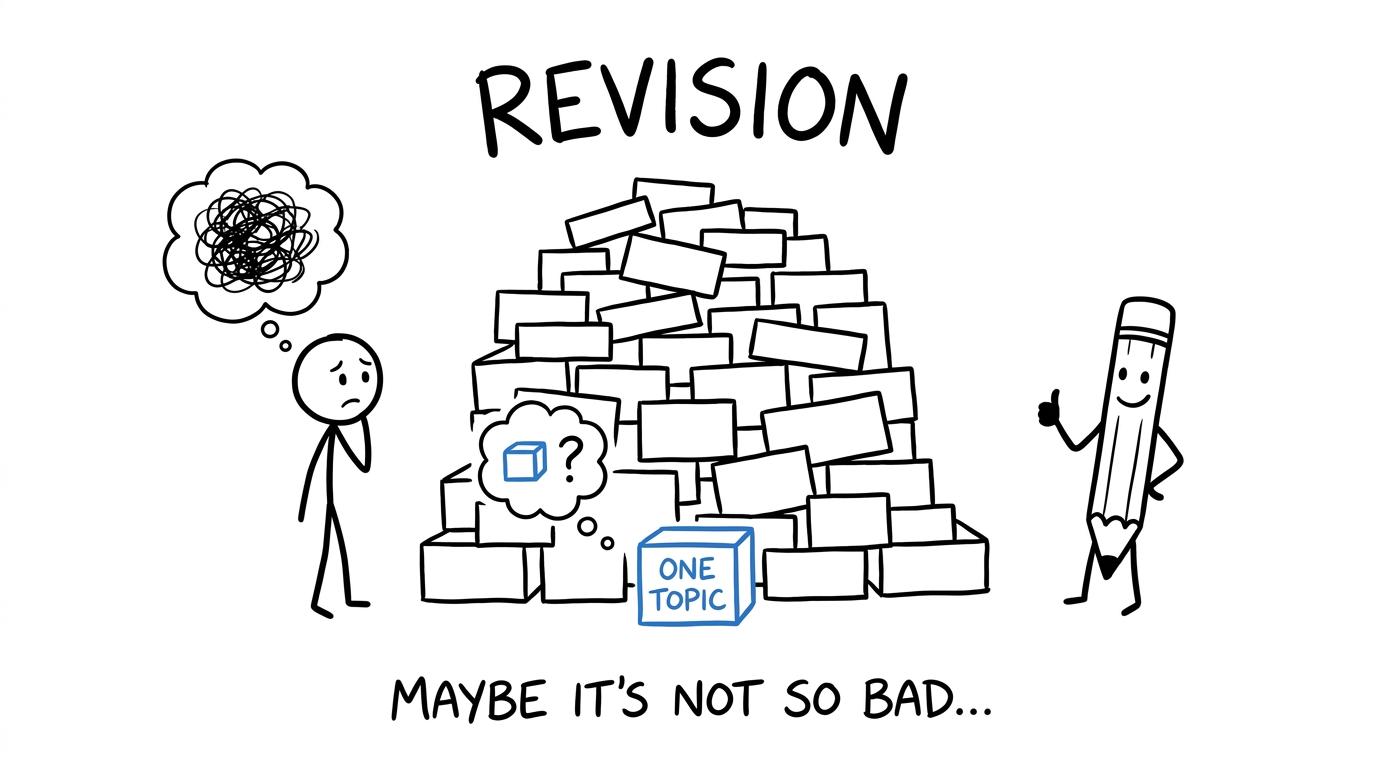 A large revision pile turning out to be a set of small manageable topic cards
Common mistakes when aiming for grade 8
Treating presentation as evidence
A polished page is pleasant to read, but marks come from relevant design thinking. Every annotation, model and image should communicate a decision, finding or improvement.
Describing without justifying
Statements such as “this material is strong” are incomplete unless strength is relevant and supported. Explain the required property, connect it to the product and consider limitations or alternatives.
Leaving evaluation until the end
Evaluation should influence development throughout the project. Test ideas and prototypes while changes are still possible, then document how the evidence affected your decisions.
Ignoring units and precision
A correct numerical method can still produce an unusable design if measurements are inconsistent or units are missing. Estimate first, calculate carefully and check whether the result is realistic.
Assuming a fixed percentage guarantees grade 8
Grade boundaries change between examination series and exam boards. Historical boundaries can provide context, but they are not promises. MathsGenie's discussion of GCSE grade-boundary history explains why marks should be interpreted in context rather than treated as permanent targets.
Chasing predicted content alone
Predictions can focus practice, but they cannot replace broad specification coverage. The same principle is explained in MathsGenie's guide to using predicted topics sensibly. Secure the core knowledge first, then use predicted papers and focused questions to test it.
A high grade is evidence, not identity
A grade 888 in GCSE Design and Technology represents excellent, well-rounded performance. It indicates that a student can combine technical understanding, design development, practical capability, evaluation and mathematical reasoning at a demanding level. Broadly, it sits in old A* territory, although there is no exact one-to-one conversion.
The most productive next step is not to stare at the grade boundary. It is to find the next mark you can make more reliable.
Use MathsGenie's free GCSE maths resources to strengthen the calculations behind scale, materials, dimensions and data. Start with a revision lesson, complete the practice questions, check the mark scheme and use video solutions to correct your method. Then build confidence with mini tests, past papers and predicted papers.
Grade 888 is the outcome. The repeatable revision process is what gets you closer to it.











