GCSE Computer Science Exam Length Explained
GCSE Computer Science exam length varies by board. Compare AQA, OCR, Edexcel and Eduqas timings, then plan your focus, energy and exam-day routine.
The clock can feel strangely loud when you are waiting for an exam to begin. You may know the content, yet still be wondering how long you must concentrate before you can finally put your pen down.
The GCSE Computer Science exam length depends on your exam board and paper. Current specifications use papers lasting between 111 hour 303030 minutes and 222 hours. Across the full qualification, students normally complete between 333 hours and 333 hours 454545 minutes of examined assessment, split across two separate papers.
That is only the scheduled assessment time. On the day, you also need to allow for arriving, finding your seat, hearing instructions, completing candidate details and waiting to be dismissed. This guide explains the complete time commitment so you can plan your energy rather than merely watch the clock.
GCSE Computer Science exam length at a glance
The current published assessment structures for the main GCSE exam boards are shown below. Always confirm your board and paper code with your school because specifications and arrangements can change.
| Exam board | First paper or component | Second paper or component | Total examined time |
|---|---|---|---|
| AQA | 222 hours | 111 hour 454545 minutes | 333 hours 454545 minutes |
| OCR | 111 hour 303030 minutes | 111 hour 303030 minutes | 333 hours |
| Pearson Edexcel | 111 hour 303030 minutes | 222 hours | 333 hours 303030 minutes |
| Eduqas | 111 hour 454545 minutes | 222 hours | 333 hours 454545 minutes |
These papers are taken on different days. You are not expected to complete the total qualification time in one sitting.
Unlike GCSE maths, where students enter foundation or higher tier, the Computer Science qualifications listed here are untiered. Everyone taking the same specification completes the same assessment, although approved access arrangements can alter an individual student's working time.
Quick exam-day checklist
Before each paper, make sure you know:
- your exam board and exact paper code
- whether the assessment is written or onscreen
- the scheduled duration shown on your timetable
- your school's required arrival time
- which equipment is permitted
- whether you have approved access arrangements
- how you will divide the paper into first pass, return pass and checking time
 A student carrying a small focus battery towards a long exam hall
How long is each board's Computer Science exam?
The total time does not tell the whole story. Different boards divide their assessments differently, and an onscreen programming paper demands a different kind of concentration from a conventional written paper.
AQA GCSE Computer Science
AQA GCSE Computer Science has two equally weighted written examinations:
- Paper 111, Computational Thinking and Programming Skills: 222 hours, 909090 marks and 50%50\%50% of the qualification
- Paper 222, Computing Concepts: 111 hour 454545 minutes, 909090 marks and 50%50\%50% of the qualification
The combined examined time is therefore:
2 hours+1 hour 45 minutes=3 hours 45 minutes. 2\text{ hours} + 1\text{ hour }45\text{ minutes} = 3\text{ hours }45\text{ minutes}. 2 hours+1 hour 45 minutes=3 hours 45 minutes.AQA's revised content applies from the summer 202720272027 examinations, but the published assessment durations remain 222 hours and 111 hour 454545 minutes. Students should still check that their revision materials match the specification for their examination year.
OCR GCSE Computer Science
OCR J277 consists of two compulsory written papers:
- Component 010101, Computer Systems: 111 hour 303030 minutes and 808080 marks
- Component 020202, Computational Thinking, Algorithms and Programming: 111 hour 303030 minutes and 808080 marks
Each component contributes 50%50\%50%, giving a combined duration of:
1 hour 30 minutes+1 hour 30 minutes=3 hours. 1\text{ hour }30\text{ minutes} + 1\text{ hour }30\text{ minutes} = 3\text{ hours}. 1 hour 30 minutes+1 hour 30 minutes=3 hours.Both OCR papers are non-calculator assessments. The second paper includes sections covering computational thinking and programming, so your practice should include writing and tracing code without relying on an IDE.
Pearson Edexcel GCSE Computer Science
Pearson Edexcel 1CP2 uses two different assessment formats:
- Paper 111, Principles of Computer Science: a written examination lasting 111 hour 303030 minutes
- Paper 222, Application of Computational Thinking: an onscreen examination lasting 222 hours
Both papers are worth 757575 marks and contribute 50%50\%50% each. The total examined time is:
1 hour 30 minutes+2 hours=3 hours 30 minutes. 1\text{ hour }30\text{ minutes} + 2\text{ hours} = 3\text{ hours }30\text{ minutes}. 1 hour 30 minutes+2 hours=3 hours 30 minutes.The practical onscreen paper can feel quicker than a written paper because you are moving between reading, planning, entering code and testing. Practising at a computer under the full time limit matters. Knowing programming concepts is not quite the same as sustaining an accurate workflow for 222 hours.
Eduqas GCSE Computer Science
The current Eduqas assessment structure includes:
- Component 111, Understanding Computer Science: a written examination lasting 111 hour 454545 minutes
- Component 222, Computer Programming: an onscreen examination lasting 222 hours
Each component contributes 50%50\%50% of the qualification under the current published structure. Together, they require:
1 hour 45 minutes+2 hours=3 hours 45 minutes. 1\text{ hour }45\text{ minutes} + 2\text{ hours} = 3\text{ hours }45\text{ minutes}. 1 hour 45 minutes+2 hours=3 hours 45 minutes.Because Component 222 is onscreen, students should prepare for the practical routines required by their centre rather than assuming it will operate like an ordinary classroom programming lesson.
How long are you actually sitting on exam day?
The printed duration begins when the invigilator tells candidates to start. It does not include every minute you spend in the room.
Your complete exam-day sequence will normally include:
- arriving by the time specified by your school
- waiting outside or entering the exam room
- locating your candidate seat
- listening to formal instructions
- checking the paper and completing candidate details
- completing the scheduled assessment
- waiting while scripts or computer files are secured
- leaving only when instructed
There is no universal amount to add because schools, rooms and onscreen arrangements differ. A sensible personal plan is to protect at least 303030 minutes before the required arrival time from rushed revision or stressful travel. Leave some space afterwards too, particularly before another lesson or revision session.
Do not treat the finish time on your own calculation as a promise. Your school timetable and invigilator instructions are the authority on the day.
Plan energy for a paper lasting up to two hours
Long exams are rarely lost because a student cannot concentrate at all. More often, concentration becomes uneven. Ten careful minutes are followed by twenty hurried ones, and a difficult question quietly consumes the checking time.
A calmer approach is to think in phases.
Before the start
Use the final minutes before entering for practical checks, not frantic learning. Confirm your equipment, use the toilet if permitted and avoid comparing predicted questions with friends. A last-minute fact may help, but a last-minute panic can follow you into the first page.
During the first pass
Answer questions you can begin confidently. Read command words carefully and keep an eye on the marks available. If a question has stalled you, mark it clearly and continue. Moving on is not surrender; it protects the rest of the paper.
During the return pass
Come back to incomplete questions with the context of the whole assessment in mind. For programming tasks, check variables, conditions, loops, indentation where relevant and whether your solution answers the precise requirement.
During the final check
Try to preserve roughly the final 101010 to 151515 minutes of a longer paper for checking. This is guidance rather than a rigid rule. An onscreen programming task may require testing throughout, while a written paper may benefit from a distinct final review.
Look for omissions before polishing answers that are already complete. A blank response has more potential value than repeatedly rewriting one sentence.
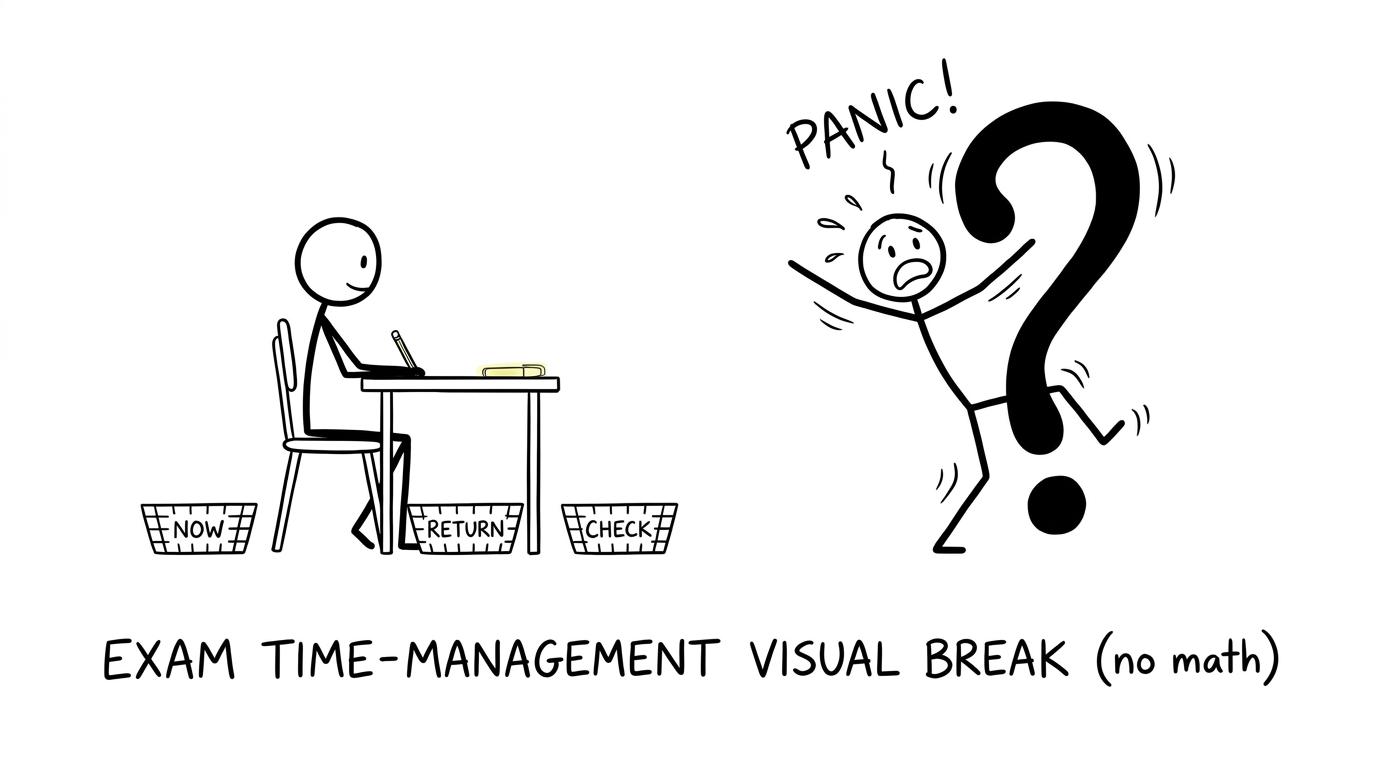 A calm student sorting exam questions while another wrestles a giant question mark
Use maths practice to build exam stamina
Computer Science and maths are different subjects, but the examination habits overlap: interpreting precise language, maintaining logical steps, managing time and recovering when a question looks unfamiliar.
Start with the free GCSE Maths revision hub and use a mixture of focused practice and timed assessment. Short sessions improve individual skills; longer papers reveal whether those skills remain reliable when you are tired.
If a full paper currently feels overwhelming, the Edexcel GCSE Maths mini tests provide shorter timed practice. You can then progress to Edexcel GCSE Maths past papers, using the mark schemes and available solutions to identify where concentration dropped.
The same principle applies to Computer Science: practise the format you will actually face. A 202020-minute programming exercise develops knowledge, but it does not fully prepare you for a 222-hour onscreen assessment.
For a sustainable weekly structure, use the GCSE maths revision timetable guide. It helps balance topic learning, timed work and review rather than turning every evening into a full-paper marathon.
Common mistakes when planning for the exam
Assuming every board has the same timings
The shortest total among the boards above is 333 hours, while the longest is 333 hours 454545 minutes. Check the specification named on your school timetable, not a friend's revision plan or an old online summary.
Confusing assessment time with arrival time
A paper lasting 111 hour 303030 minutes does not mean you should arrive exactly 111 hour 303030 minutes before your expected finish. Follow your school's stated arrival time and build in a travel buffer.
Practising only untimed questions
Untimed practice is useful while learning. It is insufficient for testing stamina. The guide to starting GCSE past papers at the right time explains how to move gradually from mini tests to timed sections and complete papers.
Spending time in direct proportion to question order
Questions are not always arranged to match your personal strengths. Use the available marks as a guide, but also consider the task type. Planning, coding and testing may need to happen across several stages.
Finishing without checking for blanks
Students often check the answers they remember writing and overlook a page they skipped. Before improving wording, scan the whole paper or onscreen task list for missing responses.
Treating a timed paper as finished once it is marked
The real improvement happens afterwards. Classify each lost mark as a knowledge gap, misreading, technical error or timing problem. The guide to using GCSE maths past papers properly gives a practical review process that transfers well to other logical subjects.
 An exam clock acting as a friendly pacing coach
Build familiarity before you need confidence
Confidence on exam day is often just familiarity remembered at the right moment. You have sat for this length before. You have met a difficult question without letting it consume the paper. You know what the final tired minutes feel like, and you still have a checking routine.
First, confirm your GCSE Computer Science exam board and paper codes. Then complete timed practice using the exact written or onscreen format required. Record when your concentration slips and adjust your pacing instead of merely promising to work faster.
Alongside Computer Science, make MathsGenie your base for free maths revision. Use revision lessons and practice questions to repair weak topics, mini tests to develop focus, and past papers or predicted papers to rehearse full exam conditions. Mark schemes and video solutions then turn mistakes into a clear next action.
The clock is not there to frighten you. With enough realistic practice, it becomes something quieter and more useful: a plan you have already followed.