

GCSE Computer Science 6 to 8: A Revision Plan
GCSE computer science 6 to 8: discover what separates the grades, improve programming and theory, and build a focused revision plan for grade 8.

A grade 6 often feels close to a grade 8. You recognise most topics, can write some code and rarely feel completely lost. Yet marks disappear through incomplete explanations, weak application and small programming errors. Moving from GCSE computer science 6 to 8 is therefore less about learning twice as much and more about using what you know with greater precision.
The short answer is this: grade 8 performance combines comprehensive knowledge with sustained computational thinking. You must explain ideas accurately, apply them in unfamiliar contexts, trace and refine algorithms, justify decisions and produce solutions that satisfy every requirement. Revision needs to move beyond reading and towards deliberate exam practice.
Your grade 6 to grade 8 checklist
Focus on these changes:
- learn the exact content in your exam board's specification
- replace vague definitions with precise technical vocabulary
- practise applying knowledge to unfamiliar scenarios
- trace, write, test and refine algorithms regularly
- answer every part of a programming problem's requirements
- justify comparisons using the context in the question
- use mark schemes to identify what earns credit
- keep a record of recurring mistakes and retest them
- complete timed questions before attempting full papers
The principle is simple. A grade 6 student often knows the idea. A grade 8 student can recognise when it matters, use it correctly and explain why the answer fits the problem.
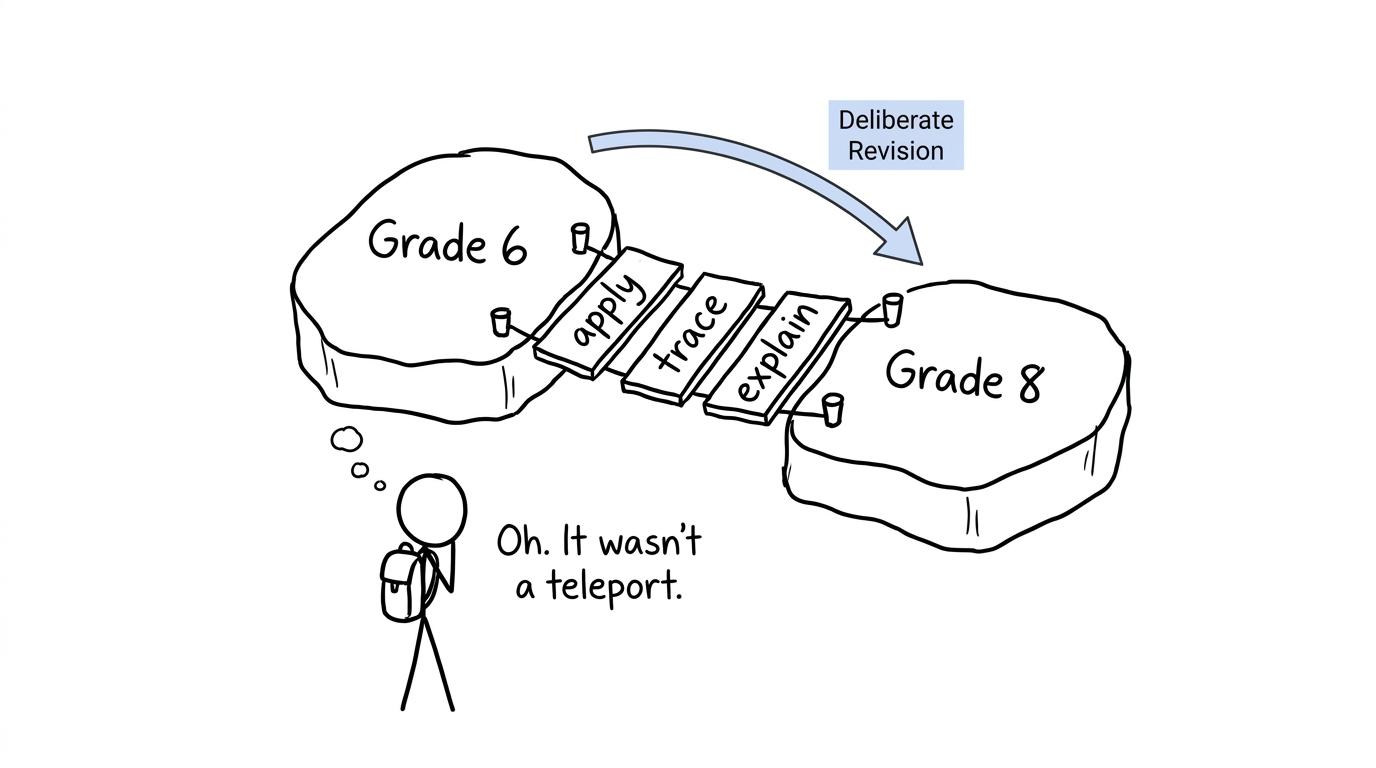 A student discovers that the route from grade 6 to grade 8 is a bridge built from applying, tracing and explaining
What separates a grade 6 from a grade 8?
There is no official grade 6 performance descriptor that creates a neat national checklist. Grade boundaries also change between exam series because they reflect the demand of each set of papers. Do not build your plan around a fixed raw-mark target taken from another year.
The official grade 8 descriptor is more revealing. It describes relevant and comprehensive knowledge, effective application to a wide range of complex problems, sustained analytical and evaluative thinking, and the ability to develop and refine a complete solution.
That wording points to four practical differences.
Knowledge becomes connected understanding
At grade 6, a student may recall what RAM does, identify a network topology or state the purpose of encryption. At grade 8, the student can connect that knowledge to a scenario, distinguish it from related ideas and explain the consequence of using it.
Avoid revising topics as isolated flashcards. Build links between hardware and performance, networks and security, data representation and storage, or programming constructs and robust software. The harder questions often test those connections.
Application replaces rehearsed recall
A familiar question can make knowledge look stronger than it is. Grade 8 questions may place an ordinary concept inside an unfamiliar business, medical, environmental or domestic setting.
Train yourself to ask:
- What detail in the scenario changes my answer?
- Which technical concept is being tested?
- What is the consequence for this particular user or system?
- Have I answered the command word?
This is closely related to mathematical problem-solving. Maths revision becomes valuable when it teaches you to translate information, select a method and check whether the result is sensible. The GCSE maths topics guide explains a similar progression from coverage to topic practice and then paper practice.
Programming becomes complete rather than plausible
A nearly correct algorithm can look convincing while failing one requirement. Grade 8 performance is more systematic: identify inputs and outputs, decompose the problem, select suitable data structures, handle every branch, test boundary conditions and refine errors.
Current GCSE specifications assess more than the ability to remember code. Students may need to interpret, trace, complete, correct, write or refine algorithms. The exact permitted response format varies by board and question, so learn the conventions required by AQA, OCR, Edexcel or Eduqas rather than assuming every form of pseudocode is interchangeable.
Explanations become reasoned judgements
A strong comparison does not merely provide two facts. It establishes a criterion, explains the effect of each option and reaches a conclusion tied to the scenario.
Words such as faster, safer and better are usually too loose on their own. Explain what improves, why it improves and who benefits. Where a limitation matters, include it. Evaluation means weighing relevant consequences, not producing a memorised list of advantages and disadvantages.
Make programming your highest-quality practice
Programming exposes the difference between recognition and control. Watching someone else correct a loop can feel easy. Finding the fault independently is different.
Use short but frequent practice. In each session, include a mixture of:
- tracing values through selection and iteration
- identifying syntax, logic and runtime errors where relevant
- completing missing lines
- writing algorithms from requirements
- choosing normal, boundary and erroneous test data
- explaining how a refinement improves the solution
Trace tables deserve particular attention because they force you to follow the program as the computer would. Record each changed variable carefully and check loop conditions at the correct moment. Mental tracing is tempting, but nested structures quickly exceed what working memory can hold reliably.
For algorithm-writing questions, turn every requirement into a visible checklist before writing. If the task needs validation, calculation, repetition and output, your final solution must show all four. Elegant code that omits one requirement is still incomplete.
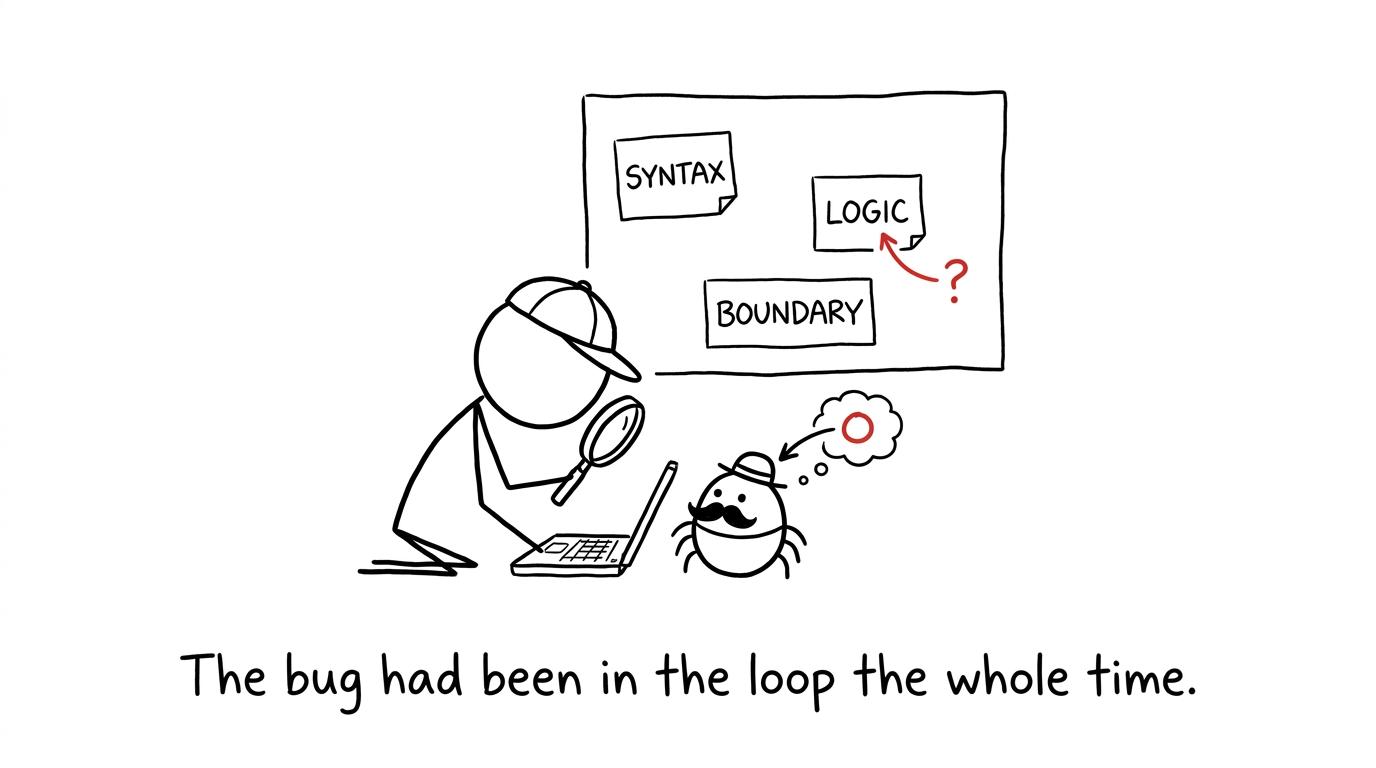 A student detective discovers that the programming bug was hiding inside the loop
Strengthen the maths behind computer science
GCSE Computer Science requires confident mathematical and logical thinking. Depending on your specification, this can include binary and hexadecimal representation, data-size calculations, Boolean logic and reasoning about algorithm behaviour.
Do not treat these as facts to reread. Practise writing each stage clearly. For binary place values, understand powers of two rather than relying on a remembered pattern:
20, 21, 22, 23,… 2^0,\ 2^1,\ 2^2,\ 2^3,\ldots 20, 21, 22, 23,…For storage calculations, distinguish bits from bytes and apply the units stated in your specification or question. If a conversion is needed, write it before substituting values. A correct method with one arithmetic slip may access more credit than an unsupported answer.
Boolean logic also rewards disciplined notation and complete checking. Make sure you understand how NOT, AND and OR affect inputs, and practise interpreting truth tables and logic diagrams where these appear in your course.
MathsGenie's free GCSE and A Level maths revision can strengthen the algebra, number and logical problem-solving that support these tasks. Use it as complementary practice while keeping your computer science specification as the authority on examinable content.
Turn mark schemes into a feedback system
Completing questions is only half the work. The improvement happens afterwards.
Mark each response and classify every lost mark:
- knowledge gap: you did not know the required fact
- application gap: you knew the topic but did not use the scenario
- precision gap: your wording was too vague
- logic gap: your reasoning or algorithm failed
- completion gap: you missed a requirement
- timing gap: you knew the answer but did not finish
Then write one action, not a long reflection. For example: revise the distinction, redo a trace without notes, or plan a longer response before writing it.
This is the same feedback loop that makes past-paper practice effective in GCSE maths: sit, mark, diagnose, repair and retest. MathsGenie's past-paper tools can help you develop that habit in maths, while your school or exam board's materials should provide the computer science papers matching your specification.
Build a revision routine that moves marks
A useful week balances recall, application and programming rather than giving each topic equal time.
Short weekday sessions
Begin with closed-book retrieval. Then complete a small set of targeted questions and mark them immediately. Finish by correcting one weak answer from an earlier session.
A session might contain:
- 101010 minutes of factual recall
- 202020 minutes of exam questions
- 151515 minutes of tracing or programming
- 101010 minutes of marking and corrections
Change those timings to fit your circumstances, but protect the correction stage. The GCSE revision timetable guide offers a practical structure for fitting topic work and timed practice into a realistic week.
Weekly timed practice
Complete one timed section from a paper matching your board and current specification. Early in revision, a section is often more useful than a full paper because you can review it properly. Move towards complete papers as the exams approach.
Record performance by topic and error type, not only by total mark. A higher score can hide a recurring programming weakness if that paper happened to contain a friendlier question.
Fresh practice is valuable once you have repaired known gaps. In maths, Edexcel GCSE predicted papers provide unseen exam-style questions, but predicted papers should supplement rather than replace official past papers. Apply the same principle to computer science: use fresh questions to test learning, not to guess the exact content of the next exam.
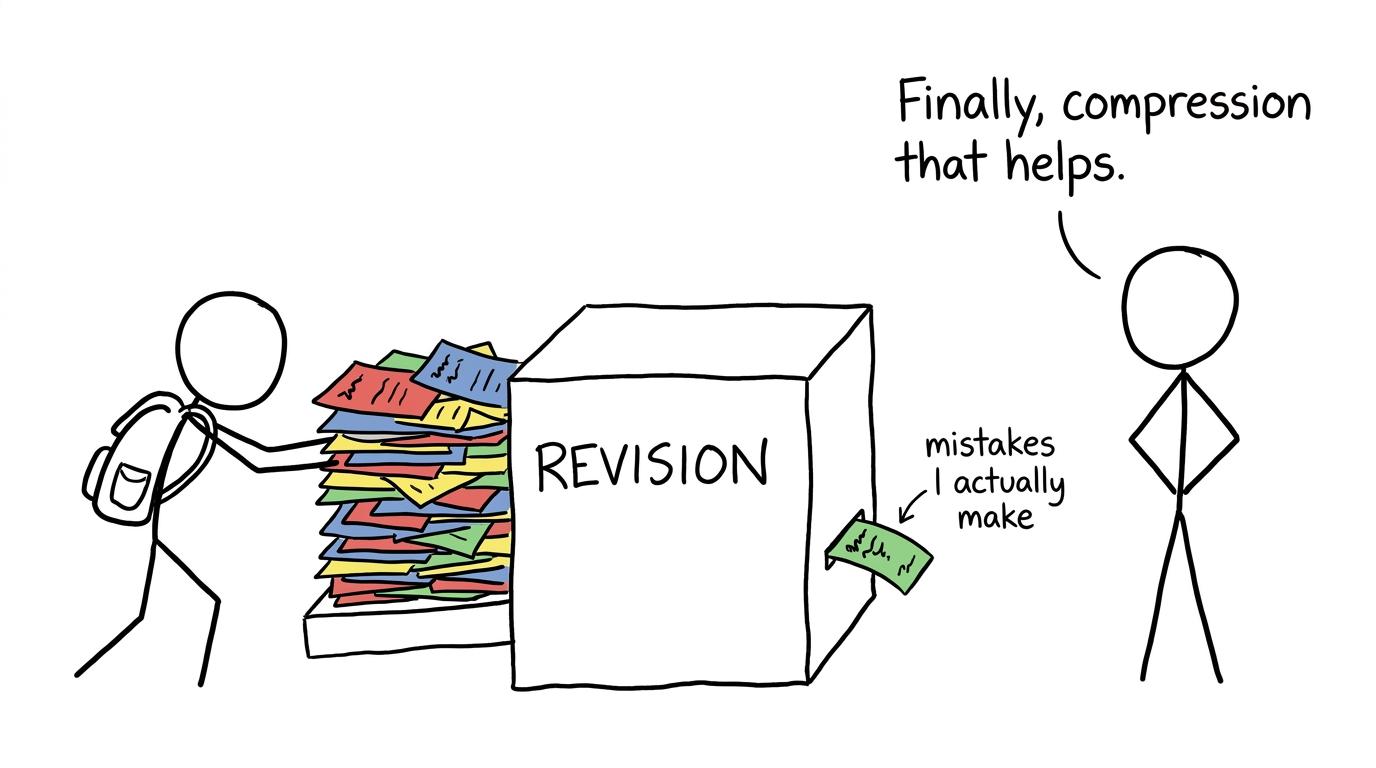 A revision machine compresses a huge pile of notes into a useful list of mistakes
Common mistakes that keep students at grade 6
Rereading instead of retrieving
Notes can create familiarity without reliable recall. Close the book and reconstruct definitions, processes and diagrams from memory. Check afterwards and correct omissions.
Memorising generic evaluation paragraphs
Prepared advantages and disadvantages often ignore the scenario. Select only relevant ideas and develop each one through cause and consequence.
Writing code before decomposing the problem
Starting immediately can produce tangled logic. Identify inputs, processes, outputs, validation and repeated tasks first. A brief plan protects more marks than hurried code.
Ignoring edge cases
A solution may work for ordinary data but fail at a boundary, empty input or invalid entry. Testing is part of problem-solving, not an afterthought.
Treating the mark scheme as an answer sheet
Copying an accepted answer does not guarantee you could produce it independently. After reviewing the scheme, close it and answer the question again in your own words.
Spending too long on one question
If progress stops, annotate your plan, leave space and return later. A partially completed difficult algorithm should not consume marks available elsewhere. Near the exam, the GCSE night-before plan also offers sensible guidance on choosing focused practice rather than attempting an exhausting final cram.
The final step from grade 6 to grade 8
The gap is not crossed by collecting more notes. It is crossed when your revision begins to resemble the performance the exam demands: precise recall, contextual application, sustained reasoning and complete solutions.
Start with one timed computer science section. Mark it carefully, identify the three largest marks leaks and spend the next week repairing them. Then retest those skills without notes.
Alongside your subject-specific preparation, use MathsGenie to strengthen the mathematical foundations and revision habits that support computer science. Work through free revision lessons and practice questions, check mark schemes and video solutions, use mini tests to expose gaps, and build confidence with MathsGenie's past papers and predicted papers. Grade 8 becomes more realistic when every practice session produces a clear next action.











