GCSE Combined Science Time Pressure Mistakes
GCSE combined science time pressure mistakes: avoid lost marks in calculations, units, graphs and six-mark answers with a calm strategy for every paper.
The clock rarely causes a student to forget all their science. It does something subtler: it encourages shortcuts. Units disappear, command words are skimmed, calculator entries become rushed, and a difficult question consumes time that belonged to several easier ones.
The most common GCSE combined science time pressure mistakes are avoidable. Read the instruction precisely, match your answer to the marks, show every stage of a calculation, convert units before substituting, and move on temporarily when a question stops producing marks. These habits matter because at least 20%20\%20% of GCSE Combined Science marks assess mathematical skills across the qualification.
This is good news for students preparing for maths exams too. The same disciplined habits, clear working, sensible estimates and careful interpretation, protect marks in both subjects.
The quick exam-pressure checklist
Before exploring each mistake, keep this compact routine in mind:
- Check the command word and number of marks.
- Underline quantities, units and required rounding.
- Write the equation or scientific principle before calculating.
- Convert units before substitution.
- Keep full calculator values until the final answer.
- Include working, even when using a calculator.
- If stuck, leave space, mark the question and return later.
- Reserve a final check for units, graph scales and unanswered pages.
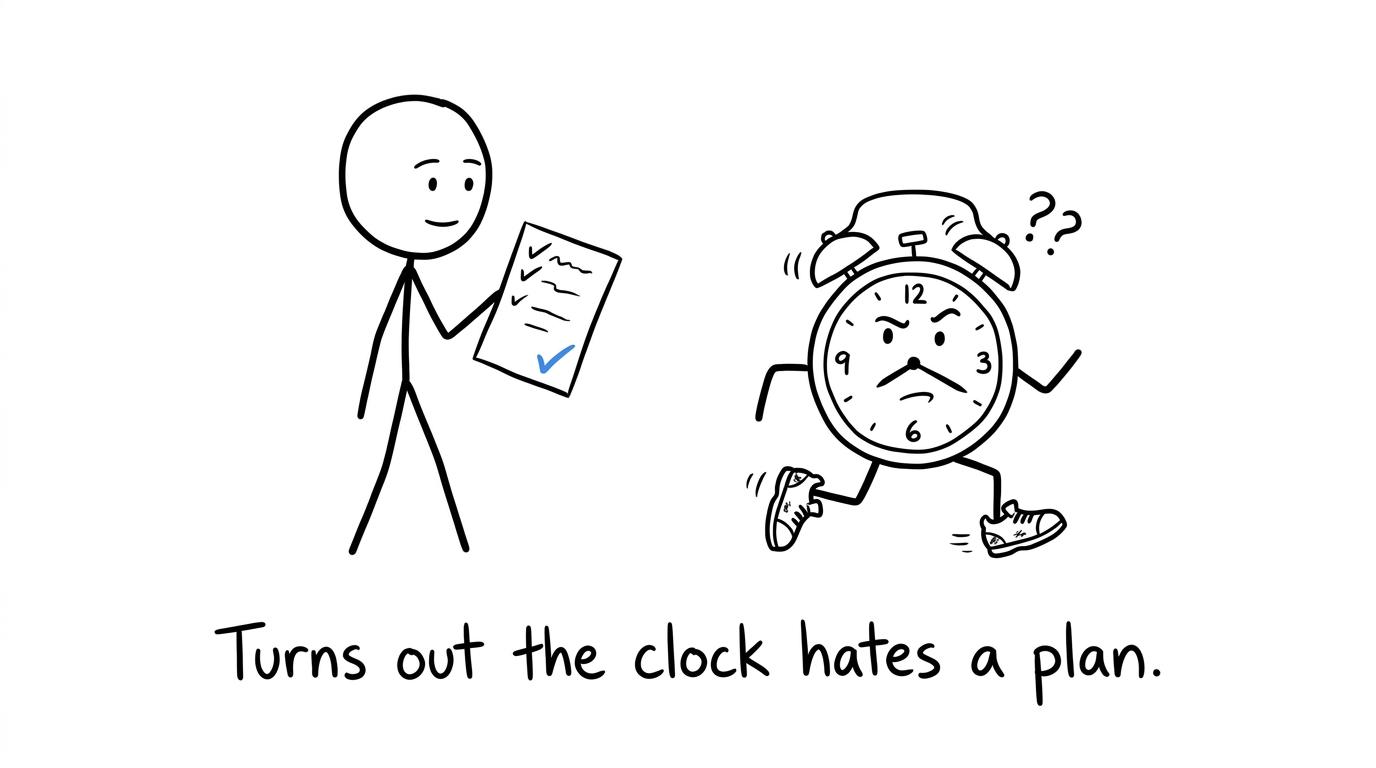 A student calmly outwitting a running exam clock with a checklist
Treating every question as if it needs the same amount of time
A one-mark recall question and a six-mark evaluation do not deserve equal attention. Yet pressure can make a short question feel important simply because it is awkward.
Use the marks as a guide to the expected depth. A command such as give or name normally calls for a brief response. Explain requires linked scientific reasoning. Compare requires similarities or differences between the items named, while evaluate requires evidence, limitations and a supported judgement.
Exam boards including AQA, Edexcel, OCR and Eduqas publish their own command-word guidance, so practise with materials for your specification. The wording may differ slightly, but the central lesson is stable: answer the task that was set, not the nearby question you hoped to see.
A sensible two-pass strategy protects accessible marks. On the first pass, answer questions you can complete accurately and keep moving. Mark slower questions clearly. On the second pass, return to calculations and extended responses requiring more thought. Skipping temporarily is not surrender. It is time management.
Rushing science calculations and hiding the method
Under pressure, students often type every number into a calculator and record only the result. That may be quick, but it makes an otherwise recoverable answer fragile.
A safer calculation structure is:
equation→rearrangement→substitution→answer with unit\text{equation} \rightarrow \text{rearrangement} \rightarrow \text{substitution} \rightarrow \text{answer with unit}equation→rearrangement→substitution→answer with unitThis structure helps you notice whether the equation suits the required quantity. It can also expose a rearrangement or transcription error before it spreads through the calculation. Where a mark scheme awards credit for a correct method, visible working may preserve marks even when the final value is wrong.
Combined Science requires arithmetic, ratios, percentages, standard form, algebra, graph interpretation, gradients and geometrical reasoning. Ofqual requires the mathematical marks across biology, chemistry and physics to be allocated in the ratio 1:2:31:2:31:2:3. Physics therefore carries the greatest share, but calculations can appear throughout the course.
If rearranging equations feels slow, strengthen the underlying skill using MathsGenie’s rearranging harder formulae revision resources. The broader GCSE Maths revision hub lets you choose your exam board and practise the number, algebra and graph skills that transfer into science.
Forgetting conversions, units and sensible rounding
A calculation can have the correct equation and still lose marks because the quantities were measured in incompatible units. This is particularly common when the page contains a mixture of prefixes, areas, volumes or time units.
Do not rely on noticing the problem halfway through. Circle or underline every unit before calculating. Convert the supplied data into the units required by the equation, then substitute.
Common prefixes include:
kilo=103,centi=10−2,milli=10−3\text{kilo} = 10^3, \qquad \text{centi} = 10^{-2}, \qquad \text{milli} = 10^{-3}kilo=103,centi=10−2,milli=10−3Area and volume conversions need extra care because the conversion factor is also squared or cubed. The physical unit must match the quantity: area uses square units, while volume uses cubic units.
Avoid rounding intermediate values unless the question tells you to do so. Keep the full calculator value and round once at the end to the requested number of decimal places or significant figures. Then ask whether the scale of the answer is plausible. An order-of-magnitude estimate can reveal a missed power of ten surprisingly quickly.
 A calculator being questioned about a missing unit
Reading graphs too quickly
Graphs look familiar, which is precisely why they are dangerous under time pressure. Students begin before checking what the axes represent.
Before plotting or reading a value, inspect:
- the axis labels and units;
- whether the scale starts at zero;
- the value represented by each small square;
- whether the question asks for a point, gradient, intercept or area;
- whether a line of best fit or tangent is required.
For a straight-line gradient, the mathematical structure is:
gradient=change in vertical quantitychange in horizontal quantity\text{gradient} = \frac{\text{change in vertical quantity}}{\text{change in horizontal quantity}}gradient=change in horizontal quantitychange in vertical quantityChoose two well-separated points on the line rather than automatically using adjacent plotted points. For a tangent, use points on the tangent itself. Keep the units in the calculation because a gradient usually has a meaningful scientific unit.
Graph confidence comes from repeated, mixed practice rather than memorising one diagram. MathsGenie’s GCSE Maths self-assessment sheet can help identify whether graphs, ratio, standard form or another transferable skill needs attention.
Writing too much for short questions and too little for long ones
Time pressure distorts answer length in both directions. A student may write a paragraph for a one-mark item, then reach a six-mark response with only minutes remaining.
For short questions, be direct. If asked to state a variable that should be controlled, name the variable. Do not bury it inside a speculative paragraph.
For an extended response, pause briefly before writing. Build a small mental or written plan containing the relevant scientific ideas, evidence from the question, and any conclusion required by the command word. A clear sequence is more valuable than disconnected facts.
Practical-method questions need scientific precision. Depending on the task, that may include the independent variable, dependent variable, control variables, measurement method, repeat readings, calculation of a mean, safety measures and a way to improve reliability. Include only points relevant to the stated investigation.
Losing marks by copying data inaccurately
The hurried eye often reads what it expects rather than what the page says. A negative sign disappears. A value from the wrong column enters the calculator. A question asking for percentage increase is treated as though it asks for the new total.
Reduce this risk by making substitution visible. Copy each value on to the calculation line and tick it against the question. Use calculator brackets whenever the numerator or denominator contains more than one operation.
For percentage change, the structure is:
percentage change=changeoriginal value×100\text{percentage change} = \frac{\text{change}}{\text{original value}} \times 100percentage change=original valuechange×100The denominator is the original value, not whichever value is larger. In ratio questions, preserve the order given in the question. These are simple ideas, but simplicity does not make them immune to haste.
Spending the final minutes fighting one large question
One intimidating question can become an anchor. The student stays because leaving feels like failure, even while easier marks remain elsewhere.
Set a practical stopping rule during timed practice. If you have read the question twice, written any relevant equation or idea, and made no further progress after a reasonable interval, leave space and continue. Returning later often helps because the wording feels less crowded once other marks are secure.
Use the final minutes to scan for omissions rather than rewriting answers that are already sound. Look for blank pages, unanswered subparts, missing units, unchecked graph scales and calculator answers that were never transferred to the paper.
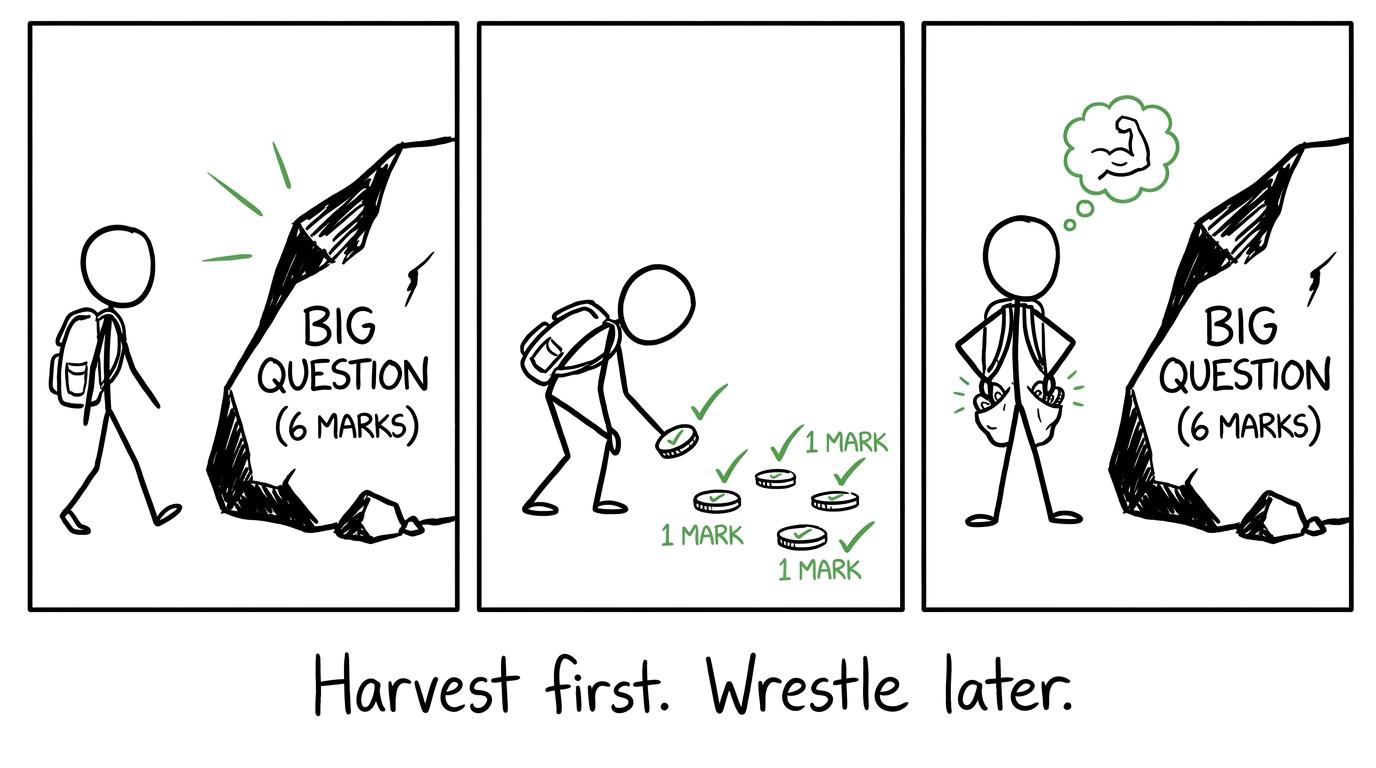 A student collecting easy marks before returning to a large question
Common mistakes to remove before the exam
The easiest way to improve under pressure is to identify your recurring marks leak. Most errors fit into one of these categories:
Knowledge mistakes
You did not know the scientific fact, equation or required practical detail. Repair this with active recall and a short revision lesson, then answer questions on the same micro-topic.
Method mistakes
You knew the content but selected the wrong equation, graph process or experimental method. Compare your response carefully with the mark scheme and write a one-sentence rule for next time.
Accuracy mistakes
These include incorrect calculator entries, lost powers, premature rounding and inaccurate data copying. Slow down at the substitution stage rather than trying to check an invisible method afterwards.
Communication mistakes
The science may be understood, but the answer lacks units, working, comparisons, linked reasoning or a conclusion. Mark schemes reveal what must appear on the page, not merely what was present in your head.
Timing mistakes
You spent too long on one part or left no checking time. This can only be repaired through timed practice. MathsGenie’s past-paper library includes timers, official mark schemes and worked support for selected papers. You can also use the guide to practising OCR Physics papers or the AQA Physics past-paper routine to build a repeatable attempt, mark, repair and retest cycle.
How to train accuracy when the clock is running
Start with short timed sections rather than immediately sitting full papers. Choose a mixture of calculations, data interpretation and written explanations. Work without notes, stop when the timer ends and mark the section honestly.
For every lost mark, record:
- the type of mistake;
- what caused it;
- the rule that would prevent it;
- the skill you need to practise next.
Then repair the underlying weakness. A unit error needs conversion practice. A blank calculation may need equation selection or algebra. A weak evaluation needs command-word practice, not another hour of passive reading.
Retest the skill after a gap. The goal is not to remember the previous answer; it is to reproduce the correct process independently. As the exam approaches, combine these short drills with full timed papers so concentration, pacing and checking become familiar.
For a calm final preparation routine, adapt MathsGenie’s GCSE maths night-before plan. The subject changes, but the principle remains useful: choose a small number of high-value tasks, prepare your equipment and stop before tired revision creates new confusion.
Turn pressure into a process
Time pressure becomes dangerous when every question demands a fresh decision. A routine removes those decisions. Read the command word. Check the marks. Show the method. Convert the units. Answer, check and move on.
Start at the MathsGenie GCSE Maths revision hub and strengthen the mathematical skills beneath Combined Science: percentages, ratio, rearranging formulae, standard form, graphs and estimation. Use revision lessons and practice questions to learn each method, mini tests to build reliable recall, and past papers or predicted papers to rehearse under time pressure. Mark your work with the mark schemes and use video solutions where available.
The clock does not need to become slower. Your process needs to become clearer.