

GCSE Combined Science Foundation Tier Grade Cap
GCSE combined science foundation tier grade cap explained: discover the highest grade, how double grades work and when Higher tier may suit your goals.
There is a particular kind of frustration in discovering that your ambition is higher than the paper you have been entered for. You can revise harder, correct every calculation and improve every mock result, yet the tier still sets a ceiling.
The GCSE combined science foundation tier grade cap is 5-55\text{-}55-5. Foundation tier students can receive grades from 1-11\text{-}11-1 up to 5-55\text{-}55-5, including adjacent outcomes such as 4-34\text{-}34-3 and 5-45\text{-}45-4. If you are aiming for 6-66\text{-}66-6 or above, you must take Higher tier papers.
That is the short answer. The more useful question is what the cap means for your revision, your tier decision and the maths marks hidden inside Biology, Chemistry and Physics.
The essential grade-cap checklist
Before changing your revision plan, make sure these facts are clear:
- The highest Foundation tier Combined Science grade is 5-55\text{-}55-5.
- Combined Science is worth two GCSEs, so you receive a double grade.
- Your grade comes from your total mark across the complete qualification, not separate grades for Biology, Chemistry and Physics.
- Foundation tier offers outcomes from 1-11\text{-}11-1 to 5-55\text{-}55-5.
- Higher tier normally offers 4-44\text{-}44-4 to 9-99\text{-}99-9, with a narrow 4-34\text{-}34-3 safety-net outcome for students just below 4-44\text{-}44-4.
- A 5-55\text{-}55-5 achieved on Foundation is equivalent to a 5-55\text{-}55-5 achieved on Higher.
- Your certificate does not show which tier you sat.
- If your target is above 5-55\text{-}55-5, speak to your science teacher about Higher tier rather than assuming that a switch is automatic.
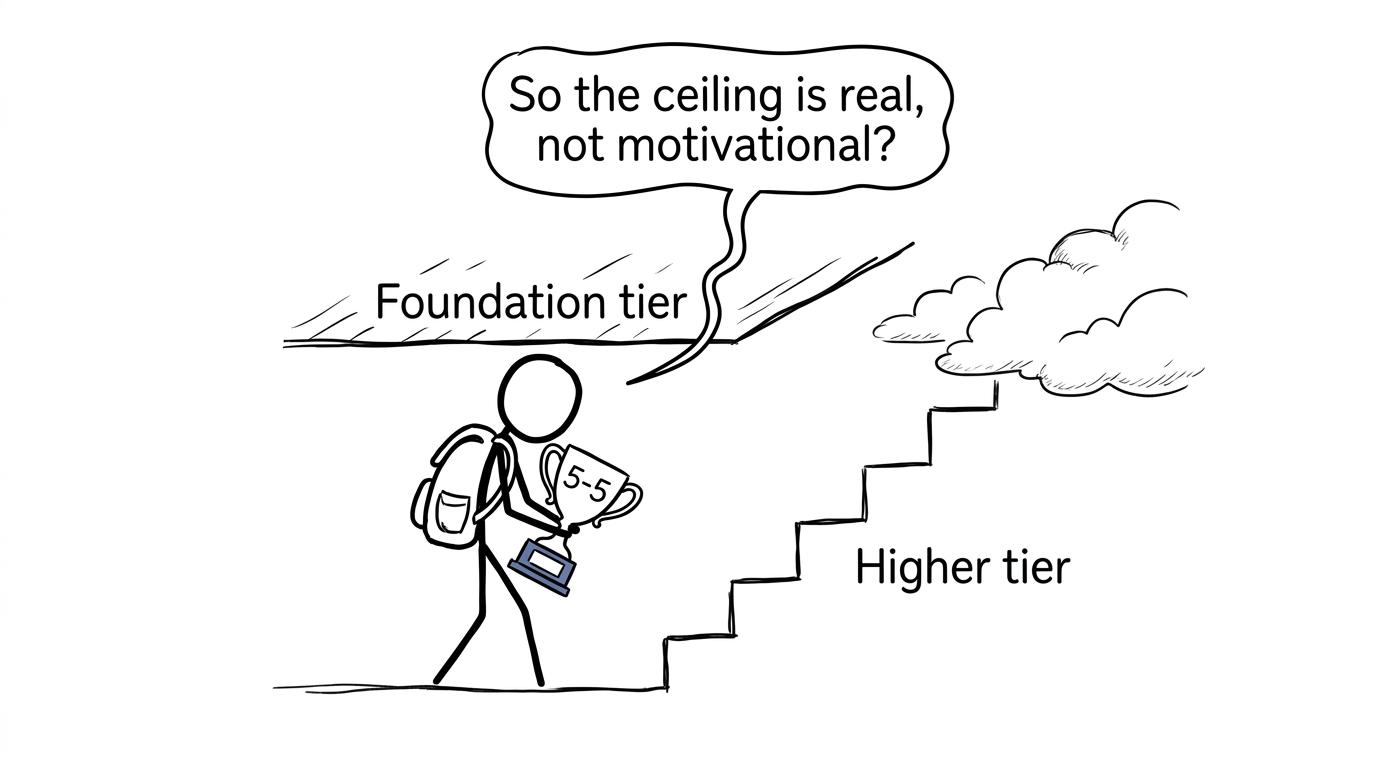 A student discovers the Foundation tier ceiling while the Higher tier staircase continues upwards
How Combined Science double grades work
Combined Science is larger than an ordinary single GCSE. It assesses Biology, Chemistry and Physics and is worth two GCSEs, so the final result contains two numbers.
There are 171717 possible outcomes across the complete grading scale. The numbers must be equal or adjacent, such as 5-55\text{-}55-5, 5-45\text{-}45-4 or 4-44\text{-}44-4. A result such as 5-25\text{-}25-2 is not available.
The two numbers are not separate subject grades. A 5-45\text{-}45-4 does not mean that you earned a grade 555 in Biology and a grade 444 in Chemistry, with Physics somehow left out. Marks from all the papers are added together before the overall double grade is awarded.
This matters because performance can balance out across the qualification. Strong marks on Biology questions can compensate for weaker marks in Physics, for example. But relying on compensation is risky. A more dependable plan is to identify the topics and question types where marks repeatedly disappear.
You can read more about totals and boundaries in MathsGenie's guide to GCSE Combined Science grade boundaries.
Foundation and Higher tier compared
The tier decision is not a judgement about intelligence. It is a decision about which paper gives you the most suitable route to your target grade.
| Feature | Foundation tier | Higher tier | | --- | --- | | Available grade range | 1-11\text{-}11-1 to 5-55\text{-}55-5 | 4-44\text{-}44-4 to 9-99\text{-}99-9 | | Highest normal grade | 5-55\text{-}55-5 | 9-99\text{-}99-9 | | Lowest normal grade | 1-11\text{-}11-1 | 4-44\text{-}44-4 | | Safety-net grade | Not required | Narrow 4-34\text{-}34-3 outcome | | Best suited to | Students targeting grades up to 5-55\text{-}55-5 | Students securely targeting higher grades |
Ofqual's current guidance says that students expected to achieve grade 444 or 555 should be entered appropriately for Foundation tier. Exam boards are required to make standards at the overlapping grades comparable. Foundation is therefore not a lesser version of grade 555.
Higher tier provides access to grades above 5-55\text{-}55-5, but it also carries greater risk near the bottom of its range. A Higher tier student who does not reach the narrow 4-34\text{-}34-3 safety net receives an unclassified result. Foundation gives access to more questions targeted below grades 444 and 555, which can make it the more secure route for some students.
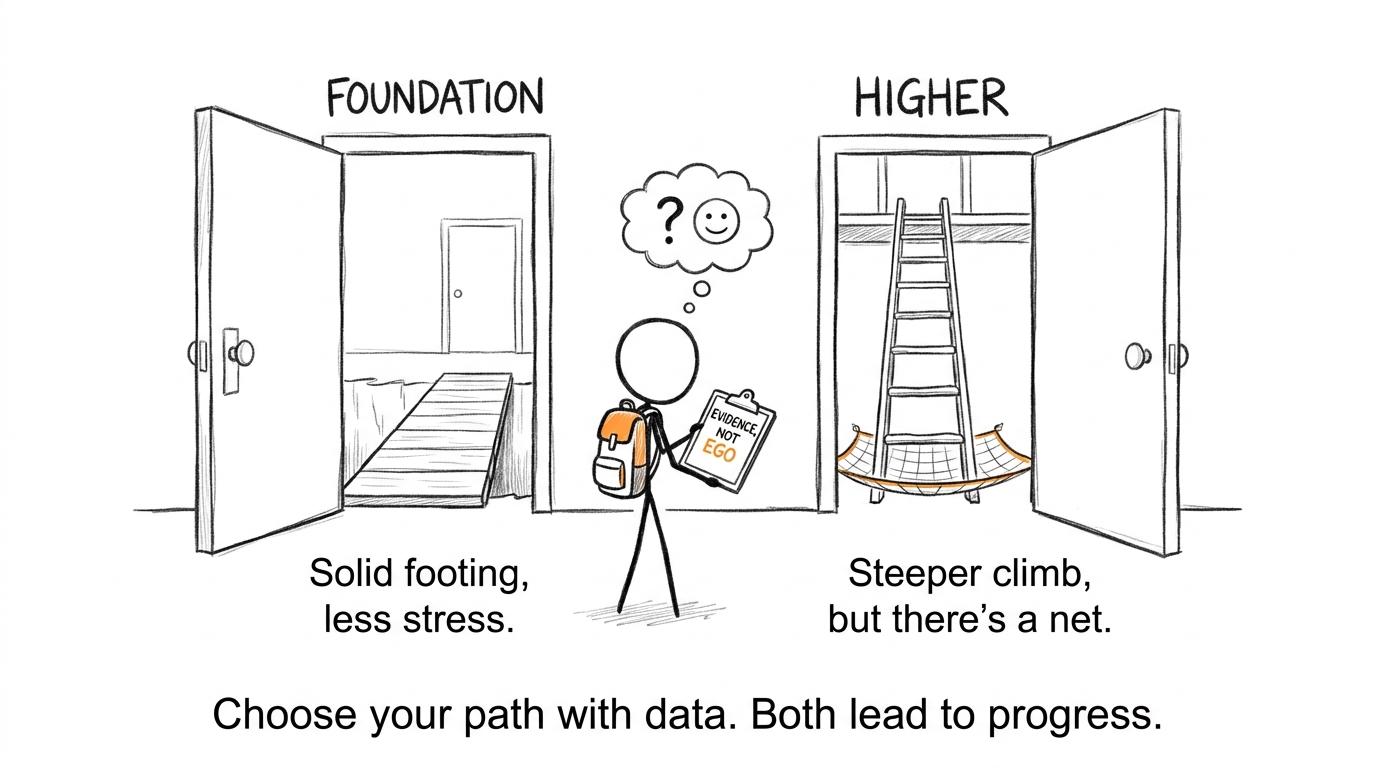 A student chooses between Foundation and Higher using evidence rather than ego
What the grade ceiling means if you want top grades
If your goal is 5-55\text{-}55-5, Foundation tier can take you all the way there. You do not need Higher tier simply to make a Foundation grade 555 look stronger. The qualification certificate records the grade, not the tier.
If your goal is 6-66\text{-}66-6, 7-77\text{-}77-7 or above, Foundation cannot award it, regardless of how many marks you score. You need a Higher tier entry.
That does not mean you should demand an immediate switch after one encouraging test. A sensible decision uses several pieces of evidence:
- performance across more than one mock or assessment;
- confidence with topics and questions that are specific to Higher tier;
- accuracy on grade 444 and 555 crossover content;
- performance across all three sciences, not only your strongest one;
- your teacher's knowledge of the specification and entry deadlines;
- whether your intended sixth form or college course has particular entry requirements.
Ask your teacher a precise question: What evidence would I need to show to be entered for Higher tier? That produces a plan. Asking only whether Higher is harder usually produces a vague answer.
The same principle applies in maths. MathsGenie's guide to moving from Foundation to Higher GCSE Maths explains how to use stable evidence rather than one unusually good or bad result.
Grade boundaries are not the same as the grade cap
The cap is fixed: Foundation tier cannot award more than 5-55\text{-}55-5.
The grade boundary is different. It is the minimum total mark required for a particular outcome in a specific exam series. Boundaries can move because papers vary in difficulty, and the official boundaries are set through the awarding process after the examinations have been marked. A boundary from a previous year is useful context, not a promise.
This distinction prevents two unhelpful assumptions. First, earning 5-55\text{-}55-5 does not necessarily mean answering every question correctly. Second, a raw-mark target from an old paper cannot be treated as a guaranteed target for your future papers.
Use past boundaries to understand broad performance, but use mark schemes to improve the things you can control: scientific knowledge, calculations, units, graph interpretation and written explanations.
Why maths revision matters in Combined Science
The national Combined Science assessment requirements allocate at least 20%20\%20% of the marks to mathematical skills. Across the sciences, the required distribution of this mathematical demand follows the ratio
Biology:Chemistry:Physics=1:2:3.\text{Biology}:\text{Chemistry}:\text{Physics}=1:2:3.Biology:Chemistry:Physics=1:2:3.Physics therefore carries the greatest share, but calculation skills matter throughout the qualification. Depending on your specification, useful areas include:
- rearranging formulae;
- substituting values accurately;
- ratios and proportional reasoning;
- percentages and percentage change;
- standard form;
- averages and rates;
- reading tables and graphs;
- converting units;
- using significant figures appropriately.
These are marks where science knowledge and mathematical fluency meet. You may know the correct equation but lose the mark through an incorrect conversion. Or you may calculate correctly but omit the unit. The gap is often smaller than it feels.
Use the MathsGenie GCSE Maths revision hub to find free lessons and practice questions for the calculation skills affecting your science papers. The GCSE Maths topics by board and tier guide can help you build a focused checklist rather than revising every maths topic at once.
A revision strategy for reaching 5-55\text{-}55-5
Aiming at the Foundation ceiling requires consistency. The top grade is rarely secured by mastering one spectacularly difficult question while giving away routine marks elsewhere.
Diagnose the marks you are losing
Complete a paper or timed set that matches your exam board and tier. AQA, Edexcel, OCR and Eduqas organise specifications and papers differently, so use the correct materials.
When marking, classify each lost mark:
- missing scientific knowledge;
- mathematical method error;
- calculator or arithmetic error;
- incorrect or missing unit;
- graph or data interpretation error;
- weak use of scientific terminology;
- incomplete extended response;
- poor timing or a misread question.
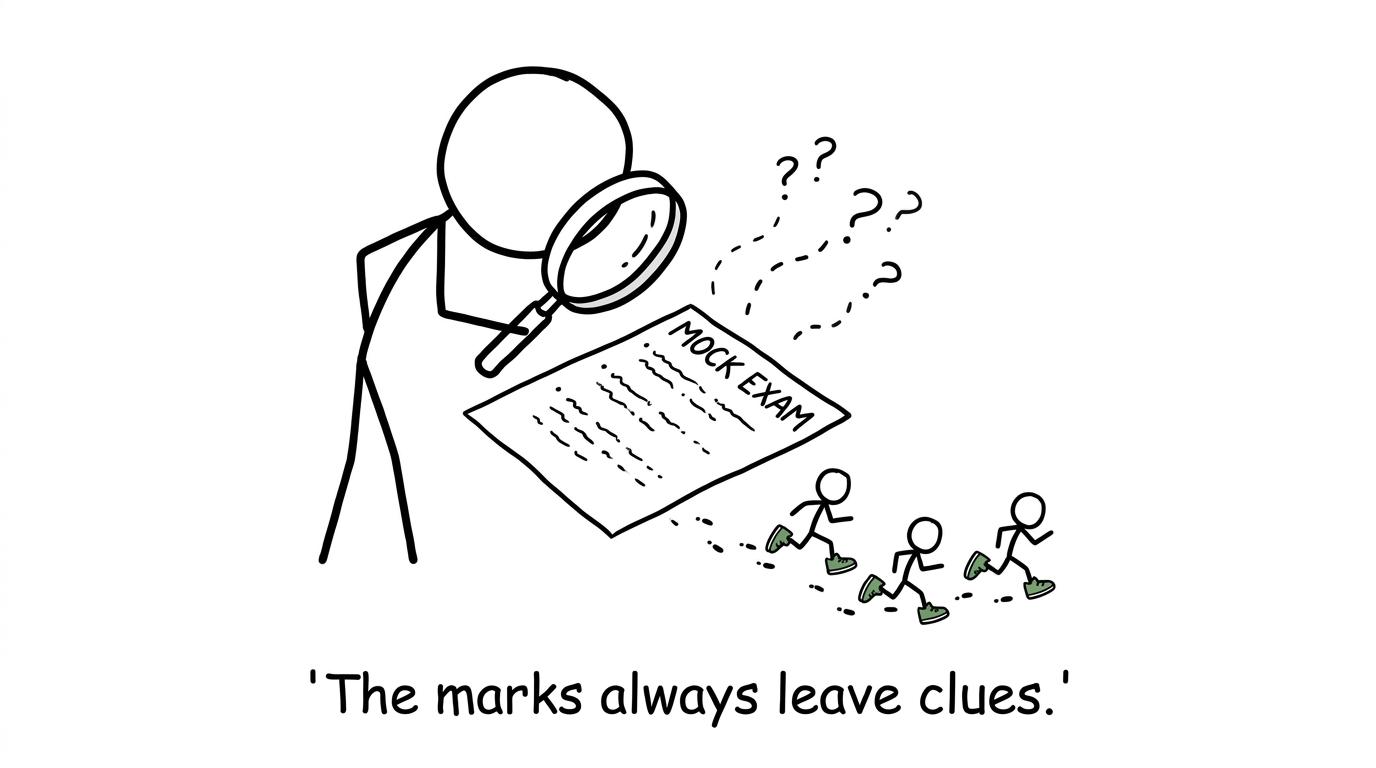 A student detective follows the clues left by escaped exam marks
Repair one weakness at a time
If calculations are costing you marks, revise the exact mathematical skill rather than writing “science maths” on a revision list. “Rearranging formulae” or “converting units” gives you something you can actually practise.
MathsGenie's free AQA GCSE Maths past papers are useful for building calculation accuracy under time pressure. If you take Edexcel Maths, the Edexcel GCSE Maths predicted papers provide fresh exam-style practice with mark schemes and worked solutions. These are maths resources, so use them to strengthen transferable numerical skills alongside your board-specific science materials.
Retest instead of rereading
After correcting a weakness, answer a different question requiring the same skill. Then revisit it after a gap. Recognition can feel like understanding when the solution is open in front of you; retrieval shows whether the method is genuinely available under exam pressure.
For a balanced weekly structure, adapt the approach in the MathsGenie GCSE revision timetable: focused topic work, immediate marking and regular timed practice.
Common mistakes about the Foundation grade cap
Thinking 5-45\text{-}45-4 is impossible
Foundation Combined Science includes adjacent grades. If your total falls below the 5-55\text{-}55-5 boundary but above the 4-44\text{-}44-4 boundary, 5-45\text{-}45-4 may be awarded.
Treating the two numbers as subject grades
The double grade represents the complete Combined Science qualification. You do not receive an individual grade for each science.
Assuming Higher tier automatically improves your result
Higher opens the door to higher grades, but opening a door is not the same as walking through it. The questions target a broader and more demanding grade range, while marks below the Higher safety net lead to an unclassified outcome.
Comparing raw marks across tiers
Foundation and Higher papers are different. Do not assume that the same raw mark or percentage must produce the same result on both tiers. The overlapping grades are kept comparable through the awarding process, not by using identical boundaries.
Ignoring calculations during science revision
Mathematical skills account for a meaningful share of Combined Science marks. Practising formulae, ratios, graphs and units can improve performance across several topics rather than only one chapter.
Turn the ceiling into a clear target
A grade cap can sound restrictive, but clarity has value. If you are taking Foundation tier, the destination is known: 5-55\text{-}55-5 is the highest available result. You can now decide whether that matches your goals and, if it does, build a revision plan around securing it consistently.
If your ambitions require 6-66\text{-}66-6 or above, speak to your teacher early and ask what evidence is needed for Higher tier entry. If 5-55\text{-}55-5 is your target, do not let the word “Foundation” diminish it. A Foundation 5-55\text{-}55-5 carries the same standard as a Higher 5-55\text{-}55-5.
Start with the MathsGenie GCSE Maths revision hub. Use revision lessons to rebuild weak calculation skills, practice questions and mini tests to check them, then past papers and predicted papers to develop timing. Mark every attempt with the available mark schemes and use video solutions when your method needs repairing. The grade ceiling is fixed. The quality of your preparation is not.











