

GCSE Classical Civilisation Revision: Silence or Noise?
GCSE classical civilisation revision: silence or noise? Evidence-led advice on lyrics, instrumental music, recall, essays and exam practice at home.
There is a familiar moment in revision: the book is open, the notes are ready, and choosing a playlist somehow feels easier than beginning. If you are wondering about GCSE classical civilisation revision silence or noise, the evidence-led answer is straightforward: use silence for demanding reading, memorisation, essay planning and timed practice. If complete quiet feels uncomfortable, low-volume instrumental sound may be a workable alternative, but music with lyrics and audible conversation are more likely to interfere.
That matters particularly in Classical Civilisation because much of the work is verbal. You are reading sources, remembering names, distinguishing interpretations and arranging evidence into an argument. Yet the lesson also travels well. GCSE maths students face the same decision when reading unfamiliar problems or holding several steps in mind.
The quick revision checklist
- Choose silence by default for new material and difficult tasks.
- Avoid lyrics and background speech while reading or writing.
- Use quiet instrumental audio only if it helps you settle, not because it has been proved to improve learning.
- Practise retrieval without any soundtrack so you know what you can recall independently.
- Complete timed exam practice in silence to resemble the real assessment environment.
- Test your choice using results, not simply how productive the session felt.
- Move your phone away, because changing tracks can become a second source of distraction.
The soundtrack is not the revision method. It is only the environment in which the method happens.
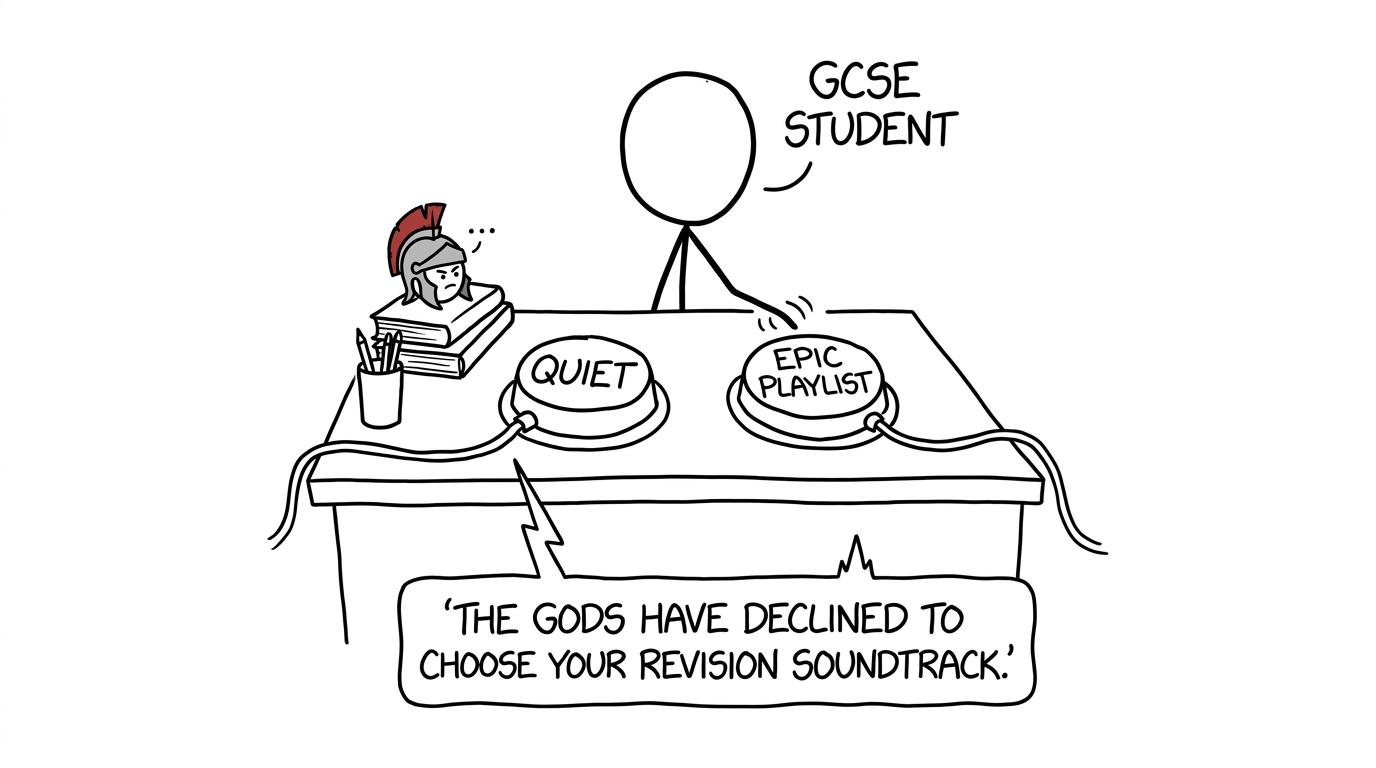 A student asks the gods to choose between silence and a revision playlist
What the evidence actually says about silence and noise
Research does not show that every sound ruins every task. It does, however, reveal a fairly consistent pattern: meaningful sound is risky when the task also depends on language.
A major meta-analysis covering 65 studies found that background speech, ordinary noise and music each had a small but reliable negative effect on reading performance. Intelligible speech and lyrical music produced the greatest disruption. This is relevant to Classical Civilisation because reading a passage about religion, myth, warfare or Roman society requires attention to meaning, not merely recognition of words.
A later systematic review examining 95 articles and 154 experiments reached a similarly careful conclusion. Background music did not damage every kind of performance, but detrimental effects appeared most consistently in memory and language tasks. Music with lyrics tended to be more disruptive than instrumental music.
A controlled study published in 2023 compared silence, instrumental lo-fi music and music with lyrics. Performance was generally strongest in silence, between the two in the instrumental condition and weakest with lyrics. Instrumental music did not provide a reliable improvement over silence. That last point is easy to miss: music can feel helpful without producing better recall or comprehension.
Research into environmental noise also associates noisier settings with poorer reading and language outcomes, although the strength of evidence varies by noise source, age group and task. Chosen music, classroom chatter and long-term exposure to traffic or aircraft noise are not identical conditions, so findings from one should not be casually treated as proof about another.
The honest conclusion is not that silence possesses special powers. It is that silence removes a source of competition for attention.
Why lyrics are especially distracting
When you read a written source, your mind is already processing language. A nearby conversation, podcast or song lyric supplies another stream of meaningful words. Those words can compete with the material you are trying to understand.
This explains why a favourite song can be more disruptive than an unfamiliar instrumental track. Familiar lyrics are easy to follow automatically. You may not decide to listen to them, but your attention still recognises the next line.
For Classical Civilisation, use silence when you are:
- reading a literary or visual source closely;
- learning names, events, practices and terminology;
- comparing ancient evidence;
- planning an extended response;
- checking whether each paragraph answers the question;
- recalling material without notes.
The same principle applies in maths. Reading a multi-step problem is partly a comprehension task. If you are switching between a question, a diagram and information held in working memory, extra language rarely helps. The GCSE Maths revision hub provides lessons and practice questions that are ideal for testing this under controlled conditions.
Is instrumental music acceptable?
Sometimes. The evidence suggests that quiet instrumental music is generally less disruptive than lyrical music, but it has not been shown to be a universal learning aid.
There is a practical distinction between helping you begin and helping you perform. A predictable instrumental track might make a noisy home feel calmer or reduce the temptation to leave your desk. That benefit is real if it gets you working. But once the task becomes difficult, silence may still produce better comprehension and recall.
If you use instrumental audio, keep it:
- quiet;
- familiar rather than surprising;
- free from lyrics and spoken samples;
- steady in volume and mood;
- controlled before the session begins.
Do not spend ten minutes creating the perfect playlist for a twenty-minute task. Choose one track or playlist, remove the phone from reach and begin.
Match the sound environment to the revision task
Different activities place different demands on attention. A useful policy is to become stricter about sound as the task becomes more language-heavy, unfamiliar or exam-like.
Learning unfamiliar content
Choose silence. New material requires you to select important details and connect them with what you already know. Background speech and lyrics add avoidable competition.
For maths, this is the equivalent of learning a method through a revision lesson before attempting questions. MathsGenie's guide to finding your weakest GCSE maths topics explains how to diagnose a gap and repair it with focused practice.
Making simple resources
Low-volume instrumental sound may be acceptable while organising headings, sorting flashcards or preparing a revision timetable. These activities are usually less demanding than interpreting a source or producing an argument.
Be careful, though. Copying notes while music plays can feel smooth because recognition is easy. It does not demonstrate that you can retrieve the information later.
Active recall and essay planning
Use silence. Close the book and write everything you can remember about a topic, source or theme. Then check your response and correct omissions. The quiet makes failure visible, which is precisely what makes the activity useful.
Students balancing Classical Civilisation with maths can use the same cycle: attempt, mark, diagnose and repeat. The GCSE maths revision timetable guide shows how to build short, repeatable sessions around weak areas rather than revising only comfortable topics.
Routine question practice
Instrumental sound may be tolerable when practising material you already understand. However, turn it off if you begin rereading questions, making unusual slips or losing track of your reasoning.
Short tests make this easier to monitor. The Edexcel GCSE Maths mini tests offer focused practice that can reveal whether your preferred background genuinely supports accuracy.
Timed papers
Use silence and realistic exam conditions. Your final revision should prepare you to retrieve knowledge without a playlist acting as a cue. That applies to Classical Civilisation essays and maths papers alike.
When preparing for maths, use your correct exam board and tier. The Edexcel GCSE Maths past papers, for example, include papers and mark schemes for timed practice. The guide to using Edexcel past papers properly also explains why marking and repairing errors matter more than simply completing another paper.
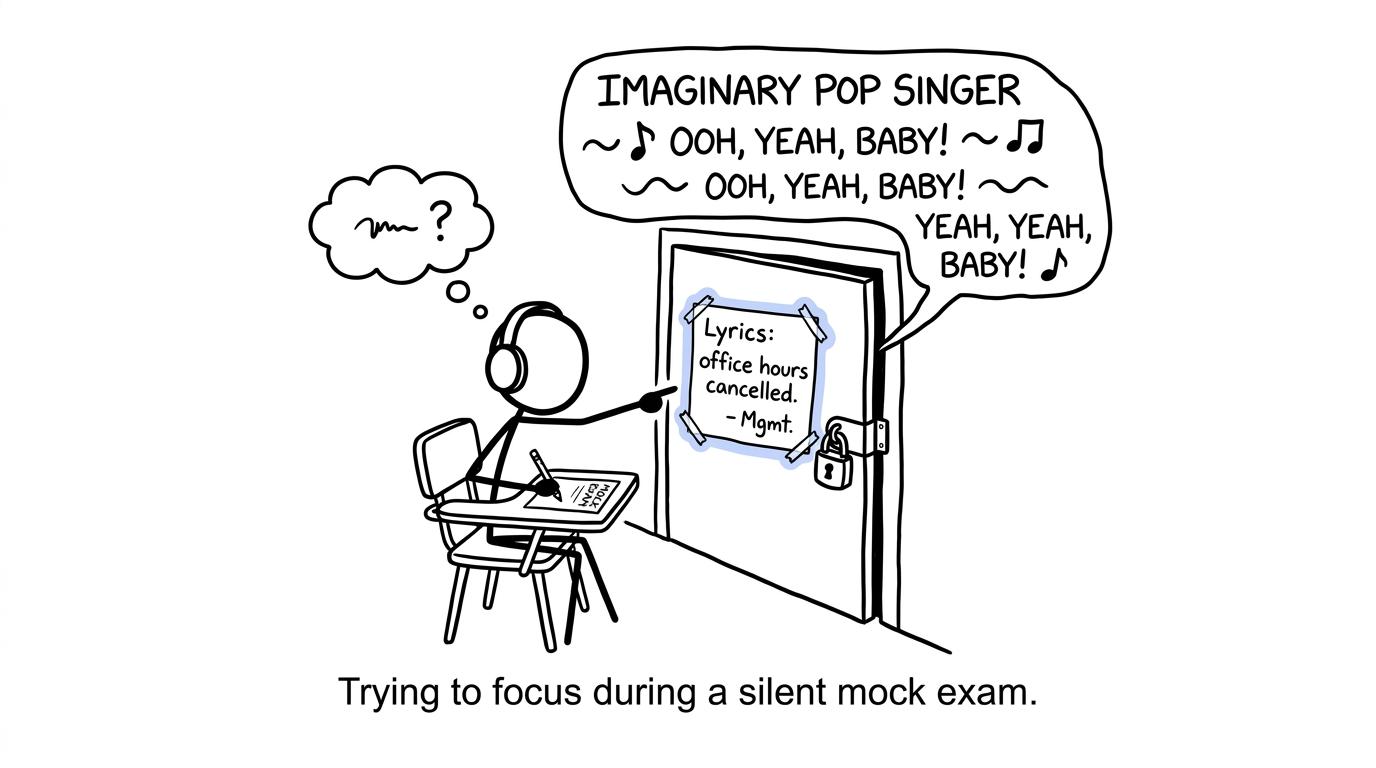 A student keeps song lyrics outside during silent exam practice
Run your own fair silence-versus-noise test
Personal preference matters, but preference is not the same as performance. Test both conditions rather than trusting the one that feels nicest.
Choose two comparable revision tasks. They might be two source passages, two sets of recall prompts or two equally demanding maths mini tests. Complete one in silence and one with your usual background sound. Keep the duration, difficulty and time of day as similar as reasonably possible.
After each session, record:
- how much you completed;
- how accurately you answered;
- how much you recalled after a short break;
- how often you reread or restarted;
- whether you reached for your phone;
- how mentally tired you felt.
Repeat the comparison on more than one day. A single result can be affected by topic difficulty, tiredness or prior knowledge. If silence repeatedly improves recall or accuracy, the decision is made. If instrumental sound produces equivalent results and helps you start consistently, it may be a reasonable compromise for ordinary practice.
Do not run this experiment with lyrical music during your final timed papers. Exam preparation should increasingly resemble the conditions in which the knowledge must be used.
Common mistakes when choosing revision sound
Assuming enjoyment means improvement
Music can lift your mood and make time pass quickly. Neither proves that you understood more. Check recall and marked work afterwards.
Treating all background sound as identical
Lyrics, nearby speech, steady instrumental music and unpredictable household noise have different properties. Meaningful words are especially likely to interfere with reading and verbal memory.
Revising only with one familiar cue
If every fact is learnt with the same playlist, silent retrieval may feel strangely empty. Include plenty of cue-free recall and exam practice.
Changing tracks repeatedly
Even harmless instrumental music becomes distracting if you keep selecting songs. Prepare the audio before starting and keep the controlling device out of reach.
Using silence with passive revision
A quiet room cannot rescue an ineffective method. Rereading a page silently is still usually less revealing than closing it and recalling the argument, evidence or method from memory.
Ignoring the real source of noise
Headphones may mask conversation, but notifications can still break concentration. Disable alerts and remove unnecessary tabs. If your home is persistently noisy, a library or supervised school revision space may be more useful than searching for stronger masking audio.
The best rule is simple enough to follow
For GCSE Classical Civilisation, make silence your default whenever you are reading closely, memorising content, planning essays or practising under time pressure. If you need sound to settle into routine work, use quiet instrumental audio and judge it by your results. Avoid lyrics and speech for language-heavy tasks.
Then apply the same discipline across your subjects. Start at the MathsGenie GCSE revision area, choose your exam board and work from a revision lesson into practice questions. Use mini tests to check understanding, then complete past papers and predicted papers in silence. Mark them carefully with the available mark schemes and use video solutions to repair methods rather than merely noticing mistakes.
A good revision environment does not make the work effortless. It makes the important work easier to see. Choose quiet, begin one focused task, and let the evidence on the page tell you what to do next.











