GCSE Chinese Grade Boundaries Explained
GCSE Chinese grade boundaries explained clearly: learn why raw marks, paper demand and yearly awarding mean your percentage does not guarantee a grade.
A percentage can feel wonderfully definite. You add the marks, divide by the total and expect the answer to tell you your grade. But GCSE grading does not work through one permanent percentage scale.
With GCSE Chinese grade boundaries explained, the central idea is simple: your exam board adds your eligible marks across the qualification, then compares that total with boundaries set for that specific exam series, specification and tier. Because the demand of an examination can vary, the raw mark needed for a grade can move from one year to another.
That is why the same percentage can lead to different grades in different years. It is also why last year's boundary is useful evidence, but never a promise.
The essential grade-boundary checklist
Before interpreting a Chinese result or practice-paper score, check:
- your exam board, such as AQA or Pearson Edexcel;
- your specification and exam series;
- whether you entered foundation or higher tier;
- the maximum mark for that qualification;
- the overall subject boundary, not a notional paper boundary;
- whether the figures are confirmed boundaries or merely predictions;
- how securely your total sits above or below your target.
You can see published figures on the Edexcel GCSE Chinese grade boundaries page. For the broader principles, read MathsGenie's guide to GCSE grade boundaries.
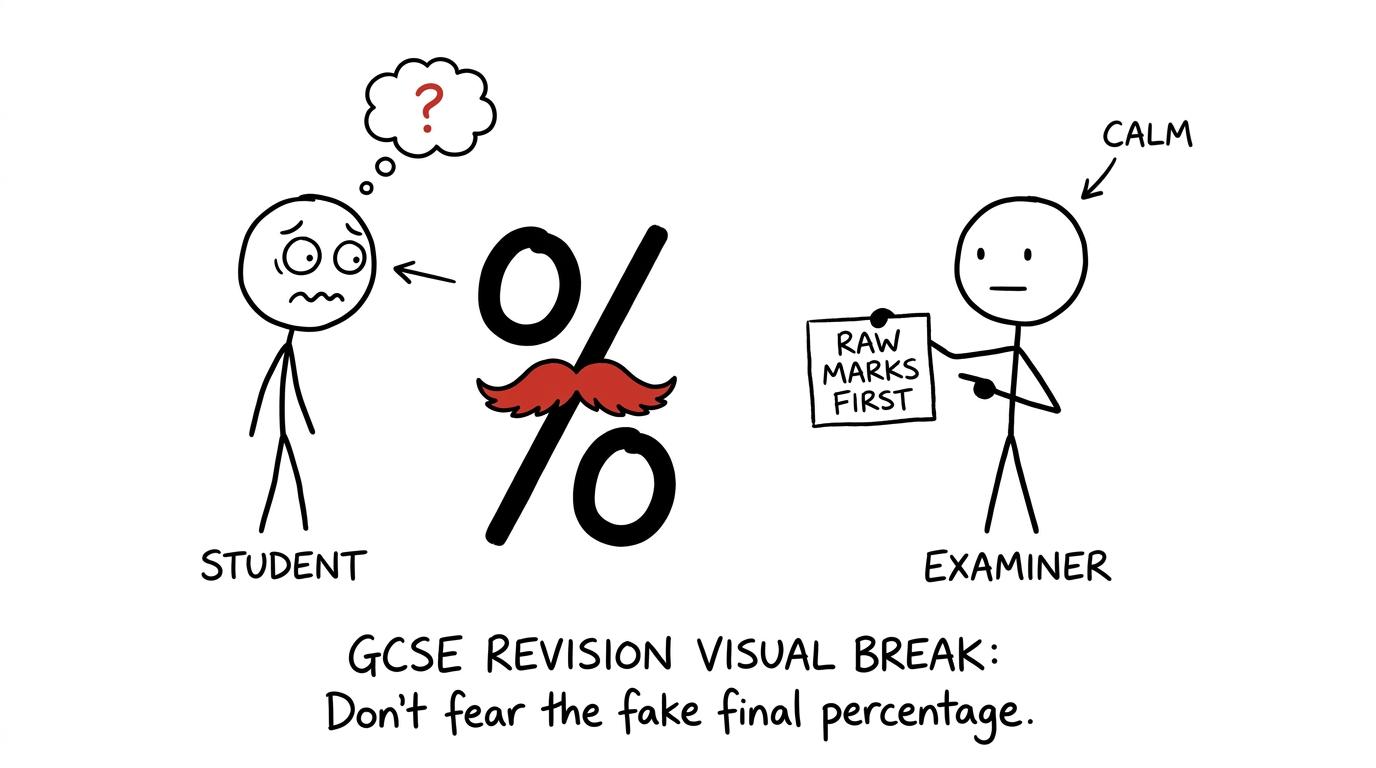 A percentage sign tries to disguise itself while a student learns that raw marks come first
What a GCSE Chinese grade boundary means
A grade boundary is the minimum total mark required for a particular grade in a particular examination series.
If a published grade boundary is bbb, then a total of bbb reaches that grade. A total of b−1b-1b−1 does not. The boundary is a threshold rather than a description of how well every individual skill was performed.
Your percentage can still be calculated:
Percentage score=raw markmaximum mark×100\text{Percentage score}=\frac{\text{raw mark}}{\text{maximum mark}}\times 100Percentage score=maximum markraw mark×100However, that calculation does not create the grade. The exam board's confirmed boundary does.
This distinction matters because different Chinese specifications can have different total marks and assessment structures. In the published June 2025 tables, AQA GCSE Chinese was reported out of 240240240 marks, while Pearson Edexcel GCSE Chinese was reported out of 280280280 marks. A raw mark cannot therefore be compared sensibly without its denominator, board, tier and series.
The same principle applies in maths. A score only becomes meaningful when you match it to the correct specification and boundary table. MathsGenie's AQA GCSE grade boundaries and OCR GCSE grade boundaries for 2025 show why board labels must never be treated as optional details.
Why the required raw mark changes each year
Exam boards aim to maintain a comparable standard over time. Yet no two examination papers can be perfectly identical in demand. One listening paper may contain less familiar vocabulary. A reading paper may make inference more demanding. Another series may include writing prompts that candidates find more accessible.
If boundaries were fixed permanently, students taking a harder paper could be unfairly disadvantaged. Moving boundaries allow the awarding process to account for differences between examination series.
Boundaries are set after the examinations
Grade boundaries are not normally fixed before students sit the papers. During awarding, exam boards use several forms of evidence. These can include statistical information, the expected performance of the cohort based on prior attainment, comparisons with previous series and expert review of candidates' work around important grade thresholds.
Senior examiners consider what the marks represent on that particular assessment. The purpose is to preserve the standard required for a grade, not to preserve one percentage forever.
This does not mean grades are casually adjusted according to whether an exam felt difficult on social media. Nor does it mean a fixed proportion of students must receive each grade. The process uses evidence across the cohort and the quality of work produced.
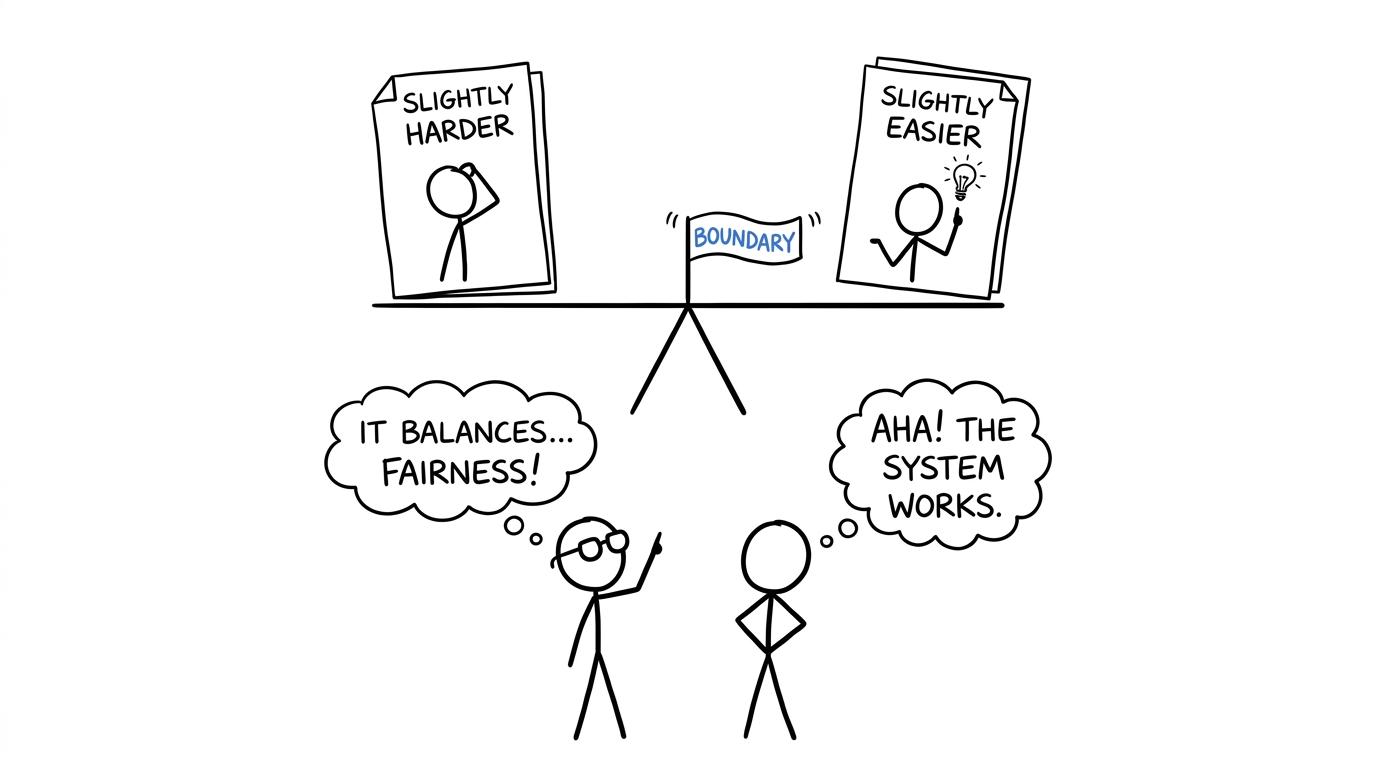 Two exam papers balance on a seesaw while a movable boundary keeps the standard fair
Boundaries belong to a specific board and series
An AQA boundary cannot be transferred to an Edexcel paper. Even when two qualifications assess listening, speaking, reading and writing, their papers, mark totals and assessment arrangements are not interchangeable.
The published June 2025 figures make this visible. For AQA higher-tier Chinese, the grade 777 boundary was 141141141 out of 240240240. For Edexcel higher-tier Chinese, it was 168168168 out of 280280280. These correspond to:
141240×100=58.75%\frac{141}{240}\times 100=58.75\%240141×100=58.75%and
168280×100=60%\frac{168}{280}\times 100=60\%280168×100=60%Those percentages describe two confirmed boundaries from one series. They do not establish a universal rule that grade 777 will always require roughly 60%60\%60%.
Overall grades are not four separate paper grades
GCSE Chinese assesses four language skills: listening, speaking, reading and writing. The precise marks and assessment arrangements depend on the specification, but the final qualification grade is based on the combined, appropriately weighted result.
Exam-board documents sometimes publish notional component boundaries. These estimate what a grade boundary might look like on an individual component. They can help schools understand performance, but they do not award a separate official GCSE grade for each paper.
A weaker listening result can therefore be offset by stronger work elsewhere, provided the combined total reaches the required qualification boundary. That does not make listening unimportant. It means the final grade reflects the whole assessment rather than demanding the same grade on every component.
When marking practice, keep both views:
- record performance by skill so you know what to revise;
- calculate the combined total so you can judge overall progress.
This is the same useful distinction in maths revision. Individual questions diagnose topic weaknesses, while full GCSE maths past papers test the total performance that ultimately determines the grade.
Foundation and higher tier change the picture
Both AQA and Edexcel Chinese use foundation and higher tiers. Students take the required assessments at one tier, rather than mixing tiers across the qualification.
Foundation tier provides access to grades 111 to 555. Higher tier is designed principally for grades 444 to 999, with a limited grade 333 safety-net outcome available below the grade 444 boundary under the usual tiering arrangements. A result below the lowest available boundary is unclassified.
This means a foundation percentage cannot be compared directly with a higher-tier percentage. The papers target different ranges of demand, and each tier has its own boundaries.
Tier choice should be discussed with your teacher using consistent evidence, including classroom work, mock results and performance across all four skills. One unusually strong or weak paper should not carry the whole decision.
How to use old boundaries without being misled
Historical boundaries are valuable when treated as a range rather than a forecast. They can help you understand approximately where previous thresholds have fallen and whether your current result is comfortably placed or very close to an edge.
A sensible approach is to:
- use a paper from the correct board, tier and specification;
- complete it under realistic conditions;
- mark it strictly using the official mark scheme;
- compare it only with the boundary from that paper's series;
- examine several papers rather than trusting one result;
- aim above the historical target to create a margin for variation.
Do not build a revision plan around scraping one mark above an old boundary. If the previous threshold was bbb, a safer personal target has the form
T=b+mT=b+mT=b+mwhere mmm is a deliberate margin. The size of that margin is not an official prediction. It is protection against paper-to-paper variation, marking mistakes and uneven performance under pressure.
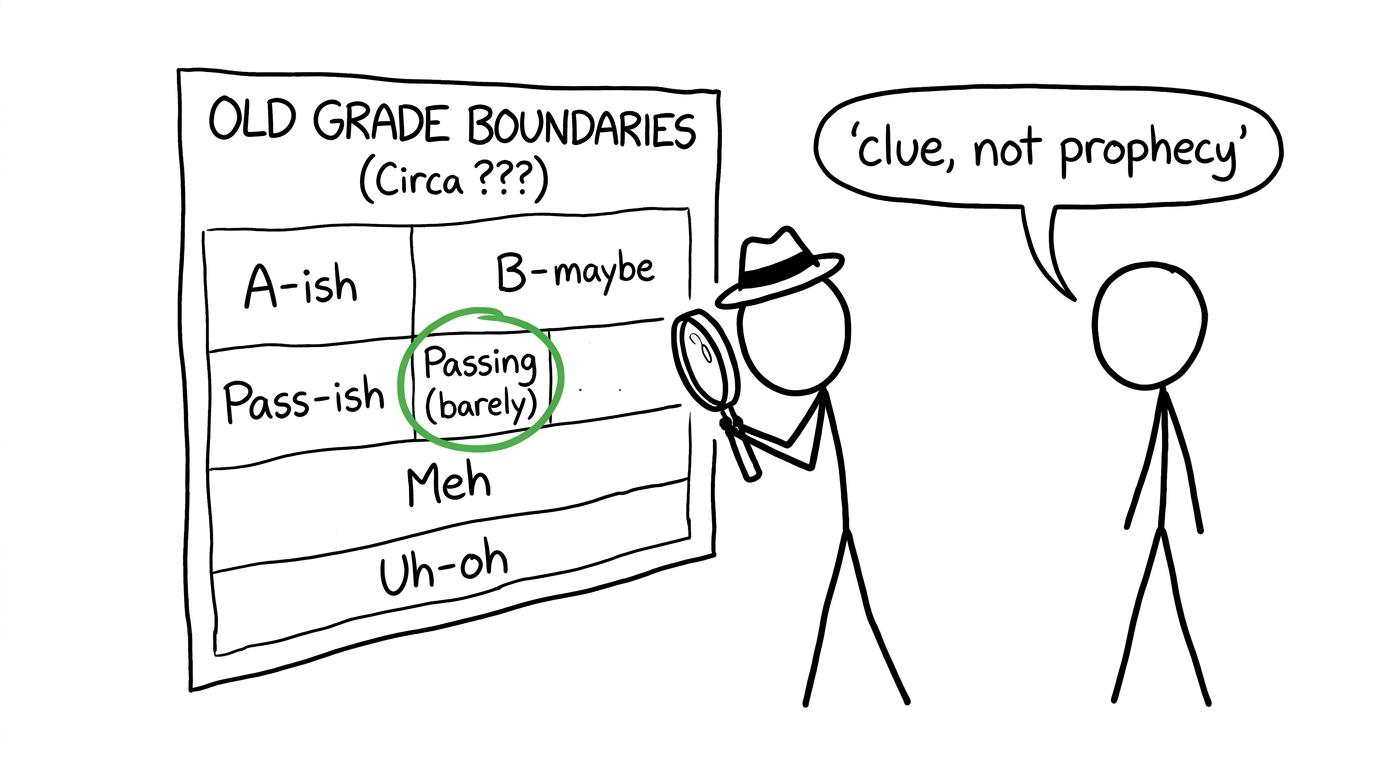 A student detective studies an old boundary chart marked as a clue rather than a prophecy
MathsGenie's analysis of GCSE Statistics grade-boundary history demonstrates the wider lesson clearly: historical movement is real, so past data should guide revision rather than control expectations.
Turn a boundary into a revision decision
A boundary tells you where a grade began. It does not tell you why you lost marks or what to do next.
After each practice paper, separate mistakes into useful categories:
- knowledge: missing vocabulary, characters, structures or topic content;
- interpretation: misunderstanding the question or stimulus;
- technique: failing to satisfy a writing bullet point or speaking requirement;
- accuracy: avoidable transcription, grammar or calculation errors;
- timing: leaving accessible marks unfinished.
For maths students, the same feedback loop is especially powerful. Follow MathsGenie's guide on using GCSE past papers properly, then move from diagnosis to GCSE revision lessons and practice questions. Nearer the examination, GCSE predicted papers can provide additional unseen practice, but they still cannot predict the final grade boundaries.
Common mistakes when reading Chinese grade boundaries
Treating percentages as permanent grades
There is no universal rule such as a fixed percentage always equalling grade 777. Confirmed raw-mark boundaries vary by board, tier and series.
Using the wrong maximum mark
A mark of 150150150 means something different out of 240240240 and out of 280280280. Always check the qualification total before calculating a percentage.
Comparing different exam boards directly
AQA and Edexcel papers are not the same assessment. Use the boundary table matching the paper you completed.
Treating component boundaries as official paper grades
Notional component boundaries are illustrative. The qualification grade comes from the combined, appropriately weighted subject total.
Assuming an old boundary predicts the next one
Past boundaries reveal history, not the future. The next boundary is confirmed only through that series' awarding process.
Aiming for the exact threshold
A one-mark cushion is fragile. Build enough confidence and accuracy to perform above recent boundaries rather than trying to land precisely on them.
Focus on marks you can still change
A grade boundary matters, but it is outside your control. The marks you earn are not.
Use the correct historical table, understand the range and then return to the work: complete the paper, mark it carefully, identify the weakest skill and practise it again. That process is less dramatic than guessing next year's threshold, but far more useful.
For maths revision, make MathsGenie your next step. Use the free revision lessons, practice questions, mark schemes and video solutions to repair individual gaps. Then test the complete performance with past papers, mini tests and predicted papers. Boundaries may move. Better preparation moves your mark.