GCSE Chemistry vs GCSE the Alternative Option
GCSE Chemistry vs GCSE the alternative option explained. Compare content, maths, workload and future plans to choose the subject that suits you best.
Choosing GCSE options can feel strangely permanent. One box on a form appears to decide what you will enjoy, how busy Year 11 becomes and what you may study later. It rarely carries that much power, but it deserves careful thought.
The honest answer to GCSE Chemistry vs GCSE the alternative option is that Chemistry suits students who enjoy scientific explanations, calculations, practical investigation and precise written reasoning. The alternative may fit better if it matches your interests, assessment strengths or future plans more closely. Before deciding, confirm what your school means by Chemistry: in many schools, it is taken as part of separate sciences alongside Biology and Physics rather than as one isolated option.
Your quick decision checklist
Ask these questions before comparing grades or following your friends:
- Is the choice between separate sciences and another option, or between science pathways?
- What exactly is the alternative subject?
- Which course content would you willingly revise for two years?
- Do you prefer calculations, data and structured explanations, or another assessment style?
- How much additional timetable content does each route involve?
- Could either choice affect entry to a sixth form course you are considering?
- What do your subject teachers and school options booklet say?
That first question matters. The phrase “GCSE Chemistry” can disguise two different routes.
What choosing GCSE Chemistry usually means
GCSE Chemistry is available as a separate GCSE through exam boards including AQA, Pearson Edexcel, OCR and Eduqas. However, schools commonly offer separate or “triple” science as a package: GCSE Biology, GCSE Chemistry and GCSE Physics. Combined Science, by contrast, includes all three scientific disciplines and normally awards two GCSE grades.
Separate Chemistry therefore does not usually mean abandoning Biology and Physics. It normally means studying all three sciences in greater breadth or depth than on the combined route and receiving three individual qualifications. The precise timetable and option-block arrangement is controlled by your school.
This distinction changes the comparison. You may really be choosing between:
- separate sciences and Combined Science plus another subject;
- separate sciences and a particular option such as Geography, Computer Science or Art;
- two pathways selected partly through teacher recommendations.
Do not assume that every school offers the same arrangement. Read your current options booklet and ask whether Chemistry consumes an option block, whether separate sciences are taught in extra lessons and whether entry depends on your present attainment.
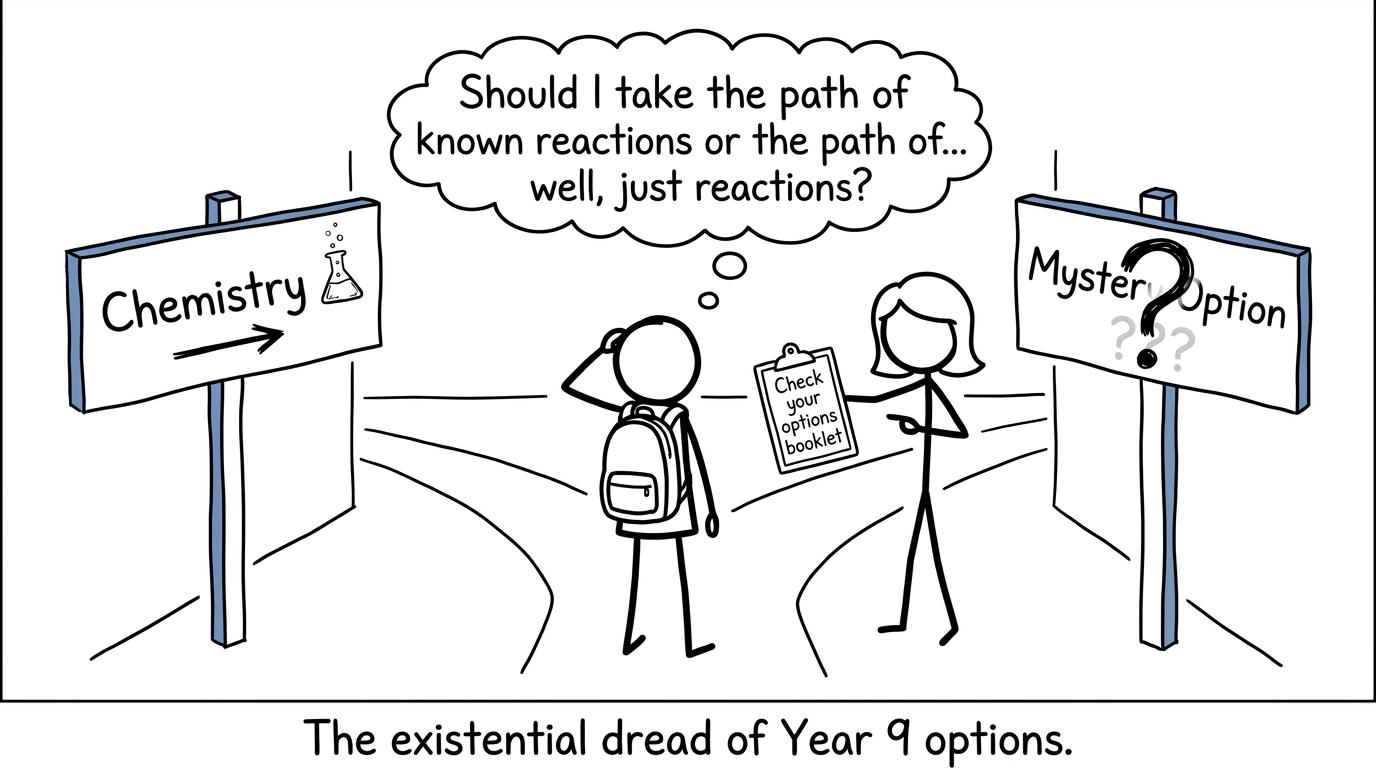 A student discovers that the mysterious alternative option needs checking in the school booklet
What GCSE Chemistry actually involves
Chemistry is not simply a large collection of element symbols. The course asks you to connect models of particles and bonding with observable reactions, experimental evidence and quantitative relationships.
Although specifications organise material differently, common areas include:
- atomic structure and the periodic table;
- bonding, structure and properties;
- quantitative chemistry;
- chemical changes and electrolysis;
- energy changes;
- rates and equilibrium;
- organic chemistry;
- chemical analysis;
- atmospheric chemistry;
- using resources sustainably.
Separate Chemistry contains material beyond the chemistry component of Combined Science. Under the regulations applying to GCSE single sciences in England, at least 20%20\%20% of Chemistry marks assess mathematical skills, while at least 15%15\%15% relate to practical work. Students must also be given opportunities to complete the specified practical activities. Practical competence is assessed through written examination questions rather than a separate coursework mark.
The papers can require recall, application, data analysis, evaluation and extended reasoning. That makes Chemistry a good fit for students who like discovering why a result occurs, not only remembering what occurred.
How much maths is in GCSE Chemistry?
Chemistry is more mathematical than its reputation sometimes suggests. You may need to use:
- ratios, fractions and percentages;
- standard form and significant figures;
- substitution and rearranging formulae;
- unit conversions;
- means and data tables;
- gradients, tangents and graph interpretation;
- proportional relationships;
- areas and volumes in scientific contexts.
The maths is normally attached to a chemical idea. You must recognise the required relationship, select the relevant data, maintain units and judge whether the result is sensible. Students who enjoy this combination of science and calculation may find Chemistry satisfying.
If these skills currently feel uncertain, that is not automatically a reason to avoid the subject. Skills are trainable. Begin with MathsGenie's GCSE maths revision resources, then identify the topics that transfer most directly into science. The guide to GCSE maths topics by exam board and tier is useful for checking number, ratio, algebra, graphs and measures.
A sensible learning sequence also matters. The best order for learning GCSE maths topics builds from number fluency into ratio, algebra and graphs, the same foundations that the same foundations that make quantitative Chemistry less intimidating.
How the alternative option may differ
There is no single “alternative option”, so no responsible comparison can claim that Chemistry is universally harder or more useful. A practical subject, essay-based humanity, language, creative course or technical qualification will ask for different kinds of effort.
Compare the real courses under four headings.
Content and curiosity
Chemistry rewards curiosity about matter, reactions, materials and evidence. Another option may be stronger if you are more interested in people, places, design, performance, languages or computing.
Interest is not a soft consideration. You will spend many lessons and revision sessions with the subject. Curiosity makes sustained practice easier; indifference makes even a manageable specification feel heavy.
Assessment style
Chemistry is generally assessed through written papers containing calculations, short responses, practical interpretation and extended answers. Your alternative might include coursework, performance, design work or longer essays, depending on the qualification and school.
Check the current specification rather than relying on what older students remember. Ask how much is examined, whether there is non-exam assessment and what a typical high-mark response demands.
Workload pattern
Separate sciences usually add content across Biology, Chemistry and Physics, not Chemistry alone. An alternative option may have less scientific content but require portfolios, rehearsals, fieldwork or regular written assignments.
Workload is not only the number of pages in a textbook. It is also when the work arrives and whether its format suits you.
Progression
Separate Chemistry can provide useful preparation for A Level Chemistry because it gives you broader prior knowledge. Yet Combined Science can also lead to A Level sciences, subject to the entry requirements set by the individual school or college.
Never choose a course solely because someone calls it essential. Check the published sixth form requirements for courses you might consider, then speak to your science teacher. Requirements vary, and your eventual grades in science and maths may matter alongside the route taken.
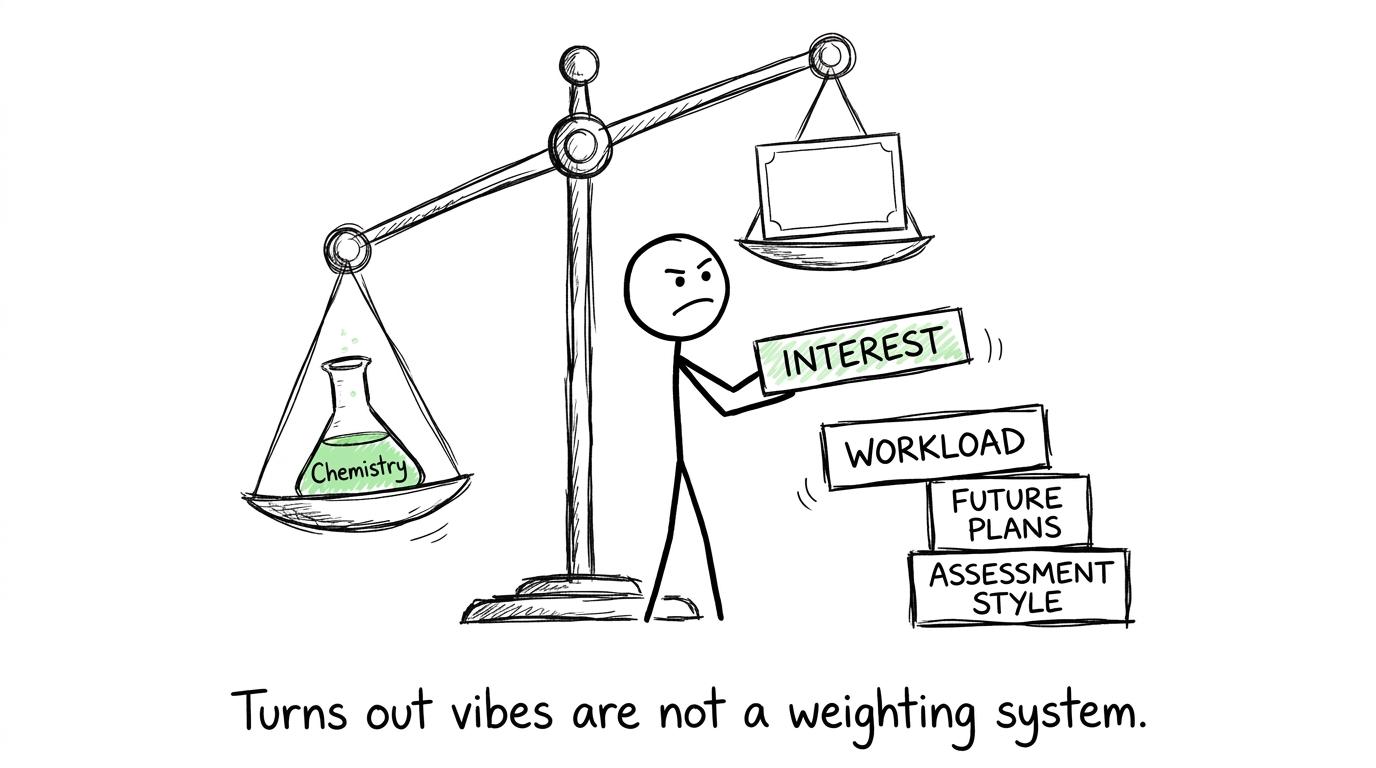 A student balances interest, workload, future plans and assessment style
Which option fits your strengths better?
Chemistry may suit you if you tend to enjoy:
- explaining results through scientific models;
- following multi-stage logical arguments;
- handling ratios, units and graphs carefully;
- learning precise terminology;
- evaluating methods and experimental evidence;
- revising through retrieval and exam questions.
The alternative may suit you better if its content genuinely interests you more, its assessment style reflects your strongest work, or it supports a direction you are already considering.
Be careful with the phrase “I am not good at maths”. A current weakness is evidence about what to practise, not a permanent identity. Use a short diagnostic or mini test, mark it honestly and separate conceptual gaps from avoidable errors. MathsGenie's article on GCSE maths topics that appear regularly can help you prioritise transferable skills.
If independent revision is one of your concerns, follow a repeatable system: learn one method, answer questions, check the mark scheme and revisit errors. The guide to self-studying GCSE maths explains how to make that cycle manageable.
A calm way to make the final decision
Give each course a score from 111 to 555 for interest, present strengths, assessment fit, workload fit and usefulness for possible next steps. Do not simply total the numbers. Look at why you awarded them.
Then take three practical actions:
- read the specification summary and your school's course description;
- ask teachers what daily lessons and assessments are actually like;
- compare a small sample of questions from both courses.
A decision based on evidence is usually more reliable than one based on reputation. Also choose for yourself. Friends can influence how comfortable September feels, but they cannot sit your examinations or sustain your revision.
 A checklist defeats the revision monsters of facts and data
Common mistakes when choosing between the subjects
Assuming Chemistry is a standalone option
Your school may only offer it within separate sciences. Confirm the full package and the option-block cost before comparing it with one other subject.
Choosing only for a career you might want
Future plans matter, but they are not the only factor. Keep useful routes open where possible while choosing courses you can realistically engage with and complete well.
Treating Combined Science as an easy route
Combined Science still includes Biology, Chemistry and Physics, practical understanding and mathematical questions. It covers less separate-science content, but it remains a substantial GCSE course.
Avoiding Chemistry because of one weak maths topic
Ratio, standard form, graphs and rearranging formulae can improve through targeted practice. Use revision lessons first, then questions and mark schemes. As examinations approach, GCSE predicted papers and past-paper practice can reveal whether those methods remain secure under pressure.
Ignoring your school's rules
Option blocks, staffing, entry guidance and sixth form requirements vary. National specifications tell you what may be assessed; your school tells you which route is actually available.
Choose the course you can commit to
The best choice is not automatically the subject with the most equations, the strongest reputation or the friendliest option block. It is the course whose content, demands and future usefulness fit you most convincingly.
If that is Chemistry, strengthen the maths beneath it early. Use MathsGenie's free revision lessons and practice questions to repair individual skills, mini tests to check recall, and mark schemes and video solutions to understand lost marks. Later, build exam confidence with a phased past-paper strategy and predicted papers.
Your option form is a choice, not a verdict on your ability. Check the facts, notice your strengths and choose the route you are prepared to practise.