GCSE Chemistry Switch Tier: Foundation to Higher
GCSE chemistry switch tier: learn if you can move to higher, when schools decide, what evidence matters and how to prepare with confidence.
A tier can feel like a verdict. It is not. It is an exam-entry decision based on which paper is most likely to let you demonstrate what you know.
A GCSE chemistry switch tier is usually possible partway through the course because your school does not make the final exam entry when teaching begins. However, you cannot change tier by yourself. Your teacher, science department and exams officer decide which tier to enter, normally using mock results, classwork and performance on tier-specific questions.
There is no single date by which every school must make that decision. Schools often set an internal deadline before the exam board's entry or amendment deadline, so the practical answer is simple: ask as early as possible. If you are considering moving from foundation to higher, do not wait for the final weeks before the exams.
The short answer and your checklist
A move may be realistic if:
- you are taking separate GCSE Chemistry or your Combined Science entry can still be changed;
- your recent work shows secure performance on foundation content;
- your target grade is above the foundation ceiling;
- you can cope with the additional higher-tier content and question demand;
- your teacher has enough evidence to support the change;
- your school's internal deadline has not passed; and
- you can prepare for the correct papers without weakening revision in other subjects.
Remember that GCSE Chemistry and GCSE Maths are separate qualifications. Moving to higher-tier Chemistry does not automatically move you to higher-tier Maths, or the other way around.
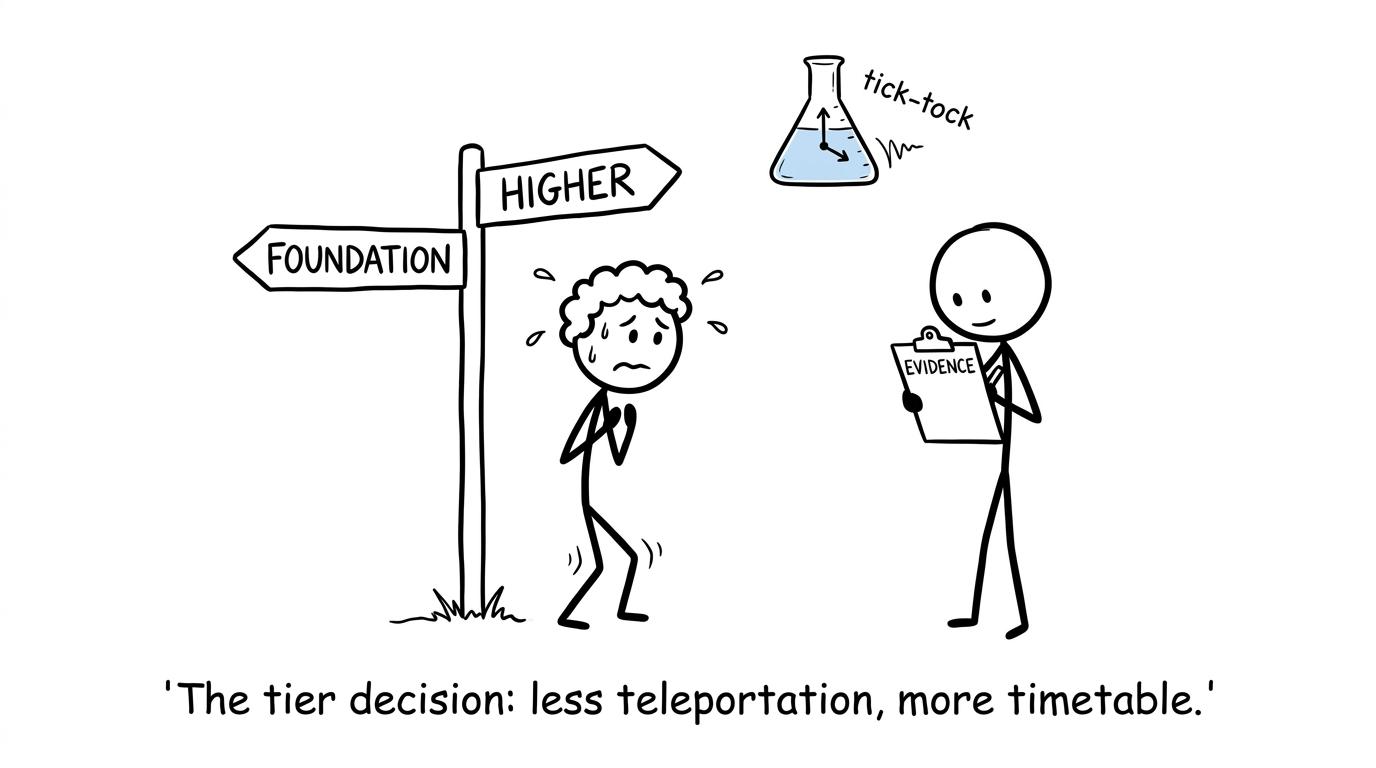 A student considers the foundation and higher signposts while a teacher checks the evidence
What changing Chemistry tier actually means
For current tiered GCSE sciences in England, foundation tier normally offers grades 111 to 555. Higher tier principally covers grades 444 to 999, with a narrow allowed grade 333 for a candidate who falls just below grade 444. Below that safety net, the result is unclassified.
That creates the central trade-off. Foundation caps your possible result at grade 555, but it gives students working around grades 444 and 555 a paper designed for that range. Higher opens access to grades 666 to 999, but carries more demanding questions and greater risk if the underlying knowledge is not secure.
Official guidance therefore treats tier choice as a question of appropriate entry, not prestige. A foundation paper is not a lesser qualification. If your likely outcome is grade 444 or 555, foundation may provide the more dependable route to that grade.
Exam-board structures also matter:
- In separate GCSE Chemistry, both papers must normally be taken at the same tier.
- A separate-science student may be able to take Chemistry at a different tier from Biology or Physics, depending on the specification.
- In Combined Science, students normally take the same tier across all six Biology, Chemistry and Physics papers. You cannot simply change the Chemistry components alone.
AQA, Pearson Edexcel and OCR specifications all require a consistent tier across the papers contributing to the relevant qualification. If you take Eduqas or WJEC, ask your teacher to confirm the rules for your exact course and specification.
How late can you move from foundation to higher?
There are two deadlines to understand.
Your school's internal deadline
This is the deadline that matters most to you. A school may decide tiers after autumn assessments, a Year 111111 mock series or another set of trial exams. It may then set an internal cut-off so that teachers can finish teaching, arrange intervention and submit accurate entries.
That deadline is a school policy, not a national rule. Some departments keep the decision open longer than others. Timetabling, class sets, missed higher-only content and the amount of evidence available can all affect what is practical.
The exam board's administrative deadline
Exam boards publish entry and amendment deadlines for each examination series. A tier can sometimes be amended after the original entry has been submitted, although later changes may attract fees and create administrative risks.
For example, AQA's published guidance for the summer 202620262026 series allowed tier changes after the main February entry deadline, with an amendment deadline in April. That example should not be treated as a permanent annual date: deadlines vary by board and series, and schools generally need decisions well before the last technical opportunity.
In other words, “the exams officer can still alter the entry” does not necessarily mean “the school will approve a late move”. Ask your teacher these questions now:
- When is our internal tier deadline?
- What evidence would justify moving me?
- Which higher-tier topics have I not yet covered?
- When will my progress next be reviewed?
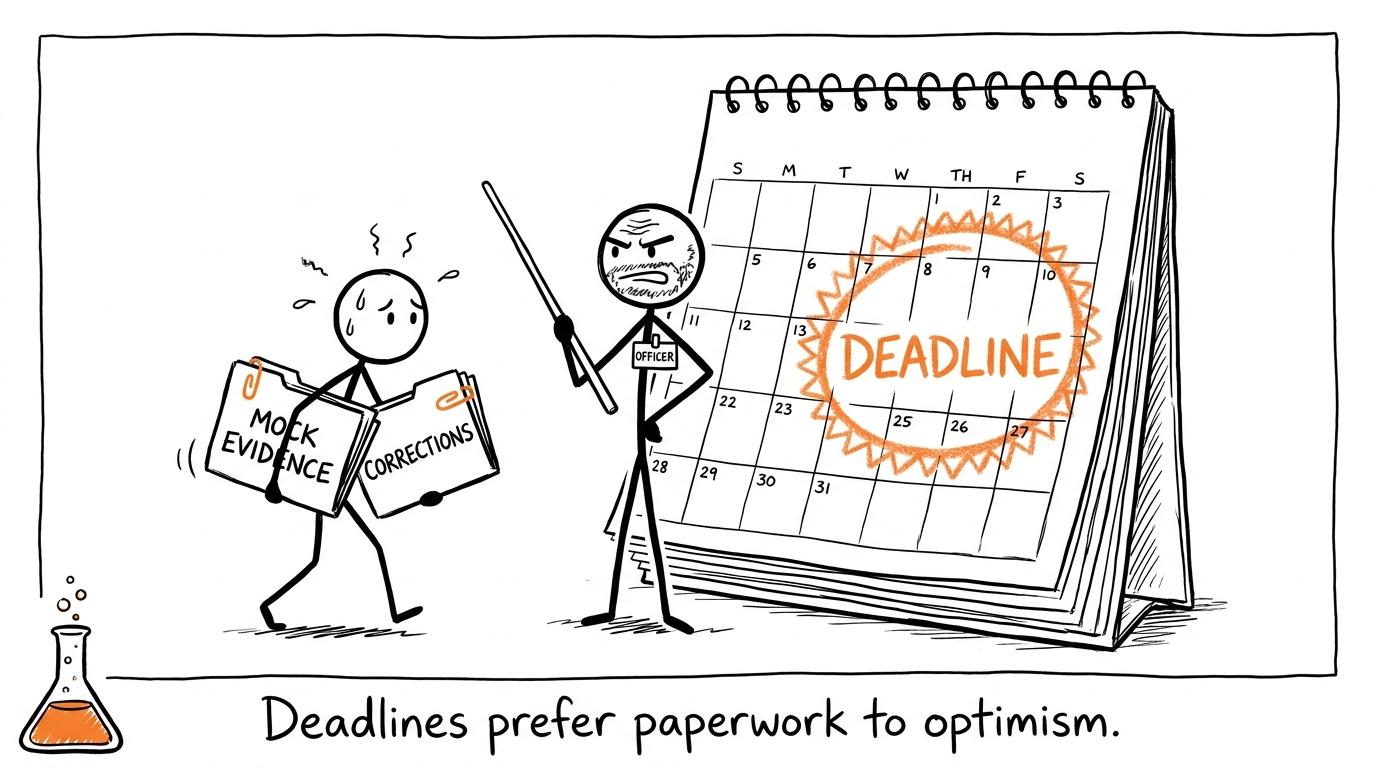 An exams officer guards a large calendar as a student arrives with mock evidence
What evidence will your school consider?
One strong topic test may start the conversation, but it rarely settles it. Teachers need evidence that is broad, recent and repeatable.
Performance on common and foundation questions
The first test is usually whether you are secure on the knowledge shared between tiers. Moving up does not remove the need for accurate recall, practical understanding, units or basic calculations. Higher questions build on those foundations.
Look at patterns rather than one total mark. Are you consistently reaching the upper end of foundation papers? Are mistakes caused by missing knowledge, weak exam language or avoidable arithmetic? The cause tells you more than the score alone.
Performance on higher-tier material
Your teacher may give you higher questions or a higher mock section. These assess whether you can apply knowledge in unfamiliar contexts, connect several ideas and sustain multi-stage reasoning.
Do not hide the parts you find difficult. Corrected work is useful evidence because it shows whether feedback turns into improvement. The guide to using past papers properly explains the most valuable cycle: attempt, mark, diagnose, repair and retest.
Your overall workload
A switch must be manageable alongside Maths, English and your other GCSEs. Higher Chemistry may require catching up on content while you are also preparing for several examination papers. A sensible decision considers the opportunity cost, not just the possible grade ceiling.
The maths skills behind higher-tier Chemistry
Higher Chemistry is not simply “Chemistry with harder numbers”. Yet mathematical fluency matters because it frees your attention for the science.
Depending on your specification, calculations may involve proportional reasoning, quantities of substances, concentration, percentage yield, atom economy, rates, graphs and unit conversion. Useful relationships include:
percentage yield=actual yieldtheoretical yield×100\text{percentage yield}=\frac{\text{actual yield}}{\text{theoretical yield}}\times 100percentage yield=theoretical yieldactual yield×100and
mean rate=change in quantitytime taken.\text{mean rate}=\frac{\text{change in quantity}}{\text{time taken}}.mean rate=time takenchange in quantity.The goal is not to memorise isolated buttons. It is to recognise the relationship, keep units consistent, rearrange correctly and present enough working to earn method marks.
Use MathsGenie's free calculations involving masses resources to review Chemistry calculations matched to the Edexcel specification. For reaction data and gradients, the calculating rates of reactions revision guide develops the relevant AQA skills.
You can then repair specific mathematical weaknesses through:
- ratio revision and practice for reacting quantities and proportional reasoning;
- standard form revision for very large or small quantities; and
- changing the subject of a formula for equations where the required quantity is not already isolated.
These Maths resources do not replace your Chemistry specification. They strengthen the calculation tools beneath it.
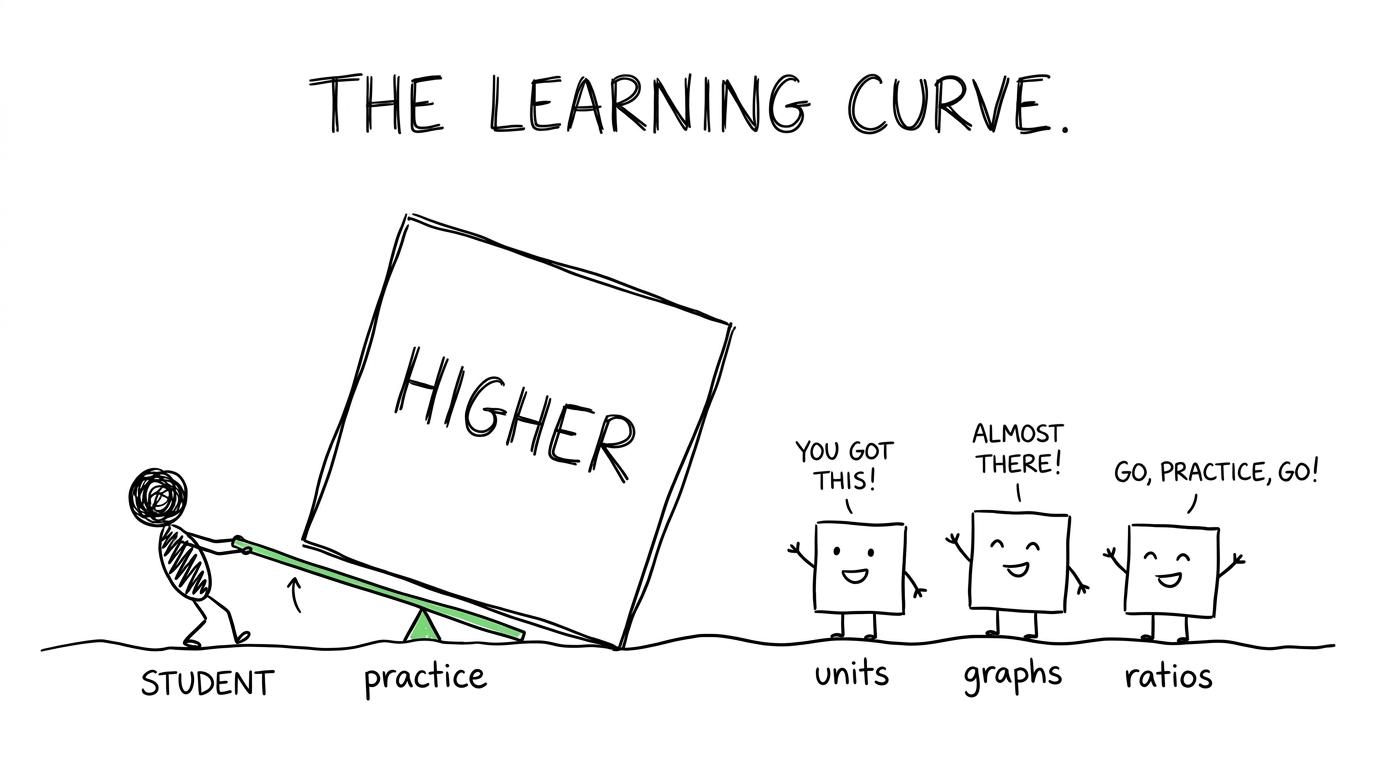 A student uses practice as a lever to lift a box labelled higher
How to build a case for switching tier
Ask for a review rather than demanding a change. A calm, evidence-led conversation is more useful than saying that foundation feels too easy.
Bring:
- recent marked assessments;
- a record of corrected mistakes;
- results from higher-tier questions set by your teacher;
- a list of higher-only content you need to learn; and
- a realistic revision plan.
Your plan might use three repeating stages:
Learn
Use your class materials and specification to identify missing Chemistry content. Keep the list precise. “Quantitative chemistry” is too broad; a named calculation or concept gives you something you can complete and test.
Practise
Attempt questions without notes. For the mathematical foundations, MathsGenie's Edexcel GCSE Maths past papers provide foundation and higher papers with mark schemes and solutions where available.
Review
Classify each error as knowledge, application, exam wording, maths or units. Relearn the smallest relevant skill and test it again. Nearer the Maths exams, Edexcel GCSE Maths predicted papers can provide realistic rehearsal, while your Chemistry practice should remain matched to your own science board.
Agree on a review date with your teacher. This turns an uncertain request into a measurable process.
Common mistakes when considering a tier change
Assuming higher always produces a better grade. It only increases the available grade range. It does not make grade 444 or 555 easier to secure.
Focusing only on the grade ceiling. The important question is which paper best reflects your current knowledge and likely performance under timed conditions.
Using one unusually good mock as proof. Teachers are more likely to trust a stable pattern across topics and assessments.
Ignoring Combined Science rules. In Combined Science, a tier change normally affects the complete science qualification, not Chemistry alone.
Waiting until the exam-board deadline. Your school may close decisions much earlier, and you need time to learn missing content.
Doing higher papers without repairing errors. Completing difficult questions creates evidence only when you mark them, understand the lost marks and improve on a later attempt.
Neglecting other subjects. A Chemistry tier move is not worthwhile if the catch-up plan destabilises your preparation for GCSE Maths or English.
Make the decision from evidence, not fear
Yes, moving from foundation to higher-tier GCSE Chemistry partway through the course can be possible. The decision belongs to your school, must follow the rules of your exact qualification and becomes harder to manage as internal and exam-board deadlines approach.
Start the conversation early. Ask what evidence is required, practise on the correct tier and treat every marked mistake as information. Whether you remain on foundation or move to higher, the best tier is the one that gives you the strongest chance to show what you genuinely know.
For the maths supporting your science calculations, use MathsGenie's free revision lessons, practice questions, mini tests, past papers, predicted papers, mark schemes and video solutions. Choose one weak skill today, practise it carefully, mark it honestly and take that evidence into your next conversation with your teacher.