

GCSE Chemistry Resit: Your Results Day Plan
GCSE chemistry resit plan for after results day: confirm your entry, diagnose lost marks and follow clear milestones using papers and worksheets each week.
Results day can make one grade feel like the whole story. It is not. A GCSE chemistry resit is a second attempt with one major advantage: you already know what the course, revision process and exam room feel like.
The practical answer is to contact your school or college promptly, confirm where and when you can retake the qualification, then build revision around questions, mark schemes and corrected mistakes. Chemistry is normally retaken in the next summer exam series rather than November, but availability and entry arrangements should always be confirmed with your centre.
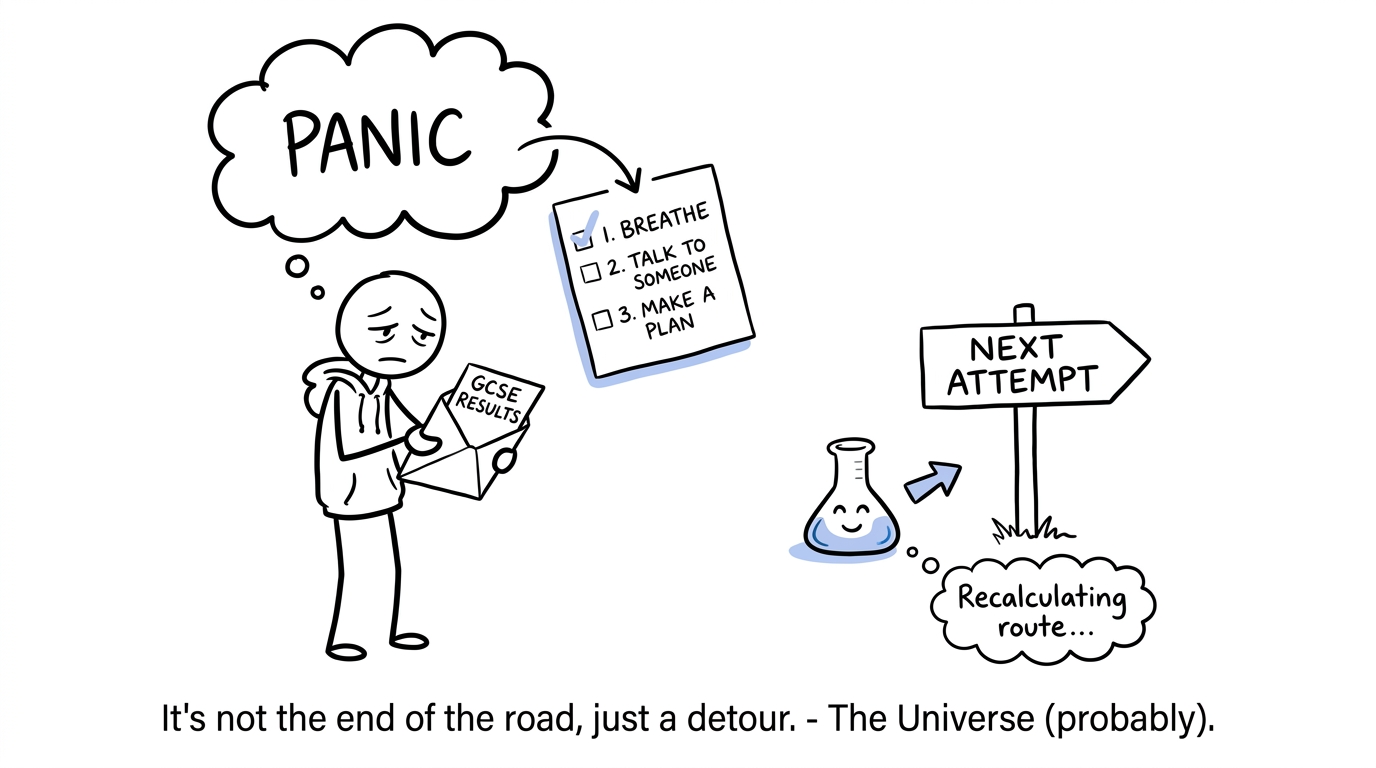 A student turns results-day panic into a calm resit checklist
Your first GCSE chemistry resit checklist
Before reopening a textbook, settle the administrative details. Uncertainty consumes attention that revision needs.
- Ask your school, college or approved exam centre whether it can enter you.
- Confirm your exam board: AQA, Edexcel, OCR or Eduqas.
- Check whether you are retaking separate Chemistry or Combined Science.
- Confirm your foundation or higher tier entry where tiers apply.
- Ask about entry fees, deadlines and access arrangements.
- Discuss whether a results review is appropriate before committing to a retake.
- Obtain the current specification and identify every assessed paper.
Unlike GCSE English language and maths, Chemistry is not generally part of the compulsory post-161616 resit requirement. Government guidance applies that condition to English and maths. A Chemistry retake is usually a deliberate choice made to improve a grade or meet an entry requirement.
Costs are not fixed nationally. They can depend on your centre, teaching arrangements and exam entry, so ask for the full amount before registering.
Build the plan from evidence, not disappointment
A disappointing grade tells you that marks were lost. It does not tell you why.
Begin with a diagnostic assessment using the correct board and tier from the GCSE Chemistry past papers and revision hub. Attempt one paper or a substantial section without notes. Mark it strictly, then classify each lost mark:
- Knowledge: a fact, definition or process was missing.
- Application: you knew the content but could not use it in context.
- Calculation: the formula, substitution, units or arithmetic went wrong.
- Practical skills: you missed variables, apparatus, safety or evaluation.
- Exam technique: the response lacked enough precise scientific detail.
This turns “I am bad at Chemistry” into a list of repairable problems. The guide to using GCSE past papers properly explains the same productive loop: attempt, mark, repair and retest.
A milestone plan for resitting GCSE Chemistry
Milestone one: rebuild the course map
During the opening fortnight, place every specification topic into one of three groups: secure, uncertain or weak. Do not rely on how familiar a chapter looks. Test it with questions.
If you take AQA, use the AQA GCSE Chemistry revision guides. Edexcel students can organise their work through the Edexcel GCSE Chemistry revision area. Students following OCR or Eduqas should select resources that match their exact specification rather than borrowing a convenient paper from another board.
Your target is a complete topic map and an error log containing the first weaknesses to repair.
Milestone two: repair knowledge and practical understanding
Spend the next phase working topic by topic. A useful session has three parts:
- retrieve key facts without notes;
- complete targeted worksheets or exam questions;
- mark immediately and rewrite incomplete answers precisely.
Required practical work still matters in written examinations. Questions can assess methods, variables, observations, safety, data and evaluation, so revising a practical means understanding why each step is used, not merely remembering an equipment list.
The broader guide to GCSE Chemistry revision without wasting time can help you keep these sessions question-led.
Milestone three: protect the calculation marks
Chemistry calculations often expose maths weaknesses in ratio, percentages, standard form, graphs, rearranging formulae and unit conversion. Keep a separate calculation log and record whether each error came from Chemistry knowledge or mathematical execution.
Use MathsGenie’s GCSE maths revision resources when the underlying skill needs rebuilding. Revision lessons and practice questions can strengthen the method before you return to concentration, reacting masses, yields, atom economy or energy calculations.
Write formulas before substituting, show working, keep units visible and check whether the final value is reasonable. These habits can preserve method marks even when an arithmetic slip appears later.
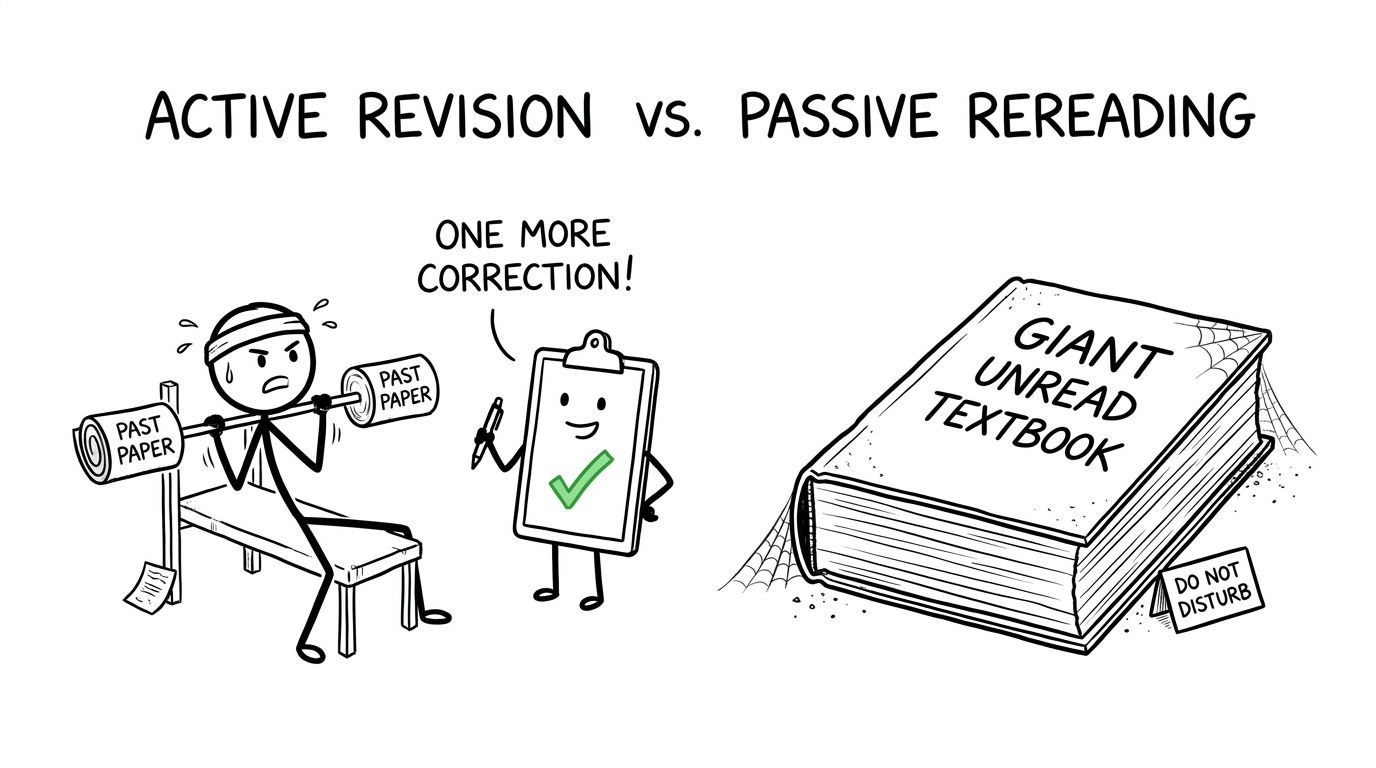 A student trains with past papers while an unread textbook gathers cobwebs
Milestone four: move from topics to timed papers
Once most weak topics have been repaired, complete mixed sections under time pressure. Later, progress to whole papers using the equipment and conditions required by your board.
Mark each paper on the same day if possible. Then schedule corrections before attempting another. A stack of completed papers can look impressive while hiding the same repeated errors.
Predicted papers are best saved for the later stages, after broad specification coverage. MathsGenie’s GCSE predicted papers area also demonstrates how to use fresh papers as rehearsals rather than forecasts.
A sustainable weekly routine
A practical week could contain three focused topic sessions, one calculation session and one timed paper section. End every session by recording:
- what you attempted;
- which marks you lost;
- what needs relearning;
- when you will retest it.
Use the MathsGenie revision planner, mini tests and video solutions for your supporting maths work where appropriate. The goal is not endless revision. It is a repeatable feedback cycle that steadily removes known weaknesses.
Common GCSE chemistry retake mistakes
Waiting for motivation: put short sessions into a fixed weekly timetable instead.
Using the wrong specification: similar topics can be assessed differently across AQA, Edexcel, OCR and Eduqas.
Only rereading notes: recognition feels comfortable but does not prove that you can construct an answer.
Ignoring practical questions: practical knowledge is assessed through the written papers.
Doing papers without corrections: the learning happens when lost marks become specific actions.
Neglecting calculations: improving transferable maths skills can unlock marks across several Chemistry topics.
Turn the result into a starting point
Resitting GCSE Chemistry is not about repeating the same year more intensely. It is about using better information. Confirm the entry, diagnose the paper, repair one weakness at a time and test whether the repair lasted.
Start with MathsGenie’s free GCSE Chemistry past papers, worksheets and practice questions. Combine them with revision guides, predicted papers and mark schemes, then use MathsGenie’s maths lessons, mini tests and video solutions to strengthen the calculations behind your Chemistry grade. Your result was one measurement. Your plan determines what happens next.











