

GCSE Chemistry Lower Grade Than Expected: Next Steps
GCSE chemistry lower grade than expected? Check marks, consider a review, protect college plans and build a calm, focused resit strategy for next summer.
Opening a results envelope can make months of work feel compressed into one number. If you received a GCSE chemistry lower grade than expected, pause before deciding what it means. Your immediate next steps are to check the result carefully, speak to your school or college, confirm whether it affects your next course, and then choose between accepting the grade, requesting a review or preparing for a resit.
Disappointment is real, but a grade is information rather than a verdict. What matters now is turning that information into a sensible decision.
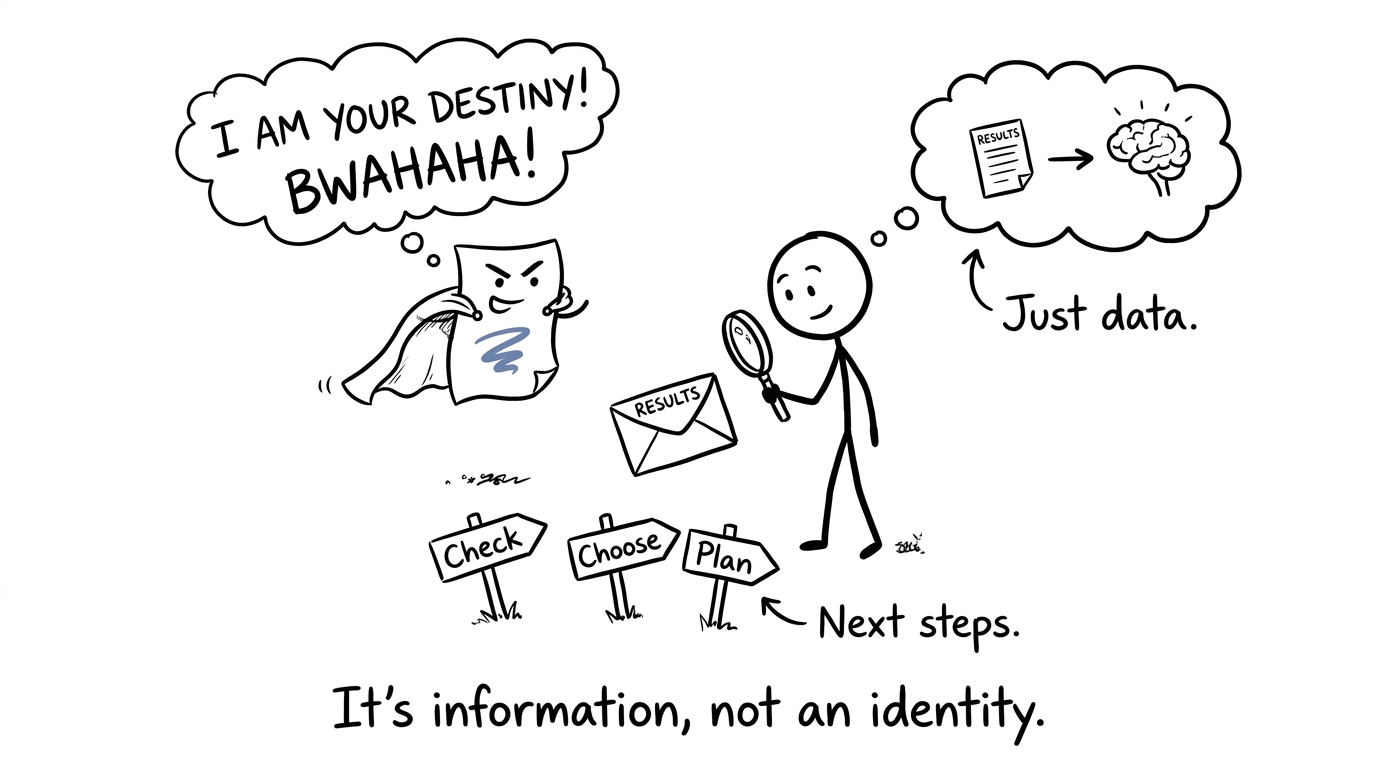 A GCSE result meets a much larger action plan
Your GCSE chemistry results-day checklist
Before making a decision:
- Confirm whether the result is for separate Chemistry or Combined Science.
- Ask for your raw marks and the relevant grade boundaries.
- Find out how far you were from the grade above.
- Speak to your chemistry teacher or exams officer.
- Check whether the grade affects your sixth-form, college or apprenticeship offer.
- Ask about access to your marked scripts and review deadlines.
- If necessary, investigate resit dates, costs and entry arrangements.
Do this promptly. Schools often set internal post-results deadlines earlier than the exam board deadline.
Check exactly what your result means
A predicted grade is an estimate based on earlier evidence. It is not a guaranteed result. Grade boundaries are set after papers have been marked and can change between exam series to account for differences in paper difficulty.
Ask your school for the marks awarded on each component. Compare your total with the official subject boundary for your specification and tier. Boundaries for individual papers may only be notional in a linear qualification, so concentrate on the overall subject result rather than assuming one paper independently produced your grade.
Also establish which qualification you took. A separate Chemistry result and a Combined Science result do not create identical resit options. If you took Combined Science, you generally cannot simply replace the chemistry portion while leaving every other component untouched. Your exams officer can explain the rules for your exact AQA, Edexcel, OCR or Eduqas entry.
Speak to your school before contacting the exam board
For a school-entered candidate, post-results requests normally go through the school or exam centre. Take these questions to your teacher or exams officer:
- Can we access a copy of my marked scripts?
- Does the marking appear consistent with the mark scheme?
- Were all pages and questions marked?
- How many marks am I below the next grade?
- What is the fee, deadline and possible outcome of a review?
Accessing the script can help a teacher identify whether the issue was marking, missing knowledge, weak exam technique or calculation errors. It replaces guesswork with evidence.
Decide whether a review of marking is appropriate
A review of marking checks whether the mark scheme was applied correctly. It is not an automatic fresh attempt to find extra marks simply because the result was disappointing.
Your school might recommend a clerical re-check if there is concern that marks were not recorded or totalled correctly. A review of marking may be more appropriate where a teacher can identify a plausible marking error.
You must usually provide written consent because the mark and grade can go down, stay unchanged or go up. There may also be a fee. Consider the evidence, the distance from the next boundary and whether the result affects progression before agreeing.
If your school decides not to support a request, ask for its internal appeals procedure. Private candidates should follow the instructions of their entering centre or exam board.
Protect your college or sixth-form plans
If the grade affects an offer, contact the provider immediately. Explain the confirmed result and ask what alternatives are available. Depending on its admissions policy, it might accept the grade, offer another course, require a resit or suggest a different route.
Do not assume that one GCSE chemistry disappointing result has ended your plans. Equally, do not assume the requirement will be waived. Get the answer directly from the organisation making the decision.
If you hope to study A Level Chemistry, ask whether your result meets the provider's subject and maths entry requirements. A Level Chemistry includes substantial numerical work, so maintaining your maths skills remains useful whatever happens next. The free GCSE Maths revision hub provides board-specific lessons, questions and papers for that work.
Plan a GCSE Chemistry resit carefully
For most GCSE Chemistry qualifications, the next resit opportunity is in the following summer. The November GCSE series in England is generally available for English Language and Maths rather than Chemistry. Availability can depend on your qualification, nation and exam board, so confirm the next series with an approved centre.
A resit should begin with diagnosis, not with rereading an entire textbook. Use the free GCSE Chemistry revision hub to select your exam board and find lessons, worksheets, practice questions, revision guides and past papers. Edexcel students can go directly to the Edexcel GCSE Chemistry revision resources.
Build a simple error log with four categories:
- Knowledge: content you could not recall.
- Application: knowledge you could not apply in an unfamiliar context.
- Exam writing: missing scientific vocabulary or incomplete explanations.
- Maths: errors involving units, ratio, graphs, formulae or standard form.
The guide to improving a pass-grade Chemistry result explains how to turn those categories into targeted practice. You can also use the efficient GCSE Chemistry revision method to organise short question-and-feedback cycles.
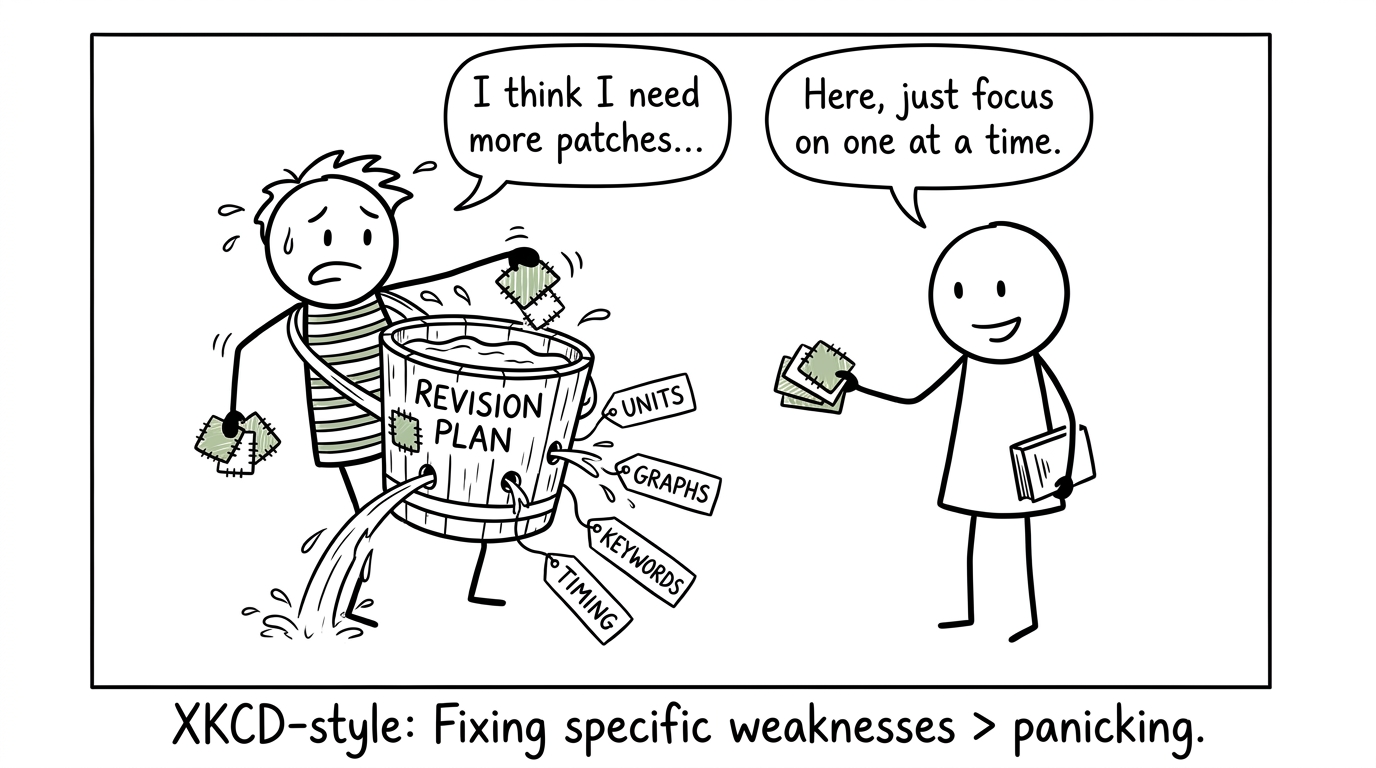 A student patches specific leaks in a revision plan
Strengthen the maths inside Chemistry
Chemistry questions often require ratio, percentages, rearranging formulae, interpreting graphs and managing powers of ten. If these caused lost marks, practise the underlying maths separately before returning to the scientific context.
MathsGenie's standard form revision lesson and questions can help with very large and small quantities. Use the broader Edexcel GCSE Maths revision page for ratio, proportion, gradients, percentages and changing the subject of a formula.
For chemistry knowledge, turn each weak specification point into a question and answer it without notes. The Chemistry active recall guide shows how to build a compact error bank and revisit material systematically.
Common mistakes after a disappointing result
- Requesting a review without seeing evidence: being close to a boundary does not itself prove a marking error.
- Missing the centre's deadline: ask for dates and costs immediately.
- Assuming a mark can only rise: reviews can reduce marks and grades.
- Ignoring progression requirements: speak to your intended provider rather than relying on rumours.
- Repeating the same revision: more rereading will not fix weak calculations or imprecise exam answers.
- Neglecting maths revision: continuing with maths protects both your next maths exam and the calculation skills needed in Chemistry.
Turn the result into a plan
The best GCSE chemistry next steps are calm and evidence-led: inspect the marks, seek teacher advice, protect your next course and resit only when it serves a clear purpose.
If a resit is right for you, start with MathsGenie's free GCSE Chemistry resources. Combine revision lessons with practice questions, mark schemes, video support, mini tests, past papers and predicted papers. Keep your maths moving alongside it. A disappointing grade describes one exam series; your next actions decide what happens after it.











