Does Handwriting Speed Matter in GCSE Chemistry?
GCSE chemistry handwriting speed matters when slow writing leaves answers unfinished. Learn to improve pace, clarity and exam technique without panic.
A student can know exactly why a reaction happens, picture the particle model clearly and still feel defeated by one ordinary object: a pen that cannot keep up.
So, does GCSE chemistry handwriting speed genuinely affect your mark? Not directly. Examiners award marks for chemistry, not words per minute. But slow handwriting can cost marks indirectly if you leave questions unfinished, shorten explanations until they become vague or rush chemical notation so badly that it cannot be read.
The goal is not beautiful handwriting. It is readable, precise work completed within the time allowed.
This matters in chemistry, but it also transfers directly to GCSE maths: clear working, accurate symbols and sensible time management help an examiner see what you know.
The short answer: what actually matters?
Use this checklist:
- Speed itself is not assessed. There is no mark for writing quickly.
- Legibility matters. An examiner cannot award credit for an answer they cannot interpret reliably.
- Completion matters. Unattempted questions cannot earn marks.
- Chemical notation must be unambiguous. Subscripts, superscripts, charges and element symbols need particular care.
- Concise answers are usually faster and stronger. Follow the command word rather than writing everything you remember.
- Persistent writing difficulties deserve support. Speak to your teacher, SENCo or exams officer well before the examination series.
You do not need to transform your handwriting into calligraphy. You need a system that protects meaning when the clock becomes uncomfortable.
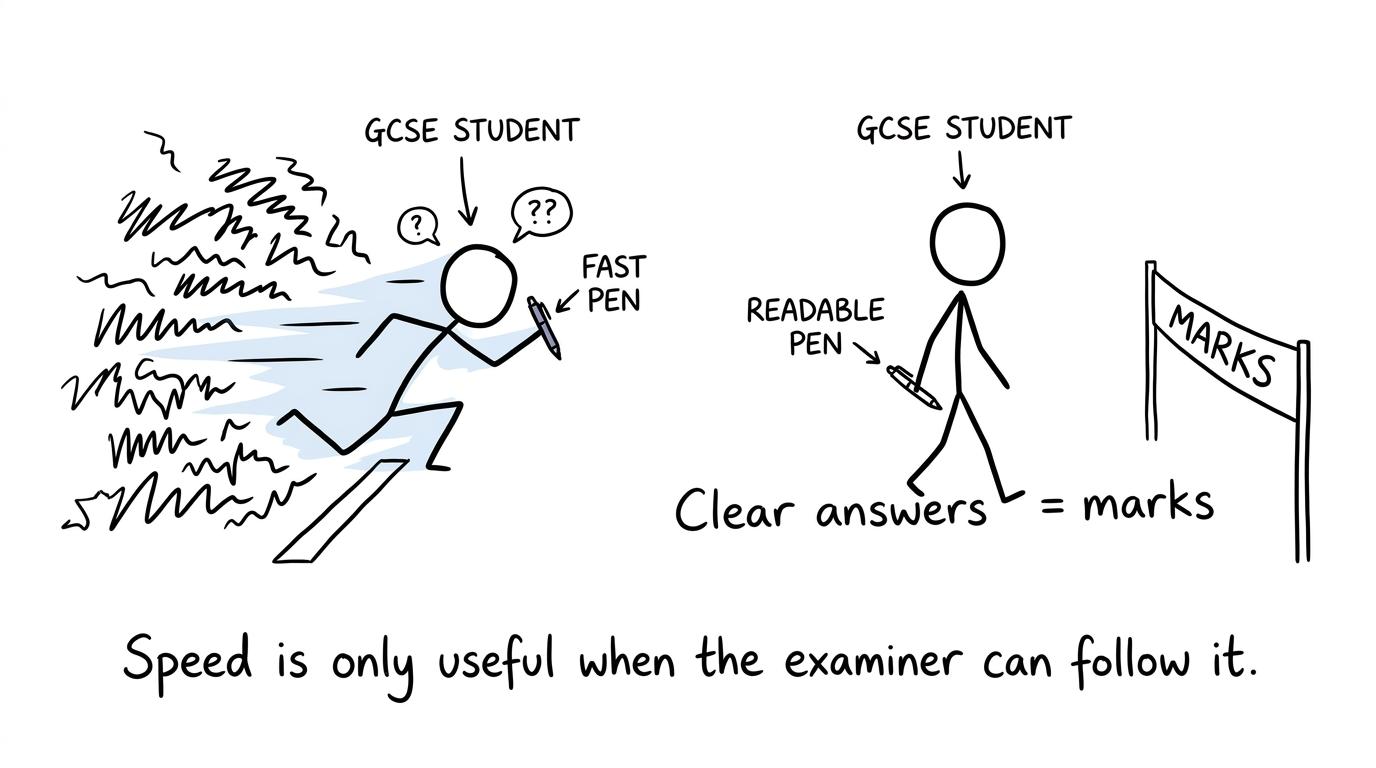 A fast pen races in the wrong direction while a clear pen walks towards marks
Can slow handwriting genuinely cost GCSE Chemistry marks?
GCSE Chemistry mark schemes from AQA, Pearson Edexcel, OCR and Eduqas reward correct scientific knowledge, application, calculations and evaluation. They do not normally contain a handwriting-speed criterion.
Official guidance nevertheless tells candidates to write clearly. OCR explains that its examiners are experienced in reading many kinds of handwriting and that difficult scripts may be passed to another examiner. That is reassuring, but it is not permission to make an answer indecipherable. Examiner reports also warn that illegible work cannot reliably receive credit.
The real risk is therefore indirect.
You may run out of time
If the final page contains unanswered questions, your knowledge never reaches the mark scheme. This is usually the most important consequence of slow writing.
Before practising speed, check whether handwriting is truly the bottleneck. Students often blame their pen when the time is actually disappearing elsewhere: rereading the question repeatedly, hesitating over recall, writing an unnecessary introduction or refusing to move on from one difficult calculation.
Your answer may become unclear
Writing faster than you can control may turn a correct idea into an ambiguous one. In chemistry, a small mark on the page can carry a large amount of meaning. The difference between a capital letter and a lower-case letter matters, as does the position of a charge or subscript.
For example, the 222 in H2OH_2OH2O must be visibly attached as a subscript. Likewise, CuCuCu is an element symbol in which the second letter is lower case. Charges such as 2+2+2+ must be placed clearly enough to show what they refer to.
You may write less than the question requires
A student worried about speed may reduce a developed explanation to a list of keywords. Keywords can help, but disconnected vocabulary does not automatically demonstrate a scientific chain of reasoning.
An explanation usually needs a cause and an effect. A comparison must refer to both things being compared. An evaluation needs relevant evidence and a supported judgement. The answer can still be concise, but it must perform the job requested by the command word.
Clear beats fast in chemistry notation
The best handwriting is not necessarily attractive. It is unambiguous.
Pay particular attention to:
- capital and lower-case letters in element symbols;
- subscripts in formulae;
- superscript charges on ions;
- minus signs and plus signs;
- decimal points in calculations;
- powers in standard form;
- units and state symbols where required;
- labels on practical diagrams and graphs.
A rushed 000 should not resemble a 666. A minus sign should not disappear into another line. If you use standard form, the exponent in an expression such as 3.2×10−43.2 \times 10^{-4}3.2×10⁻⁴ must be easy to identify.
These habits are valuable in maths too. MathsGenie’s standard form revision resources reinforce the same principle: notation is part of the answer, not decoration added afterwards.
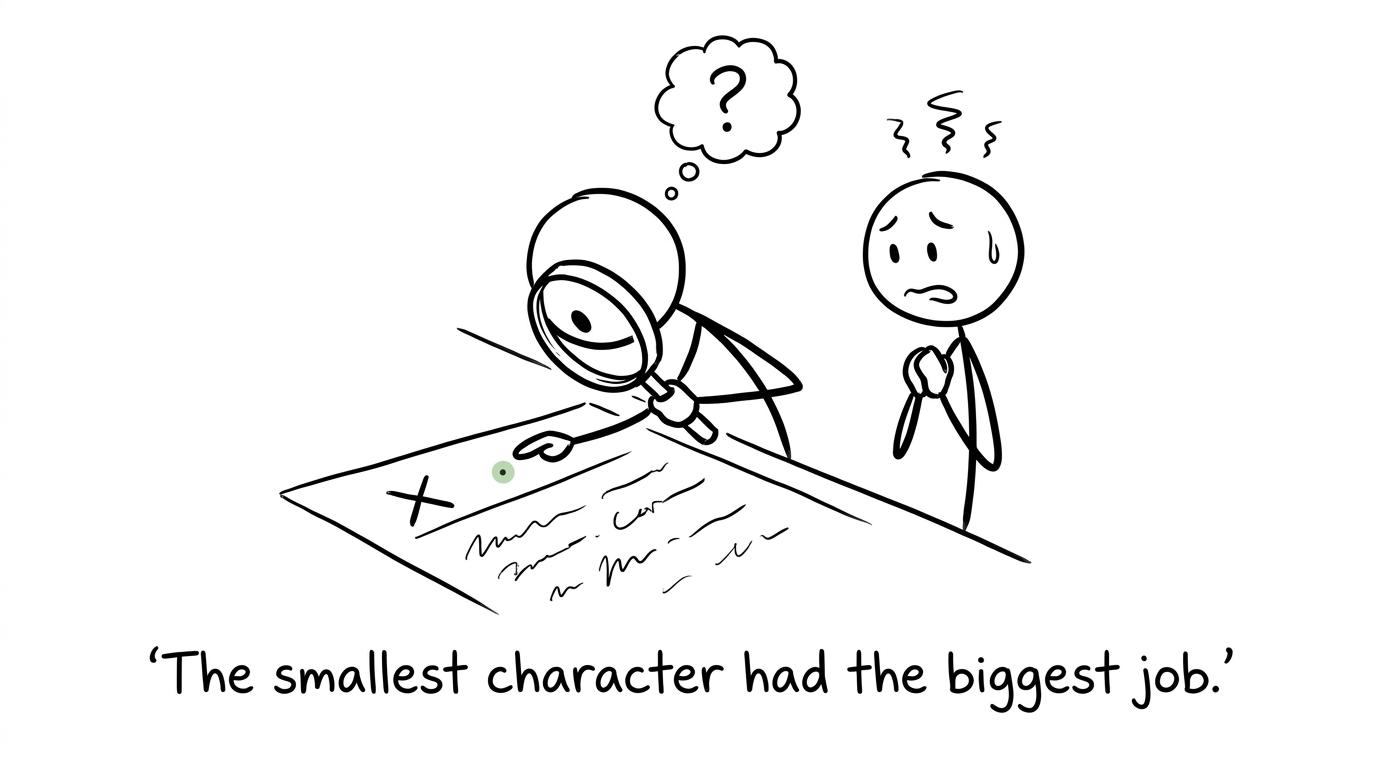 An examiner investigates whether a tiny mark is notation or a crumb
Write less by answering the command word
One of the safest ways to improve effective writing speed is to stop writing sentences that the question never requested.
AQA’s official chemistry command-word guidance distinguishes between instructions such as give, describe, explain, compare, justify and evaluate. The exact wording used can vary between specifications, so follow your exam board’s definitions and the question in front of you.
Give, name or state
These normally require a short factual response. If one fact is requested, an additional paragraph is unlikely to help. Worse, unnecessary material can introduce a contradiction.
Describe
State what happens, what is observed or what pattern the data shows. Do not spend half the answer explaining why unless that is also requested.
Explain
Make the reason clear. Build a short cause-and-effect chain using precise chemistry. A series of disconnected words may not show the relationship the examiner needs.
Compare
Refer explicitly to both substances, methods or sets of data. Writing at length about only one side is not a comparison.
Evaluate
Use the information provided, consider relevant advantages and disadvantages, and reach a supported conclusion where required. A long answer is not automatically a developed answer.
This is the quiet advantage of good exam technique: you become faster without forcing your hand to move unnaturally quickly.
A practical plan for improving handwriting pace
Handwriting speed improves most usefully when it is practised inside realistic questions, not through pages of meaningless copying.
Establish whether there is a genuine problem
Complete a chemistry paper or substantial section under the official conditions for your specification. Use the exact time printed on the paper. Afterwards, classify each unfinished answer:
- writing: you knew the answer but could not record it;
- recall: you were waiting for knowledge to arrive;
- decision: you could not choose what the question required;
- calculation: the numerical method took too long;
- perfectionism: you rewrote readable work unnecessarily.
Only the first category is purely handwriting speed. The distinction matters because each problem needs a different solution.
Maths students can use the same diagnostic habit with GCSE Maths past papers and revision resources. The clock becomes useful when it tells you why time was lost.
Practise short timed sections
Begin with manageable periods rather than repeatedly sitting full papers. Try a short set under timed conditions, mark it and inspect the final few minutes. Did your writing deteriorate? Did you begin adding fragments? Did you grip the pen more tightly?
Gradually increase the length. MathsGenie’s guide to when to start GCSE past papers explains how shorter timed sections can build towards full-paper practice without wasting valuable papers too early.
Plan extended answers briefly
For a longer response, spend a small amount of time identifying the required scientific points before writing. A few keywords in the margin or answer space can prevent repetition and reduce the temptation to restart.
Planning is not wasted time when it removes an entire unnecessary paragraph.
Use marks as a pacing signal
The number of marks gives an indication of the expected depth, although it is not always a perfect word-count guide. A rough pacing check is:
minutes per mark=available writing timetotal marks\text{minutes per mark} = \frac{\text{available writing time}}{\text{total marks}}minutes per mark=total marksavailable writing timeApply this flexibly. Calculations, data analysis and extended responses do not all consume time in the same way. The purpose is to notice when a modest question is absorbing a disproportionate share of the examination.
Train calculation fluency separately
Chemistry papers include ratios, graph interpretation, rearranging formulae, significant figures and standard form. Sometimes apparently slow writing is actually slow mathematical processing.
Use the free MathsGenie GCSE Maths revision hub to strengthen those foundations. Quicker recall of a method leaves more time for checking units, showing working and completing written explanations.
What to do during the examination
Read the instructions on the front of your paper and use the required writing equipment. Current JCQ guidance tells candidates to write clearly in black ink, while diagrams may be treated differently according to the paper instructions.
Then use a calm routine:
- scan the mark value and command word before writing;
- answer direct questions directly;
- leave space and move on if one question is consuming too much time;
- return later rather than sacrificing several accessible questions;
- cross out errors with a clear single line instead of scribbling over them;
- keep answers inside the designated spaces and use additional pages as instructed;
- reserve a final check for omitted questions, units and unclear notation.
A first pass through accessible material often protects more marks than trying to perfect the paper in order. The same strategy appears in MathsGenie’s GCSE maths night-before plan: bank what you can do, mark difficult questions and return calmly.
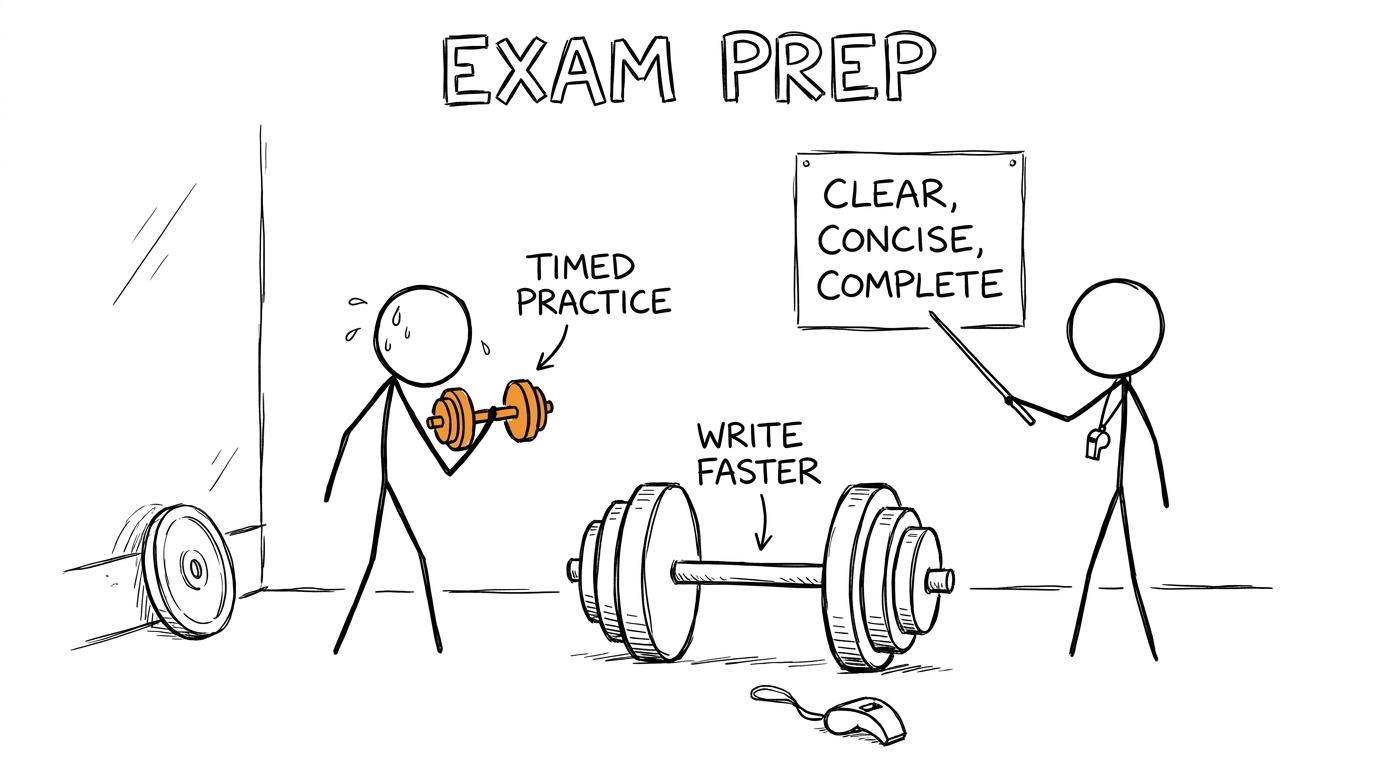 A student trains clarity and timed practice rather than trying to lift pure speed
When to ask about access arrangements
If slow or painful handwriting is linked to a disability, learning difficulty, medical condition or persistent processing difficulty, do not wait until the examination morning.
Speak to your SENCo, exams officer or teacher as early as possible. JCQ rules govern arrangements such as extra time, scribes and word processors. They are not awarded simply because someone would prefer more time. The school must consider evidence of need, the published criteria and the student’s normal way of working.
Under current JCQ guidance, a measure of writing speed may form part of the evidence considered for some extra-time applications. A word processor may be permitted when it reflects the candidate’s normal way of working, with examination functions restricted appropriately. The precise arrangement depends on individual need and current rules, so your school must make that decision.
If your hand becomes painful, unusually tired or difficult to control, tell a trusted adult. Practising harder is not a substitute for appropriate support.
Common mistakes when trying to write faster
Sacrificing legibility for raw speed
An extra sentence has no value if its symbols and key words cannot be read. Keep letters large enough, leave visible spaces and slow down briefly for formulae, charges and numerical answers.
Rewriting answers that were already readable
Perfectionism is expensive under timed conditions. Correct a genuine ambiguity, but do not rewrite a full paragraph because one letter looks untidy.
Giving every question an extended response
Match the response to the command word and mark value. Precision usually saves more time than frantic handwriting.
Practising only without a clock
Untimed revision builds knowledge but does not reveal pacing. Combine topic learning with short timed tests and eventually full papers. The process described in MathsGenie’s guide to efficient GCSE revision is useful across subjects: learn, practise, mark, fix and retest.
Treating predicted papers as a replacement for past papers
Predicted material can provide fresh timed practice, but official past papers remain essential for learning your specification’s style. Use GCSE predicted papers alongside, not instead of, past-paper practice.
Your next step
Handwriting speed matters only when it blocks communication or completion. That is good news. You do not need the fastest hand in the examination hall; you need readable notation, answers shaped by command words and enough timed practice to know when to move on.
Start with one timed section. Diagnose whether you lost time through writing, recall, decisions or calculations. Then fix the actual bottleneck.
For the mathematical parts of chemistry, make MathsGenie your free revision base. Use revision lessons and practice questions to strengthen calculations, mini tests to develop fluency, and MathsGenie’s structured self-study approach to build a repeatable routine. Finish with past papers, predicted papers, mark schemes and video solutions.
The aim is not to make your pen race. It is to make every readable line earn its chance of a mark.