

GCSE Chemistry Grade Boundaries Explained
GCSE chemistry grade boundaries explained for 2026 results day: learn how marks become grades, why boundaries move and what to do if you are close.
Results-day uncertainty often settles on one question: “How many marks did I need?” The short answer is that GCSE chemistry grade boundaries convert your total mark into a grade, but they are not fixed before the examination series. Exam boards set them after papers have been marked, accounting for how demanding that year’s assessments proved to be.
For students receiving results in England, GCSE chemistry results day is Thursday 20 August 2026. The official chemistry grade boundaries 2026 will only be confirmed around results day, so figures published earlier should be treated as estimates rather than facts.
Here is what matters:
- A boundary is the minimum mark required for a grade.
- Your marks are normally combined across the whole qualification.
- Boundaries differ by exam board, specification, tier and exam series.
- A harder paper can lead to lower boundaries; an easier paper can lead to higher ones.
- There is no fixed percentage that always guarantees a particular grade.
- There are no quotas limiting how many students can receive each grade.
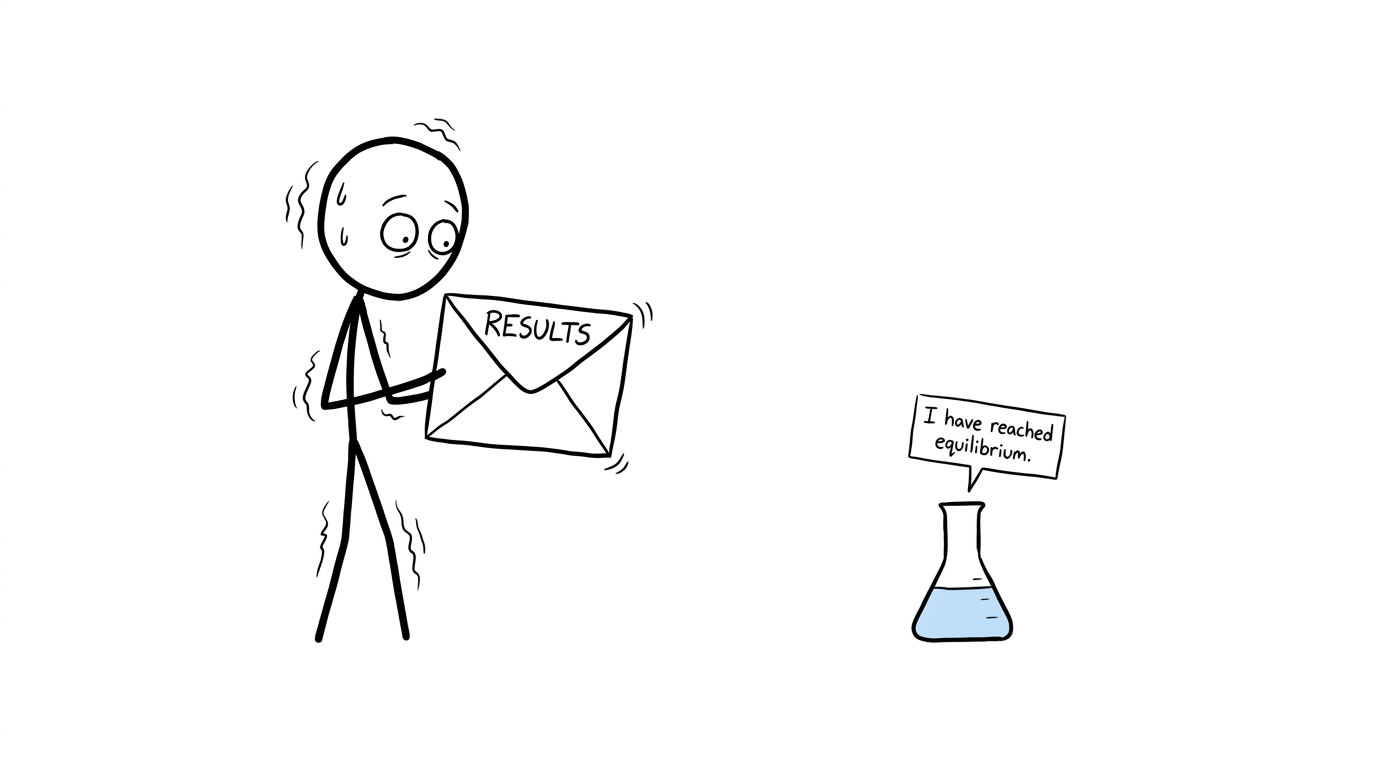 A nervous GCSE student finds that the chemistry beaker is calmer about results day
How GCSE chemistry grade boundaries work
A grade boundary is the lowest total mark that receives a particular grade. If the grade 777 boundary is 115115115 marks, for example, a total of 115115115 receives grade 777. A total of 114114114 falls into the grade below, unless another adjustment applies.
Boundaries are set after marking is nearly complete. Exam boards examine statistical evidence and senior examiners review work around proposed boundaries. The purpose is to maintain a comparable standard between years, even when two sets of papers are not exactly equal in difficulty.
This is why trying to predict an exact boundary from online reactions is unreliable. A paper can feel difficult to you while being manageable across the full national cohort. Equally, a question that caused widespread difficulty may affect how demanding the paper is judged overall.
You can check previous years through MathsGenie’s GCSE grade boundaries hub, but historical figures are context, not a promise about 2026.
Separate Chemistry or Combined Science?
Before reading any boundary document, identify your qualification.
Separate Chemistry, sometimes called triple science, produces its own GCSE Chemistry grade. Combined Science combines performance across Biology, Chemistry and Physics and awards a double grade, such as 777-666. Its Chemistry papers do not produce a standalone Chemistry grade.
You must also select the correct:
- exam board, such as AQA, Pearson Edexcel, OCR or Eduqas;
- specification code;
- foundation or higher tier, where applicable;
- qualification, rather than an individual component.
AQA Chemistry 846284628462 and Edexcel Chemistry 1CH01CH01CH0, for example, are not interchangeable. OCR also offers different routes, including Chemistry A and Chemistry B. MathsGenie organises GCSE Chemistry revision resources by exam board, making it easier to locate the specification you actually studied.
Why chemistry boundaries change
Examination papers are designed to comparable standards, but they cannot be identical each year. One series may contain unusually accessible calculation questions. Another may have more demanding practical analysis or unfamiliar applications.
Boundaries can move to reflect that variation. If a paper is harder, fewer raw marks may be required to demonstrate the same grade standard. If it is easier, more marks may be required.
That does not mean the exam board decides that only a certain number of students may pass. Ofqual confirms that there are no grade quotas or caps. Your grade depends on the quality of your assessed work against the standard for that qualification.
Historical differences also show why percentages cannot be transferred between boards. In summer 2025, the separate Chemistry higher-tier grade 777 boundary was 115115115 out of 200200200 for AQA, while Edexcel’s was 128128128 out of 200200200. These were official figures for that series only, not predictions for 2026.
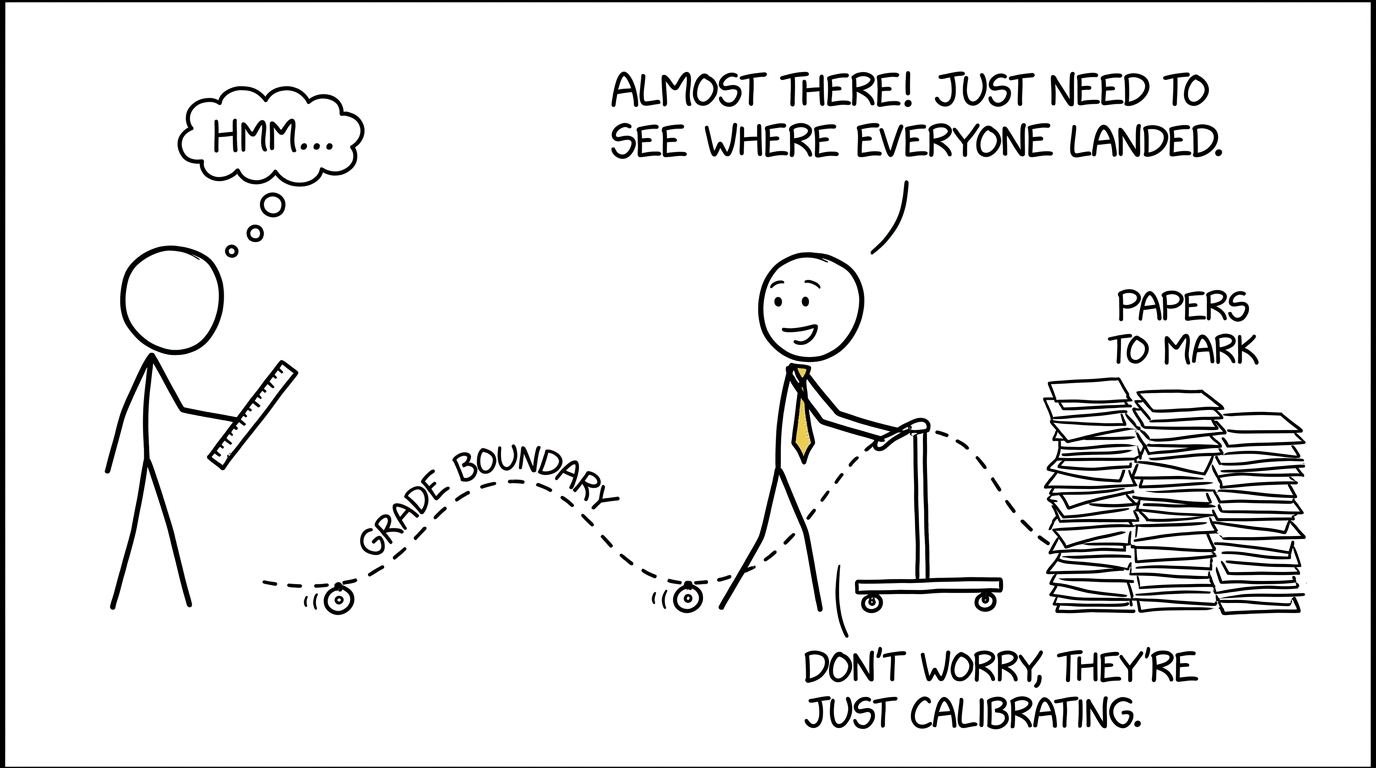 A student tries to chase a boundary before examiners have finished marking
Worked boundary example
Suppose a hypothetical higher-tier Chemistry qualification has two papers worth 100100100 marks each. Its published overall boundaries are:
- grade 999: 150150150 marks;
- grade 888: 132132132 marks;
- grade 777: 115115115 marks;
- grade 666: 909090 marks.
A student receives 646464 marks on Paper 1 and 676767 on Paper 2. Their qualification total is:
64+67=13164+67=13164+67=131Because 131131131 is at least 115115115 but below 132132132, the student receives grade 777. They are one mark below the grade 888 boundary.
Their percentage was:
131200×100=65.5%\frac{131}{200}\times 100=65.5\%200131×100=65.5%The percentage does not determine the grade by itself. The published boundary table does. This example is illustrative and is not a forecast of the 2026 boundaries.
Reading your Chemistry result correctly
Your results slip usually shows the final qualification grade. Your school may also provide marks or additional information through its results system.
If your total appears close to the next boundary, speak to your school’s examinations officer or Chemistry department. They can explain the available post-results services and whether reviewing marked work would be appropriate. A review is not an automatic extra mark, and marks can sometimes remain unchanged or move in either direction.
Avoid comparing your mark with a friend who took another board, tier or qualification. Compare it only with the official boundary for your exact entry.
Common mistakes on Chemistry results day
Trusting predicted boundaries as official
Predictions can help discussion, but nobody can confirm the final 2026 figures before the boards complete awarding. Use the official publication for your exam series.
Looking at individual-paper boundaries
Your final grade is normally based on the overall qualification mark. Component boundaries may be described as notional, meaning they show an indicative standard but do not award separate paper grades.
Assuming every percentage has a fixed grade
There is no universal rule that a particular percentage always equals grade 777 or grade 999. Boundaries change between boards and years.
Checking the wrong science qualification
Separate Chemistry boundaries cannot be used for Combined Science. Confirm your specification and tier before interpreting any marks.
Treating one mark as a judgement of ability
A boundary has to be placed somewhere. Being one mark below it describes the result of this assessment series; it does not summarise everything you understand about Chemistry.
Your next step with MathsGenie
Results day closes one chapter, but it can also make the next decision clearer. If you are continuing with science, revisit the areas that cost marks rather than broadly rereading everything.
Start with MathsGenie’s AQA GCSE Chemistry revision guides, Edexcel GCSE Chemistry revision hub or OCR Twenty First Century Chemistry resources. For quantitative weaknesses, use the guides to calculations involving masses and calculating rates of reaction.
MathsGenie brings revision lessons, practice questions, past papers, predicted papers, mini tests, mark schemes and video solutions into one free revision system. Check the correct boundary calmly, ask your school for help when necessary, and let the result guide your next useful step.











