2.6.1 Relative formula mass and percentage composition
Relative formula mass adds up every atom the formula shows
Relative formula mass
The sum of the relative atomic masses of all the atoms shown in the formula of a substance, given the symbol Mr.
Relative atomic mass
The weighted mean mass of an element's atoms, taking the abundance of each isotope into account, compared with one-twelfth of the mass of a carbon-12 atom.
- Read the formula and note how many atoms of each element it contains.
- Multiply each element's ArA_rAr by the number of its atoms, then add the results together.
- A symbol with no subscript stands for one atom.
- A number outside a bracket multiplies every atom inside that bracket.
- MrM_rMr carries no unit, because it compares one mass with another.
- Take the ArA_rAr values from the periodic table, decimals included, such as 35.535.535.5 for chlorine.
- H2O\text{H}_2\text{O}H2O: Mr=(2×1)+16=18M_r = (2 \times 1) + 16 = 18Mr=(2×1)+16=18.
- CaCO3\text{CaCO}_3CaCO3: Mr=40+12+(3×16)=100M_r = 40 + 12 + (3 \times 16) = 100Mr=40+12+(3×16)=100.
- Ca(OH)2\text{Ca(OH)}_2Ca(OH)2: Mr=40+2×(16+1)=74M_r = 40 + 2 \times (16 + 1) = 74Mr=40+2×(16+1)=74.
Percentage by mass compares one element with the whole compound
- The percentage by mass of an element is the share of a compound's total mass that the element contributes.
- Find the total ArA_rAr of that element in the formula, which is its ArA_rAr multiplied by its number of atoms.
- Divide that by the MrM_rMr of the whole compound, then multiply by 100100100: percentage by mass=total Ar of the elementMr of the compound×100\text{percentage by mass} = \frac{\text{total } A_r \text{ of the element}}{M_r \text{ of the compound}} \times 100percentage by mass=Mr of the compoundtotal Ar of the element×100
- Repeating the calculation for another element changes only the numerator.
- The percentages of every element in a compound add to 100100100, apart from small rounding differences.
- The denominator is the whole compound's MrM_rMr, never the ArA_rAr of the named element.
- Every atom counts, so the 333 in CO3\text{CO}_3CO3 multiplies oxygen's ArA_rAr before anything else happens.
A worked percentage: oxygen in calcium carbonate
- The formula is CaCO3\text{CaCO}_3CaCO3, with ArA_rAr values of 404040 for calcium, 121212 for carbon and 161616 for oxygen.
- First find the relative formula mass of the compound: Mr=40+12+(3×16)=100M_r = 40 + 12 + (3 \times 16) = 100Mr=40+12+(3×16)=100
- Then find the total contribution of oxygen in the formula: 3×16=483 \times 16 = 483×16=48
- Divide by the MrM_rMr and multiply by 100100100 to reach the percentage: 48100×100=48%\frac{48}{100} \times 100 = 48\%10048×100=48%
- Oxygen makes up 48%48\%48% of the mass of calcium carbonate.
- A percentage lands between 000 and 100100100, and one above 100100100 means the denominator is wrong.
- Rounding happens once, at the end, so extra figures are carried through the working.
Where these calculations usually go wrong
- Using the atomic number instead of the relative atomic mass changes every figure in the answer.
- Ignoring a bracket subscript undercounts the atoms inside it.
- Leaving a unit on MrM_rMr is wrong, and so is leaving the %\%% sign off a percentage.
- Checking that the formula matches the compound named catches an error before the arithmetic starts.
- Adding the percentages of all the elements gives a final check close to 100100100.
- What does the relative formula mass of a compound count?
- What is the MrM_rMr of Ca(OH)2\text{Ca(OH)}_2Ca(OH)2?
- Which value goes on the bottom of a percentage by mass calculation?
- Why does MrM_rMr carry no unit?
- What is the percentage by mass of oxygen in H2O\text{H}_2\text{O}H2O?
2.6.2 Empirical and molecular formulae
An empirical formula gives a ratio, a molecular formula gives a count
Empirical formula
The formula showing the simplest whole-number ratio of the atoms of each element in a compound.
Molecular formula
The formula showing the actual number of atoms of each element in one molecule of a substance.
- The two formulae describe the same compound in different ways.
- Glucose has the molecular formula C6H12O6\text{C}_6\text{H}_{12}\text{O}_6C6H12O6 and the empirical formula CH2O\text{CH}_2\text{O}CH2O.
- Dividing every subscript by their highest common factor turns a molecular formula into an empirical one.
- Ionic compounds are always written as empirical formulae, because a lattice contains no molecules.
- Some molecular formulae are already in their simplest ratio, such as H2O\text{H}_2\text{O}H2O.
- An empirical formula is a ratio, so several different compounds can share one.
- A molecular formula counts actual atoms, so it identifies a single substance.
From reacting masses to an empirical formula
- Write down the mass of each element present in the sample.
- Divide each mass by that element's relative atomic mass: ratio number=massAr\text{ratio number} = \frac{\text{mass}}{A_r}ratio number=Armass
- Divide every ratio number by the smallest of them.
- Turn the results into whole numbers, multiplying them all by the same factor if one comes out as 1.51.51.5 or 1.331.331.33.
- Use those whole numbers as the subscripts.
- 2.40 g2.40\ \text{g}2.40 g of magnesium gives 2.40÷24=0.1002.40 \div 24 = 0.1002.40÷24=0.100, and 1.60 g1.60\ \text{g}1.60 g of oxygen gives 1.60÷16=0.1001.60 \div 16 = 0.1001.60÷16=0.100.
- Dividing both by 0.1000.1000.100 gives 111 and 111, so the empirical formula is MgO\text{MgO}MgO.
From percentage composition to an empirical formula
- Treat the percentages as masses in a 100 g100\ \text{g}100 g sample, so 40.0%40.0\%40.0% carbon becomes 40.0 g40.0\ \text{g}40.0 g of carbon.
- That works because only the ratio between the masses matters.
- The rest of the method is identical: divide by ArA_rAr, divide by the smallest, then simplify.
- For 40.0%40.0\%40.0% carbon, 6.7%6.7\%6.7% hydrogen and 53.3%53.3\%53.3% oxygen the ratio numbers are 3.333.333.33, 6.76.76.7 and 3.333.333.33.
- Dividing by 3.333.333.33 gives 111, 222 and 111, so the empirical formula is CH2O\text{CH}_2\text{O}CH2O.
- Percentages are never used as subscripts, because a subscript counts atoms while a percentage measures mass.
- A result of 1.331.331.33 or 1.51.51.5 is not rounded, because multiplying the whole ratio by 333 or by 222 gives the right answer.
From an empirical formula to a molecular formula
Relative formula mass
The sum of the relative atomic masses of all the atoms shown in the formula of a substance, given the symbol Mr.
- Add the ArA_rAr values in the empirical formula to get its empirical formula mass.
- Divide the compound's MrM_rMr by that empirical formula mass.
- The answer is a whole number, because a molecule contains whole atoms.
- Multiply every subscript in the empirical formula by that number.
- For glucose, CH2O\text{CH}_2\text{O}CH2O has an empirical formula mass of 12+2+16=3012 + 2 + 16 = 3012+2+16=30.
- With Mr=180M_r = 180Mr=180, the multiplier is 180÷30=6180 \div 30 = 6180÷30=6.
- Multiplying every subscript by 666 gives C6H12O6\text{C}_6\text{H}_{12}\text{O}_6C6H12O6.
- The multiplier is a whole number, so anything else means the empirical formula or the MrM_rMr has gone wrong.
- The empirical formula mass is added up from the empirical formula, never from the molecular one.
Finding the formula of magnesium oxide by experiment
- Wear eye protection throughout, and move the hot crucible only with tongs.
- Clean a length of magnesium ribbon with emery paper, which removes the oxide layer already on it.
- Weigh an empty crucible with its lid, then weigh it again with the magnesium inside.
- Heat strongly, lifting the lid a little at intervals so that air reaches the magnesium while the solid oxide stays inside.
- Let the crucible cool, then weigh it again.
- Reheat, cool and reweigh until the mass stops changing, which shows the reaction has reached constant mass.
- The mass of magnesium is the second weighing minus the first.
- The mass of oxygen is the final weighing minus the second, because that increase is the oxygen taken in.
- With weighings of 20.00 g20.00\ \text{g}20.00 g, 20.24 g20.24\ \text{g}20.24 g and 20.40 g20.40\ \text{g}20.40 g, the masses are 0.24 g0.24\ \text{g}0.24 g of magnesium and 0.16 g0.16\ \text{g}0.16 g of oxygen.
- Dividing by 242424 and by 161616 gives 0.0100.0100.010 and 0.0100.0100.010, a 1:11:11:1 ratio, so the formula is MgO\text{MgO}MgO.
- What does an empirical formula tell you that a molecular formula does not?
- How is the mass of each element turned into a ratio?
- Why can a set of percentages be treated as masses in a 100 g100\ \text{g}100 g sample?
- How is the multiplier between an empirical and a molecular formula found?
- Why is the crucible heated, cooled and reweighed more than once?
2.6.3 Conservation of mass
Atoms are rearranged, so the total mass cannot change
Conservation of mass
The principle that the total mass of the products of a reaction equals the total mass of the reactants, because no atoms are created or destroyed.
- A reaction rearranges the atoms that are present, and it neither creates nor destroys any of them.
- Every atom in the reactants ends up somewhere among the products.
- The total mass of the products therefore equals the total mass of the reactants.
- The mass of any one substance does change, because substances are used up and formed.
- A balanced equation is that same statement written in symbols.
- Mass is conserved whenever every substance stays inside the container.
- A change in the balance reading means something has crossed the boundary, and it is almost always a gas.
A closed system: a precipitate is a change of form, not of mass
Precipitate
An insoluble solid that forms when two solutions are mixed.
- A closed system is sealed, so nothing can enter it or leave it.
- Mixing two solutions in a stoppered flask keeps every product inside.
- In a precipitation reaction, two solutions produce an insoluble solid.
- Lead nitrate solution and potassium iodide solution give a yellow solid: Pb(NO3)2(aq)+2KI(aq)→PbI2(s)+2KNO3(aq)\text{Pb(NO}_3)_2(aq) + 2\text{KI}(aq) \rightarrow \text{PbI}_2(s) + 2\text{KNO}_3(aq)Pb(NO3)2(aq)+2KI(aq)→PbI2(s)+2KNO3(aq)
- The flask looks cloudy afterwards, but the balance reads exactly the same.
- The atoms now in the solid were already present in the two solutions.
- Before: two clear solutions with a combined mass of 50.0 g50.0\ \text{g}50.0 g.
- After: a yellow precipitate suspended in solution, with a mass of 50.0 g50.0\ \text{g}50.0 g.
A reaction that takes in a gas gains measured mass
- A non-enclosed system lets matter cross its boundary, so a gas can enter or escape.
- Magnesium burning in an open crucible takes in oxygen from the air: 2Mg(s)+O2(g)→2MgO(s)2\text{Mg}(s) + \text{O}_2(g) \rightarrow 2\text{MgO}(s)2Mg(s)+O2(g)→2MgO(s)
- Those oxygen atoms join the magnesium and stay in the product.
- The magnesium oxide left behind therefore weighs more than the magnesium did.
- Nothing has been created, because the extra mass came out of the air.
- The extra mass comes from the air, so an answer that does not mention oxygen is unfinished.
- A sealed container changes the observation, because the oxygen supply inside it runs out.
A reaction that gives off a gas loses measured mass
- Calcium carbonate reacts with hydrochloric acid and releases carbon dioxide: CaCO3(s)+2HCl(aq)→CaCl2(aq)+H2O(l)+CO2(g)\text{CaCO}_3(s) + 2\text{HCl}(aq) \rightarrow \text{CaCl}_2(aq) + \text{H}_2\text{O}(l) + \text{CO}_2(g)CaCO3(s)+2HCl(aq)→CaCl2(aq)+H2O(l)+CO2(g)
- The gas escapes from the open flask into the room.
- The balance reading falls while the reaction runs, and steadies once it finishes.
- The carbon dioxide still has mass, so nothing has been destroyed.
- Running the same reaction in a sealed flask would show no change in mass at all.
- Naming the gas is the answer, because saying mass was lost or gained does not say where it went.
- Mass is still conserved, once the gas out in the surroundings is counted in.
Explaining a mass change
- Decide first whether the system is closed or non-enclosed.
- For a closed system, state that nothing enters or leaves, so the total mass is unchanged.
- For a non-enclosed system, name the gas and say whether it entered or escaped.
- Link that gas to the direction in which the balance reading moved.
- Finish by stating that mass is still conserved once the surroundings are included.
- What does the law of conservation of mass state?
- Why does a precipitation reaction in a sealed flask show no change in mass?
- Why does magnesium oxide weigh more than the magnesium it was made from?
- Why does the flask get lighter when calcium carbonate reacts with hydrochloric acid?
- Why is mass still conserved in both of those open-flask reactions?
2.6.4 Reacting masses and concentration in g dm⁻³
A balanced equation fixes the ratio in which substances react
Relative formula mass
The sum of the relative atomic masses of all the atoms shown in the formula of a substance, given the symbol Mr.
- The numbers written in front of the formulae are the coefficients, and they give the ratio in which the substances react.
- The subscripts inside a formula count atoms, and are never used as the reacting ratio.
- Turning that ratio into masses takes the relative formula mass of each substance.
- Multiply each coefficient by that substance's MrM_rMr to get the mass ratio the equation predicts.
- For CaCO3→CaO+CO2\text{CaCO}_3 \rightarrow \text{CaO} + \text{CO}_2CaCO3→CaO+CO2 the mass ratio is 100:56:44100 : 56 : 44100:56:44.
- Those figures balance, because 56+44=10056 + 44 = 10056+44=100 and mass is conserved.
- Coefficients give a ratio of amounts, which becomes a ratio of masses once each MrM_rMr is applied.
- The mass ratio scales, so doubling one mass doubles every other mass in the equation.
Scaling the mass ratio to the masses in the question
- Write the balanced equation, and write the mass ratio underneath it.
- Find the scale factor by dividing the mass given in the question by the ratio mass for that same substance.
- Multiply every other mass in the ratio by that scale factor.
- For 25.0 g25.0\ \text{g}25.0 g of CaCO3\text{CaCO}_3CaCO3 against a ratio mass of 100100100: scale factor=25.0100=0.250\text{scale factor} = \frac{25.0}{100} = 0.250scale factor=10025.0=0.250
- The mass of CaO\text{CaO}CaO is then the ratio mass of 565656 scaled by the same factor: m(CaO)=0.250×56=14.0 gm(\text{CaO}) = 0.250 \times 56 = 14.0\ \text{g}m(CaO)=0.250×56=14.0 g
- The answer is smaller than the starting mass because carbon dioxide is given off as well.
- One scale factor runs the whole calculation, because it is the same for every substance in the equation.
- The total mass of the products cannot exceed the total mass of the reactants, though a single product may well outweigh the one reactant named in the question.
Concentration in grams per cubic decimetre
Concentration
The mass or amount of a solute dissolved in a given volume of solution.
- A solution's concentration compares the mass of solute with the volume of solution it is dissolved in.
- The calculation is: c=mVc = \frac{m}{V}c=Vm
- Here ccc is in g dm−3\text{g dm}^{-3}g dm−3, mmm is in g\text{g}g and VVV is in dm3\text{dm}^3dm3.
- Volumes are usually measured in cm3\text{cm}^3cm3, and 1 dm3=1000 cm31\ \text{dm}^3 = 1000\ \text{cm}^31 dm3=1000 cm3.
- So 250 cm3250\ \text{cm}^3250 cm3 becomes 250÷1000=0.250 dm3250 \div 1000 = 0.250\ \text{dm}^3250÷1000=0.250 dm3.
- Dissolving 5.0 g5.0\ \text{g}5.0 g of sodium chloride to make that volume of solution gives: c=5.00.250=20.0 g dm−3c = \frac{5.0}{0.250} = 20.0\ \text{g dm}^{-3}c=0.2505.0=20.0 g dm−3
- Convert the volume first, because dividing by a volume in cm3\text{cm}^3cm3 gives a number a thousand times too small.
- The volume is that of the finished solution, not the volume of water that was added.
Checking a mass or a concentration
- Check the equation is balanced before taking any ratio from it.
- Check every mass is in grams and every volume is in dm3\text{dm}^3dm3.
- Check the total mass of the products does not exceed the total mass of the reactants.
- Keep extra figures through the working and round once, at the end.
- Check the unit on the final answer: g\text{g}g for a mass and g dm−3\text{g dm}^{-3}g dm−3 for a concentration.
- What do the coefficients in a balanced equation tell you?
- How is a balanced equation turned into a ratio of masses?
- What mass of calcium oxide forms when 25.0 g25.0\ \text{g}25.0 g of calcium carbonate decomposes?
- How many cubic decimetres is 250 cm3250\ \text{cm}^3250 cm3?
- What is the concentration when 5.0 g5.0\ \text{g}5.0 g of solute makes 250 cm3250\ \text{cm}^3250 cm3 of solution?
2.6.5 The mole and the Avogadro constant
One mole is both a count of particles and a mass
Mole
The amount of a substance that contains the Avogadro constant of particles, and which has a mass in grams equal to its relative particle mass.
Avogadro constant
The number of particles in one mole of a substance, 6.02 x 10^23 per mole.
- Counting atoms one at a time is impossible, so chemists count them in moles instead.
- One mole of any substance contains 6.02×10236.02 \times 10^{23}6.02×10²³ particles.
- The particles are whichever the formula represents: atoms for an element such as aluminium, molecules for O2\text{O}_2O2, formula units for NaCl\text{NaCl}NaCl, or ions when the question names an ion.
- One mole of a substance has a mass in grams equal to its relative particle mass.
- The relative particle mass is the ArA_rAr for an element made of single atoms, and the MrM_rMr for a compound.
- One mole of water therefore has a mass of 18 g18\ \text{g}18 g, and one mole of aluminium a mass of 27 g27\ \text{g}27 g.
- The particle count is always the same, whatever the substance is.
- The mass of one mole changes with the substance, because each has its own relative particle mass.
Converting between mass and amount
- Divide a mass by the relative particle mass to get the amount: n=mMrn = \frac{m}{M_r}n=Mrm
- Multiply an amount by the relative particle mass to get the mass: m=n×Mrm = n \times M_rm=n×Mr
- The mass is in g\text{g}g, the amount in mol\text{mol}mol, and the relative particle mass carries no unit.
- So 36 g36\ \text{g}36 g of water is 36÷18=2.0 mol36 \div 18 = 2.0\ \text{mol}36÷18=2.0 mol.
- And 0.25 mol0.25\ \text{mol}0.25 mol of carbon dioxide has a mass of 0.25×44=11 g0.25 \times 44 = 11\ \text{g}0.25×44=11 g.
- Mass to amount: 36 g36\ \text{g}36 g of H2O\text{H}_2\text{O}H2O divided by 181818 gives 2.0 mol2.0\ \text{mol}2.0 mol.
- Amount to mass: 0.25 mol0.25\ \text{mol}0.25 mol of CO2\text{CO}_2CO2 multiplied by 444444 gives 11 g11\ \text{g}11 g.
Converting between amount and number of particles
- Multiply an amount by the Avogadro constant to get the number of particles: N=n×6.02×10²³N = n \times 6.02 \times 10^{23}N=n×6.02×10²³
- Divide a number of particles by the Avogadro constant to get the amount: n=N6.02×1023n = \frac{N}{6.02 \times 10^{23}}n=6.02×10²³N
- So 0.50 mol0.50\ \text{mol}0.50 mol of oxygen contains 0.50×6.02×1023=3.01×10230.50 \times 6.02 \times 10^{23} = 3.01 \times 10^{23}0.50×6.02×1023=3.01×10²³ molecules.
- And 1.204×10241.204 \times 10^{24}1.204×1024 chloride ions is 1.204×1024÷(6.02×10²³)=2.00 mol1.204 \times 10^{24} \div (6.02 \times 10^{23}) = 2.00\ \text{mol}1.204×1024÷(6.02×10²³)=2.00 mol.
- A number of particles carries no unit, although the particle itself has to be named.
- Dividing a mass by MrM_rMr gives an amount, not a number of particles, so the Avogadro constant is still to come.
- Not every particle is a molecule, so an ionic compound is counted in formula units and an element such as aluminium in atoms.
Going from mass straight to particles
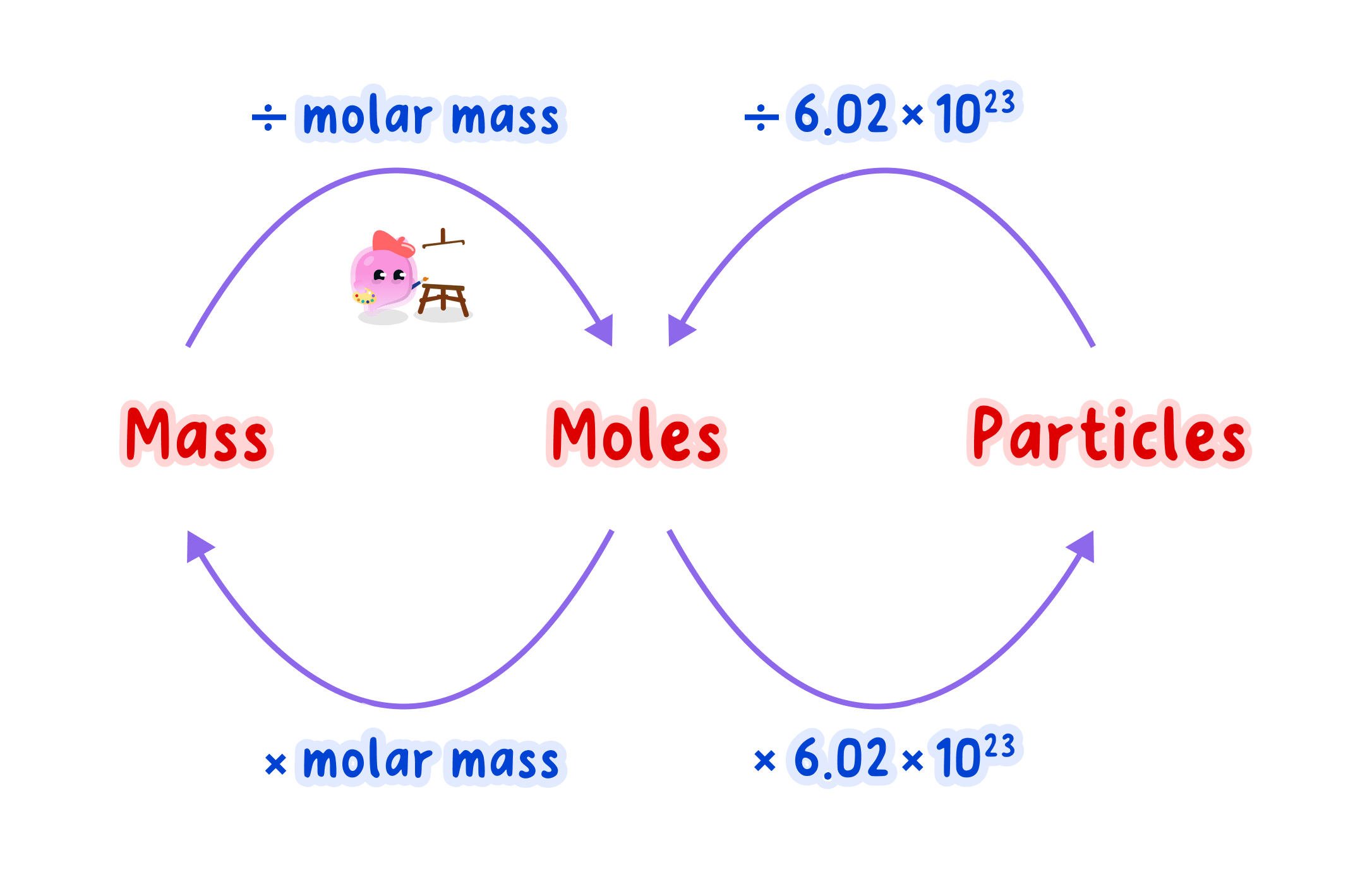
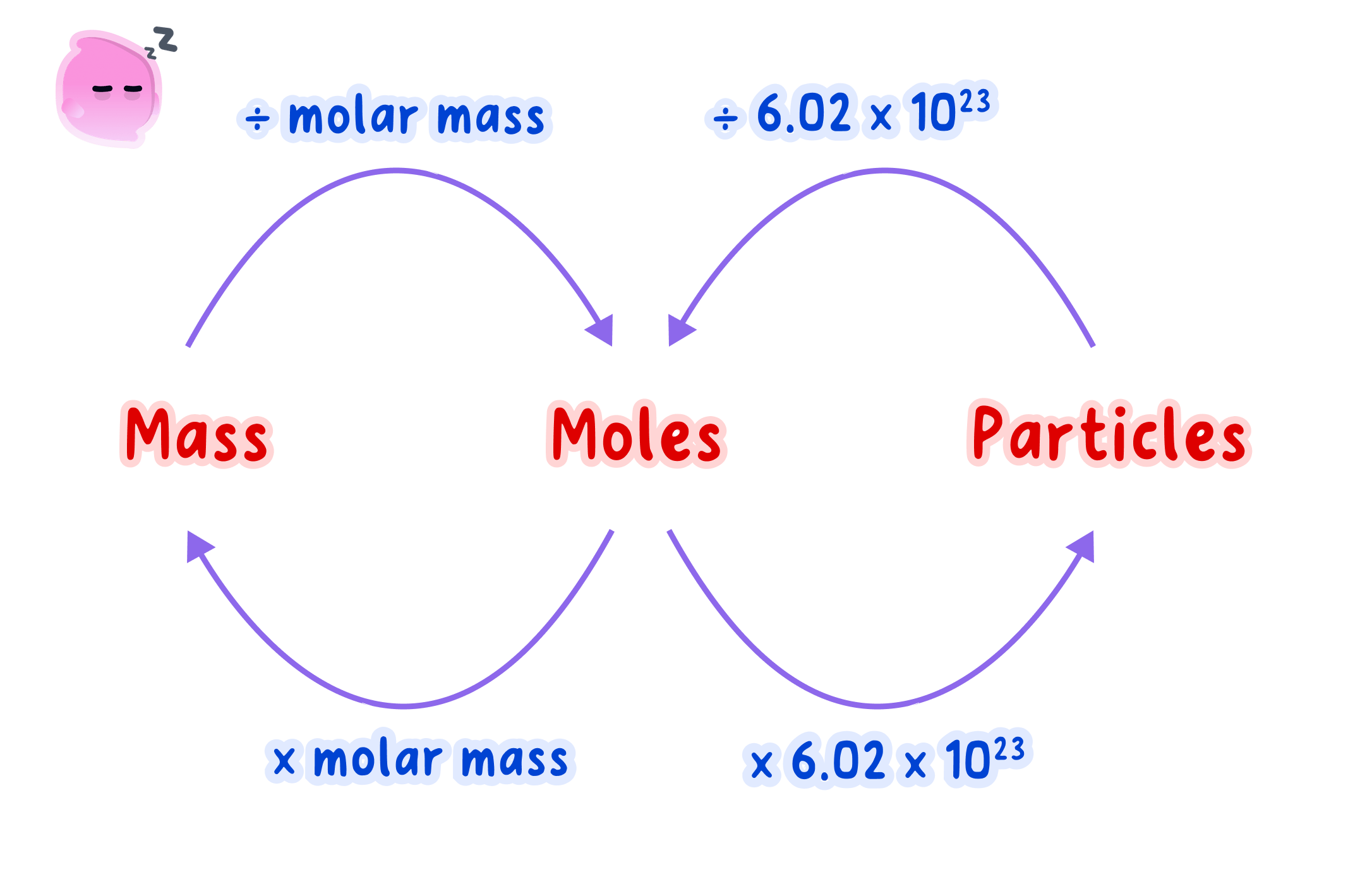
- Mass and particle number are linked through the amount in moles.
- From a mass, divide by the relative particle mass and then multiply by the Avogadro constant: N=mMr×6.02×10²³N = \frac{m}{M_r} \times 6.02 \times 10^{23}N=Mrm×6.02×10²³
- From a number of particles, divide by the Avogadro constant and then multiply by the relative particle mass: m=N6.02×1023×Mrm = \frac{N}{6.02 \times 10^{23}} \times M_rm=6.02×10²³N×Mr
- For 9.0 g9.0\ \text{g}9.0 g of aluminium, with Ar=27A_r = 27Ar=27, the amount is 0.3333 mol0.3333\ \text{mol}0.3333 mol and the count is 2.0×10232.0 \times 10^{23}2.0×10²³ atoms.
- For 3.01×10233.01 \times 10^{23}3.01×10²³ molecules of CO2\text{CO}_2CO2, the amount is 0.500 mol0.500\ \text{mol}0.500 mol and the mass is 0.500×44=22 g0.500 \times 44 = 22\ \text{g}0.500×44=22 g.
- Extra figures survive the middle step, because rounding the amount early shifts the particle count.
- The two-step route and the single equation agree, since both pass through the amount in moles.
Choosing the right quantity
- A mass in the question and a mass in the answer means the relative particle mass is used twice.
- A particle count anywhere in the question means the Avogadro constant appears in the working.
- The amount in moles sits in the middle of every one of these conversions.
- Units settle most slips: g\text{g}g for a mass, mol\text{mol}mol for an amount, and no unit for a particle count.
- The relative particle mass always comes from the substance named, never from a neighbouring one.
- Reading which quantity the question gives, and which it asks for, settles which equation to use.
- A particle count is named, so the answer reads 2.0×10232.0 \times 10^{23}2.0×10²³ aluminium atoms rather than a bare number.
- The relative particle mass always comes from the substance the question names.
- What is the value of the Avogadro constant?
- What is the mass of one mole of a substance whose MrM_rMr is 444444?
- How many moles are there in 36 g36\ \text{g}36 g of water?
- How many molecules are there in 0.50 mol0.50\ \text{mol}0.50 mol of oxygen?
- What mass of carbon dioxide contains 3.01×10233.01 \times 10^{23}3.01×10²³ molecules?
2.6.6 Limiting reactants and stoichiometry
The reactant that runs out first controls how much product forms
Limiting reactant
The reactant that is completely used up in a reaction, and which therefore controls the maximum mass of product formed.
- Reactants are rarely mixed in exactly the ratio the equation calls for.
- One of them is used up before the other, and the reaction stops at that point.
- Whatever is left over is described as being in excess.
- The amount of product is set entirely by the reactant that ran out.
- Adding more of the excess reactant changes nothing, because there is nothing left for it to react with.
- The limiting reactant caps the product, whatever else is in the flask.
- The excess reactant is left behind, so it appears in neither the product mass nor the calculation of it.
Comparing amounts, not masses, identifies the limiting reactant
Mole
The amount of a substance that contains the Avogadro constant of particles, and which has a mass in grams equal to its relative particle mass.
- Equal masses of two substances are not equal amounts, because their particles have different masses.
- Convert each reactant's mass into an amount first: n=mMrn = \frac{m}{M_r}n=Mrm
- Divide each amount by that substance's coefficient in the balanced equation.
- The smallest of those results identifies the limiting reactant.
- A reactant present in the larger mass can still be the limiting one.
- Masses cannot be compared directly, because a gram of magnesium is a different number of particles from a gram of oxygen.
- The coefficient has to be divided out, because two moles of magnesium react with only one mole of oxygen.
A worked limiting reactant calculation
-
Burn 12.0 g12.0\ \text{g}12.0 g of magnesium with 10.0 g10.0\ \text{g}10.0 g of oxygen, where the equation is 2Mg+O2→2MgO2\text{Mg} + \text{O}_2 \rightarrow 2\text{MgO}2Mg+O2→2MgO.
-
Convert both masses, using Ar(Mg)=24A_r(\text{Mg}) = 24Ar(Mg)=24 and Mr(O2)=32M_r(\text{O}_2) = 32Mr(O2)=32:
n(Mg)=12.024=0.500 moln(\text{Mg}) = \frac{12.0}{24} = 0.500\ \text{mol}n(Mg)=2412.0=0.500 mol n(O2)=10.032=0.3125 moln(\text{O}_2) = \frac{10.0}{32} = 0.3125\ \text{mol}n(O2)=3210.0=0.3125 mol -
Divide each amount by its coefficient: magnesium gives 0.500÷2=0.2500.500 \div 2 = 0.2500.500÷2=0.250, and oxygen gives 0.3125÷1=0.31250.3125 \div 1 = 0.31250.3125÷1=0.3125.
-
Magnesium gives the smaller result, so magnesium is the limiting reactant and the oxygen is in excess.
-
The reaction consumes only 0.250 mol0.250\ \text{mol}0.250 mol of oxygen, leaving 0.3125−0.250=0.0625 mol0.3125 - 0.250 = 0.0625\ \text{mol}0.3125−0.250=0.0625 mol unreacted.
-
The ratio 2Mg:2MgO2\text{Mg} : 2\text{MgO}2Mg:2MgO means that 0.500 mol0.500\ \text{mol}0.500 mol of magnesium gives 0.500 mol0.500\ \text{mol}0.500 mol of magnesium oxide.
-
With Mr(MgO)=40M_r(\text{MgO}) = 40Mr(MgO)=40, the mass of product is 0.500×40=20.0 g0.500 \times 40 = 20.0\ \text{g}0.500×40=20.0 g.
- The divided figures are the comparison, 0.2500.2500.250 for magnesium against 0.31250.31250.3125 for oxygen.
- The excess amount answers a different question, about what is left over rather than what is made.
Deducing the stoichiometry from measured masses
Stoichiometry
The ratio in which substances react and are produced, given by the balancing numbers in a balanced chemical equation.
- Measured masses of the reactants and products can be turned back into the balancing numbers.
- Divide each substance's mass by its relative formula mass, which gives a set of comparison numbers.
- Divide every one of those by the smallest, then scale the results to whole numbers.
- Those whole numbers are the coefficients in the balanced equation.
- For 4.8 g4.8\ \text{g}4.8 g of magnesium, 3.2 g3.2\ \text{g}3.2 g of oxygen and 8.0 g8.0\ \text{g}8.0 g of magnesium oxide, the comparison numbers are 0.2000.2000.200, 0.1000.1000.100 and 0.2000.2000.200.
- Dividing by 0.1000.1000.100 gives 222, 111 and 222, so the equation is 2Mg+O2→2MgO2\text{Mg} + \text{O}_2 \rightarrow 2\text{MgO}2Mg+O2→2MgO.
- The masses check out as well, because 4.8+3.2=8.04.8 + 3.2 = 8.04.8+3.2=8.0.
- At Higher tier those comparison numbers are the amounts in moles, and the method is identical.
- The masses themselves are never the ratio, because the ratio compares amounts rather than masses.
- Each comparison number uses the right relative mass, so oxygen is divided by 323232 for O2\text{O}_2O2 and not by 161616.
Checking the finished equation
- Count each kind of atom on both sides of the equation you have deduced.
- Confirm the coefficients are whole numbers with no common factor left in them.
- Confirm the total mass of the reactants matches the total mass of the products.
- When a calculation follows, start from the limiting reactant rather than from whichever mass came first.
- Check the final unit, since an amount is in mol\text{mol}mol and a mass in g\text{g}g.
- The reason for choosing a limiting reactant is the divided figure, never which mass or amount happens to be larger.
- The product mass comes from the limiting reactant alone, so the excess never enters that calculation.
- Masses are converted before any ratio is taken, because the coefficients compare amounts.
- What is meant by the limiting reactant?
- Why does adding more of the excess reactant not increase the mass of product?
- How do you decide which of two reactants is the limiting one?
- Why must the masses be converted before the ratio is taken?
- What equation do 4.8 g4.8\ \text{g}4.8 g of magnesium, 3.2 g3.2\ \text{g}3.2 g of oxygen and 8.0 g8.0\ \text{g}8.0 g of magnesium oxide give?
