GCSE Chemistry Grade 6 Meaning: A Clear Guide
GCSE chemistry grade 6 meaning explained: ability, old letter-grade comparison, tier rules, boundaries and a focused revision plan for students.
The number on a GCSE results slip looks precise. Your understanding rarely feels that way. You may be confident with atomic structure, uncertain about electrolysis and still lose marks by forgetting a unit. So what is the GCSE chemistry grade 6 meaning in practical terms?
A grade 666 is a strong Level 222 result, above both the grade 444 standard pass and the grade 555 strong pass. It suggests that you can recall substantial chemistry knowledge, apply it in familiar and less familiar situations, interpret evidence and handle much of the mathematical demand. Broadly, it occupies the upper part of the old grade B territory, although there is no exact letter-for-number conversion.
This guide explains what that result represents, why it is not tied to a fixed percentage and how maths revision can help you reach it.
Grade 6 at a glance
Here is the short version:
- Grade 666 is above the standard and strong pass benchmarks.
- It sits between grade 555 and grade 777 on the grades 9-1 scale.
- It is broadly associated with a strong old grade B, but this is only an approximation.
- In separate GCSE Chemistry, grade 666 is available on higher tier, not foundation tier.
- It reflects performance across the whole qualification rather than mastery of every topic.
- It requires more than memorising facts: application, data analysis, practical understanding and mathematical accuracy matter.
- The raw mark needed changes between exam boards and examination series.
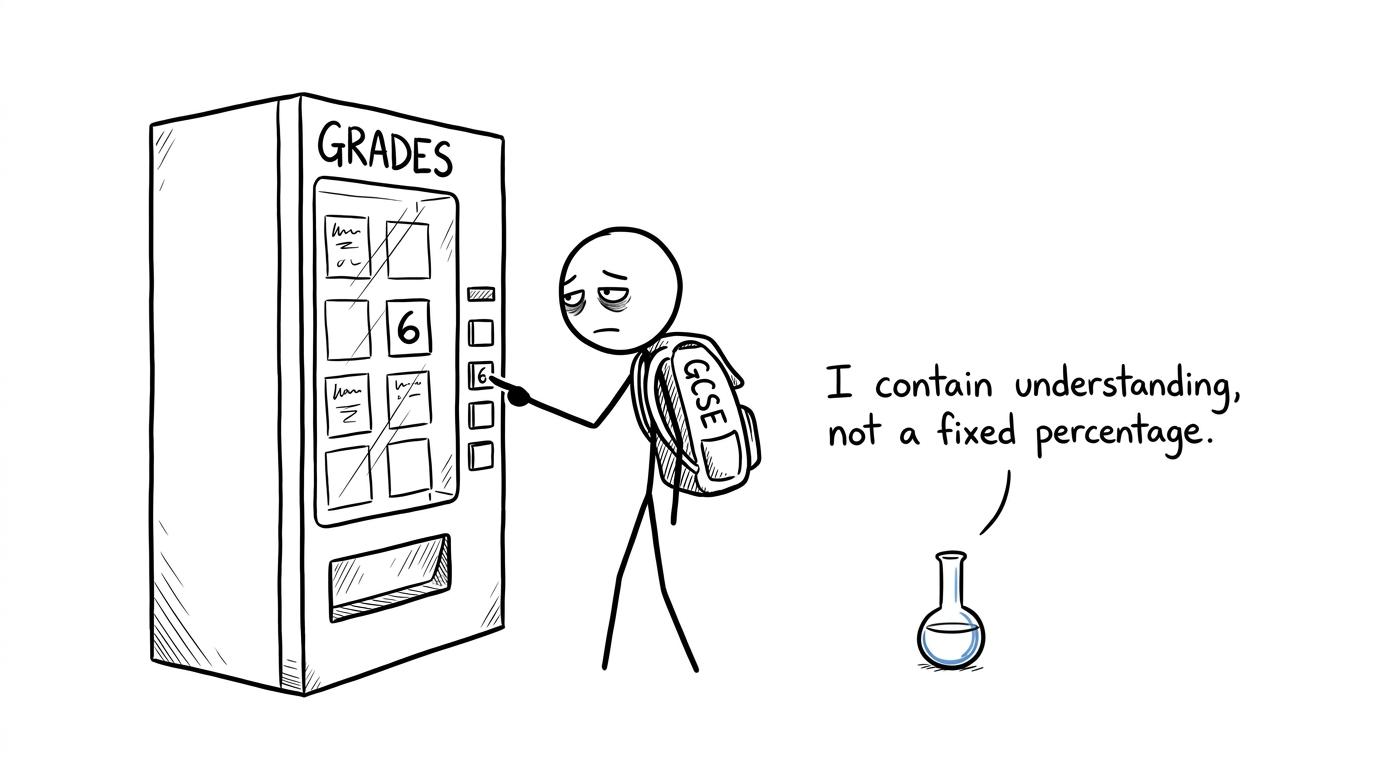 A student discovers that a grade represents understanding rather than a fixed percentage
What does a grade 6 represent in terms of ability?
A grade is a summary of performance, not a detailed diagnosis. Exam boards including AQA, Edexcel, OCR and Eduqas do not define a grade 666 student through a simple list such as “knows bonding but cannot do electrolysis”. Your result is determined by your total mark across the assessments and the grade boundaries set for that specification and series.
Nevertheless, a student working securely around grade 666 will usually demonstrate several connected abilities.
Secure knowledge across much of the specification
You should be able to recall and use important ideas from areas such as atomic structure, bonding, quantitative chemistry, chemical changes, energetics, rates, organic chemistry, chemical analysis and the atmosphere. The exact organisation and wording vary by exam board, so your own specification remains the checklist that matters.
A grade 666 does not mean every fact is remembered perfectly. It usually means gaps are limited enough that you can collect marks across both papers rather than depending on one favourite topic.
Application rather than recall alone
Chemistry questions often place familiar science inside unfamiliar contexts. A student may know that increasing temperature can increase reaction rate, but the examination might present a new reaction, a graph or an experimental method and ask them to apply that principle.
At grade 666, you are increasingly able to recognise the underlying idea even when the surface details change. That transition matters. Recall gets you started; application is what makes the knowledge useful.
Competent mathematical reasoning
Official GCSE Chemistry requirements mean that at least 20%20\%20% of the assessment involves mathematical skills at the appropriate level of demand. These can include:
- ratios, fractions and percentages;
- standard form and orders of magnitude;
- rearranging and substituting into equations;
- means, ranges and significant figures;
- unit conversions;
- plotting and interpreting graphs;
- gradients and proportional relationships.
This is why chemistry and maths revision should not live in separate boxes. Maths errors can hide chemistry understanding. If percentages are costing you marks, revisit fractions, decimals and percentages. For calculations involving very large or small values, use the standard form revision lesson.
Clear interpretation of evidence
Grade 666 performance normally includes the ability to read tables and graphs, identify patterns, compare results and draw conclusions supported by data. You also need to understand practical work: variables, accuracy, repeat measurements, sources of error and sensible improvements.
The important habit is to connect every conclusion to the evidence provided. A scientific answer should not merely sound plausible. It should be supported.
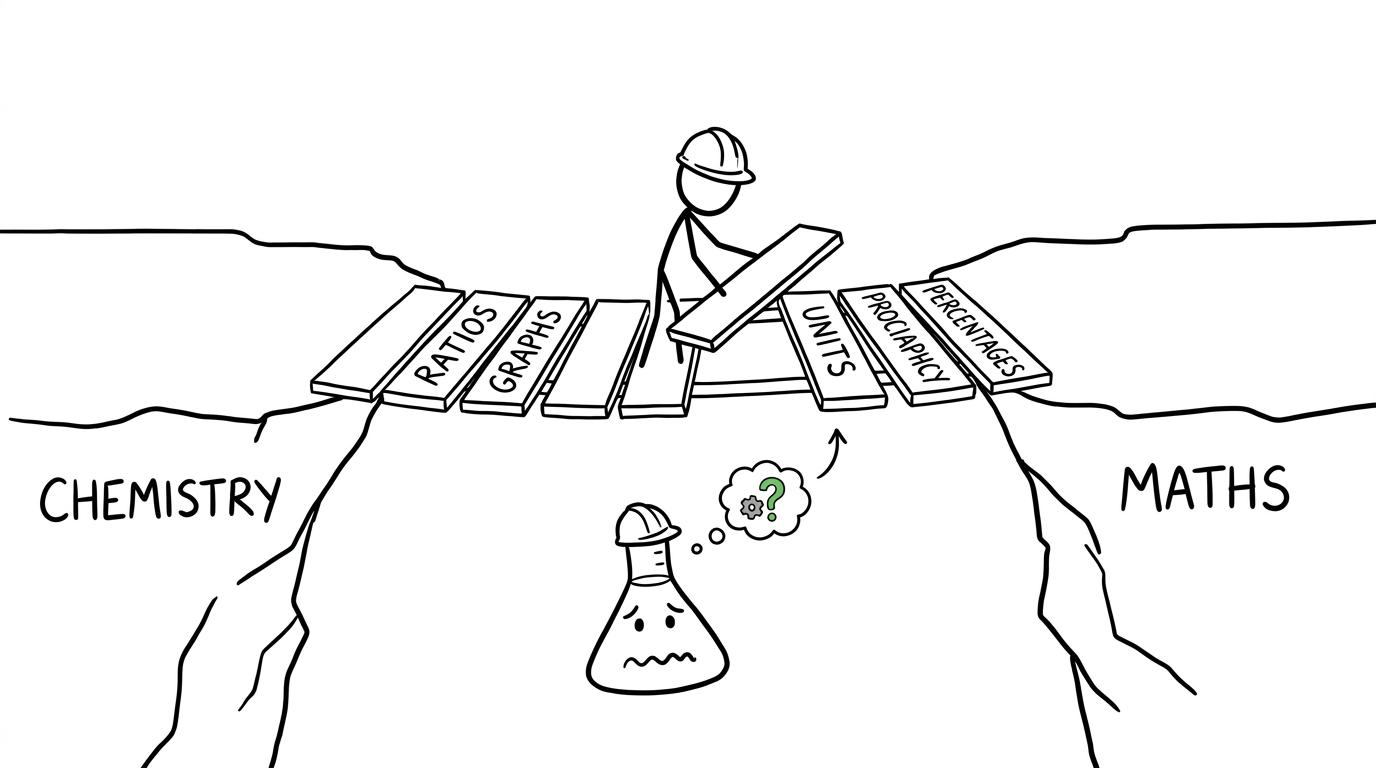 A student builds a bridge between chemistry and maths using ratios, graphs, units and percentages
Is a grade 6 equivalent to an old grade B?
Broadly, yes, but not exactly.
Ofqual’s official comparison between the numbered and former letter scales uses three anchor points:
| Numbered grade boundary | Official comparison point |
|---|---|
| Bottom of grade 777 | Bottom of the former grade A |
| Bottom of grade 444 | Bottom of the former grade C |
| Bottom of grade 111 | Bottom of the former grade G |
There is no official statement that every grade 666 is directly equal to a B. However, grades 444, 555 and 666 cover the part of the scale previously associated broadly with grades C and B. Because grade 666 lies just below the grade 777 anchor, it is commonly described as a strong or upper B.
That description is useful for orientation, particularly when adults remember letter grades. It should not be treated as an exact conversion. The reformed GCSEs changed content, assessment and grading, while the numbered scale created more differentiation between students.
The safest statement is simple: a grade 666 is a strong result below the old-A comparison point at grade 777.
Does grade 6 mean a fixed percentage?
No. There is no permanent percentage that guarantees a grade 666 in GCSE Chemistry.
Grade boundaries are set after papers have been taken and marked. Exam boards use statistical evidence and expert judgement to maintain a comparable standard between years. If a paper proves more demanding, its boundary may be lower. If it proves more accessible, the boundary may be higher.
Boundaries can also differ between AQA, Edexcel, OCR and Eduqas because their papers and total marks are different. A raw score from one board should never be compared directly with a score from another.
This leads to a useful revision principle: use previous boundaries to understand the approximate region you are working in, not as a promise about the next examination. Your real target should be a margin above recent grade 666 boundaries rather than the smallest mark that might be enough.
The same principle applies in maths. GCSE past papers organised by exam board let you measure performance using the correct paper and mark scheme instead of relying on a vague percentage target.
Tier and qualification details that matter
Separate GCSE Chemistry
For reformed separate GCSE Chemistry qualifications in England, foundation tier offers grades 111 to 555. Higher tier targets grades 444 to 999, with a limited allowed grade 333 safety net for students who narrowly miss grade 444.
Therefore, a grade 666 in separate Chemistry must come from higher-tier assessment. This does not mean you need flawless answers to the hardest questions. It means your total mark across the higher-tier papers reaches the grade 666 boundary.
Combined Science
Combined Science produces a double grade, such as 666-666 or 666-555, because it is worth two GCSEs. You do not normally receive a standalone Chemistry grade from that qualification. Your performance across biology, chemistry and physics contributes to the combined result.
This distinction matters when reading entry requirements. “Grade 666 in Chemistry” may refer specifically to separate GCSE Chemistry, while a course may set a different requirement for Combined Science. Always check the precise wording with the school, college or sixth form.
How to turn a grade 5 into a grade 6
The distance between two grades often feels like a mountain. In practice, it is usually a collection of small marks lost repeatedly.
Diagnose the marks, not your confidence
Complete a timed section or paper without notes. Mark it strictly, then label every lost mark as one of the following:
- missing chemistry knowledge;
- weak application;
- calculation or graph error;
- practical-method misunderstanding;
- imprecise wording;
- incomplete working or missing units.
MathsGenie’s guide to finding your weakest GCSE topics shows how to turn lost marks into a short, useful priority list.
Repair one skill at a time
Do not respond to a disappointing paper by trying to revise the entire specification in one evening. If concentration calculations are weak, separate the problem. Is the chemistry equation missing, or is rearranging the formula the real difficulty? If graph questions are weak, is the issue plotting, calculating a gradient or interpreting what the trend means?
A narrow diagnosis leads to narrow practice. Narrow practice is easier to repeat.
Use mark schemes as feedback
A mark scheme shows what evidence examiners reward. Compare it with what you actually wrote, not what you intended to write. The MathsGenie guide to using mark schemes explains how to convert each mistake into a specific revision action.
For Chemistry paper practice, the same attempt-mark-fix cycle is explored in this guide to using AQA Chemistry past papers properly.
Retest after the correction
Reading a correction can feel like learning, but recognition is not the same as recall. Return to a similar question later without notes. Improvement becomes real when you can produce the method independently.
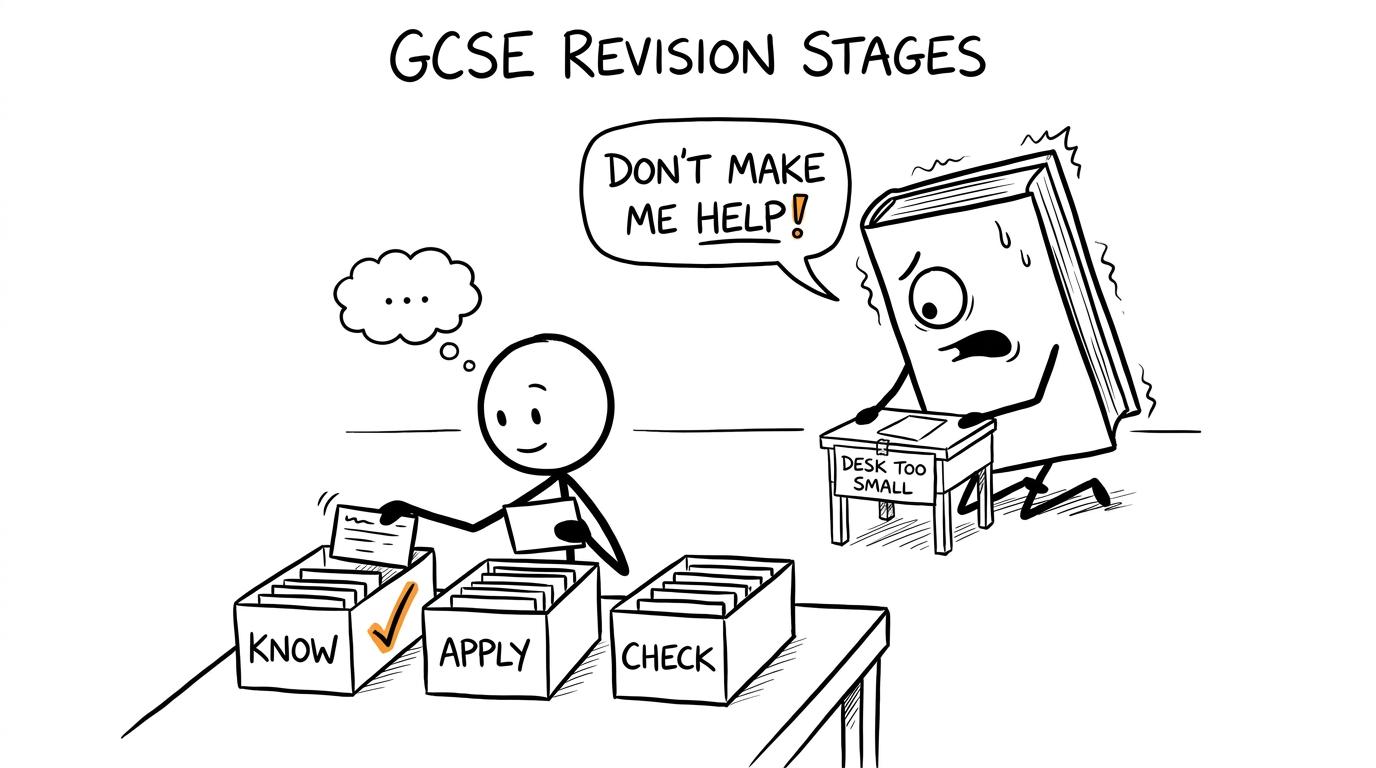 A calm student sorts revision into Know, Apply and Check while a giant textbook panics
Common mistakes when interpreting or targeting grade 6
Treating grade 6 as one fixed percentage
The required raw mark changes with the paper, examination series and board. Previous boundaries are evidence, not guarantees.
Assuming a grade 6 is exactly a B
“Strong B” is a helpful shorthand, but only grades 777, 444 and 111 have official comparison anchors with the former A, C and G boundaries.
Revising knowledge while ignoring calculations
At least 20%20\%20% of GCSE Chemistry assessment involves mathematical skills. Weaknesses in ratio, percentages, graphs, units or significant figures can create a ceiling even when your scientific recall is good.
Counting marks without analysing them
A total score tells you where you are. It does not tell you what to do next. Sort lost marks by cause and target the most frequent pattern.
Using foundation material when targeting grade 6
Foundation Chemistry is capped at grade 555. Students aiming for grade 666 need higher-tier preparation matched to their exam board and specification.
Completing papers without revisiting mistakes
Past papers become valuable when they change your next revision session. Use the paper, mark scheme and corrections as one process. A realistic GCSE revision timetable can help you make room for diagnosis, focused practice and retesting.
Make the grade a direction, not a label
A grade 666 means you have demonstrated strong GCSE-level chemistry across knowledge, application, practical reasoning and calculations. It is above the strong-pass benchmark, broadly comparable with the upper region of the former grade B and a credible foundation for further scientific revision. It does not mean perfection, and it is not defined by one universal percentage.
The useful question is no longer “Am I a grade 666 student?” It is “Which marks would move my next paper into grade 666 territory?”
MathsGenie can help you answer that with evidence. Strengthen the calculations through free revision lessons and practice questions, test yourself with GCSE past papers, and use mark schemes and video solutions to understand every lost mark. As examinations approach, fresh GCSE predicted papers and mini tests can help you practise selection, accuracy and timing.
One number may appear on results day. The improvement behind it is built one corrected mistake at a time.