

GCSE Business Exam Start Time: What to Expect
GCSE business exam start time explained: check official sessions, school variations, arrival timing and what happens before you can begin writing.
A timetable might say PM, your school may tell you to arrive at lunchtime, and an invigilator may not let you open the paper immediately. That leaves one very practical question: what is the GCSE business exam start time when you actually sit down and begin writing?
For UK centres following JCQ arrangements, the published start is normally 9.00 am9.00\text{ am}9.00 am for a morning examination or 1.30 pm1.30\text{ pm}1.30 pm for an afternoon examination. However, schools can adjust the start within the permitted session window. Your personal candidate timetable and your school's instructions therefore take priority.
In practical terms, arrive at the time your school gives you, commonly well before the published start, and expect registration, seating and compulsory instructions before writing begins.
The short answer
Use this checklist rather than relying on a time found in a group chat:
- Check whether your Business paper is marked AM or PM.
- Treat 9.00 am9.00\text{ am}9.00 am and 1.30 pm1.30\text{ pm}1.30 pm as the standard published session times.
- Follow the arrival time on your personal school timetable.
- Check your exam board, paper code, date, room and seat number.
- Allow for registration and invigilator instructions before the paper starts.
- If your school gives a different start, follow the school rather than assuming it has made a mistake.
Current JCQ instructions for the 2025/262025/262025/26 examination cycle allow UK centres to begin a morning examination between 8.30 am8.30\text{ am}8.30 am and 9.30 am9.30\text{ am}9.30 am, and an afternoon examination between 1.00 pm1.00\text{ pm}1.00 pm and 2.00 pm2.00\text{ pm}2.00 pm. This flexibility explains why two students at different schools may start the same paper at slightly different times.
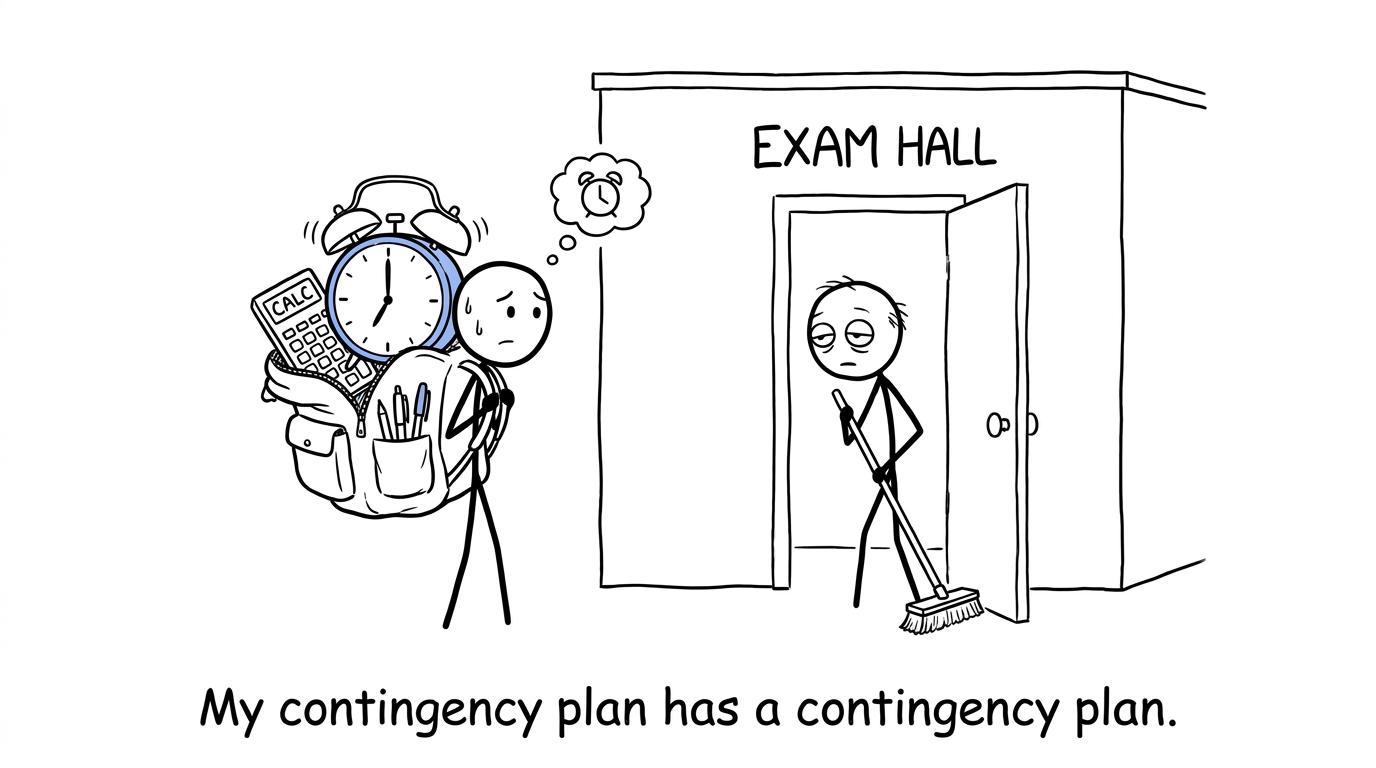 A GCSE student arrives extremely early with an oversized alarm clock
Is GCSE Business normally a morning or afternoon exam?
There is no permanent rule saying that GCSE Business must always be in the afternoon. The session is set for each examination series, so it must be checked against the final timetable for the relevant year and board.
As a recent reference point, the main written GCSE Business papers for AQA, Pearson Edexcel and OCR in summer 202620262026 were scheduled in afternoon sessions. Eduqas Business Component 111 was also scheduled in an afternoon session. That does not guarantee the same arrangement in another year.
Paper structures and durations also differ. For example, in summer 202620262026:
| Exam board | Qualification or paper | Published session | Duration |
|---|---|---|---|
| AQA | Business papers 111 and 222 | Afternoon | 1 h 45 min1\text{ h }45\text{ min}1 h 45 min each |
| Pearson Edexcel | Business papers 111 and 222 | Afternoon | 1 h 45 min1\text{ h }45\text{ min}1 h 45 min each |
| OCR | Business papers 111 and 222 | Afternoon | 1 h 30 min1\text{ h }30\text{ min}1 h 30 min each |
| Eduqas | Business Component 111 | Afternoon | 2 h2\text{ h}2 h |
These details are historical examples, not a substitute for your current timetable. Specifications can have different paper codes and assessment structures, while schools may enter students for qualifications with similar-sounding names. Check the exact code printed on your candidate timetable.
Why your school may use a slightly different start time
The published session time coordinates examinations nationally. It helps protect the security of question papers and keeps centres working within a shared structure.
But a school still has practical decisions to make. It may need to organise hundreds of candidates, several rooms, access arrangements, supervised breaks or timetable clashes. JCQ rules consequently permit limited movement within the session.
For the 2025/262025/262025/26 rules, the normal windows are:
| Session | Published start | Permitted centre window |
|---|---|---|
| Morning | 9.00 am9.00\text{ am}9.00 am | 8.30 am8.30\text{ am}8.30 am to 9.30 am9.30\text{ am}9.30 am |
| Afternoon | 1.30 pm1.30\text{ pm}1.30 pm | 1.00 pm1.00\text{ pm}1.00 pm to 2.00 pm2.00\text{ pm}2.00 pm |
This does not mean students can choose any time in that window. The decision belongs to the examination centre. If your school says that candidates must assemble at 12.55 pm12.55\text{ pm}12.55 pm for a 1.30 pm1.30\text{ pm}1.30 pm session, 12.55 pm12.55\text{ pm}12.55 pm is your deadline for being there.
The safest principle is simple: the exam board determines the date and session; your school tells you when and where to report.
A realistic GCSE Business exam-day walkthrough
An afternoon paper can feel deceptively distant in the morning. There seems to be plenty of time, until lunch, travel and an unexpected room change consume the margin. A calm exam day is usually built from small pieces of preparation rather than last-minute speed.
Before leaving home
Read your personal timetable again. Confirm:
- the subject and paper number;
- the exam board, such as AQA, Edexcel, OCR or Eduqas;
- the examination date and session;
- the school arrival time;
- the room, seat or candidate details if supplied;
- the equipment permitted by your centre.
Pack black pens and any approved equipment your school has requested. Business papers can involve numerical information, but calculator rules and requirements should be checked for your exact qualification. Do not assume that another board follows identical instructions.
Phones, watches, earbuds and other unauthorised devices must not be taken into the examination room unless your centre has told you exactly how they will be stored. Turning a device to silent is not the same as removing it from your possession.
Arriving at school
Suppose your centre uses the standard afternoon start of 1.30 pm1.30\text{ pm}1.30 pm. It might ask you to arrive around 1.00 pm1.00\text{ pm}1.00 pm or earlier. That is an illustrative schedule, not a national arrival rule.
On arrival, you may need to:
- register with a teacher or exams officer;
- leave bags and unauthorised items in a designated place;
- check a seating list;
- use the toilet before entering;
- wait quietly with other candidates;
- move to a separate room if you have approved access arrangements.
Arriving early is not wasted time. It creates a buffer between ordinary life and examination conditions.
Entering the exam room
You will normally enter under instructions, find your assigned seat and place permitted equipment on the desk. The question paper may already be face down. Do not open it until instructed.
The invigilator will check that candidates have the correct paper and may ask you to complete details such as your name, candidate number and centre number. They will explain the examination conditions, tell you the paper duration and deal with any corrections or notices.
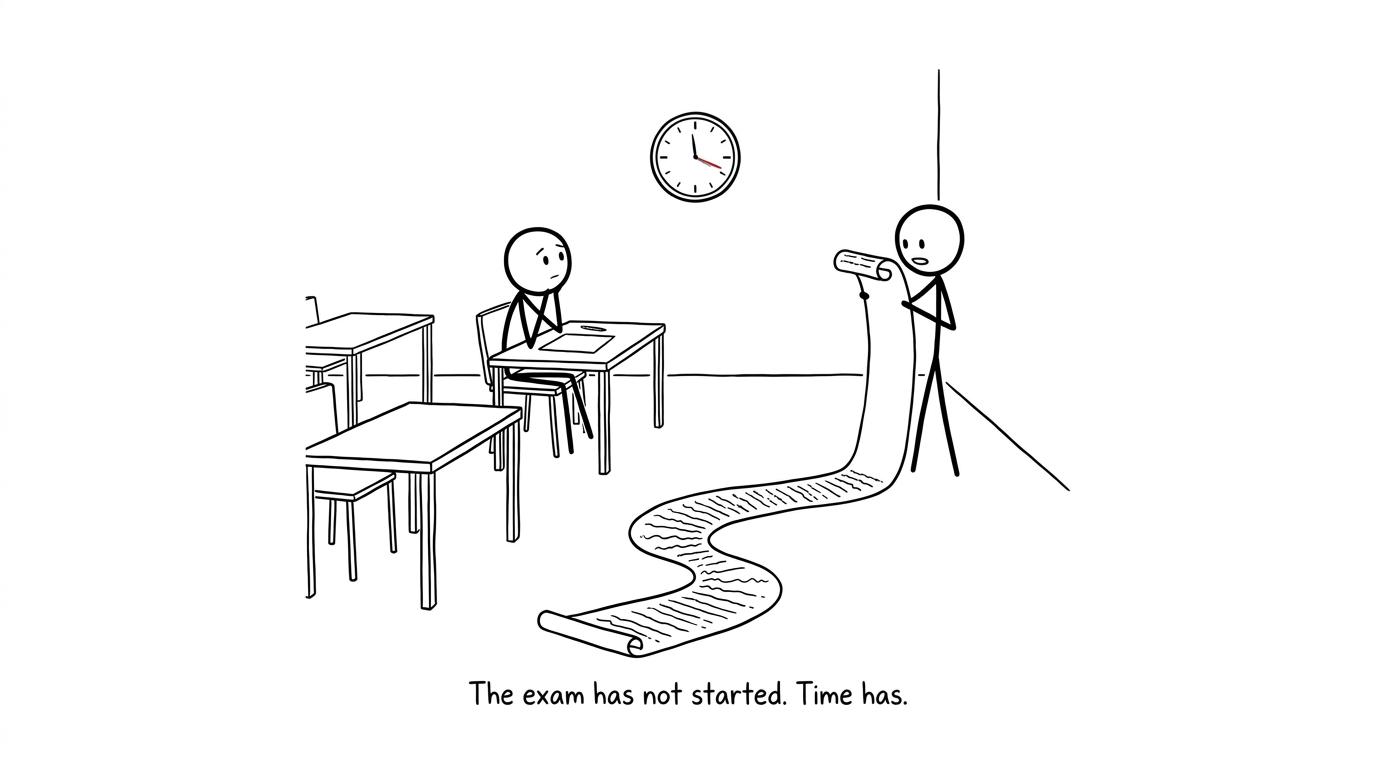 An invigilator reads instructions from a comically long scroll
When you actually start writing
You begin the assessed work only when the invigilator announces that the examination has started. If the centre is using the published afternoon time, that will normally be around 1.30 pm1.30\text{ pm}1.30 pm.
The minutes spent entering, checking details and listening to instructions are not usually taken from the stated paper duration. The invigilator records the official start and finish times where candidates can see them.
If your paper lasts 1 h 45 min1\text{ h }45\text{ min}1 h 45 min and begins at 1.30 pm1.30\text{ pm}1.30 pm, the scheduled finish would ordinarily be 3.15 pm3.15\text{ pm}3.15 pm, subject to any approved arrangements or instructions from the centre. Never calculate your own finish time and leave independently; wait for the invigilator.
During and after the paper
Read the front of the paper carefully. Use the case-study information provided, watch the command words and show calculations clearly where relevant. If you need help because something appears wrong, raise your hand. An invigilator can handle administrative issues but cannot explain a Business question.
At the end, stop writing immediately when instructed. Papers are collected and counted before candidates are dismissed. This means your actual departure may be a few minutes after the formal finish.
What if you have two exams on the same day?
A Business paper may sit alongside another GCSE in your timetable. Two exams on one day are not automatically a clash if one is in the morning and one is in the afternoon. You may simply have a supervised gap between them.
A genuine clash occurs when examinations are scheduled in the same session. Your exams officer decides the arrangement, which may involve consecutive papers, a supervised break or another approved solution. Do not create your own plan or leave the centre without permission.
This is also why keeping a clear revision schedule matters. The GCSE maths revision timetable guide can help you plan around crowded exam weeks rather than treating every paper as an isolated event.
What should you do if you are running late?
Contact the school or examination centre immediately and follow its instructions. On arrival, report directly to the exams officer or reception rather than going to the normal classroom.
Do not assume that being late means you should stay at home. Equally, do not assume that admission, full working time or acceptance of the script is guaranteed. The centre must apply the current examination rules and consider how late you are.
Avoid discussing the paper with anyone, looking for information online or contacting students who may already have sat it. Examination security still matters while the centre decides what happens.
Common mistakes around GCSE Business exam timing
Confusing arrival time with writing time
A school may request arrival at 1.00 pm1.00\text{ pm}1.00 pm even though writing begins at 1.30 pm1.30\text{ pm}1.30 pm. Both times are important. One gets you safely into the room; the other starts the examination.
Checking the wrong year's timetable
Search results can retain old or provisional documents. Verify the year, exam board, qualification title and paper code. Your personal timetable is safer than a screenshot passed between students.
Assuming every Business qualification has two identical papers
AQA, Edexcel, OCR and Eduqas do not use identical structures or durations. Similar subject names are not enough. Match the component code.
Treating PM as any time after lunch
PM is a formal examination session, not an invitation to arrive during the afternoon. The standard published start is 1.30 pm1.30\text{ pm}1.30 pm, subject to your centre's permitted adjustment and reporting instructions.
Bringing prohibited items to the desk
A phone or watch can create a serious problem even if you never intend to use it. Follow your centre's storage procedure before entering.
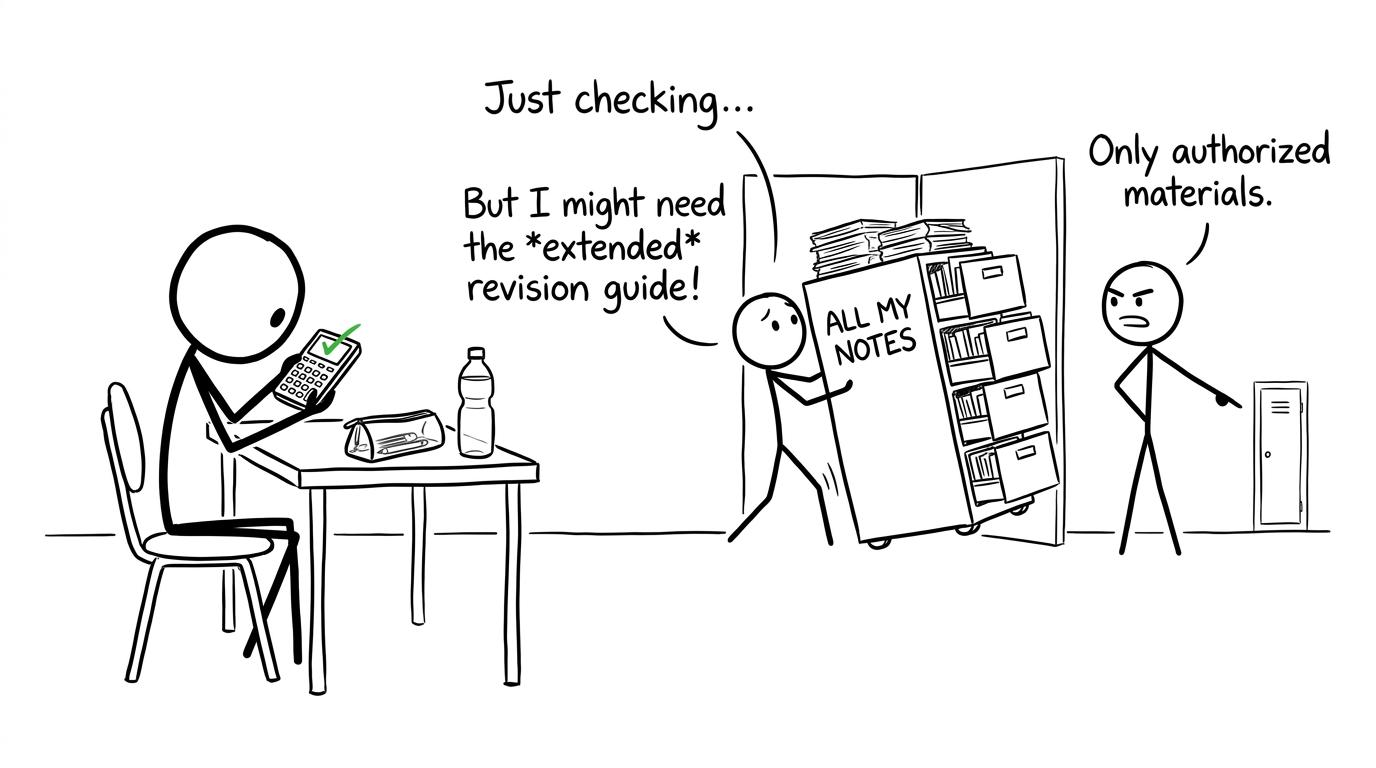 A student checks permitted equipment while another brings an enormous notes cabinet
Use the same timing habits for your maths exams
The discipline is transferable. Check the board, tier, paper type, session and duration before every GCSE maths paper. Foundation and higher tier candidates may sit at the same published time, but they must receive the correct paper.
Start from the free GCSE Maths revision hub, then choose resources matching your board. MathsGenie has dedicated collections for Edexcel GCSE Maths past papers, AQA GCSE Maths past papers and OCR GCSE Maths revision.
Timed practice is particularly useful because knowing a method and producing it under examination conditions are different skills. Use GCSE predicted papers for fresh practice, but keep official past papers at the centre of your preparation. Mark each attempt, identify why marks were lost, then return to revision lessons, practice questions, mini tests and video solutions.
If the final evening feels busy, the GCSE maths night-before plan gives you a short routine for checking equipment, selecting focused practice and stopping revision at a sensible time. You can also use the guide to starting GCSE past papers at the right stage to build timing confidence before exam week.
Know the session, then trust your timetable
The reliable answer is that UK GCSE examinations normally have published starts of 9.00 am9.00\text{ am}9.00 am in the morning and 1.30 pm1.30\text{ pm}1.30 pm in the afternoon. Your school can vary that time within JCQ rules, so its candidate timetable and arrival instructions are the final practical authority.
Check the details early. Arrive with time to spare. Listen before opening the paper. Then, when the invigilator says you may begin, the uncertainty is over and your preparation can take its place.
For the maths papers surrounding your Business exam, make MathsGenie your revision base. Use the free revision lessons to rebuild methods, practice questions and mini tests to improve accuracy, and past papers, predicted papers, mark schemes and video solutions to make the real examination feel familiar.










