

GCSE Business Access Arrangements: How to Apply
GCSE business access arrangements explained: learn how extra time works, what evidence schools need, who to ask and when to request exam support.

The hardest part of an exam should be showing what you know. It should not be reading print you cannot access, writing through pain or processing questions under conditions that put you at a substantial disadvantage.
That is the purpose of GCSE business access arrangements. They adjust how an assessment is taken without changing the knowledge, skills or understanding being assessed. If you think you may need extra time, rest breaks, a word processor, a reader, a scribe or a modified paper, speak to your school's SENCo or exams officer as early as possible. Your school gathers the evidence and, where required, submits the application; students do not normally apply directly to an exam board.
GCSE business access arrangements at a glance
Use this checklist as your starting point:
- Speak to your SENCo, learning support team or exams officer early.
- Explain the difficulty you experience, not simply the arrangement you want.
- Use agreed support in lessons, internal tests and mock exams.
- Attend any assessment organised by the school.
- Ask what evidence is required and what your school's internal deadline is.
- Confirm the final arrangement before the examination series.
- Practise Business and Maths papers using the conditions you will receive.
- Report any new injury or sudden change immediately.
The rules are updated annually by the Joint Council for Qualifications, usually called JCQ. Schools must therefore use the guidance for the relevant academic year rather than relying on what happened for an older sibling or in a previous exam series.
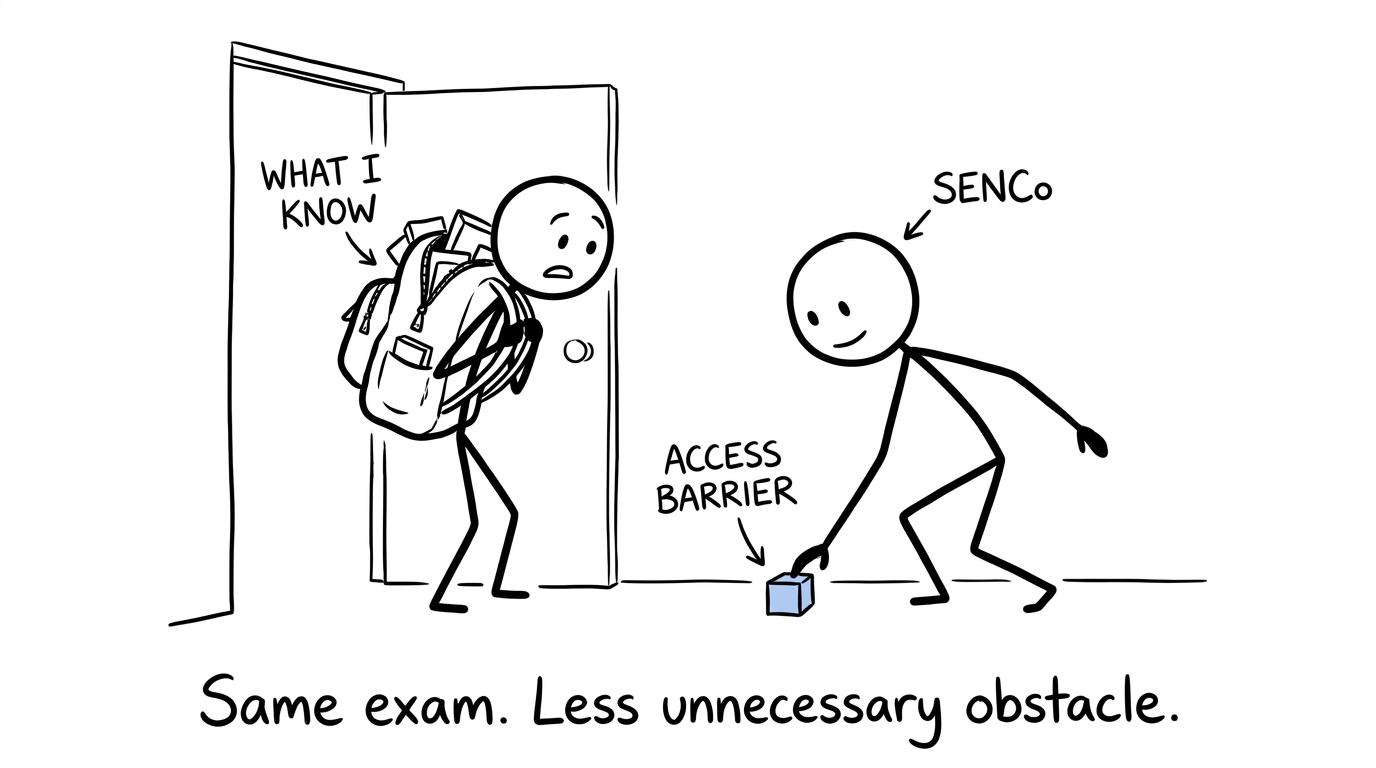 A student reaching the same exam through a doorway with an unnecessary barrier removed
What access arrangements actually do
Access arrangements are agreed before an assessment. They are intended for students with disabilities, special educational needs, learning difficulties or temporary injuries where support is necessary to access the exam fairly.
They do not make GCSE Business easier. The same Business content, command words and assessment objectives still apply. You must still interpret the case study, perform calculations and construct supported judgements. The arrangement removes an access barrier rather than lowering the standard.
This distinction matters because access arrangements are not rewards for working hard and they are not automatic after a diagnosis. The support must be appropriate to your individual need and, in most cases, reflect your normal way of working.
Common arrangements include:
- extra time, often 25%25\%25%;
- supervised rest breaks;
- use of a word processor with restricted functions;
- a computer reader or human reader where permitted;
- a scribe or speech-recognition technology;
- modified enlarged or Braille papers;
- coloured paper or an overlay;
- alternative rooming arrangements;
- a prompter, practical assistant or approved assistive technology.
Some arrangements require approval through Access Arrangements Online. These include 25%25\%25% extra time, readers or computer readers, and scribes. Other arrangements may be delegated to the exam centre, meaning the school can decide whether to provide them under JCQ rules. Delegated does not mean informal: the arrangement still needs to be appropriate, organised and recorded.
How extra time works in GCSE Business
The most familiar arrangement is 25%25\%25% extra time. The additional time is calculated from the published duration of the paper:
total time=standard time×1.25\text{total time}=\text{standard time}\times 1.25total time=standard time×1.25A timing guide looks like this:
| Standard paper time | Time with 25%25\%25% extra |
|---|---|
| 606060 minutes | 757575 minutes |
| 909090 minutes | 112.5112.5112.5 minutes |
| 105105105 minutes | 131.25131.25131.25 minutes |
| 120120120 minutes | 150150150 minutes |
Your centre will tell you the precise finishing time. Do not assume every Business paper has the same duration: AQA, Edexcel, OCR and Eduqas use different assessment structures, and specifications can change.
Extra time is available for the whole paper, but it should be used purposefully. In GCSE Business, it may help you process source material, plan extended responses, complete calculations or check that each judgement is supported by the case study. It is not intended to create extra revision time after the paper has started.
For applications for 25%25\%25% extra time processed during the 2025/26 academic year, JCQ requires representative internal-test or mock evidence across relevant subjects, alongside teacher comments explaining why the time is needed and how it is used. Your school may ask you to change pen colour when standard time ends so that the use of the additional time is visible.
If extra time is approved across your qualifications, practise under the same arrangement in both Business and Maths. The GCSE Business revision hub provides board-specific resources, while the GCSE Maths revision hub lets you choose your board and, for Maths, foundation or higher tier. GCSE Business itself is not divided into foundation and higher tiers.
Extra time is not always the right adjustment
A longer exam is not automatically a more accessible exam. A student affected by fatigue, pain, anxiety linked to a substantial impairment or difficulty sustaining concentration may benefit more from supervised rest breaks.
During a supervised rest break, the student pauses work and the examination clock is stopped. The script and question paper remain supervised, and the student cannot revise or discuss the exam. The exact procedure is controlled by the centre.
A word processor may be appropriate where typing is the student's established way of working because of handwriting, physical or processing difficulties. It is not normally approved merely because typed answers look neater. Spellcheck, grammar tools and internet access are generally disabled unless a separately approved arrangement permits a particular function.
Modified papers must be ordered in advance and can include Braille or modified enlarged formats. These have earlier deadlines because the awarding body needs time to produce the correct version.
How to request access arrangements
Start with the SENCo or exams officer
Tell a trusted teacher, your SENCo or the exams officer what happens when you complete timed work. Be specific. For example, explain whether reading takes significantly longer, handwriting becomes painful, concentration cannot be sustained or you regularly fail to finish despite knowing the content.
The useful question is not, “Can I have extra time?” It is, “What barrier is preventing me from showing what I know, and what arrangement would address it?”
Parents and carers can contact the school and share relevant reports, but the centre is responsible for determining the evidence required and making any formal application.
Let the school build evidence
Evidence varies according to the need and arrangement. It may include:
- teacher observations;
- classwork and timed assessments;
- mock scripts showing the arrangement in use;
- records of support already provided;
- an assessment by the centre's appointed assessor;
- medical or specialist documentation where relevant;
- previous approved arrangements.
A diagnosis, Education, Health and Care Plan or earlier arrangement may support the process, but none automatically guarantees a particular adjustment. Conversely, not every route depends on having a named diagnosis. The central issue is the demonstrated disadvantage and the support needed to address it.
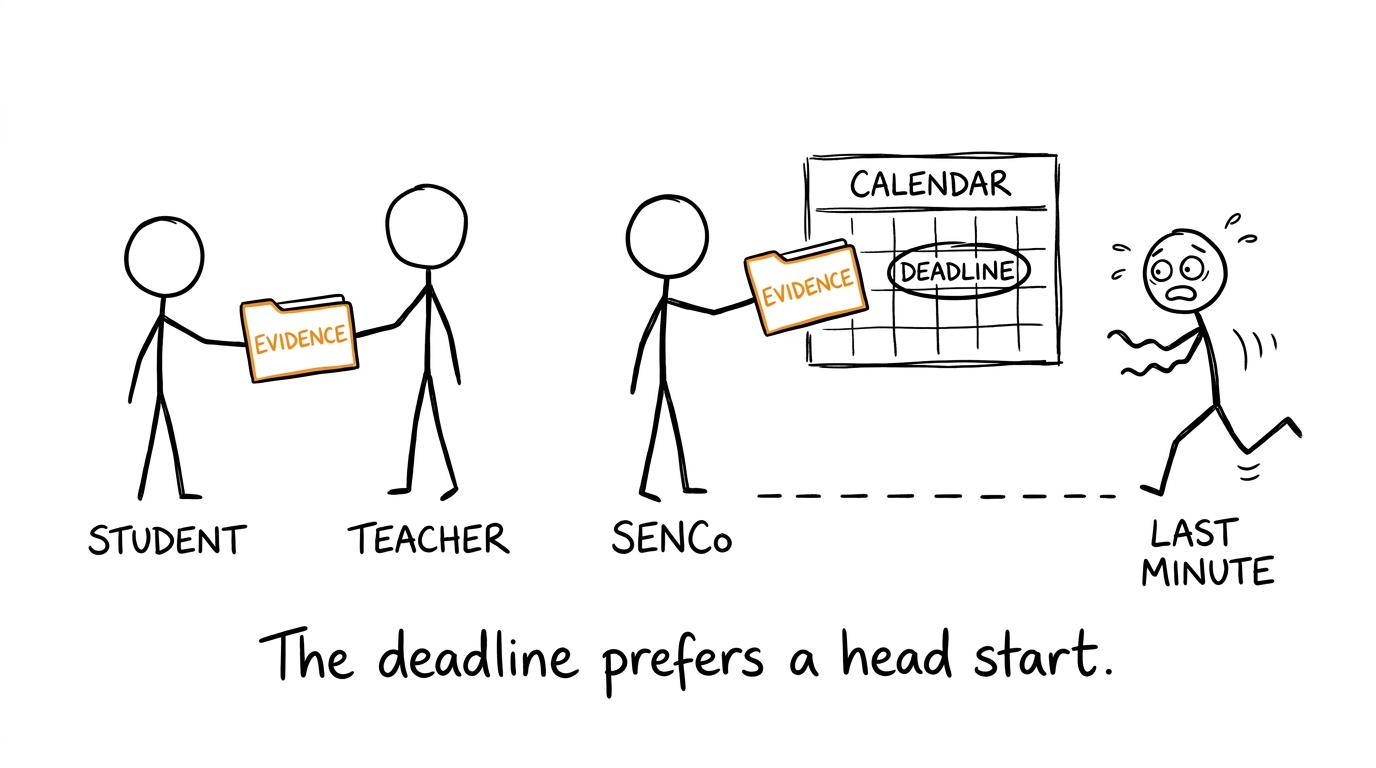 A teacher, student and SENCo passing evidence towards a calendar before the last-minute runner arrives
Use the arrangement in normal school assessments
“Normal way of working” means the arrangement reflects how you ordinarily access teaching and assessment in your centre. If a laptop, rest break or extra time is genuinely necessary, it should normally appear in lessons, tests or mocks where appropriate, not for the first time on the morning of the GCSE.
Mock practice also tells the school whether an arrangement works. A student may discover that rest breaks are more effective than simply extending an already tiring paper. Evidence is not only paperwork; it helps identify the right support.
You can combine this process with effective revision. Use GCSE Business resources by exam board, complete a timed paper under the proposed conditions and review it using the mark scheme. Maths students can use Edexcel GCSE Maths mini tests for shorter timed practice or follow the broader guide to using GCSE past papers properly.
When should you request access arrangements?
Early is safer because assessment, evidence gathering and trialling support take time. A sensible journey is:
| Stage | What to do |
|---|---|
| Year 9 or early Year 10 | Raise persistent difficulties and begin using suitable classroom support. |
| Year 10 | Allow teachers to record your normal way of working and trial arrangements in internal tests. |
| Autumn of Year 11 | Confirm that the SENCo knows your needs and ask about assessment and internal deadlines. |
| Mock-exam period | Use the proposed arrangement consistently and allow the school to retain relevant evidence. |
| Spring of Year 11 | Ask the exams officer to confirm what has been approved and how it will operate. |
| Before each paper | Check your room, start time, equipment and finishing time. |
For the June 2026 series, the published JCQ deadlines were 31 January 2026 for modified papers and 21 March 2026 for other applications processed through Access Arrangements Online. Those dates have passed and should not be copied into a future plan. JCQ publishes dates for each series, while schools usually set earlier internal deadlines so that evidence can be checked.
Students preparing for summer 2027 should ask their centre for its current deadline and check that the school is working from the 2026/27 JCQ guidance once published. Never wait for the national deadline.
Private candidates must find an exam centre willing to accept their entry and discuss access arrangements with that centre well in advance. The centre still needs to satisfy the relevant JCQ requirements.
What happens in the exam room?
Your centre should explain where you will sit, which equipment you may use and how timing or breaks will be recorded. You might remain in the main hall, sit in a smaller room or work separately where the arrangement requires it.
The invigilator must follow the approved conditions. A reader or scribe cannot provide hints, explain Business terminology or improve an answer. A word processor cannot provide unrestricted access to stored files. The arrangement changes access, not authorship.
Practise the routine before the real paper. Students using extra time should decide how they will divide it between reading, answering and checking. Students using rest breaks should know how to signal the invigilator. Familiarity turns an arrangement from something distracting into something useful.
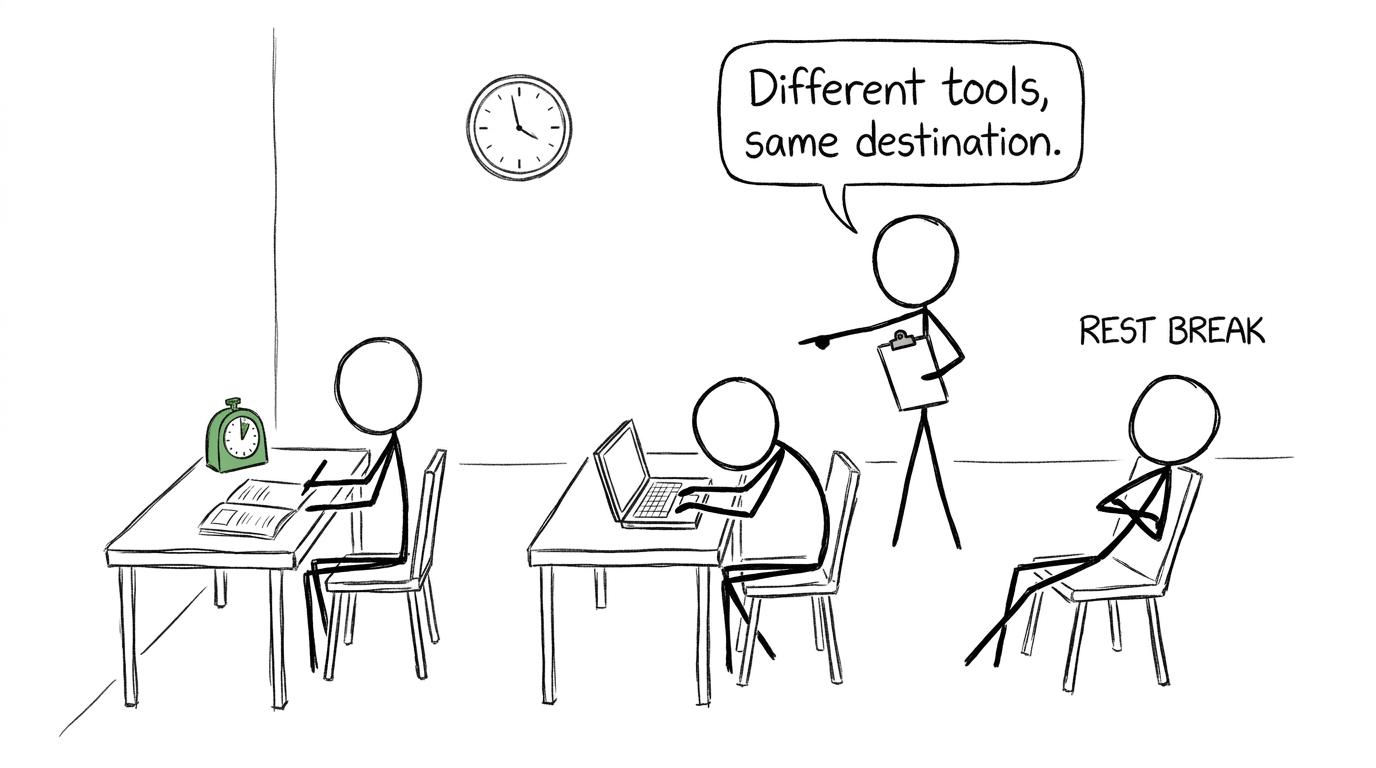 Students using different approved exam tools while an invigilator notes that the destination is the same
Common mistakes to avoid
Waiting until the examination season
A last-minute request may leave too little time for assessment, evidence and approval. Ask early even if you are uncertain whether you qualify.
Assuming a diagnosis guarantees extra time
Access arrangements are based on individual need, disadvantage, evidence and normal working practice. Two students with the same diagnosis may appropriately receive different support.
Asking only a subject teacher
A Business or Maths teacher can provide valuable evidence, but the SENCo and exams officer coordinate the formal process. Make sure the right people know.
Treating extra time as the only option
Rest breaks, assistive technology, modified papers or a word processor may address the actual barrier more effectively. Let the evidence guide the decision.
Practising under standard conditions only
If an arrangement is approved, rehearse it. Use Business papers and Maths resources under realistic timings, then learn from the mark scheme. MathsGenie's guide to using mark schemes as a revision coach can help turn each mock into specific improvements.
Confusing access arrangements with special consideration
Access arrangements are normally agreed before an exam. Special consideration is a separate process for temporary illness, injury or another unforeseen event affecting a student at or near the time of assessment. Report sudden problems to the school immediately rather than assuming an existing arrangement covers them.
Make the arrangement part of your revision plan
Approval is not the finish line. It is the point at which you can practise in conditions that better reflect the real exam.
Choose your specification from the GCSE Business revision area, then combine revision lessons, practice questions and timed past papers. If Maths is also on your timetable, use Edexcel GCSE Maths video lessons or the board-specific resources in the main Maths hub. Build both subjects into a realistic GCSE Maths revision timetable, leaving room for mocks completed with your approved support.
Speak to your SENCo or exams officer now, not when the first paper is on your desk. Then make MathsGenie your free revision base: learn through revision lessons, practise with topic questions and mini tests, and test yourself using past papers, predicted papers, mark schemes and video solutions. The right arrangement gives you access. Calm, repeated practice helps you use it well.










