GCSE Biology OCR Grade Boundaries Explained
GCSE biology OCR grade boundaries explained using confirmed 2025 marks, tier rules, results-day guidance and practical advice for your next steps.
Results day can make one mark feel enormous. Yet the number on your results slip only makes sense when it is compared with the correct boundary for your specification and tier. This guide explains GCSE Biology OCR grade boundaries, using the latest confirmed June 2025 figures for Biology A (Gateway Science) and Biology B (Twenty First Century Science). If you are awaiting 2026 results, remember that those boundaries will not be confirmed until marking is nearly complete.
Here is the short version:
- Check whether you took Biology A (J247) or Biology B (J257).
- Use the boundary for your tier: Foundation or Higher.
- Compare your combined mark across both papers with the overall boundary.
- Do not use 2025 boundaries to predict an exact 2026 grade.
- Speak to your school promptly if your result is unexpected.
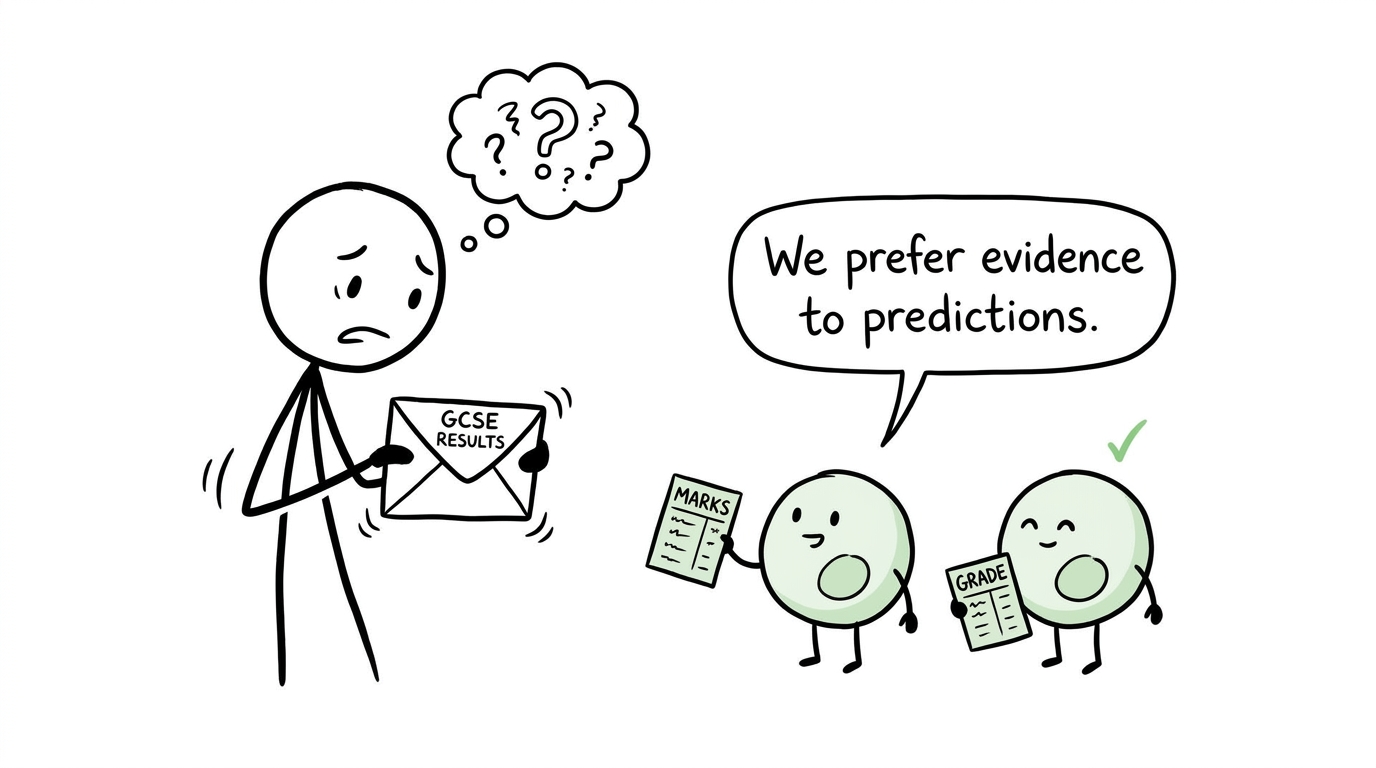 A student opens a results envelope while two biology cells discuss marks and grades
Latest GCSE Biology OCR grade boundaries
The tables below show OCR's confirmed overall grade boundaries for June 2025. Each separate Biology qualification had two papers worth 909090 marks each, producing a total of 180180180 marks.
OCR Biology A Gateway Science J247
| Grade | Foundation mark out of 180180180 | Higher mark out of 180180180 |
|---|---|---|
| 999 | Not available | 139139139 |
| 888 | Not available | 128128128 |
| 777 | Not available | 117117117 |
| 666 | Not available | 100100100 |
| 555 | 109109109 | 838383 |
| 444 | 909090 | 666666 |
| 333 | 666666 | 575757 allowed grade |
| 222 | 424242 | Not available |
| 111 | 181818 | Not available |
Biology A is OCR's Gateway Science specification. Paper 111 assesses Topics B1 to B3, while Paper 222 assesses Topics B4 to B6 with assumed knowledge from earlier topics. Practical skills appear across the qualification. Students can strengthen individual areas through the free OCR GCSE Biology revision guides, including focused resources such as the OCR photosynthesis revision guide.
OCR Biology B Twenty First Century Science J257
| Grade | Foundation mark out of 180180180 | Higher mark out of 180180180 |
|---|---|---|
| 999 | Not available | 141141141 |
| 888 | Not available | 129129129 |
| 777 | Not available | 118118118 |
| 666 | Not available | 989898 |
| 555 | 116116116 | 797979 |
| 444 | 101101101 | 606060 |
| 333 | 808080 | 505050 allowed grade |
| 222 | 595959 | Not available |
| 111 | 393939 | Not available |
Biology B has a Breadth in Biology paper and a Depth in Biology paper. Both assess content from across its eight teaching chapters, and each contributes 50%50\%50% of the qualification. If this is your course, use the dedicated OCR Twenty First Century Biology revision hub.
What the OCR Biology boundaries mean
A boundary is the minimum combined raw mark needed for a grade. It is not a target set before the exam, and it is not normally necessary to reach that mark on each individual paper.
OCR may publish component boundaries to show how a paper performed, but these are not separate grades awarded for each component. Your qualification grade comes from your total weighted mark across the two papers.
Foundation tier normally awards grades 1-5. Higher tier normally awards grades 4-9, although an allowed grade 333 may be issued when a student falls a small number of marks below the grade 444 boundary. A mark below the allowed grade threshold results in an unclassified outcome rather than a grade 222 or 111 on Higher tier.
Why OCR Biology grade boundaries change
Grade boundaries move because exam papers cannot be made identically difficult every year. They are set when marking is nearly complete, using statistical evidence and expert review of students' work around potential boundaries.
If a paper is slightly harder, its boundaries may be lower. If it is slightly easier, they may rise. The moving boundary is intended to keep the standard represented by each grade comparable.
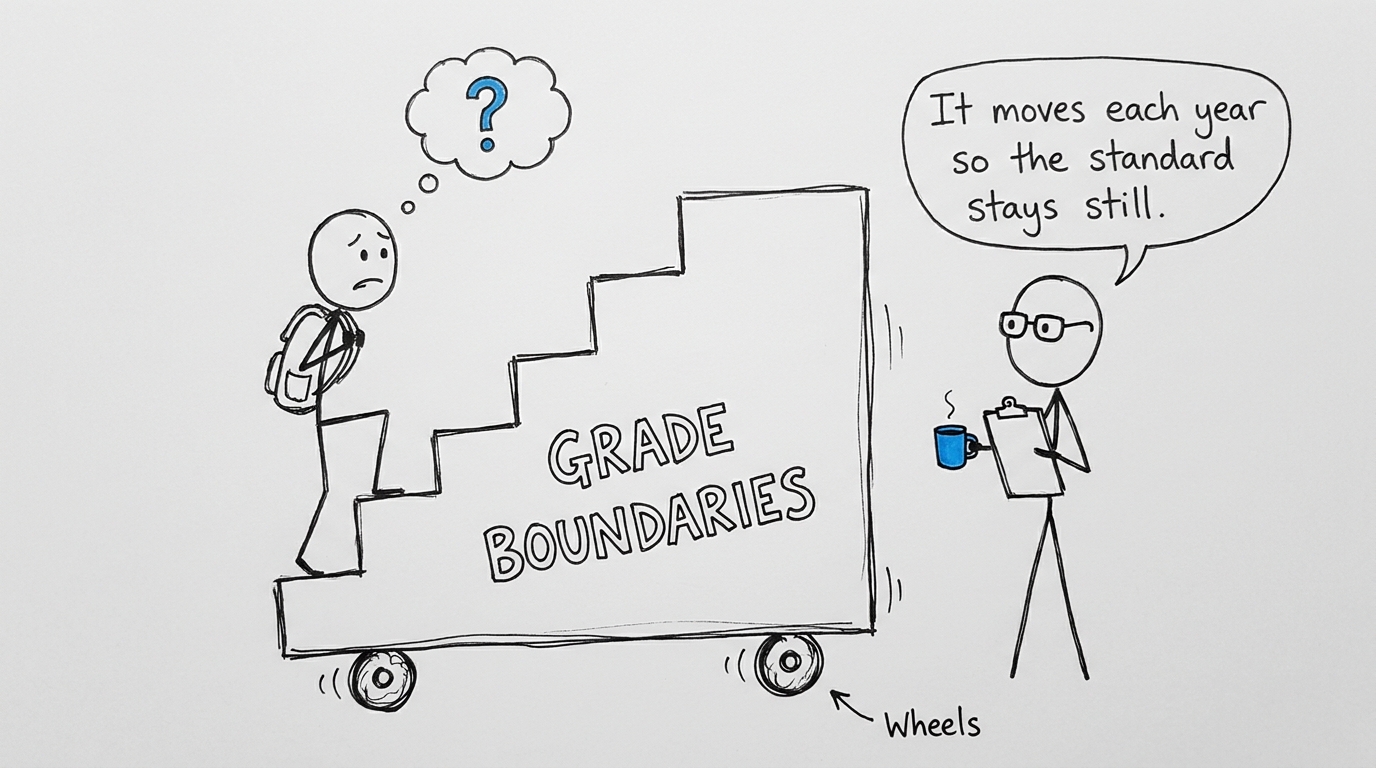 A moving grade-boundary staircase keeps the academic standard still
That is why last year's OCR biology grade boundaries are useful context, but poor promises. They can help you interpret a past paper; they cannot tell you the exact grade attached to an unfinished or future exam series.
What to do on GCSE Biology results day
GCSE results day in England is Thursday 20 August 2026. Your school decides how and when you collect your results, so follow its instructions.
When you receive your result:
- confirm that the subject and grade are recorded correctly;
- ask for your component marks if they are not shown;
- check the correct OCR specification and tier;
- compare your overall mark with the official boundary;
- speak to a teacher or exams officer before making decisions about post-results services.
If you are close to the next grade, that does not automatically mean a review will raise the result. Marks can stay the same, rise or fall. Your school can explain access to scripts, reviews of marking, deadlines and any fees before you decide.
Common mistakes when reading OCR biology grade boundaries
Mixing up Biology A and Biology B
J247 and J257 have different papers and different boundaries. The word “OCR” alone is not enough; check your entry code.
Comparing one paper with the overall boundary
The tables above use totals out of 180180180. A mark from one 909090-mark paper cannot be compared directly with them.
Treating boundaries as fixed revision targets
A historical grade 777 boundary can provide perspective, but aiming only for that exact mark leaves no room for changing paper difficulty or ordinary exam slips. Revise for secure understanding and collect every available mark.
Ignoring maths within Biology
Rates, percentages, graphs, sampling and data interpretation can quietly decide several marks. Use the environmental monitoring revision guide alongside OCR GCSE Maths video lessons when numerical skills are costing you marks.
Turn boundaries into better revision decisions
A boundary tells you where a grade began; a marked paper tells you what to improve. Start with the free GCSE Biology revision hub, complete OCR questions without notes, mark them strictly and record why each mark was lost. The guide to revising OCR Biology without wasting time provides a practical attempt, feedback and correction routine.
MathsGenie brings together revision lessons, OCR Biology revision guides, practice questions, mark schemes and past papers. For your wider exam preparation, you can also use the GCSE Maths revision hub and GCSE predicted papers. Begin with one weak Biology topic today, answer questions, mark them honestly and turn the uncertainty of a boundary into a revision plan you can control.