Catch Up GCSE English Language After Absence
Catch up GCSE English Language after absence with a realistic plan for missed work, exam practice, teacher support and balanced maths revision.
Missing several weeks of school can make GCSE English Language feel strangely difficult to re-enter. Your class may be discussing a paper you have never seen, your folder may contain gaps, and every missed lesson can seem equally urgent. If you are trying to catch up GCSE English Language after absence, begin with three actions: ask your teacher exactly what was covered, identify which exam skills you missed, and build a short weekly routine around practice and feedback. Do not attempt to recreate every lesson in order.
That last point matters. Catching up is not the same as copying up. English Language rewards your ability to read unfamiliar texts, explain effects, compare ideas and write effectively under timed conditions. Your recovery plan should rebuild those skills while protecting enough time for your other subjects, including GCSE Maths.
Your catch-up checklist
Use this checklist before doing hours of independent revision:
- Tell your English teacher what material you already have and what is missing.
- Confirm your exam board: AQA, Edexcel, OCR or Eduqas.
- Ask for the missed lesson titles, texts, assessments and homework.
- Check which reading and writing skills were taught.
- Obtain your exam board's current paper structure from your school.
- Complete one short diagnostic task rather than an entire paper immediately.
- Ask your teacher which two gaps should be addressed first.
- Schedule short sessions across several days.
- Continue regular maths practice instead of abandoning one subject for another.
- Review your plan after one week and reduce it if illness-related fatigue continues.
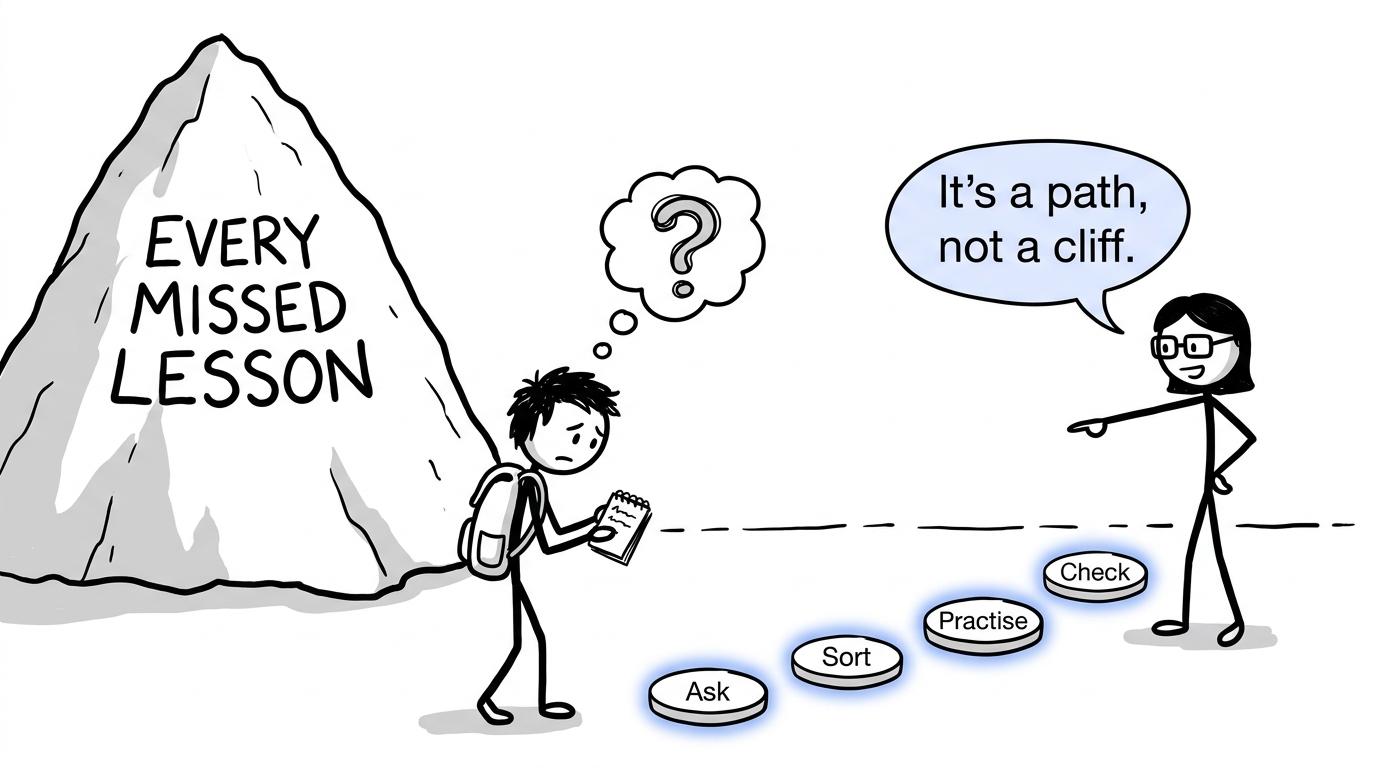 A returning student chooses a manageable path through missed lessons
Find out what you actually missed
The mind tends to turn an unknown gap into an enormous one. A list makes it finite.
Ask your teacher for a simple curriculum summary covering your absence. Useful questions include:
- Which paper or unit did the class study?
- Which reading question types were practised?
- Was the focus fiction, non-fiction or transactional writing?
- Did the class complete a timed assessment?
- Is there teacher feedback or a model response you should read?
- Are any speaking and listening activities still outstanding?
GCSE English Language is not divided into foundation and higher tiers in the way GCSE Maths is. However, paper structures, question wording and assessment arrangements differ between exam boards. A useful technique taught for one specification may still develop your reading, but you should practise the exact format used by your school.
Do not rely on a friend's memory of what happened. Ask for the department's lesson resources, shared files and assessment dates. If your absence continues, request one named contact who can send essential work. This is usually more manageable than receiving separate messages from several teachers.
Prioritise skills, not pages of notes
A complete folder can feel reassuring without proving that you can answer an exam question. Once you know what was covered, divide the missed work into three groups.
Essential exam skills
These are skills that directly affect your ability to complete a paper. They may include retrieving information, making inferences, analysing language or structure, comparing viewpoints, evaluating a text and organising extended writing.
Place these first. If you missed several lessons on language analysis, for example, your aim is not to copy every slide. It is to understand what the question asks, attempt a response and receive feedback.
Supporting knowledge
This includes terminology, planning methods, vocabulary and reminders about punctuation or sentence control. Learn what helps you communicate accurately, but avoid collecting elaborate terminology that you cannot apply precisely.
Material you can skim or leave
Some classroom activities exist to introduce discussion, provide extra practice or help a particular class at a particular moment. Your teacher can tell you whether these need to be repeated. Catch-up becomes realistic when you accept that not every missed worksheet has equal value.
Build a realistic four-week recovery plan
A useful plan is small enough to survive an ordinary school week. It should account for lessons, homework, sleep and recovery from illness.
| Week | English Language priority | Maths protection |
|---|---|---|
| First week | Collect materials and complete one short diagnostic task | Keep two short topic-practice sessions |
| Second week | Relearn the highest-priority reading skill and apply it | Continue current classwork and one mini test |
| Third week | Practise the highest-priority writing skill and seek feedback | Review one weak topic using practice questions |
| Fourth week | Complete timed sections, review errors and agree next steps | Use a past-paper section or predicted-paper task |
Each English session can follow a simple structure: review the question demands, attempt a focused task, check it against guidance, and record one improvement. Twenty-five purposeful minutes may produce more progress than an evening spent rewriting someone else's notes.
If you are also preparing for maths exams, use the free GCSE Maths revision resources to choose work by grade and topic. A planned English catch-up should sit beside maths revision rather than consume it.
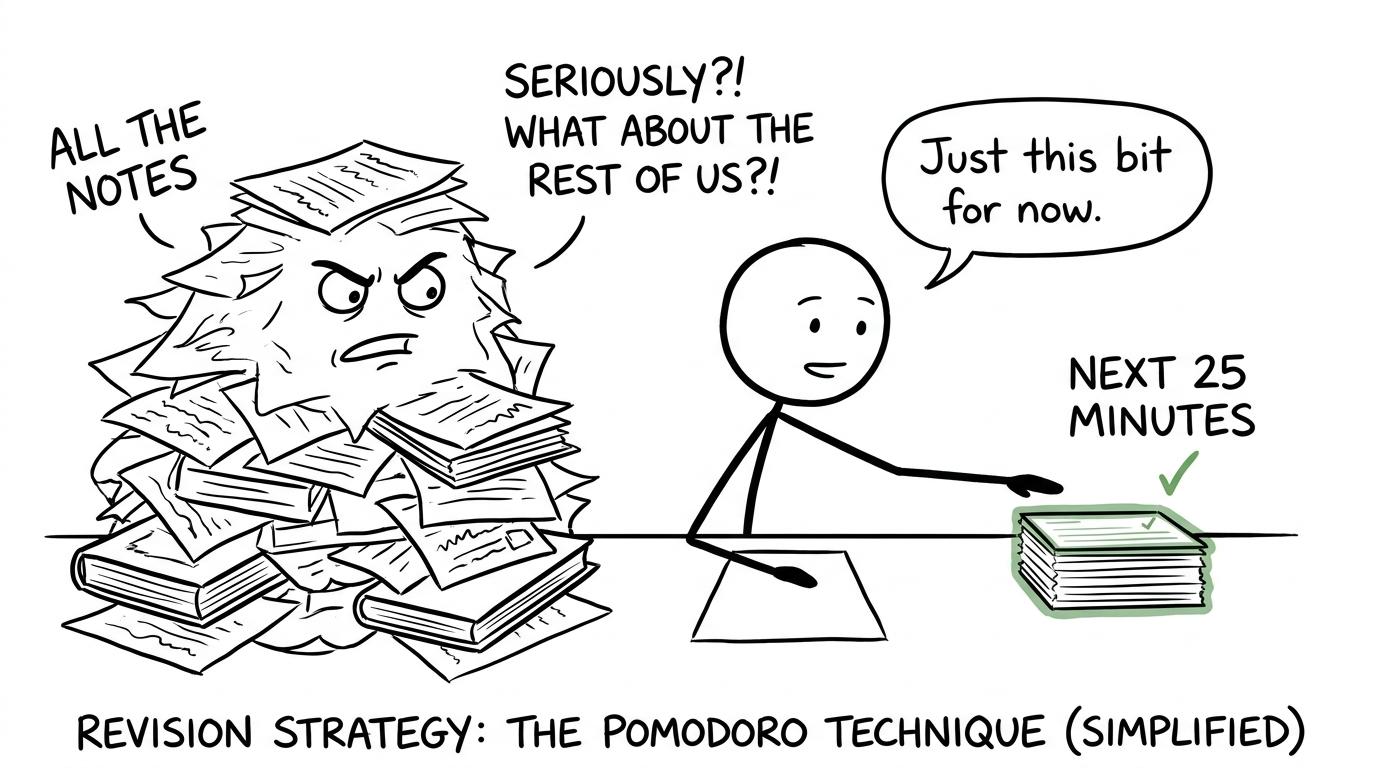 A student chooses the next short revision session instead of the enormous pile
Use diagnosis before intensive revision
Your first task should be informative, not punishing. Choose a short reading question or one writing plan from the paper your class has studied. Attempt it without spending hours preparing, then ask your teacher to identify the most important improvement.
Feedback might reveal that your main issue is understanding the command word, selecting evidence, explaining an effect, structuring paragraphs or controlling the timing. That is far more useful than assuming every missed topic is equally weak.
Apply the same principle in maths. MathsGenie's grade 444 revision topics, grade 555 revision topics and grade 777 revision topics let you locate practice at an appropriate level. Videos can rebuild understanding, while practice questions and mark schemes test whether that understanding holds.
The sequence is simple: diagnose, practise, check, adjust. It works because it replaces vague worry with evidence.
Practise English Language actively
English Language revision can become passive very quickly. Reading model answers is useful, but only if it changes what you do next.
Use a mixture of these activities:
- annotate a short extract with a specific question in mind;
- plan an answer under a brief time limit;
- write one developed paragraph and improve it after feedback;
- compare your response with the mark scheme or teacher guidance;
- edit a piece of writing for structure, clarity and technical accuracy;
- complete timed sections once the underlying skill is secure;
- keep an error log containing no more than a few recurring priorities.
When reviewing a mark scheme, remember that it describes qualities of performance. It is not normally a script into which you insert memorised phrases. Your teacher can help translate broad assessment language into a practical next step.
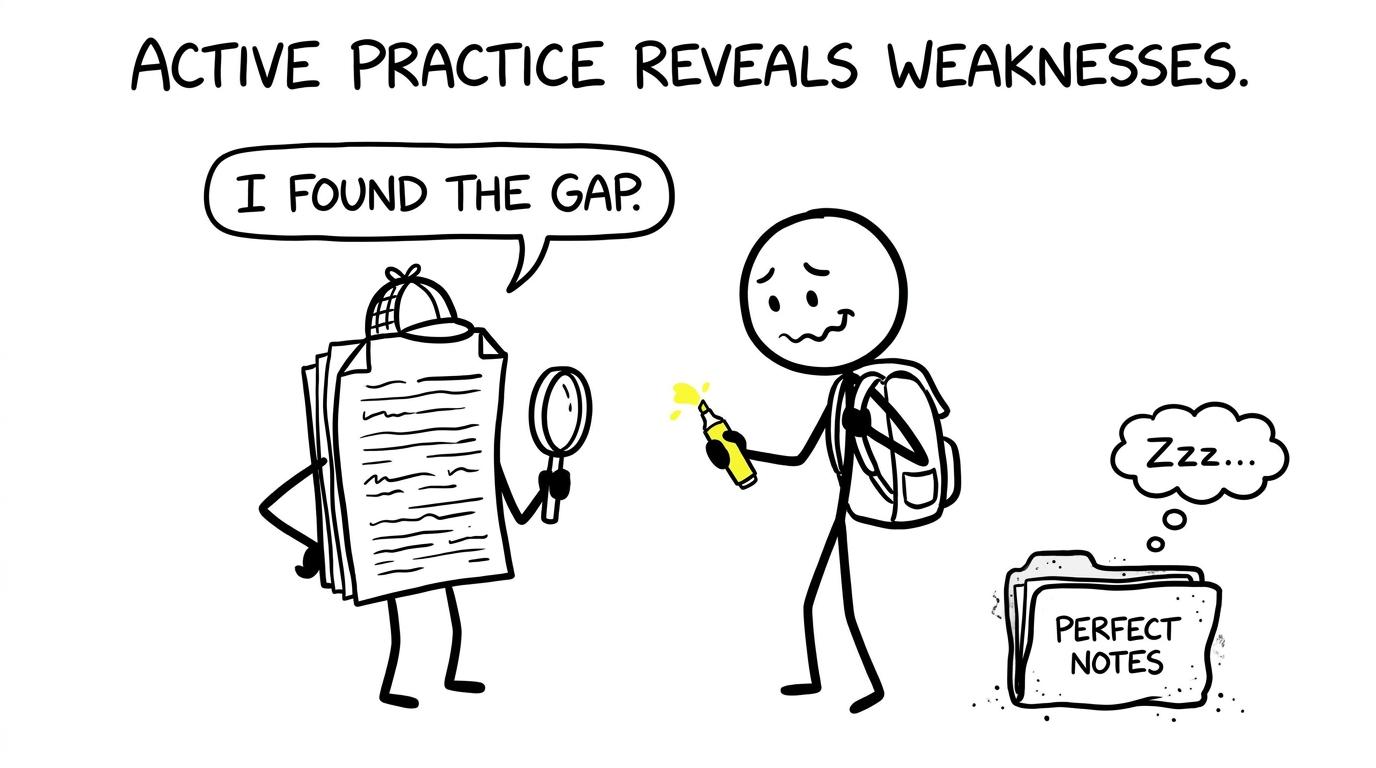 A detective practice paper finds the gap while perfect notes sleep
Protect your maths revision while catching up
Students preparing for GCSE exams often respond to a gap in one subject by temporarily dropping another. The problem is that mathematical fluency fades when practice disappears completely.
Keep a minimum routine. Two or three short maths sessions each week can maintain contact with algebra, number, geometry, ratio, probability and statistics. Choose one current classroom topic and one older weakness rather than moving randomly through the specification.
MathsGenie's GCSE past papers and mark schemes are useful once you need broader assessment practice. The GCSE predicted papers can provide further exam-style preparation, but they should complement revision lessons and past papers rather than replace them.
A revision planner can help you alternate subjects across the week. For maths, use a revision lesson, attempt the associated practice questions, mark the work honestly and return to mistakes. Mini tests and video solutions then give you a focused way to check progress without completing a full paper every evening.
Ask for the right support after illness
If you are still unwell, a demanding timetable may delay rather than accelerate your return. Speak to your parent or carer, form tutor, head of year and relevant subject teachers about what is realistic. Your school's pastoral or special educational needs team may also be able to coordinate support.
Possible school-based adjustments could include phased deadlines, prioritised work, access to lesson materials or a quieter place to catch up. What is appropriate depends on your circumstances and school arrangements.
If a health condition may affect public examinations, ask your school's exams officer or special educational needs co-ordinator early. Formal access arrangements and special consideration have specific rules and evidence requirements. They are handled through the school, and a diagnosis does not automatically lead to a particular arrangement. Do not wait until an examination day to begin that conversation.
Common mistakes when catching up after absence
Copying everything before attempting anything
Neat notes can hide uncertainty. Copy only the essential guidance, then apply it to a focused task.
Starting with a full timed paper
A complete paper may be overwhelming when you do not yet know the question format. Begin with a diagnostic section and build towards full-paper practice.
Using resources for the wrong exam board
The broad skills overlap, but question sequences, wording and timings can differ. Confirm your specification before practising paper technique.
Creating an impossible timetable
A plan that assumes perfect health and unlimited concentration will collapse. Include rest, ordinary homework and smaller sessions for other subjects.
Treating feedback as a judgement
Feedback is most useful when converted into one action. Instead of recording “analysis needs detail”, ask what detail is missing and practise that feature in the next response.
Neglecting maths until English is fixed
There is rarely a clean moment when one subject becomes completely finished. Maintain a small maths routine using MathsGenie's free GCSE revision hub while you repair the English gap.
Move forward without recreating the past
To catch up GCSE English Language after absence, you do not need to rebuild every missed school day. You need an accurate map of what was covered, a clear order of priority, active practice and regular teacher feedback. Start with the next manageable task, then let its result decide what follows.
Keep the same calm structure across your exam preparation. Use MathsGenie's revision lessons and video solutions to relearn maths topics, practice questions and mini tests to test them, and past papers, predicted papers and mark schemes to develop exam technique. Visit the MathsGenie GCSE Maths revision page, choose one topic, and make today’s next step small enough to complete.