GCSE Engineering Discord Server: Is It Worth It?
GCSE engineering Discord server guide: discover the benefits, risks and safer ways to combine online communities with structured maths revision for exams.
A difficult engineering question can make revision feel strangely lonely. You may understand the design idea but not the calculation, while the mark scheme appears to skip the exact step you need. At that moment, joining a GCSE engineering Discord server can seem like the quickest route to an explanation.
It can help. A well-managed community may offer useful discussion, revision accountability and different ways of thinking about a problem. But it remains an informal support tool, not a replacement for your teacher, specification, textbook or structured maths practice.
The short answer is simple: join only if the server is safe, relevant and moderated, then use it to support active revision rather than consume your revision time.
A quick checklist before joining
A useful subject community should have:
- clear rules and active moderation;
- channels organised by topic rather than one endless conversation;
- an obvious ban on cheating, harassment and sharing assessed work;
- explanations that encourage students to show methods;
- privacy controls and sensible boundaries around direct messages;
- content relevant to your qualification and exam board;
- a culture where sources and mark schemes matter more than confidence;
- enough focus that you can leave after solving the problem you brought.
If several of these features are missing, the server may create more noise than progress.
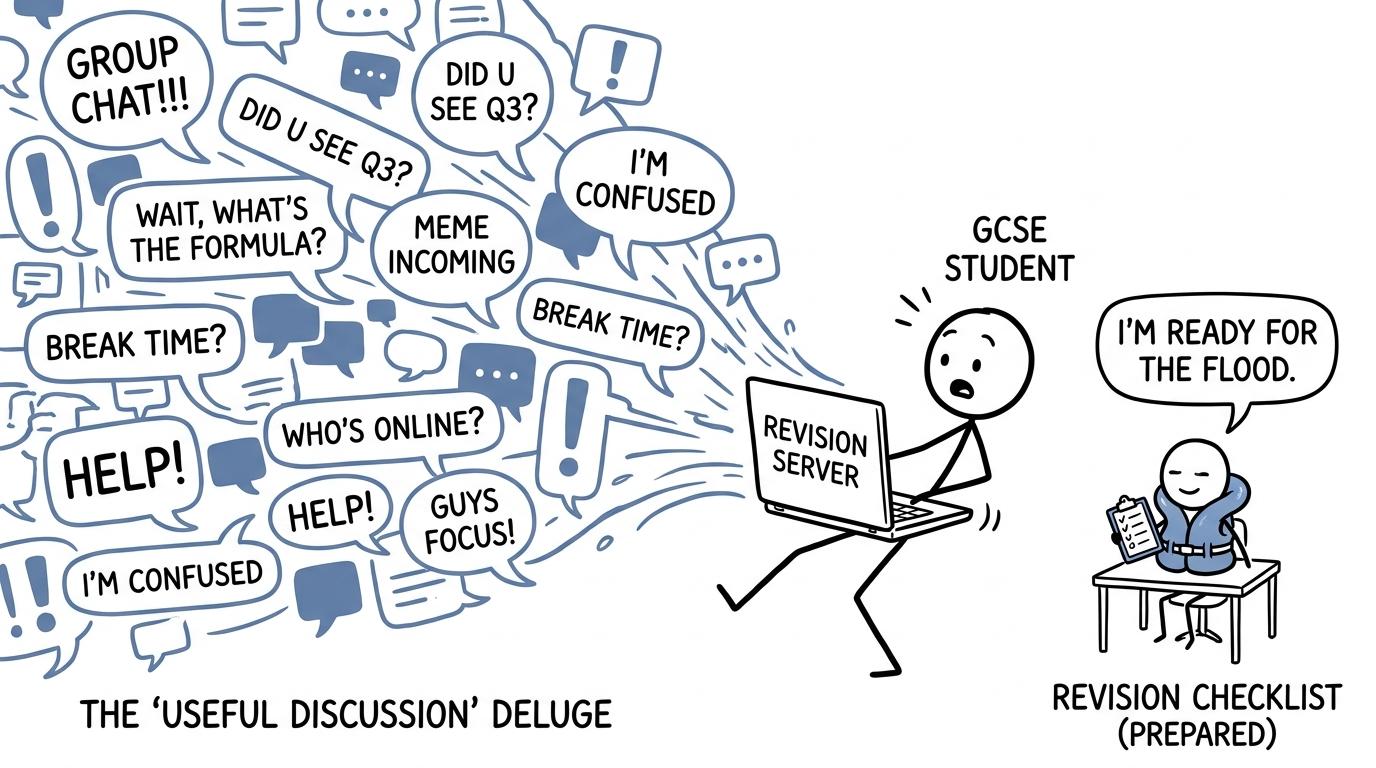 A revision checklist tries to survive a waterfall of online notifications
What a GCSE engineering Discord server can realistically offer
The best reason to join is not instant answers. It is access to productive conversations that help you identify what you do not yet understand.
Explanations in different language
Teachers, textbooks and videos cannot predict every point of confusion. Another student may describe a force, scale drawing or ratio in language that makes the idea click. That explanation is not automatically authoritative, but it can reveal a new route into the topic.
Engineering also connects several areas of GCSE maths. Depending on your course and specification, you may encounter measurement, units, scale, proportion, graphs, geometry, standard form and formulae. A discussion can help you recognise which mathematical skill sits underneath an engineering question.
Once you have identified that skill, move to a structured resource. The MathsGenie GCSE revision page organises free lessons and practice by topic and grade, making it easier to repair the precise gap rather than continue scrolling through chat.
Help with interpreting questions
Sometimes the calculation is not the main obstacle. The problem is deciding what the question wants.
A focused community can help you unpack command words, identify the relevant quantities and distinguish useful information from context. It can also encourage good questions. Instead of posting “I do not get this”, explain what you tried, where your reasoning changed and which line of the mark scheme caused difficulty.
That habit has value beyond Discord. Clear questions reveal clear thinking.
Revision accountability
Online communities can create a gentle sense that other people are working too. Topic check-ins, quiet revision rooms and short goal-setting threads may help you begin when motivation is low.
The important word is begin. Accountability should lead to independent work. A message saying that you plan to complete ratio questions is not revision; completing the questions, checking the mark scheme and correcting mistakes is revision.
You can build that structure through the topic lists and practice materials on the GCSE maths revision hub, then use a community only for unresolved questions.
Exposure to common misconceptions
Seeing other students make mistakes can be useful when the discussion explains why the mistake occurred. Engineering calculations often depend on units, sensible accuracy and correct substitution. A conversation about an incorrect answer may highlight a check that you were not performing yourself.
However, misinformation travels through a chat just as easily as insight. Popular agreement is not evidence that a method matches your specification.
Why engineering students still need structured maths revision
Engineering contexts change, but the underlying mathematics is usually more stable. A design problem may involve a scale factor; a materials question may involve area, volume or density; a technical graph may require gradients or interpretation.
Useful relationships might include:
density=massvolume\text{density}=\frac{\text{mass}}{\text{volume}}density=volumemassor a percentage change expressed as:
percentage change=changeoriginal amount×100\text{percentage change}=\frac{\text{change}}{\text{original amount}}\times 100percentage change=original amountchange×100Knowing a formula is only the beginning. You must select it appropriately, keep units consistent, substitute accurately and communicate enough method to earn marks.
That is why informal discussion should sit beside deliberate practice. Use MathsGenie practice questions and revision lessons to strengthen the underlying technique. Then test whether you can recognise and apply it inside an unfamiliar engineering context.
Past papers add another layer. They expose you to exam wording, realistic mark allocations and the level of detail expected in a written solution. MathsGenie provides GCSE maths past papers with mark schemes and supporting solutions across major exam boards.
The risks of relying on Discord too much
A community becomes unhelpful when it replaces the difficult mental work that revision requires.
Confident answers can still be wrong
A polished explanation may contain an incorrect assumption, an unsuitable formula or a rounding error. Users may also be following another exam board, tier or qualification.
Check important advice against your teacher, the current specification and an official mark scheme. For maths exam practice, compare community suggestions with the methods accepted in the relevant Edexcel, AQA, OCR and Eduqas paper collections.
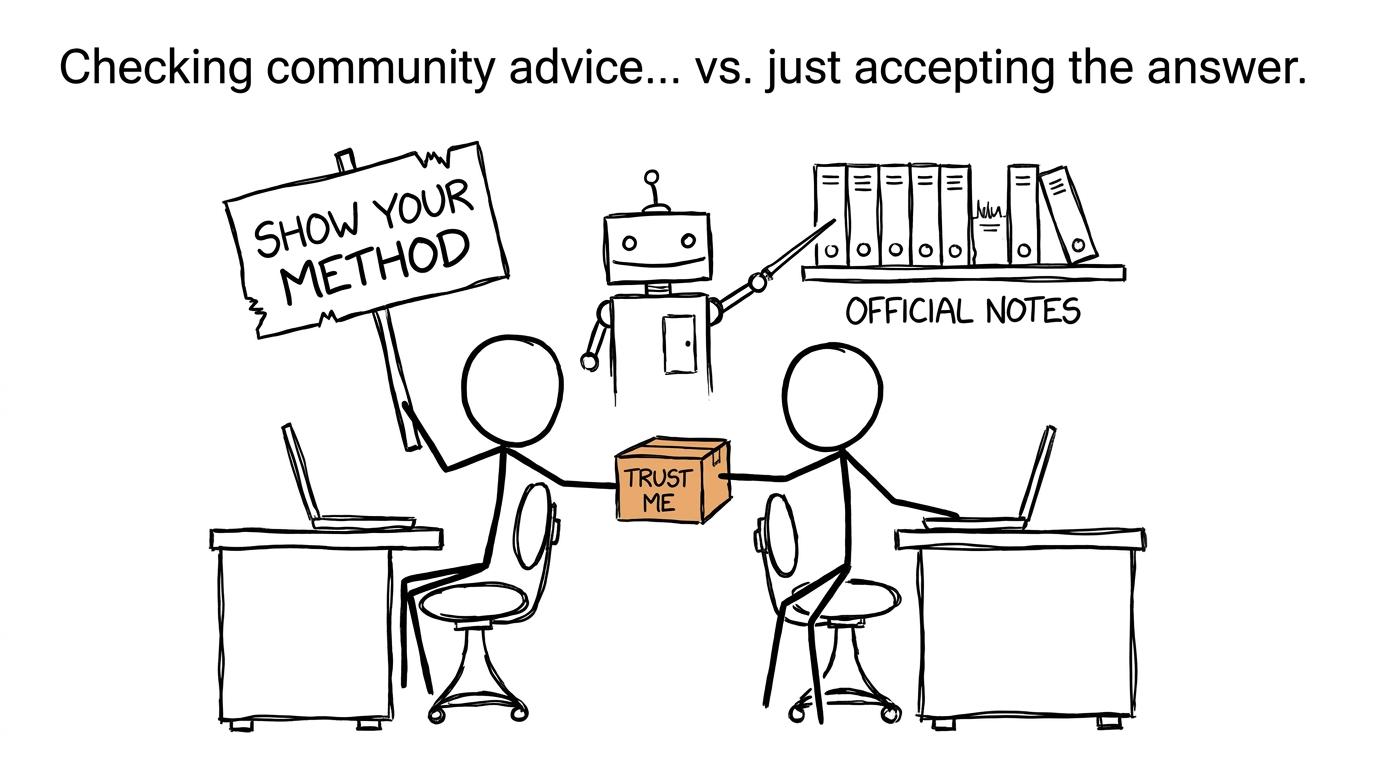 A mysterious answer competes with a request to show the method
Reading solutions can imitate understanding
A solution often feels obvious after somebody else has written it. That feeling is unreliable. Recognition is easier than recall.
After receiving help, close the explanation and attempt the question again independently. Return to it later without prompts. If you still need the chat history, the method has not yet become yours.
Notifications fragment attention
Discord is built around conversation, not the order of your specification. A useful question can quickly become ten unrelated channels, several notifications and a discussion that has nothing to do with your next exam.
Set a narrow purpose before opening the app. For example: find one explanation, ask one question or join one timed revision session. Mute unnecessary channels and leave when the task is complete.
Coursework and assessment boundaries matter
Do not upload confidential assessment material or ask another person to complete work that must be your own. Avoid sharing full coursework files, personal school information or restricted exam content. Your teacher and awarding body guidance should determine what collaboration is permitted.
Legitimate support improves your understanding. It does not disguise somebody else’s work as yours.
Public communities carry safeguarding risks
Discord generally requires users to meet its minimum age rules, which can vary by country, but meeting an age threshold does not make every server safe. Public communities may include strangers, unsolicited direct messages, inappropriate material or attempts to collect personal information.
Use a non-identifying username, review privacy settings and avoid revealing your full name, school, timetable, address or location. Do not move conversations into private calls simply because someone offers tutoring or files. Block and report concerning behaviour, leave unsafe spaces and tell a trusted adult.
How to use an online engineering community well
Treat Discord as a help desk rather than a revision curriculum.
A balanced routine could look like this:
- choose a topic from your specification;
- learn or review the method using a structured lesson;
- complete practice questions without chat assistance;
- check your answers and record mistakes;
- ask the community about one specific unresolved point;
- verify the response against a trusted source;
- redo the question independently;
- revisit the skill through exam questions later.
This sequence protects the most valuable part of revision: attempting something before seeing the answer.
For maths, begin with the MathsGenie GCSE topic resources. As exams approach, use past papers and mark schemes under timed conditions. Predicted papers can then provide additional practice, but they cannot guarantee which topics will appear and should never replace broad specification coverage.
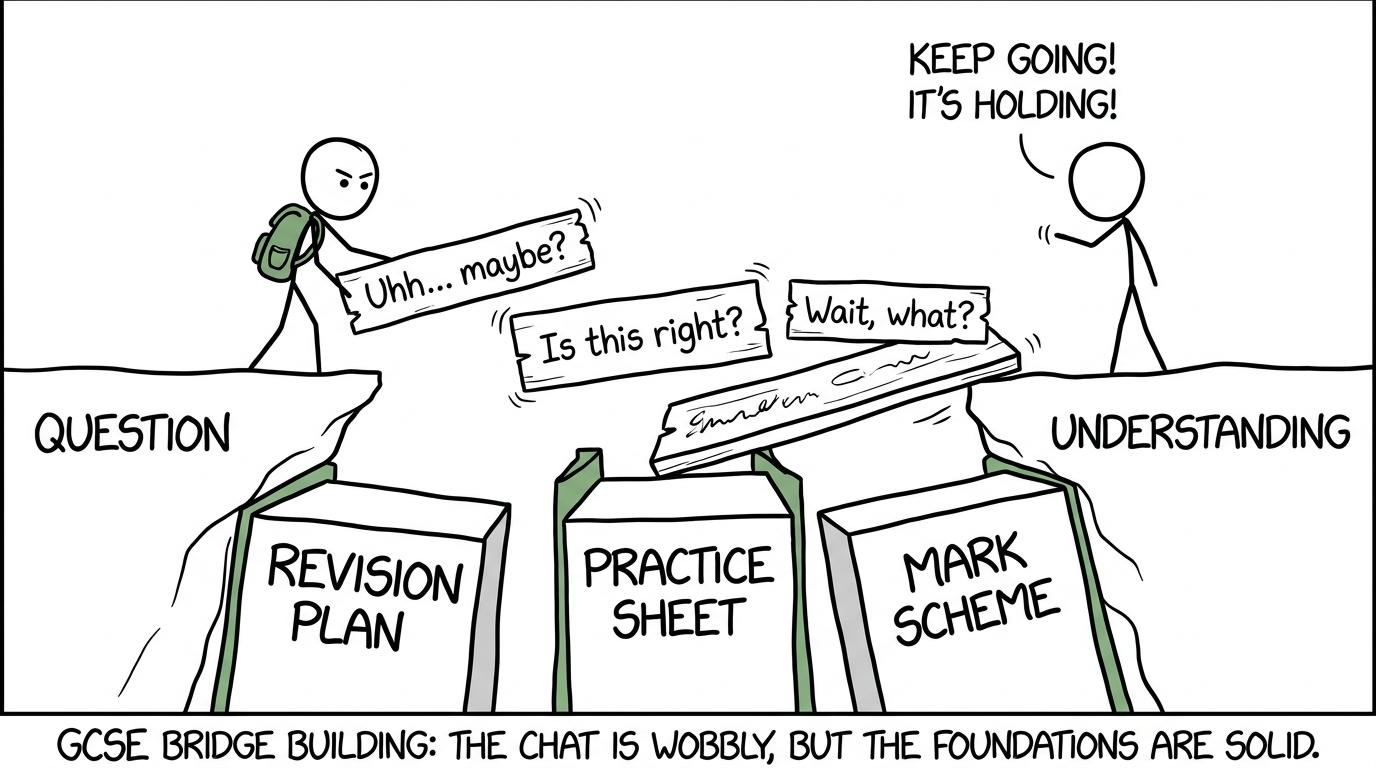 A revision plan and mark scheme support a bridge towards understanding
How to judge the quality of advice
Before trusting an answer, ask four questions.
Does it match your course?
Engineering qualifications and course content are not identical across schools. Confirm the qualification, awarding body and current specification. For the separate maths exam, also check whether the advice applies to foundation or higher tier.
Is the method explained?
An unexplained final answer gives you little protection against a changed question. Useful help identifies the principle, shows the reasoning and leaves enough work for you to complete independently.
Can you verify it?
Compare mathematical methods with your notes, a revision lesson and an official mark scheme. MathsGenie’s GCSE paper archive is particularly useful for seeing how correct methods are rewarded in real exam questions.
Can you reproduce it alone?
The final test is not whether you understand the message while reading it. It is whether you can solve a related problem later, without the message.
Common mistakes when joining revision servers
Joining too many communities: More servers usually mean duplicated resources and more notifications, not broader understanding. Choose one carefully and review whether it helps after a week.
Using chat as the first step: Attempt the question before asking for help. Even an incomplete attempt gives other students something precise to respond to.
Copying without checking: A correct-looking answer can use the wrong units, degree of accuracy or exam-board convention. Verify it before adding it to your notes.
Confusing activity with progress: Reading hundreds of messages may feel productive while leaving no completed questions behind. Measure revision through work checked and corrected.
Sharing too much information: Keep your identity, school details and private files out of public channels. Report concerning messages rather than trying to manage them alone.
Ignoring the specification: Community enthusiasm can pull you towards advanced or irrelevant content. Interesting mathematics has value, but exam revision should begin with what you are actually required to know.
A community should support the system, not become it
A good GCSE engineering Discord server can make revision feel less isolated. It may help you phrase better questions, discover another explanation and maintain momentum. Its value is real but limited.
Your dependable revision system should still be built from the specification, lessons, deliberate practice, feedback and exam questions. That system works even when nobody online replies.
Use MathsGenie as the structured centre of that process. Start with free GCSE revision lessons, videos and practice questions, then move to past papers, predicted papers and mark schemes. Use mini tests and a revision plan to identify what needs attention next. If an online community helps you complete that work more thoughtfully, keep it. If it mainly produces distraction, mute it and return to the question in front of you.