

GCSE Biology Grade 5 Meaning: What It Really Shows
GCSE biology grade 5 meaning explained: ability, old letter-grade comparison, tier limits, grade boundaries and practical steps to improve your result.

A result can look wonderfully precise. One number, printed beside one subject. Yet the meaning behind it is wider than the ink.
The short answer to gcse biology grade 5 meaning is this: a grade 555 shows a good, secure performance in GCSE Biology. It sits above the grade 444 benchmark and is commonly described as a strong pass. Compared with the old letter system, it falls between a high grade C and a low grade B, although there is no exact one-to-one conversion.
More importantly, it suggests that you can recall and apply biological knowledge, handle data and calculations, interpret evidence, and reason about experimental methods with reasonable accuracy. It does not mean that you answered half the paper correctly, nor is it a fixed percentage across every year or exam board.
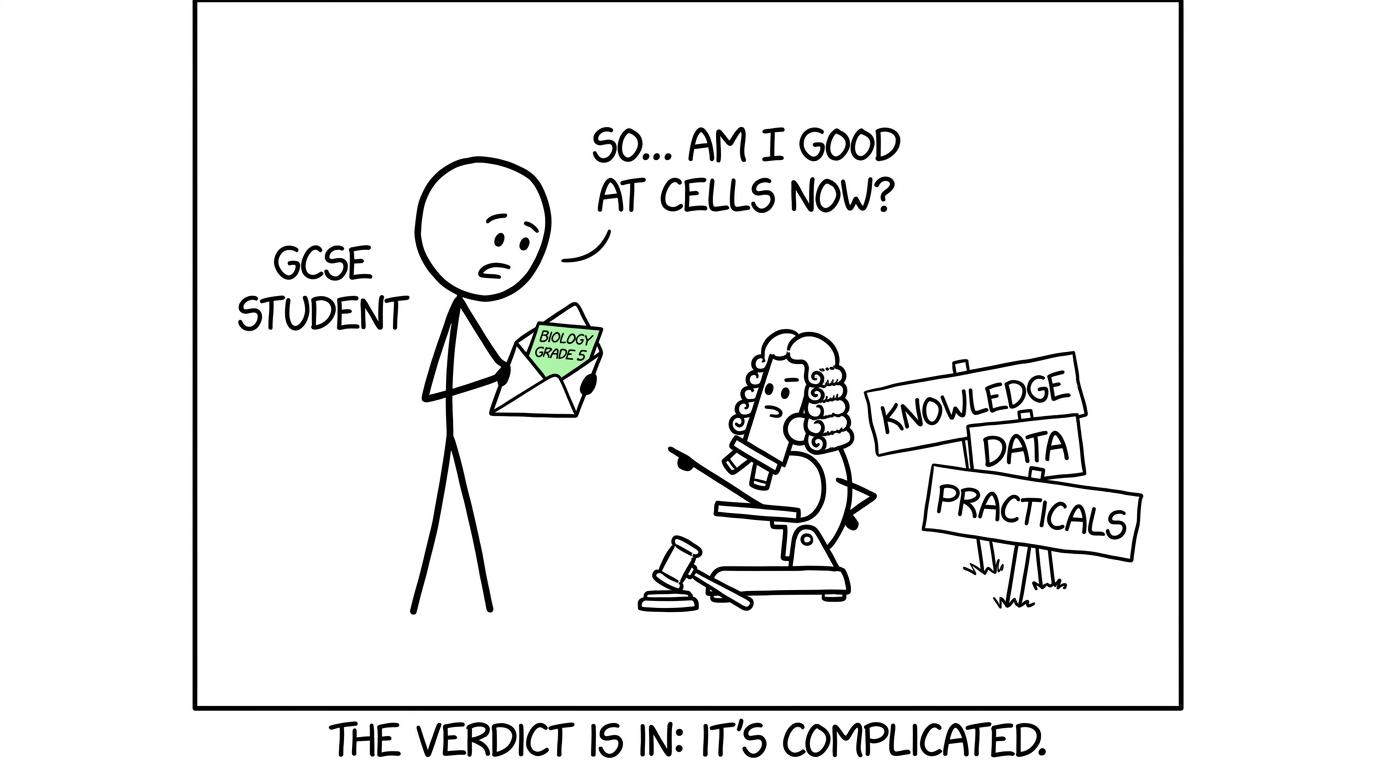 A microscope delivers its verdict on a Biology grade 5
Grade 5 at a glance
Here is the practical picture:
- Grade 555 is above grade 444 and below grade 666 on the GCSE grades 999-111 scale.
- It is often called a strong pass, particularly in school performance measures.
- It broadly overlaps the upper part of the old grade C and the lower part of grade B.
- It represents more than factual recall: application, calculations, data analysis and evaluation matter.
- It is available on both foundation and higher tier in GCSE Biology, although foundation tier is capped at grade 555.
- The raw mark needed changes between exam series and awarding organisations.
- A grade 555 in separate GCSE Biology is not the same qualification result as 555-555 in Combined Science.
That final distinction matters. Separate Biology produces one GCSE grade. Combined Science normally produces a pair of linked grades representing achievement across biology, chemistry and physics together.
What ability does a grade 5 represent?
Official grade descriptors are intended to indicate the typical performance found around the middle of a grade. They are not a checklist that every grade 555 student must satisfy perfectly.
At this level, a student will generally be able to:
- demonstrate mostly accurate biological knowledge and understanding;
- apply that knowledge mostly correctly in familiar and unfamiliar situations;
- use scientific terminology with reasonable accuracy;
- select suitable mathematical methods for multi-step calculations;
- analyse qualitative and quantitative information;
- draw plausible conclusions supported by some evidence;
- evaluate an investigation and suggest sensible improvements;
- comment on whether scientific conclusions are justified.
The phrase mostly accurate is useful. A grade 555 student is not expected to produce flawless grade 999 responses. They may miss fine detail, give an incomplete evaluation or make occasional errors when several ideas must be connected. But the underlying understanding is usually sound enough to deal with much more than simple recall.
A grade is therefore evidence of performance across the whole assessment. One excellent answer on genetics cannot cancel every gap in ecology, and one difficult calculation does not define the entire result.
How grade 5 compares with the old letter grades
The grades 999-111 system was designed with several reference points to the former A*-GGG scale. Grade 444 was aligned broadly with the bottom of the old grade C, while grade 777 was aligned broadly with the bottom of the old grade A.
Grade 555 lies between those anchor points. The most useful comparison is:
| Current GCSE grade | Broad old-grade comparison | Common interpretation |
|---|---|---|
| Grade 444 | Standard grade C range | Standard pass |
| Grade 555 | High C to low B range | Strong pass |
| Grade 666 | Grade B range | Performance securely above grade 555 |
| Grade 777 | Around the old grade A threshold | Strong higher-grade performance |
This table is deliberately broad. Grade 555 is not simply the old grade B with a new name, and it is not possible to convert every historical result precisely. The systems divide attainment differently.
The phrase “strong pass” can also be misunderstood. It is a useful label, not a universal admissions rule. Sixth forms, colleges, apprenticeships and individual courses set their own entry requirements. If Biology matters for your next step, check the exact published requirement rather than assuming that the word “pass” settles it.
Does grade 5 mean a particular percentage?
No. There is no permanent percentage for grade 555 in GCSE Biology.
Awarding organisations such as AQA, Edexcel, OCR and Eduqas set grade boundaries for each exam series after the papers have been taken and marked. Boundaries account for differences in paper demand so that a slightly harder paper does not automatically disadvantage the students sitting it.
Your final grade is based on the total weighted mark across the relevant papers, not the percentage printed beside a classroom test. A school may use its own grade thresholds for mocks, but those are estimates rather than future official boundaries.
This is why chasing an old boundary can create false confidence. Past boundaries are useful context, but they are not promises. A better revision target is to increase the marks you can earn reliably across several papers and topics.
Foundation and higher tier implications
GCSE Biology is tiered. Foundation tier targets grades 111 to 555, while higher tier targets grades 444 to 999, subject to the awarding organisation's rules for students who narrowly miss the lowest targeted grade.
A foundation-tier grade 555 is the highest grade available on that tier. It represents a strong performance on the foundation paper, not an inferior version of the grade. The awarded grade has the same value.
However, tier choice affects the questions presented and the grades available. It should be made with your teacher using evidence from classwork, mocks and topic assessments. Choosing higher tier merely because grade 666 exists is not automatically helpful; the right paper is the one on which you can demonstrate your knowledge consistently.
Why maths matters in GCSE Biology
Biology is often imagined as a subject made entirely of cells, organs and long written answers. The paper has other plans.
For standalone GCSE Biology qualifications, at least 10%10\%10% of the assessment is allocated to mathematical skills at the appropriate level. Specifications include skills such as ratios, fractions, percentages, standard form, means, probability, graph interpretation, gradients, areas, volumes and order-of-magnitude thinking.
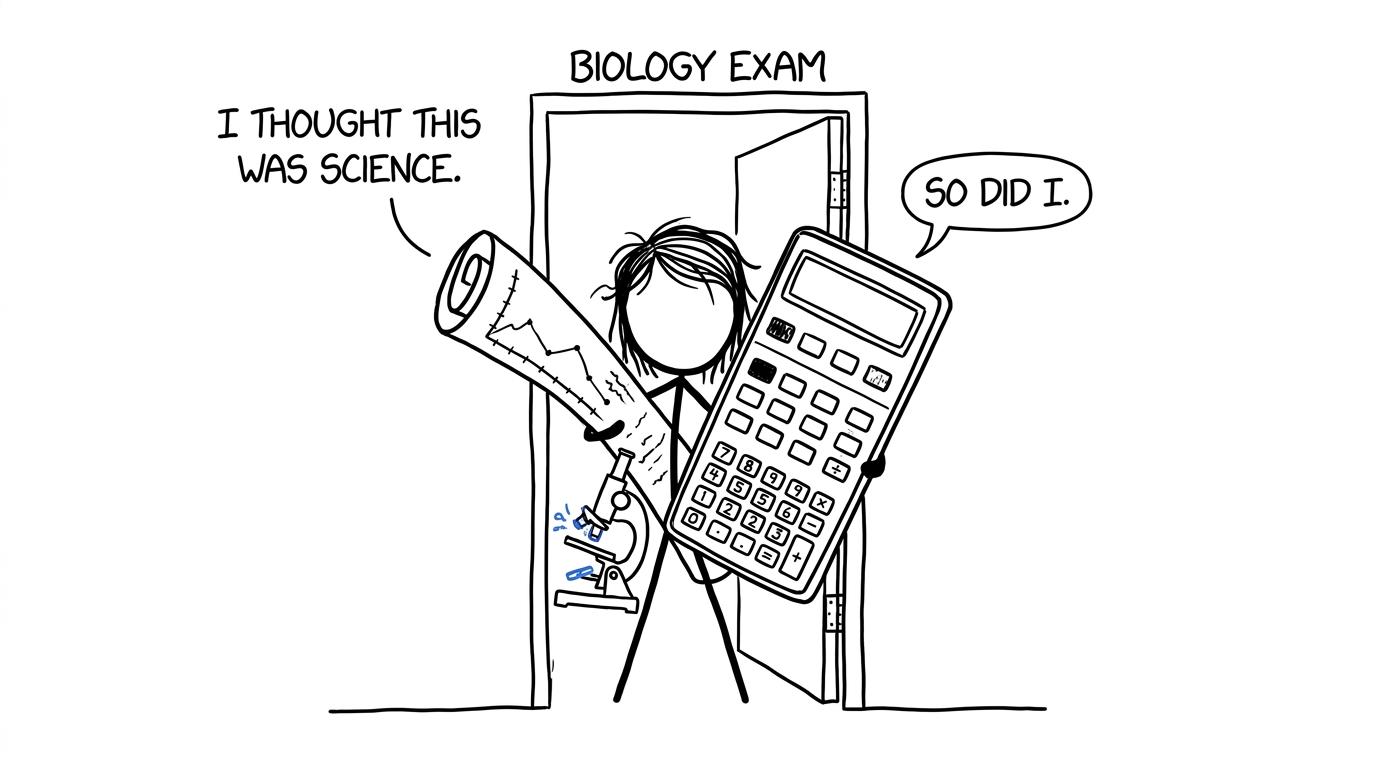 A graph and calculator discover they are sitting Biology
The formula for percentage change, for example, is:
percentage change=new value−original valueoriginal value×100\text{percentage change}=\frac{\text{new value}-\text{original value}}{\text{original value}}\times 100percentage change=original valuenew value−original value×100Knowing the formula is only one part of the skill. You must also select the correct values, preserve the sign where relevant, round appropriately and include a percentage symbol.
These are transferable GCSE Maths skills. MathsGenie's free GCSE Maths revision hub brings together lessons, exam questions, worksheets, videos and papers. The GCSE Maths topics by exam board and tier guide can help you locate the number, algebra, graph and statistics skills that support science.
Turning a grade 5 into a stronger result
Improvement rarely comes from vaguely “doing more Biology”. It comes from identifying where marks disappear.
Separate knowledge from exam skill
After completing a Biology paper, classify each lost mark:
- Knowledge: you did not know or remember the biological idea.
- Application: you knew the idea but could not use it in the context.
- Mathematics: the ratio, percentage, graph or substitution caused the problem.
- Practical work: you missed variables, controls, accuracy or evaluation.
- Communication: your response did not match the command word or lacked precision.
This turns a grade into a diagnosis. A student losing marks mainly through calculations needs a different plan from one forgetting the stages of cell division.
Repair mathematical weak spots directly
If data handling is costing marks, use the Edexcel GCSE Statistics revision resources for focused work on graphs, averages and interpreting evidence. For a broader strategy, the guide to GCSE Maths topics that appear regularly covers percentages, ratio, standard form, graphs and probability.
Maths practice should follow a short loop: review the method, answer questions without notes, check the solution, record the error and return to the skill later. MathsGenie's guide to finding your weakest GCSE topics explains how to track marks rather than relying on feelings.
Use papers as evidence
A past paper is most useful after it has been marked carefully. Record the marks available and marks earned for each skill. Your topic percentage is:
topic score=marks earnedmarks available×100%\text{topic score}=\frac{\text{marks earned}}{\text{marks available}}\times 100\%topic score=marks availablemarks earned×100%That is not a Biology grade boundary. It is a personal revision measure that helps you rank weaknesses.
MathsGenie's article on using OCR past papers effectively gives a marking and error-logging routine that transfers well to science papers. Obtain Biology-specific papers and mark schemes from your school or awarding organisation, because MathsGenie specialises in maths revision.
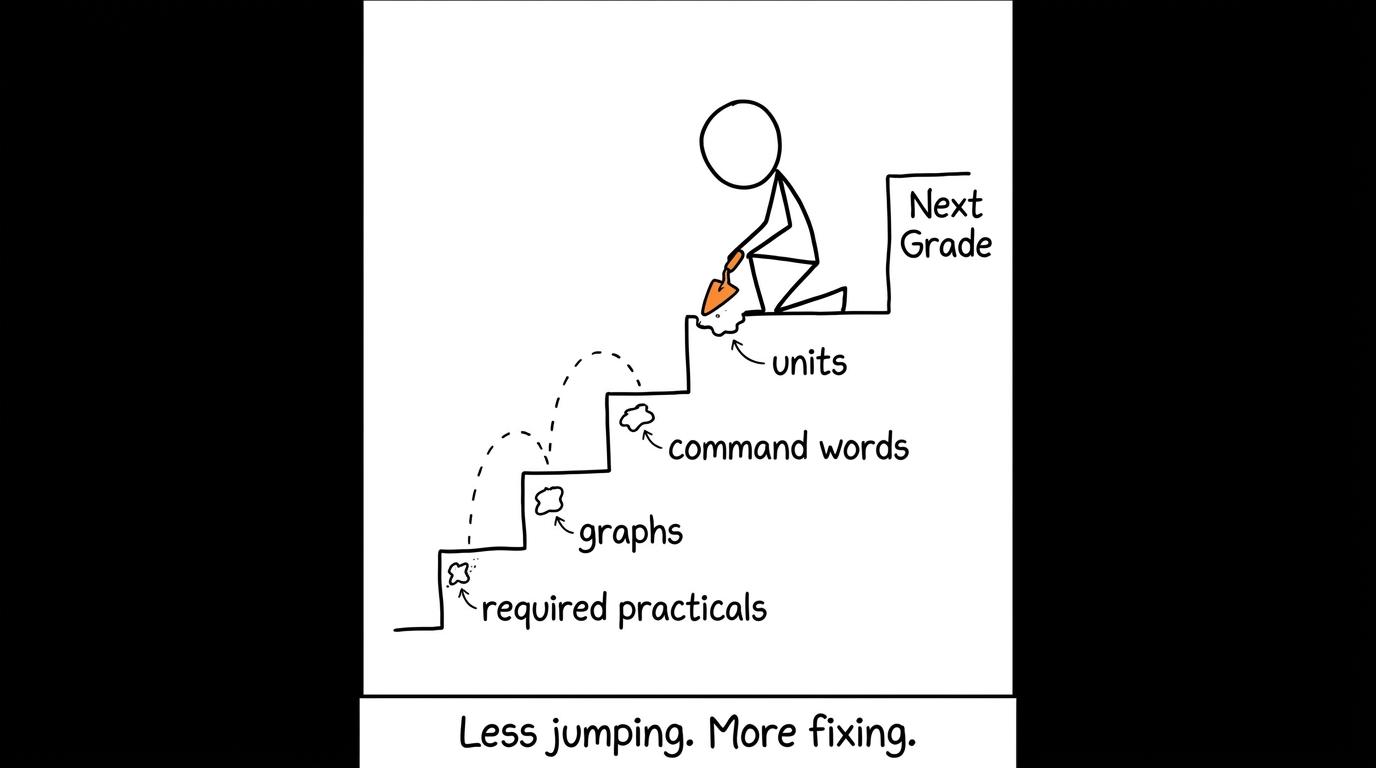 A student repairs small mark leaks instead of attempting a dramatic leap
Common mistakes when interpreting a grade 5
Treating it as exactly the old grade B
The old and new scales do not match grade by grade. High C to low B is a broad comparison, not an exact conversion.
Assuming it always requires the same percentage
Grade boundaries change by exam series and specification. Use official boundaries only for the paper to which they belong.
Confusing separate Biology with Combined Science
A Biology grade 555 is one separate GCSE result. A Combined Science result such as 555-555 is a double-grade outcome based on assessment across all three sciences.
Believing factual recall is enough
Modern GCSE Biology assesses application, data, mathematical skills, practical understanding and evaluation alongside subject knowledge.
Ignoring units and working
Correct ideas can still lose marks through missing units, premature rounding or unclear calculation steps. Strengthening these habits also supports your GCSE Maths papers. The guide to revising GCSE Maths without wasting time offers a focused lesson, practice and re-test cycle.
A grade is a snapshot, not a ceiling
The real gcse biology grade 5 meaning is not that you are “average at Biology” or incapable of reaching a higher grade. It means your assessed performance showed generally secure knowledge and a developing ability to apply, calculate, analyse and evaluate.
Use that information. Keep Biology revision aligned with your own exam board's specification and official papers, then use MathsGenie to strengthen the mathematical engine beneath your science marks. Start with free revision lessons and practice questions, check your methods with mark schemes and video solutions, and build exam confidence through mini tests, past papers and predicted papers for GCSE Maths.
A grade describes what happened on one set of assessments. Good revision decides what happens next.










