

GCSE: Find Your Weakest Topics (WJEC Students)
GCSE WJEC students: learn how to find your weakest topics fast using past papers, mark schemes and a simple tracker, plus maths methods to fix them.

If you’re a WJEC student revising for GCSE Chemistry, the hardest part often isn’t motivation; it’s accuracy. You can spend an hour “revising” and still feel like you’re guessing in the questions that matter. The real pain point is vaguer than a missed mark: you don’t know where your weakest topics are, so revision becomes a wide, anxious sweep.
Here’s the quiet truth: in exam season, progress usually comes from finding one leak at a time. Not the topics you like practising. Not the ones you’ve already “covered”. The ones that keep quietly taking marks.
And because you’re also a maths student (or at least you’re using maths in science), we’ll use a simple, numbers-first approach to find weaknesses quickly and fix them efficiently using free resources on YesGenie.
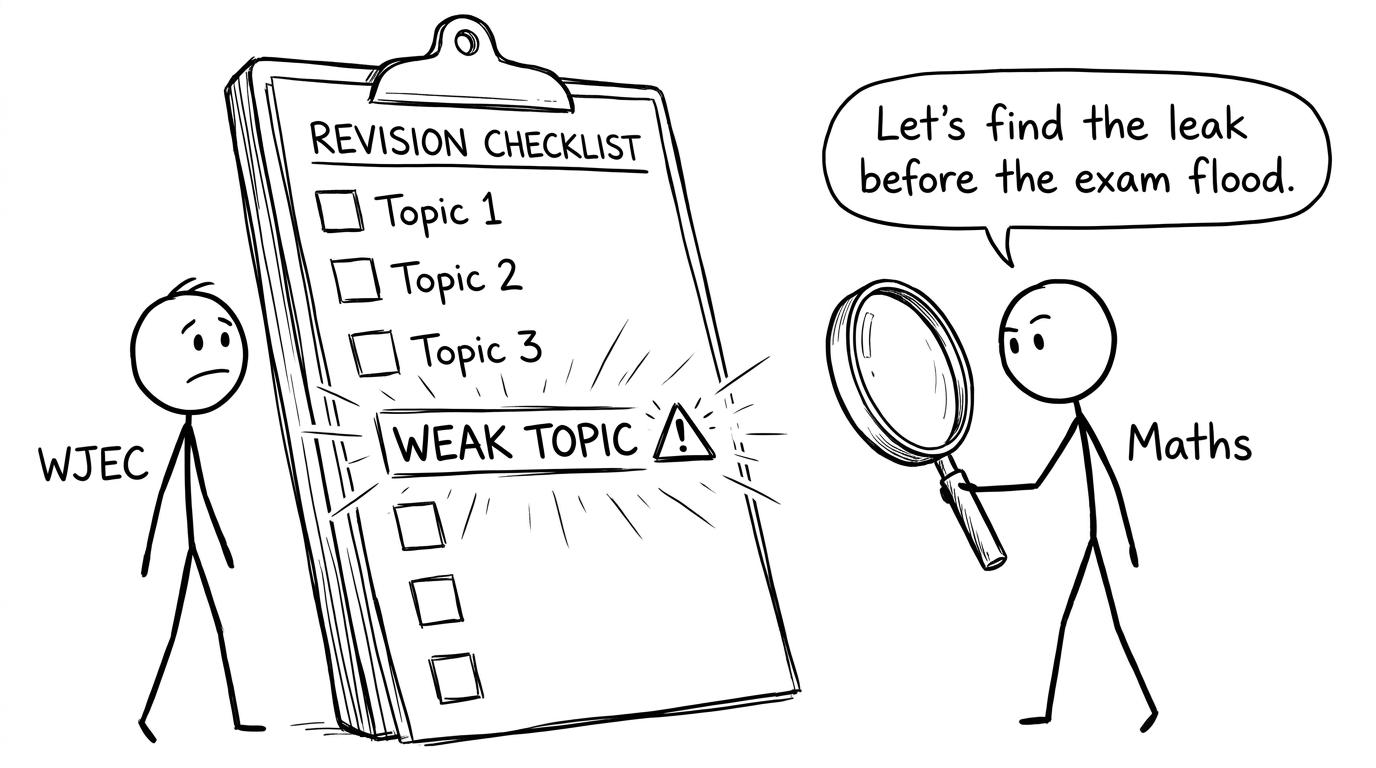 Stick figures finding a weak topic with a magnifying glass
The fastest way to find weak topics (overview)
Use this checklist to pinpoint weaknesses without overthinking it:
- Collect evidence: do a short set of exam questions (not notes) under light time pressure.
- Mark like an examiner: use the mark scheme and be strict.
- Tag each lost mark to a topic (and a reason: knowledge gap, method, units, accuracy).
- Quantify it: calculate percentages so you can rank topics.
- Fix the top 3 first: targeted practice, then re-test.
For the maths side of your science paper (and for your GCSE Maths paper itself), you can run the exact same process using:
- WJEC GCSE Maths Revision
- WJEC GCSE Maths Past Papers
- GCSE Past papers (all boards)
- Resources hub (mini tests, predicted papers and more)
Why WJEC students should treat “weak topics” as data
A lot of GCSE revision advice is emotional: “revise what you’re bad at”. That’s true, but it’s incomplete. Your brain is excellent at telling stories like “I’m just bad at calculations” or “I always mess up required practicals”. Those stories feel helpful. They’re also often too fuzzy to improve your marks.
WJEC GCSE papers reward precision: correct method, correct wording, correct units, correct significant figures, correct use of data. So instead of asking “What am I bad at?”, ask:
- Where do I lose marks most often?
- Are those marks lost because of knowledge, method, or carelessness?
- Which fixes give me the biggest mark return per hour?
The maths skill here is simply measurement. If you can measure it, you can improve it.
Build a “weakness tracker” in 15 minutes
You only need a page in a notebook or a simple spreadsheet. Set up columns like:
- Question reference (paper + question)
- Marks available
- Marks scored
- Topic tag (e.g. rates, graph interpretation, moles, energy changes)
- Reason tag (knowledge, method, units/accuracy)
- One-sentence fix (“Practise converting units before substituting”)
The key calculation: topic percentage
For each topic, you’ll total marks scored and marks available, then compute:
Topic score %=marks scoredmarks available×100 \text{Topic score \%} = \frac{\text{marks scored}}{\text{marks available}} \times 100 Topic score %=marks availablemarks scored×100Then rank topics from lowest percentage to highest. Your weakest topics are simply the bottom of the list.
This is exactly how you’d diagnose weak areas in GCSE Maths too, using topic-by-topic practice and exam questions. YesGenie makes this easier because you can jump straight into lessons, revision guides, and exam questions once you know what to target.
To build the habit on the maths side, you can use:
- AQA GCSE Maths Lessons (great for quick topic refreshers even if you’re WJEC)
- Fractions of an Amount (WJEC) Revision Guide
- Fractions, Decimals and Percentages Revision Guide
Worked example: turning a messy paper into clear priorities
Imagine you do a short WJEC-style mixed set (or a past paper section) and you tag every question you drop marks on.
Say you end up with this topic summary:
- Calculations with ratios and percentages: 121212 marks available, 777 scored
- Graphs and data interpretation: 101010 marks available, 666 scored
- Unit conversions: 888 marks available, 333 scored
Compute the percentages:
712×100=58.3‾% \frac{7}{12} \times 100 = 58.\overline{3}\% 127×100=58.3% 610×100=60% \frac{6}{10} \times 100 = 60\% 106×100=60% 38×100=37.5% \frac{3}{8} \times 100 = 37.5\% 83×100=37.5%Your weakest topic is unit conversions at 37.5%37.5\%37.5%. That is not a personality flaw. It’s a ranked priority.
Now you decide what to do next: not “revise everything”, but “spend the next two sessions fixing unit conversions, then re-test”.
How maths revision helps you gain GCSE Chemistry marks
Even if your main goal is WJEC GCSE Chemistry, your marks can be quietly limited by the maths inside the paper. Students often know the science idea, but the final answer is wrong because:
- they substitute into the wrong rearranged formula,
- they mishandle powers of ten,
- they convert cm3\text{cm}^3cm3 to dm3\text{dm}^3dm3 incorrectly,
- they round too early.
That’s why it’s worth using YesGenie alongside science revision: you can quickly patch the maths foundations that science questions assume.
Worked example: percentage change (a classic hidden weakness)
In GCSE problem-solving, percentage change appears everywhere: concentration changes, yield changes, improvements, decreases.
If a value increases from 404040 to 505050, the percentage increase is:
increaseoriginal×100=50−4040×100=1040×100=25% \frac{\text{increase}}{\text{original}} \times 100 = \frac{50-40}{40} \times 100 = \frac{10}{40} \times 100 = 25\% originalincrease×100=4050−40×100=4010×100=25%The “weak topic” here is rarely the arithmetic. It’s usually the structure: students divide by the new value or forget the ×100\times 100×100.
If this keeps costing you marks, you’d target percentages directly, then practise exam-style questions. On YesGenie, the broader skill set sits naturally within:
Worked example: rearranging a formula without panic
Rearranging is one of the most common “I knew it but still lost marks” moments.
Suppose you have:
m=ρV m = \rho V m=ρVTo make VVV the subject, divide both sides by ρ\rhoρ:
V=mρ V = \frac{m}{\rho} V=ρmThen your weakness tracker might say:
- Topic: rearranging
- Reason: method (I divide the wrong way round)
- Fix: practise rearranging with one-step division, then two-step rearrangements
Even if your chemistry teacher calls it “formula triangles”, the underlying GCSE maths skill is the same: do the same operation to both sides.
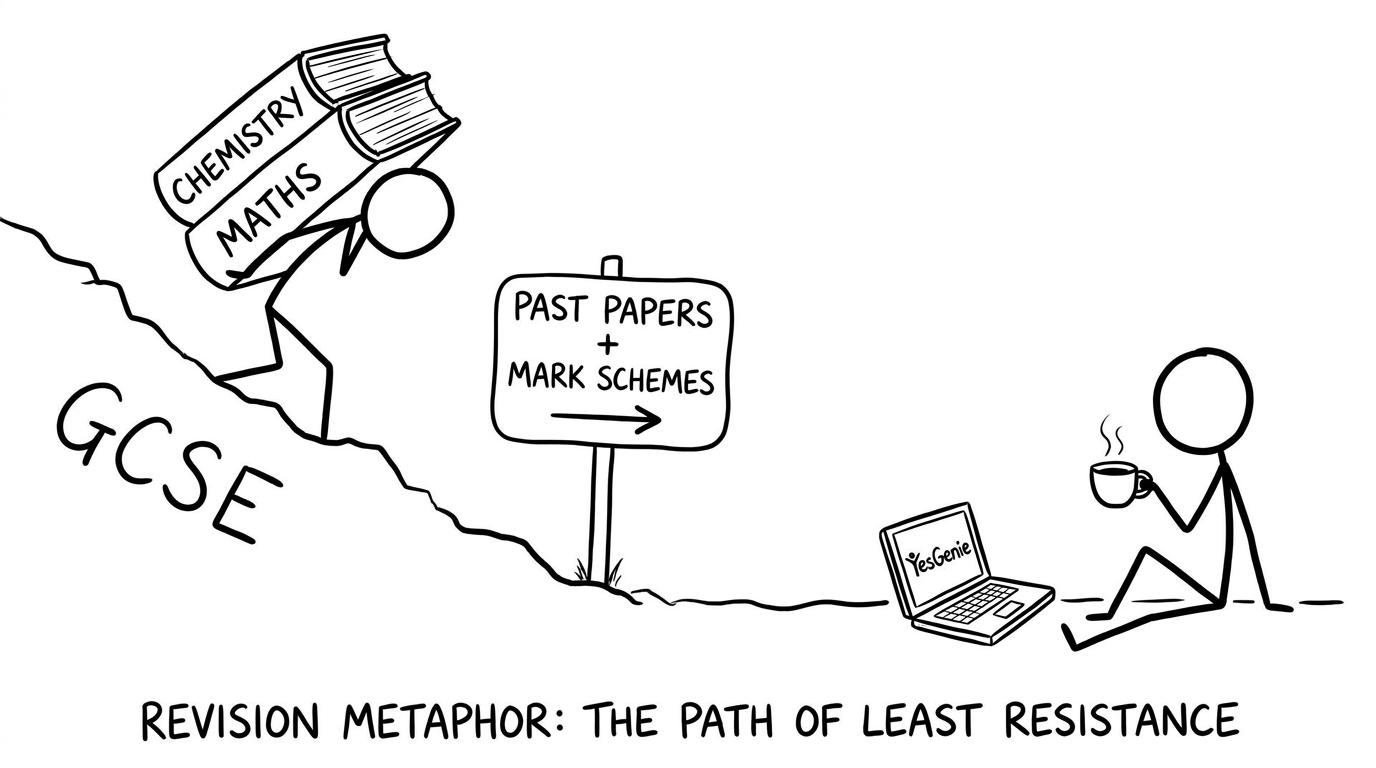 Two textbooks up a hill with a signpost to past papers
Use past papers properly (the WJEC-friendly method)
Past papers are not just for the final week. They are the quickest weakness detector you have.
A strong method looks like this:
- Pick a paper and do one section (or 303030 to 454545 minutes) rather than burning out on a full paper.
- Mark with the mark scheme and write down exactly why the mark was lost.
- Transfer mistakes into your weakness tracker.
- Do targeted practice for the weakest topics.
- Re-test with another short paper section.
For the maths process, use:
Grade boundaries matter because they remind you that you don’t need perfection. In GCSE exams, a small uplift in weak topics can move a grade.
Common mistakes when identifying weak topics
Doing “more revision” instead of getting evidence
Reading notes feels productive, but it doesn’t reveal weak topics. Weak topics show up under retrieval: exam questions, timed mini tests, or a blank-page method.
Tracking questions, not marks
If you miss a 111-mark question and a 555-mark calculation, they are not equal. Always track marks available and marks scored, then compute percentages.
Only tagging by topic, not by reason
Two students can both be weak at “calculations” for different reasons. One lacks the formula knowledge. Another makes unit errors. Your fix depends on the reason.
Rounding too early
In multi-step questions, keep full calculator accuracy until the end. If you round mid-way, small errors can snowball.
Treating the mark scheme as an answer key
Mark schemes are instruction manuals. If the scheme awards marks for a method line, copy that style into your own working next time.
 Calculator says it is just buttons
Closing: turn your GCSE weaknesses into a plan
WJEC GCSE Chemistry can feel broad until you turn it into something smaller: marks. A weakness isn’t a label, it’s a location. Once you know exactly where marks are leaking, revision becomes quieter and more effective.
So keep it simple this week: do one timed section, mark it strictly, build your weakness tracker, and attack the bottom three topics first. If the maths inside your science paper is holding you back, use YesGenie to patch it fast with clear lessons, practice questions, and exam-style papers.
Go straight to WJEC GCSE Maths Revision and WJEC GCSE Maths Past Papers, then use the same method across your GCSE subjects. When you’re ready, deepen the routine with the wider GCSE Past papers and the Resources hub for mini tests and predicted papers. Your weakest topics don’t need more worry. They just need a system.










