GCSE Biology AQA Grade Boundaries: Results Day
GCSE Biology AQA grade boundaries explained with the 2025 marks table, 2026 results-day date, tier rules and clear advice for checking your result.
Results day has a strange way of shrinking two years of lessons into one number. If you are searching for GCSE Biology AQA grade boundaries, the essential point is this: your grade is based on your combined mark across both Biology papers, and the boundary is the minimum total needed for that grade.
The official 2026 boundaries are not available before results day. AQA publishes them at 8.00am on Thursday 20 August 2026. Until then, the June 2025 boundaries below are useful context, but they cannot predict your 2026 grade.
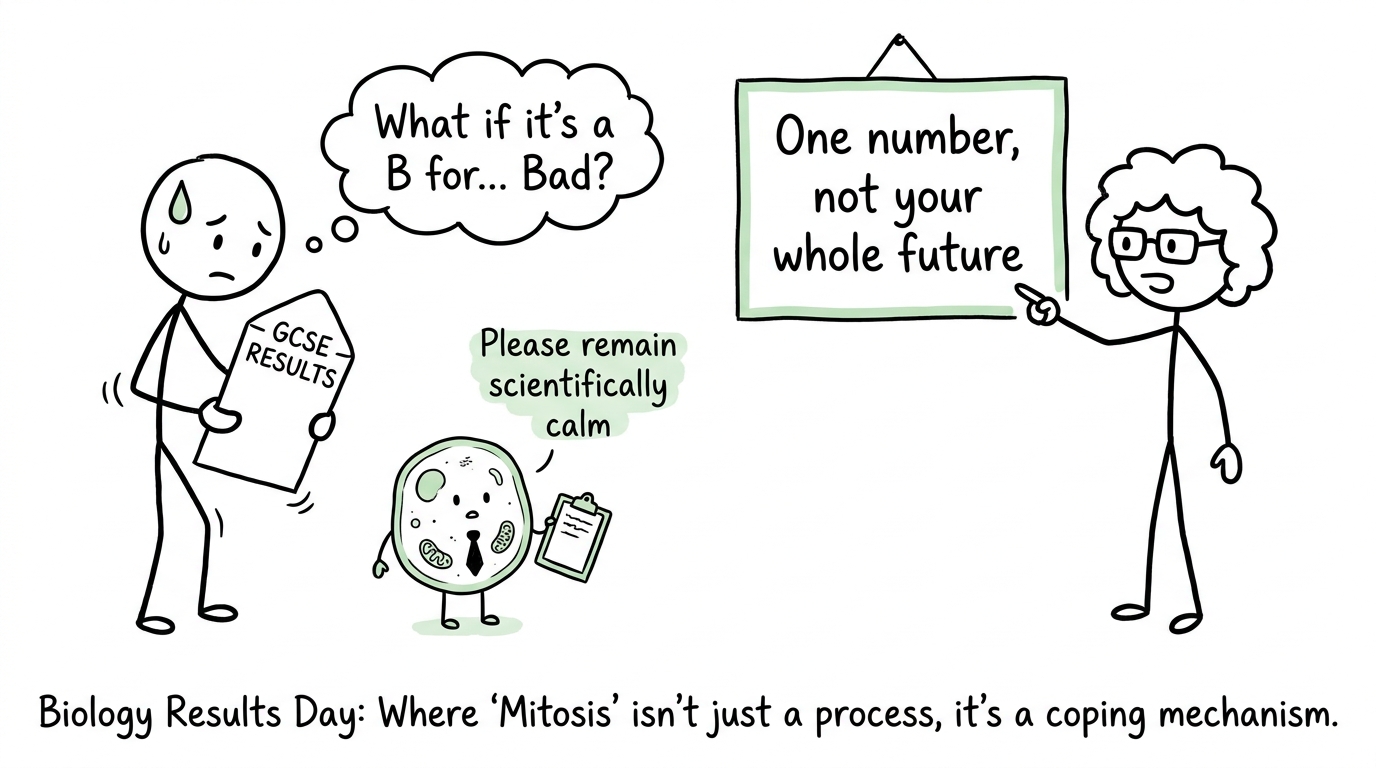 A nervous student opening a GCSE results envelope beside a scientifically calm cartoon cell
GCSE Biology results day checklist
On GCSE Biology results day:
- check that your qualification is AQA GCSE Biology, specification
8461; - confirm whether you sat Foundation or Higher tier;
- find your total raw mark across Paper 1 and Paper 2;
- use the boundary table for the correct exam series and tier;
- speak to your teacher or exams officer if the mark is missing or unexpected;
- remember that historical boundaries are guides, not promises.
AQA Biology grade boundaries for June 2025
These are the official June 2025 subject boundaries for AQA GCSE Biology 8461. Each paper was worth 100100100 marks, producing a maximum total of 200200200.
| Grade | Foundation tier minimum mark | Higher tier minimum mark |
|---|---|---|
| 999 | Not available | 141141141 |
| 888 | Not available | 127127127 |
| 777 | Not available | 113113113 |
| 666 | Not available | 949494 |
| 555 | 140140140 | 757575 |
| 444 | 121121121 | 565656 |
| 333 | 878787 | 464646 allowed grade |
| 222 | 535353 | Not available |
| 111 | 191919 | Not available |
A boundary is inclusive. Meeting the published mark earns that grade; it is not necessary to score above it. The table also shows why you must use the correct tier. Foundation and Higher are separate entries with different available grade ranges.
How the AQA Biology result is calculated
AQA GCSE Biology is a linear qualification, so both exams are taken at the end of the course. Paper 1 and Paper 2 each last one hour and 45 minutes, carry 100100100 marks and contribute 50%50\%50% of the qualification.
Your subject total is therefore:
Biology total=Paper 1 mark+Paper 2 mark\text{Biology total}=\text{Paper 1 mark}+\text{Paper 2 mark}Biology total=Paper 1 mark+Paper 2 markThe final grade is determined from this total out of 200200200. The separate paper boundaries sometimes shown in AQA documents are notional and are provided only as an illustration. You do not receive separate GCSE grades for Paper 1 and Paper 2.
For specification-focused preparation, the AQA GCSE Biology revision hub brings together lessons, exam-style questions and paper practice in one place.
Foundation and Higher tier rules
Foundation tier normally awards grades 111 to 555. Higher tier normally awards grades 444 to 999, although an allowed grade 333 may be awarded when a student narrowly misses grade 444. A Higher-tier mark below the allowed grade 333 boundary is unclassified.
This matters when reading boundary tables. A Foundation student cannot receive grade 666, however high their raw mark is. Equally, Higher tier does not provide grades 111 or 222.
These rules apply to separate Biology. If your results slip says Combined Science, you need the AQA Combined Science boundaries instead. Its papers, total marks and double-grade system are different.
Why GCSE Biology AQA grade boundaries change
Grade boundaries are set after the papers have been marked. Senior examiners and assessment specialists consider how demanding the papers were and the standard demonstrated by students. If a paper proves harder than one from another year, its boundaries may be lower; an easier paper may produce higher boundaries.
That movement is not a punishment or a bonus. Its purpose is to keep the standard represented by a grade comparable between years. There is also no fixed quota requiring a particular number of students to pass or fail.
This is why predicted boundaries circulating before results day should be treated cautiously. The previous table tells us what happened in June 2025, not what must happen in 2026.
What to do if your grade is unexpected
First, ask your school or college for your component marks. Compare the combined total with the correct subject boundary, then look at how the marks were divided between the papers.
If there may be a marking issue, discuss it promptly with your teacher and exams officer. AQA post-results requests are made through the centre and require student consent. A review of marking checks whether the mark scheme was applied correctly; it is not a fresh attempt to award extra marks. A mark can rise, remain unchanged or fall.
A copy of the marked script can also help your teacher decide whether a review is sensible. Schools set their own internal deadlines, usually earlier than the awarding body's deadline, so do not wait.
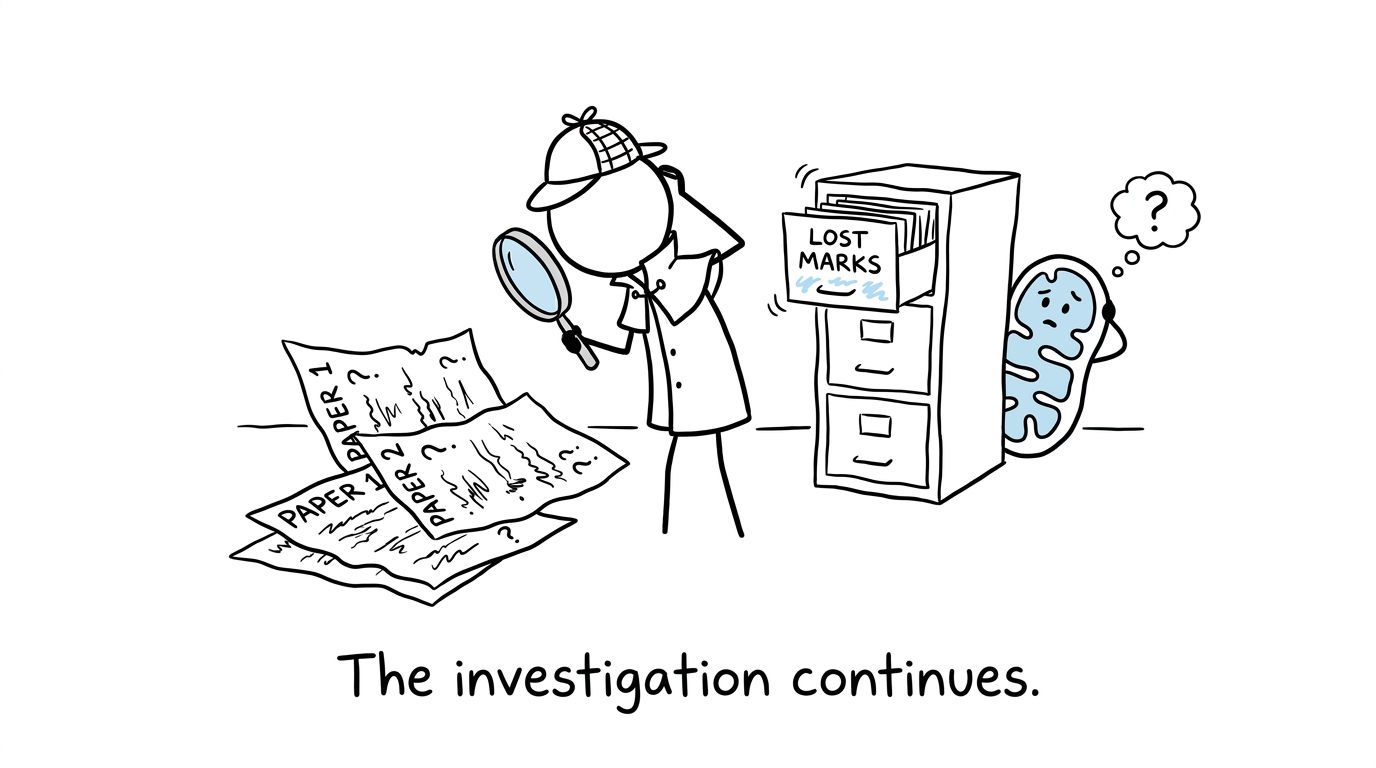 A student detective investigating two Biology papers while a mitochondrion guards the lost marks
Common mistakes when reading the boundaries
Using percentages instead of raw marks
The official table gives minimum marks out of 200200200. Converting marks to percentages may help you interpret performance, but your grade is checked against the published raw-mark boundary.
Looking at the wrong qualification
Separate Biology 8461 is not Combined Science. Check the subject title and specification code before comparing figures.
Adding notional paper grades
Your overall result comes from the combined mark. Do not assign each paper a grade and then try to average those grades.
Treating last year's boundary as a target
Past boundaries are useful for judging practice papers from the same series. They are not confirmed boundaries for a future exam.
Revising content without answering questions
Knowing a process is different from expressing it precisely under exam conditions. Use the AQA Biology revision guides, then test that knowledge with exam-style questions. You can revisit specific areas such as active transport, mitosis and the cell cycle, respiration and communities.
Turn the boundary into a better revision plan
A grade boundary describes the outcome; it does not diagnose the cause. The useful question is where marks are being lost: missing knowledge, weak application, imprecise scientific language, data interpretation or exam timing.
MathsGenie helps you close that gap through free revision lessons, topic guides, practice questions, mini tests, past papers, predicted papers, mark schemes and video solutions. Start with the AQA GCSE Biology revision guides, then follow the practical revision loop in GCSE Biology Revision Without Wasting Time.
Results day gives you a grade. Careful practice gives you choices. Use MathsGenie to make the next set of marks more deliberate than the last.