Active Transport Moves Substances Against the Gradient
Active transport
The movement of substances across a membrane against a concentration gradient, from a lower to a higher concentration, using energy released by respiration.
- Active transport is the movement of substances against a concentration gradient.
- This means substances move from a lower concentration to a higher concentration.
- This is the opposite direction to diffusion and osmosis.
- Because it goes against the gradient, active transport needs energy released by respiration.
- Cells that carry out a lot of active transport have many mitochondria to release this energy.
Active transport moves substances up their concentration gradient, from a low to a high concentration, using energy from respiration.
How Active Transport Works
Mitochondria
The organelles where most aerobic respiration takes place, releasing energy for the cell; a single one is a mitochondrion.
- Active transport uses carrier protein molecules in the cell membrane.
- A carrier protein picks up the substance on one side of the membrane.
- Using energy from respiration, it carries the substance across and releases it on the other side.
- The carrier protein then returns to its original position to move another particle.
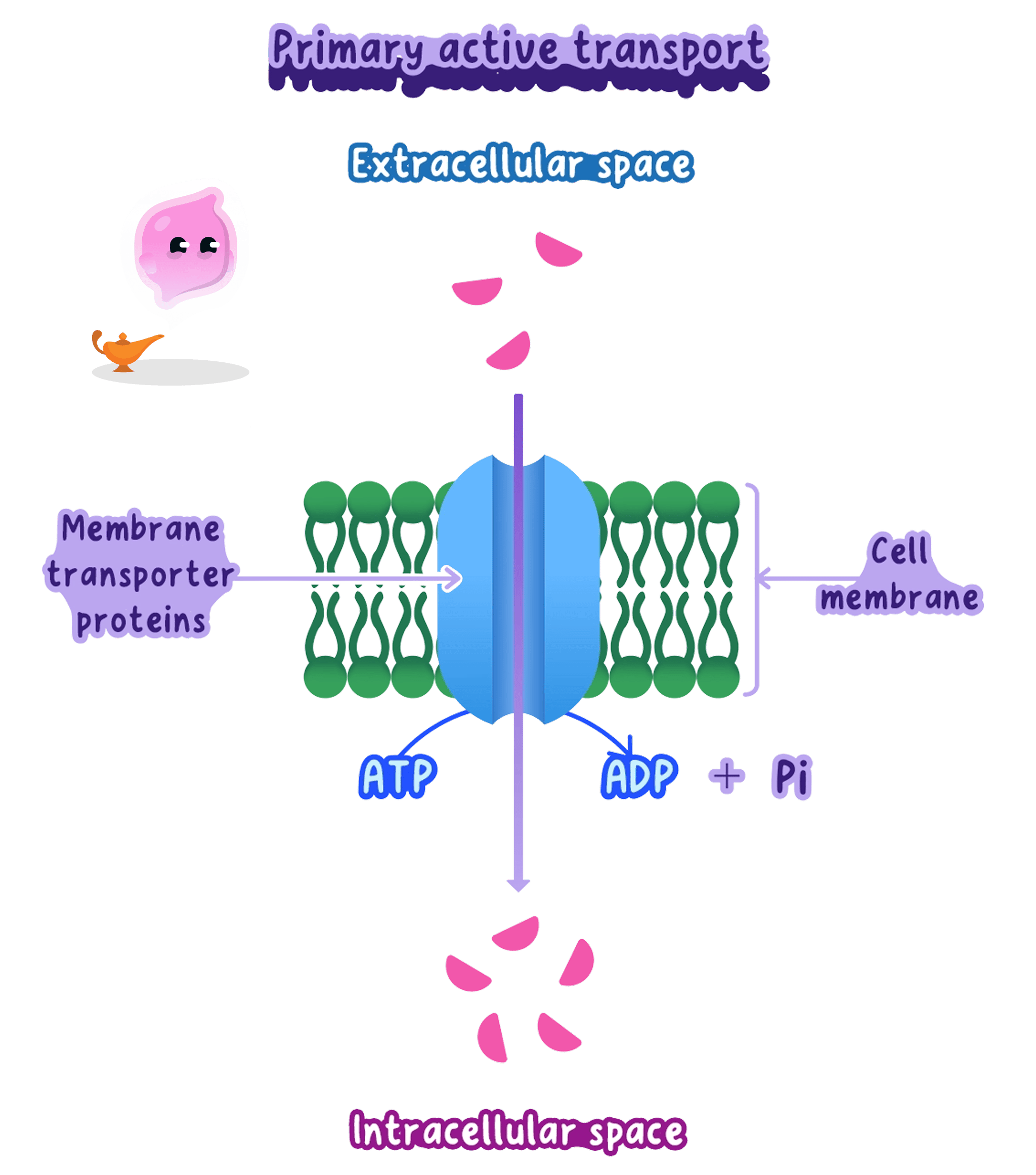
The rate of active transport depends on the rate of respiration, because respiration supplies the energy.
Active Transport in Plants
- Root hair cells absorb mineral ions from the soil by active transport.
- The soil is a very dilute solution, so the ions are at a lower concentration outside the cell than inside it.
- Diffusion cannot move the ions in, so active transport carries them in against the gradient.
- Plants need these ions to grow healthily, so nitrate ions are used to make amino acids and proteins.
Magnesium ions absorbed by active transport are used to make chlorophyll for photosynthesis.
Active Transport in Animals
- Glucose is absorbed from the small intestine into the blood.
- When the glucose concentration in the blood is higher than in the gut, diffusion cannot move it in.
- Active transport then moves glucose from the gut into the blood against the gradient.
- This makes sure as much glucose as possible is absorbed to be used in respiration.
Active transport also reabsorbs glucose in the kidney tubules so that it is not lost in the urine.
Comparing the Three Transport Processes
Concentration gradient
The difference in concentration of a substance between two regions; particles diffuse down a concentration gradient, from a higher to a lower concentration.
- Diffusion:
- Moves any small substance down its gradient, passively, with no energy from respiration.
- Osmosis:
- Moves water only, down its gradient across a partially permeable membrane, passively.
- Active transport:
- Moves substances up their gradient, using energy released by respiration.
- Define active transport.
- Which way do substances move in active transport, up or down the gradient?
- Where does the energy for active transport come from?
- Why do cells that do a lot of active transport have many mitochondria?
- Give one example of active transport in a plant and one in an animal.
