Levels of organisation
Ecosystem
The interaction of a community of living (biotic) organisms with the non-living (abiotic) parts of their environment.
- Living things are organised into levels that build up from a single organism to a whole ecosystem.
- An individual is one organism, such as a single oak tree or one red fox.
- A population is all the members of one species in a habitat at the same time, such as all the oak trees in a wood.
- A community is all the populations of the different species that live and interact in that habitat.
- An ecosystem is the community together with the abiotic (non-living) surroundings it interacts with, such as the soil, water and air.
Learn the order from small to large: individual, then population, then community, then ecosystem.
What organisms need to survive
Habitat
The place where an organism lives.
- To survive and reproduce, every organism needs a supply of materials from its surroundings and from the other organisms in its habitat.
- Plants take in light, water, carbon dioxide and mineral ions from their habitat.
- Animals get food, water, oxygen and shelter from their surroundings and from other species.
- Because these resources are limited, organisms compete for them, and they also depend on each other to get them.
Competition
Competition
When organisms of the same or different species struggle against each other for the same limited resources in a habitat.
- Competition happens when organisms need the same limited resource and there is not enough to go round.
- Plants compete with each other for light, space, water and mineral ions from the soil.
- Animals compete with each other for food, mates and territory.
- The organisms that compete most successfully are more likely to survive, grow and reproduce.
- Species that feed or live in slightly different ways can share a habitat while competing less strongly.
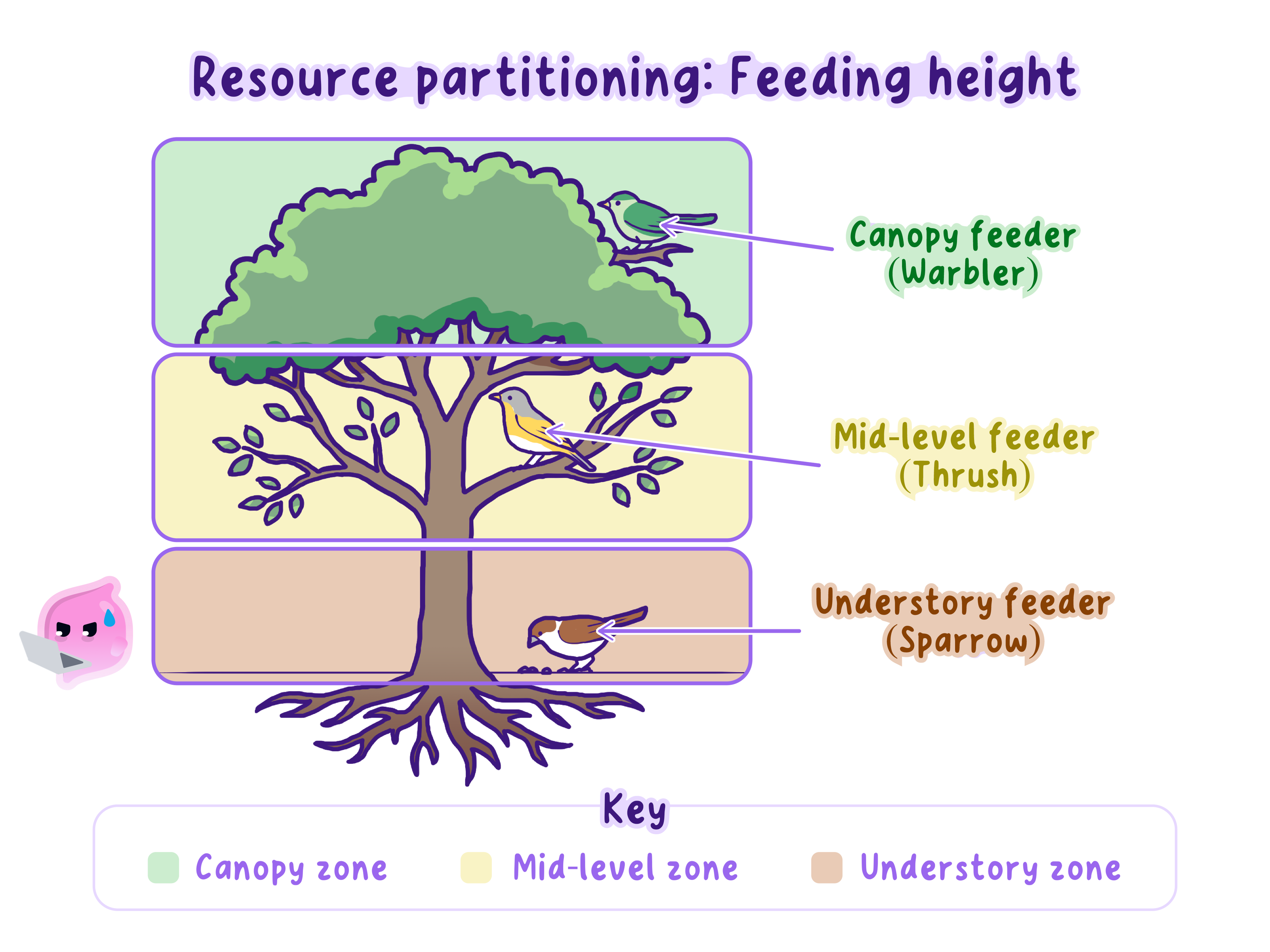
- Do not think that only different species compete with each other.
- Members of the same species often compete most strongly, because they need exactly the same resources.
Interdependence
Interdependence
The way each species in a community relies on other species for resources such as food, shelter, pollination and seed dispersal, so that removing one species affects the whole community.
- Within a community, each species depends on other species to survive, which is called interdependence.
- Species rely on each other for food, shelter, pollination and seed dispersal.
- Because the species are linked, removing one species can affect many others in the community.
If bees were lost from a meadow, the flowers they pollinate would set fewer seeds, and the animals that feed on those plants and their fruit would then have less food.
Stable communities
Stable community
A community in which the species and environmental factors are in balance, so that population sizes stay roughly constant.
- A stable community is one where the species and the environmental factors are in balance.
- In a stable community the population sizes stay roughly constant over time.
- An oak woodland and a tropical rainforest are stable communities that change very little over many years.
- What is the difference between a population and a community?
- Name three things that plants compete for.
- Name three things that animals compete for.
- What is meant by interdependence?
- What happens to population sizes in a stable community?
