Cells Divide in a Repeating Cell Cycle
Cell cycle
The series of stages a body cell goes through to divide: it grows and copies its DNA, its nucleus divides by mitosis, and finally its cytoplasm divides.
- Body cells divide in a repeating sequence of stages called the cell cycle.
- In the first stage the cell grows and copies its DNA.
- In the second stage, mitosis, the nucleus divides.
- In the final stage the cytoplasm and cell membrane divide to form two cells.
The three stages to know are growth with DNA copying, then mitosis, then division of the cytoplasm.
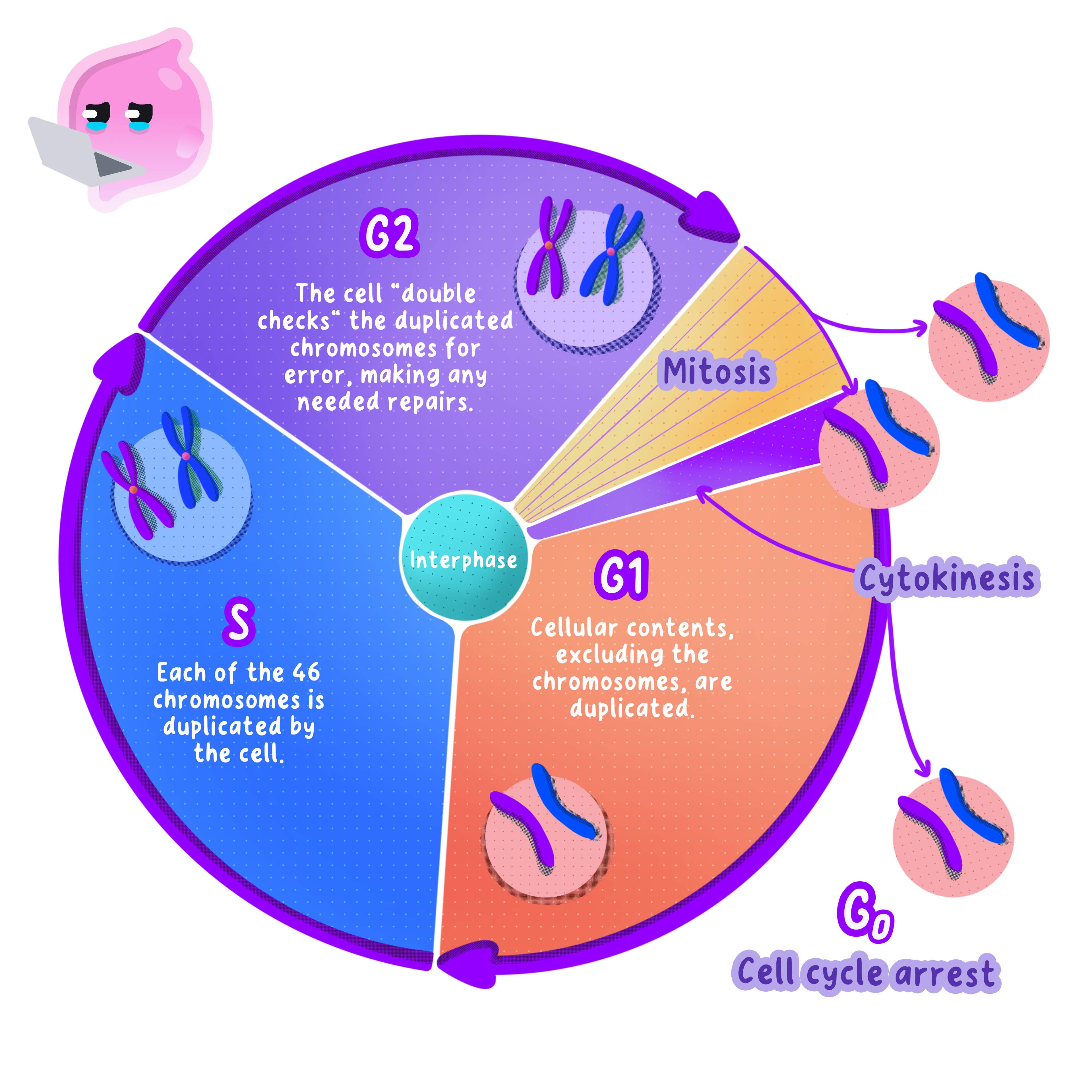
Stage 1: The Cell Grows and Copies Its DNA
Chromosome
A long molecule of DNA, coiled up in the nucleus, that carries many genes; in body cells chromosomes are found in pairs.
- In the first and longest stage, the cell grows and makes more sub-cellular structures, such as mitochondria and ribosomes.
- The DNA is copied, or replicated, so each chromosome becomes two identical copies.
- The two copies stay joined together, and each copy is called a chromatid.
- The cell also builds up its energy stores ready to divide.
Copying the DNA first is like photocopying every page of a book before splitting it into two identical copies.
Stage 2: Mitosis Divides the Nucleus
Mitosis
The type of cell division that produces two genetically identical diploid daughter cells, used for growth, repair and asexual reproduction.
- In the second stage, mitosis, the nucleus divides.
- The copied chromosomes line up across the middle of the cell.
- Cell fibres pull the two copies of each chromosome to opposite ends of the cell.
- One complete set of chromosomes gathers at each end, and a nucleus forms around each set.
- The chromosomes are separated, not broken.
- Each new nucleus gets a whole copy of every chromosome, not half of each one.
Stage 3: Cytokinesis Forms Two Identical Cells
Cytokinesis
The final stage of the cell cycle, in which the cytoplasm and cell membrane divide to form two separate cells.
- In the final stage, cytokinesis, the cytoplasm and cell membrane divide.
- This forms two new cells called daughter cells.
- The two daughter cells are genetically identical to each other and to the parent cell.
- Each daughter cell is diploid, with a full set of chromosomes in pairs.
A human cell starts with 46 chromosomes, copies them, then passes a full set of 46 to each daughter cell.
Why Mitosis Matters
- Mitosis lets a multicellular organism grow and develop.
- A fertilised egg divides by mitosis over and over to form an embryo, and then all the cells of the body.
- Mitosis also replaces cells that are damaged, worn out or lost.
- It is used in asexual reproduction, where one parent produces genetically identical offspring.
The cells at the tip of a growing root and the new skin cells that heal a cut are both made by mitosis.
Estimating How Long a Stage Lasts
- You can estimate how long a stage lasts by counting how many cells are in each stage under the microscope.
- The more cells seen in a stage, the longer that stage takes.
time in a stage=number of cells in that stagetotal number of cells×total cycle time\text{time in a stage} = \dfrac{\text{number of cells in that stage}}{\text{total number of cells}} \times \text{total cycle time}time in a stage=total number of cellsnumber of cells in that stage×total cycle time
- For example, if 14 of 54 cells are in stage 1 and the whole cycle takes 15 hours, stage 1 lasts (14÷54)×15=3.9(14 \div 54) \times 15 = 3.9(14÷54)×15=3.9 hours.
- What are the three overall stages of the cell cycle?
- What happens to each chromosome during the first stage?
- How do the two daughter cells compare with the parent cell?
- Give two reasons mitosis is important in the body.
- 20 of 80 cells are in mitosis and the cycle takes 24 hours. How long does mitosis last?
