

GCSE Biology 3 to 5: How to Raise Your Grade
GCSE biology 3 to 5: learn the knowledge, application, practical and maths changes that turn lost marks into a realistic grade 5 revision plan.

Moving from a grade 333 to a grade 555 in GCSE Biology is not mainly about memorising twice as many facts. It is about making more of what you already know: recalling it accurately, applying it to unfamiliar situations, interpreting evidence and writing answers that match the command word.
That is the heart of a GCSE biology 3 to 5 improvement plan. You need stronger foundations, but you also need better exam habits. A student working around grade 333 may recognise a topic yet struggle to turn that recognition into marks. A grade 555 student is more likely to connect ideas, use precise biological language and handle calculations or practical questions methodically.
Grade boundaries change between exam series, boards and tiers, so there is no permanent score that guarantees a grade 555. Your target should be a better process rather than a guessed percentage.
Your grade 333 to grade 555 checklist
Focus on these changes:
- Diagnose weak topics using questions, not feelings.
- Replace passive rereading with active recall.
- Learn precise definitions and biological processes.
- Practise applying knowledge to unfamiliar contexts.
- Understand variables, methods, graphs and conclusions.
- Strengthen percentages, ratios, means, units and standard form.
- Use command words to control the depth of each answer.
- Mark your work and retest every recurring mistake.
The jump is rarely one dramatic breakthrough. It is usually the result of recovering small groups of marks that have been leaking away across the paper.
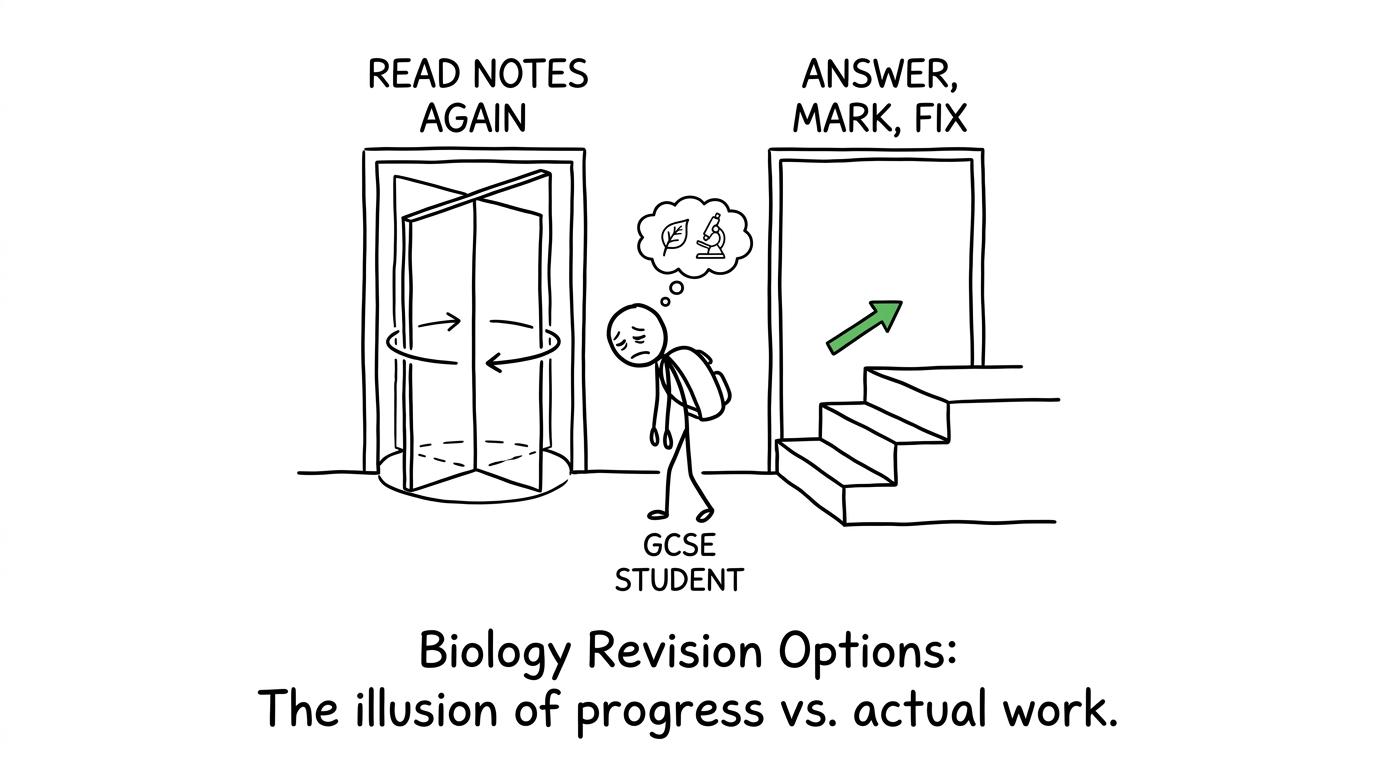 A student chooses between rereading notes and an answer-mark-fix staircase
What separates a grade 333 from a grade 555 in GCSE Biology?
Exam boards including AQA, Pearson Edexcel, OCR and Eduqas assess more than factual recall. Their GCSE Biology qualifications examine three broad abilities: knowledge and understanding, application, and the analysis or evaluation of information and evidence.
AQA, for example, gives approximately 40%40\%40% of the qualification to knowledge, 40%40\%40% to application and 20%20\%20% to analysis and evaluation. Exact paper structures differ by board, but the wider lesson is consistent: knowing a definition is necessary, yet recall alone cannot unlock the whole paper.
A grade 333 answer often recognises the topic
The student may remember that enzymes are affected by temperature or that plants need light for photosynthesis. The difficulty appears when the question changes the context, supplies a graph or asks for a chain of reasoning.
Typical signs include:
- using general words such as “things” or “it helps”;
- stating a fact without explaining its consequence;
- copying figures from a table without identifying a pattern;
- describing a practical without controlling variables;
- knowing a formula but mishandling substitution or units;
- leaving longer questions blank because the first sentence is unclear.
A grade 555 answer uses knowledge as a tool
A student working towards grade 555 is more likely to identify the relevant idea, connect it to the context and make each step explicit. Their answer does not need to sound elaborate. It needs to be scientifically precise.
For an explanation, that often means a chain such as:
biological cause →\rightarrow→ process or change →\rightarrow→ observed effect.
For data, it means describing the pattern, supporting it with suitable values and recognising anomalies or limitations where relevant. For practical work, it means identifying variables, measurements, repeats and a sensible improvement.
This is the central change: grade 333 knowledge is often present but fragile; grade 555 performance makes that knowledge usable.
Build secure knowledge before chasing difficult questions
Biology contains many connected processes. Weak understanding in one area can quietly damage several others. If diffusion is uncertain, exchange surfaces and transport become harder. If enzymes are unclear, digestion and metabolism become harder.
Start with your exam board’s specification and divide the course into small, named topics. AQA separates content into areas such as cell biology, organisation, infection and response, bioenergetics, homeostasis, inheritance and ecology. Edexcel, OCR and Eduqas organise material differently, so revise from the specification you are actually taking.
For each small topic, check whether you can do four things without notes:
- define the essential terms;
- describe the main process in the correct order;
- explain why the process matters;
- answer a short question in an unfamiliar context.
Do not label an entire area “bad”. “I cannot explain how vaccination leads to immunity” gives you an action. “Infection is hard” does not.
A realistic GCSE revision timetable can help you turn those actions into repeatable sessions. Although MathsGenie focuses on maths, the same plan, diagnose, practise, mark and revisit, works well for Biology.
Change how you revise
Rereading can feel fluent because every sentence looks familiar. The exam asks for something different: retrieval without the page in front of you.
Use a short revision cycle:
- Recall one process from memory.
- Check it against your specification or class notes.
- Complete exam-style questions.
- Mark them strictly.
- Write one correction for each lost mark.
- Retest the same idea after a gap.
The correction must be specific. “Revise ecology” is too broad. “When evaluating quadrat sampling, mention random placement and a larger sample” is useful.
If exams are close, adapt the structure in MathsGenie’s one-month GCSE revision plan. Use short topic blocks during the week and a timed Biology paper section at the weekend. A plan only becomes valuable when it contains questions and feedback, not merely coloured boxes.
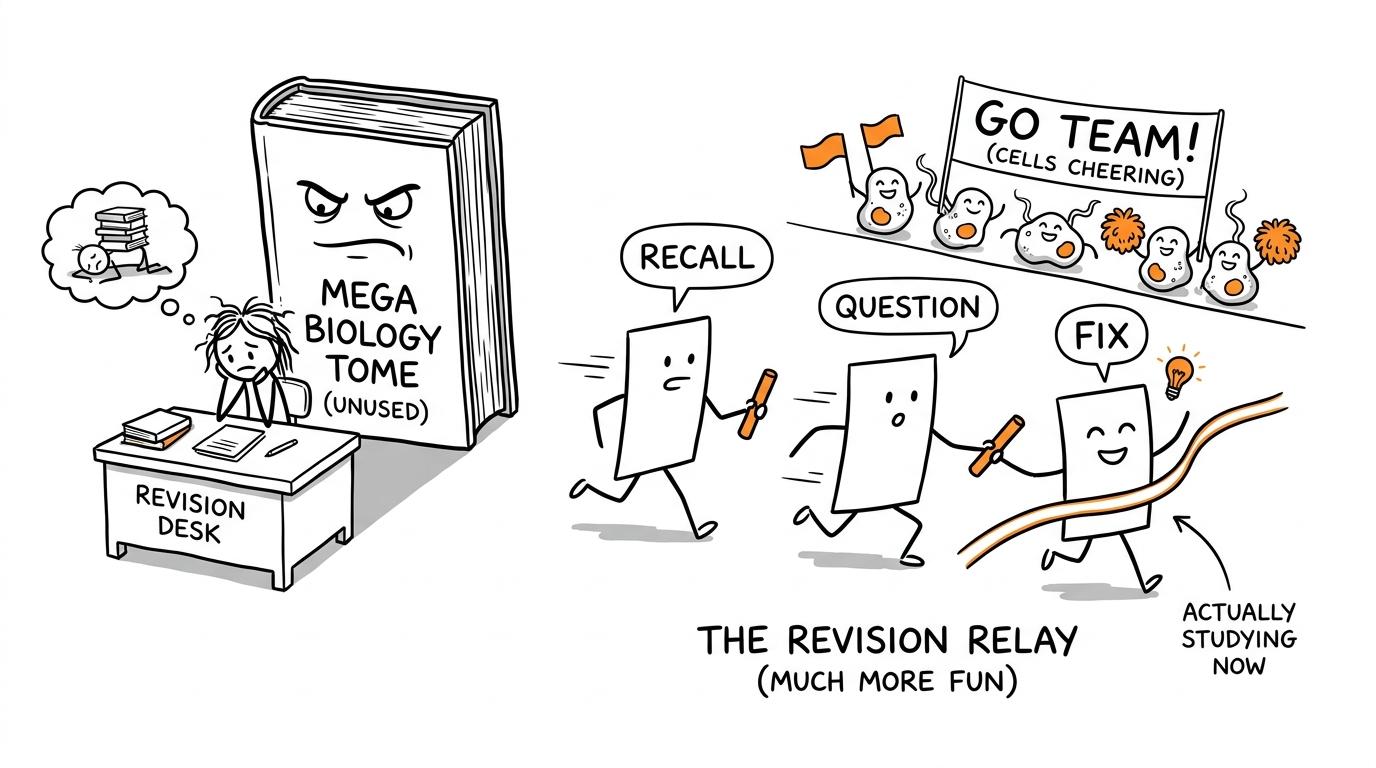 Recall, Question and Fix race past an unused textbook
Turn command words into marks
Command words tell you what kind of thinking the examiner expects.
Describe
State what happens or identify a pattern. If data are provided, use them accurately. Do not explain a cause unless the question asks for one.
Explain
Give linked reasons. Avoid stopping after the first relevant fact. Ask yourself, “What does that cause next?”
Compare
Refer to both items and use comparative language. Two disconnected descriptions may not establish a comparison.
Calculate
Show substitution, working, the final value and the appropriate unit. Even when the arithmetic seems simple, visible working protects method marks and makes errors easier to find.
Evaluate
Consider evidence on more than one side before reaching a justified conclusion. Useful points may involve sample size, controls, repeats, anomalies, reliability and whether the evidence actually supports the claim.
Read mark schemes to notice the level of precision rewarded by your board. They are not scripts to memorise word for word. They are evidence about where vague thinking loses marks.
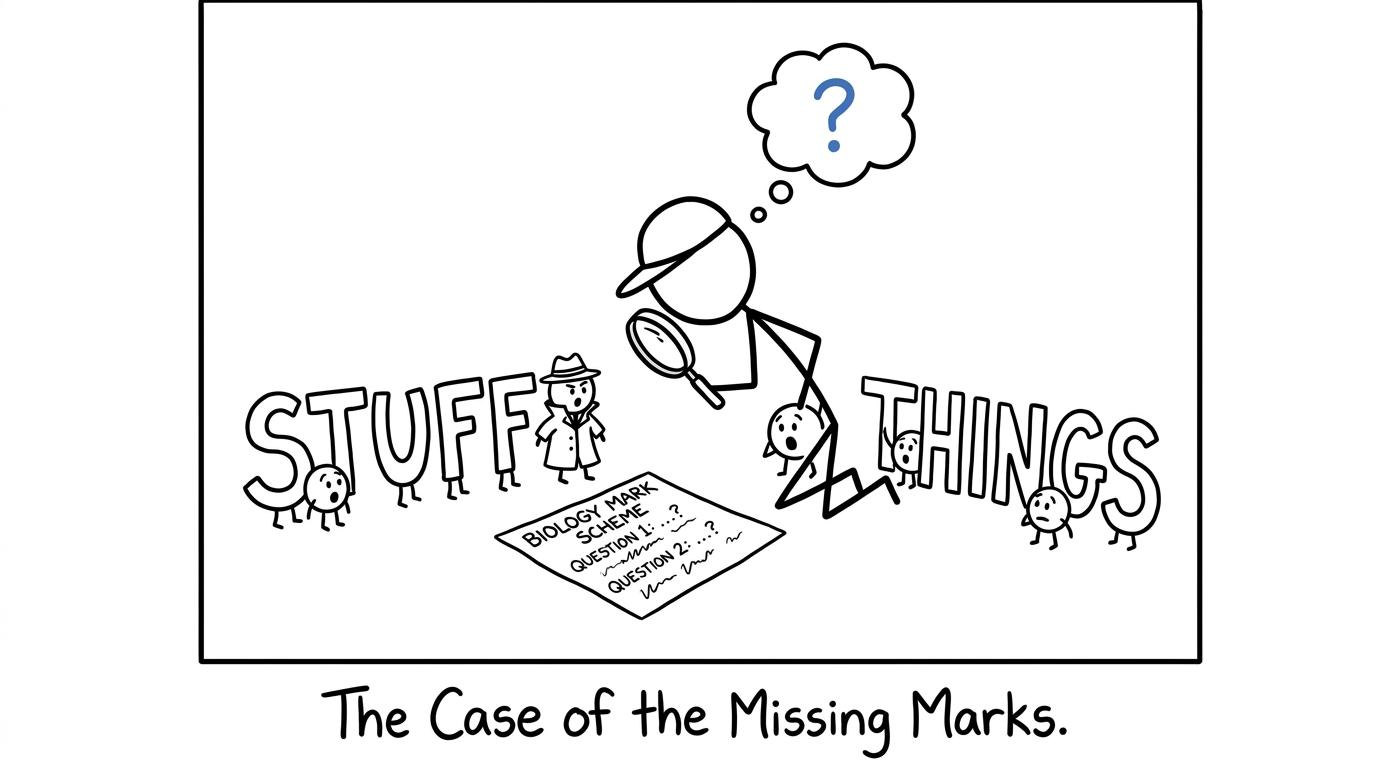 A detective investigates vague words in a biology answer
Secure the maths marks inside Biology
Official GCSE Biology specifications include mathematical skills. These can involve ratios, percentages, arithmetic means, graphs, probability, standard form, units, areas, volumes and simple algebra. Eduqas specifies a minimum mathematical weighting of 10%10\%10%, while other board specifications also embed mathematical requirements throughout their content.
These marks are especially valuable because the methods are predictable. Build confidence in:
- percentage increase and decrease;
- percentage change in mass;
- ratios and proportions;
- calculating a mean;
- interpreting tables and graph scales;
- plotting variables and describing correlation;
- converting units;
- magnification calculations;
- standard form and significant figures.
A percentage change is calculated using:
percentage change=changeoriginal value×100\text{percentage change}=\frac{\text{change}}{\text{original value}}\times 100percentage change=original valuechange×100Magnification is expressed as:
magnification=image sizeactual size\text{magnification}=\frac{\text{image size}}{\text{actual size}}magnification=actual sizeimage sizeThe equation is not the whole skill. You must identify the original quantity, make units consistent and round only at the end when appropriate.
Use MathsGenie’s free lessons and questions to repair individual weaknesses. Useful starting points include percentages practice, scatter graphs revision, conversions and units and standard form revision. The pages are written for GCSE Maths, but the underlying skills transfer directly to quantitative Biology questions.
Treat practical questions as a repeatable structure
Students sometimes revise required practicals as stories: equipment was arranged, something happened and a result appeared. Examiners need a more controlled account.
For every practical on your specification, know:
- the independent variable you change;
- the dependent variable you measure;
- important control variables;
- the equipment and method;
- relevant safety considerations;
- why repeats are used;
- how results are processed and presented;
- the limitations and realistic improvements.
When suggesting an improvement, connect it to a problem. “Repeat it” becomes stronger when you explain that repeats allow a mean to be calculated and help identify anomalous results. “Use better equipment” is vague; naming an instrument with finer resolution is more precise.
Use past papers to diagnose rather than predict
A past paper should tell you what to revise next. Begin with a timed section if a complete paper feels overwhelming. Then classify each lost mark:
- K: missing biological knowledge;
- A: failed application;
- D: data or graph error;
- P: practical-method weakness;
- M: mathematical error;
- C: command word or communication problem.
Patterns matter more than one total. Three repeated unit errors deserve attention even if they occur in different topics.
The same method is explored in MathsGenie’s guide to using OCR Biology past papers effectively. For the transferable maths skills, MathsGenie’s past-paper platform provides official mark schemes and selected worked or video solutions.
Check your Biology grade against the official boundary for your board and exam series only after results are published. Boundaries are set to reflect the demand of that particular set of papers, so an old boundary is a useful reference, not a promise.
Common mistakes that keep students at grade 333
Revising only favourite topics
Familiar topics feel productive. Your largest gains usually sit inside repeated weaknesses. Let marked questions choose the next topic.
Memorising phrases without understanding
A remembered sentence can collapse when the context changes. Explain each process in your own words, then restore the correct scientific terminology.
Ignoring units and graph scales
Check the axis interval, unit and any conversion before calculating. Write the unit beside the answer rather than hoping to remember it later.
Giving one-step explanations
If the question is worth several marks, one isolated fact is rarely enough. Build a logical cause-and-effect chain without adding irrelevant detail.
Marking generously
Do not award yourself a mark because your answer was “close”. Find the missing word, link or calculation step. Honest marking is uncomfortable for a moment but useful for the next paper.
Completing papers without repairing errors
Volume is not the same as improvement. A second paper completed with the same misconceptions simply rehearses them. Mark, repair and retest before moving on.
Make the move to grade 555 measurable
The journey from grade 333 to grade 555 becomes less mysterious when you stop treating Biology as one enormous subject. Secure one process. Improve one practical explanation. Recover one type of calculation. Then repeat.
Start today with a short Biology diagnostic and create a five-item repair list. Use your specification and board-specific questions for biological content, then make MathsGenie your free home for the quantitative skills that Biology depends on. The MathsGenie revision planner, revision lessons, practice questions, mini tests, past papers, predicted maths papers, mark schemes and video solutions can help you build a routine in which mistakes lead somewhere.
A grade changes at the end. The habits that produce it change first.










