GCSE: Use OCR Biology Past Papers Properly (Maths-Friendly)
GCSE students: learn how to use OCR Biology past papers properly with timing, mark schemes, and a maths-first mistakes log to boost marks fast.
Every GCSE student has had the same moment: you open an OCR Biology past paper, see a graph, a table, maybe a percentage change question, and your brain quietly swaps revision for panic. The paper isn’t just testing biology; it’s testing whether you can stay calm while doing maths under pressure. Used properly, OCR Biology past papers become a training ground for the exact skills that lift marks across subjects: interpreting data, showing working, and learning from the mark scheme. Used badly, they become a pile of half-done papers and vague guilt.
This post is written for UK GCSE and A Level students revising maths, because the truth is simple: even in Biology, your grade often moves on maths habits.
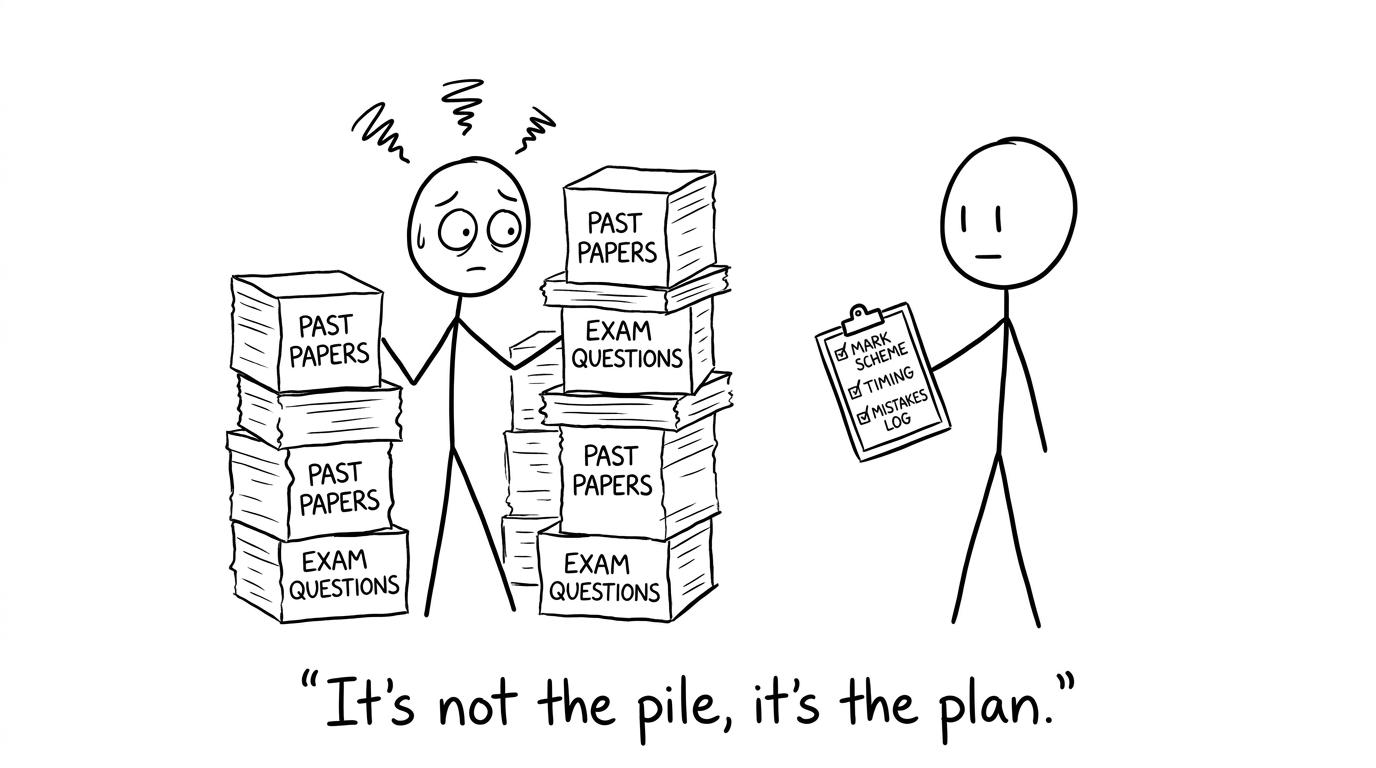 A student versus a mountain of past papers
The method in one page (save this)
If you want OCR Biology past papers to actually improve your GCSE performance, run this loop:
- Choose the right paper and do it under exam conditions (or a focused half-paper).
- Mark it with the mark scheme and annotate what the examiner wanted.
- Convert every error into a named skill (especially maths skills).
- Practise the weak skill using targeted questions.
- Reattempt the same questions after 484848 hours and again after a week.
On YesGenie, the closest maths equivalents are built in: past papers, mini tests, topic lessons, practice questions and video solutions. Start from GCSE Past papers and then zoom into your exam board for targeted work.
Why OCR Biology past papers are secretly a maths resource
OCR Biology papers often award marks for processing information, not just recalling it. That’s where maths shows up:
- calculating means, rates, percentage change and magnification
- reading scales, spotting anomalies and describing trends
- using units correctly and presenting answers to an appropriate number of significant figures
That’s also why students can “know the content” and still miss marks. In GCSE exams, marks follow method. The method is usually mathematical.
If you want to sharpen those habits directly in maths, build the same routine using your board’s maths practice pages like GCSE Maths OCR or the full set of GCSE Past papers.
Pick the right paper (and stop wasting good papers)
The biggest hidden mistake with OCR Biology past papers is using them in the wrong order.
Start with “open book” to learn the mark style
For your first 111-222 papers:
- allow yourself the specification and notes
- focus on understanding command words and typical OCR phrasing
- practise presenting calculations clearly
You are building familiarity first, not proving anything about your intelligence.
Then move to timed papers in phases
A calm progression for GCSE:
- Phase 1: 252525-353535 minute sections (data questions only)
- Phase 2: full paper with pauses (to check timing)
- Phase 3: full paper, strict conditions, strict timing
For maths revision, the equivalent is using short formats like Edexcel GCSE Maths Mini Tests to build speed and accuracy before returning to full papers.
 Stopwatch intimidation, but make it revision
How to sit OCR Biology past papers like a mathematician
In maths, you’re trained to show working even if you’re unsure. OCR Biology rewards the same behaviour in calculation and data interpretation questions.
Use “marks per minute” to decide when to move on
A good rule in GCSE papers is about 111 mark per minute. So if a question is worth 666 marks, you give it roughly 666 minutes before you make a decision.
If you’re stuck:
- write down the formula you think applies
- substitute what you can
- state the trend or pattern you can see
This often picks up method marks.
Treat units like the final line of your proof
A lot of OCR Biology calculation marks are lost to units. Make units visible throughout.
If you calculate a rate:
rate=change in quantitytime \text{rate} = \frac{\text{change in quantity}}{\text{time}} rate=timechange in quantityThen your answer should clearly show something like cm3 min−1\text{cm}^3\,\text{min}^{-1}cm3min−1 or g day−1\text{g}\,\text{day}^{-1}gday−1.
In maths, this habit carries into topics like speed and density. You can practise those directly on YesGenie via your board topic pages (OCR maths students can begin at GCSE Maths OCR).
Worked examples (the maths that keeps turning up in Biology)
These aren’t “biology facts”; they’re GCSE maths skills in a lab coat.
Percentage change (a classic mark-drop)
A student measures heart rate.
- resting: 727272 bpm
- after exercise: 909090 bpm
Percentage increase:
percentage increase=90−7272×100 \text{percentage increase} = \frac{90 - 72}{72} \times 100 percentage increase=7290−72×100 =1872×100=25% = \frac{18}{72} \times 100 = 25\% =7218×100=25%Presentation tip: write the subtraction line clearly. OCR mark schemes often want to see the “change” before the fraction.
Mean and range from a table
Five temperatures recorded: 18,19,17,20,1618, 19, 17, 20, 1618,19,17,20,16.
Mean:
mean=18+19+17+20+165=905=18 \text{mean} = \frac{18+19+17+20+16}{5} = \frac{90}{5} = 18 mean=518+19+17+20+16=590=18Range:
range=20−16=4 \text{range} = 20 - 16 = 4 range=20−16=4If the question then asks you to comment on reliability, your maths result becomes the evidence for a written answer.
Magnification (and rearranging correctly)
Magnification:
M=image sizereal size M = \frac{\text{image size}}{\text{real size}} M=real sizeimage sizeIf M=400M = 400M=400 and the image size is 20 mm20\text{ mm}20 mm, then
400=20real size 400 = \frac{20}{\text{real size}} 400=real size20 real size=20400=0.05 mm \text{real size} = \frac{20}{400} = 0.05\text{ mm} real size=40020=0.05 mmConvert if needed: 0.05 mm=50 μm0.05\text{ mm} = 50\,\mu\text{m}0.05 mm=50μm.
This is exactly the same rearranging discipline you use in GCSE maths. If rearranging is a weak spot, build it through structured topic practice (start from Edexcel GCSE Maths Lessons if you want a broad list of skills to practise).
Mark schemes: how to use them without lying to yourself
The mark scheme is not a judgement. It’s a map of what counts.
Step 1: mark in two colours
- Colour A: what you got wrong
- Colour B: what you “nearly” got right but didn’t earn marks for
That second colour matters more. It shows where your process is close but not exam-ready.
Step 2: rewrite one model answer per page
Choose one question you lost marks on and rewrite a perfect answer underneath it. Keep it short. Make it look like something you could do under time pressure.
If you want that same feedback loop in maths, it’s exactly what YesGenie’s worked solutions are for, especially when you compare your attempt to the final method.
A quick example page to see the style of video walkthroughs is June 2019 Paper 1 - Video Solutions.
Build a mistakes log that actually changes your GCSE grade
Most students write “revise bio” or “careless” and move on. That doesn’t create improvement. The log needs categories.
Use these four:
- Knowledge gap (didn’t know the biology)
- Method gap (knew what it was asking, didn’t know how)
- Maths error (wrong substitution, wrong rearranging, wrong conversion)
- Exam technique (didn’t answer the command word, missed units, misread graph)
Once you label it, you can fix it.
Maths error? Practise the underlying skill with targeted sets and short tests (see Resources on YesGenie for mini tests, predicted papers and paper formats).
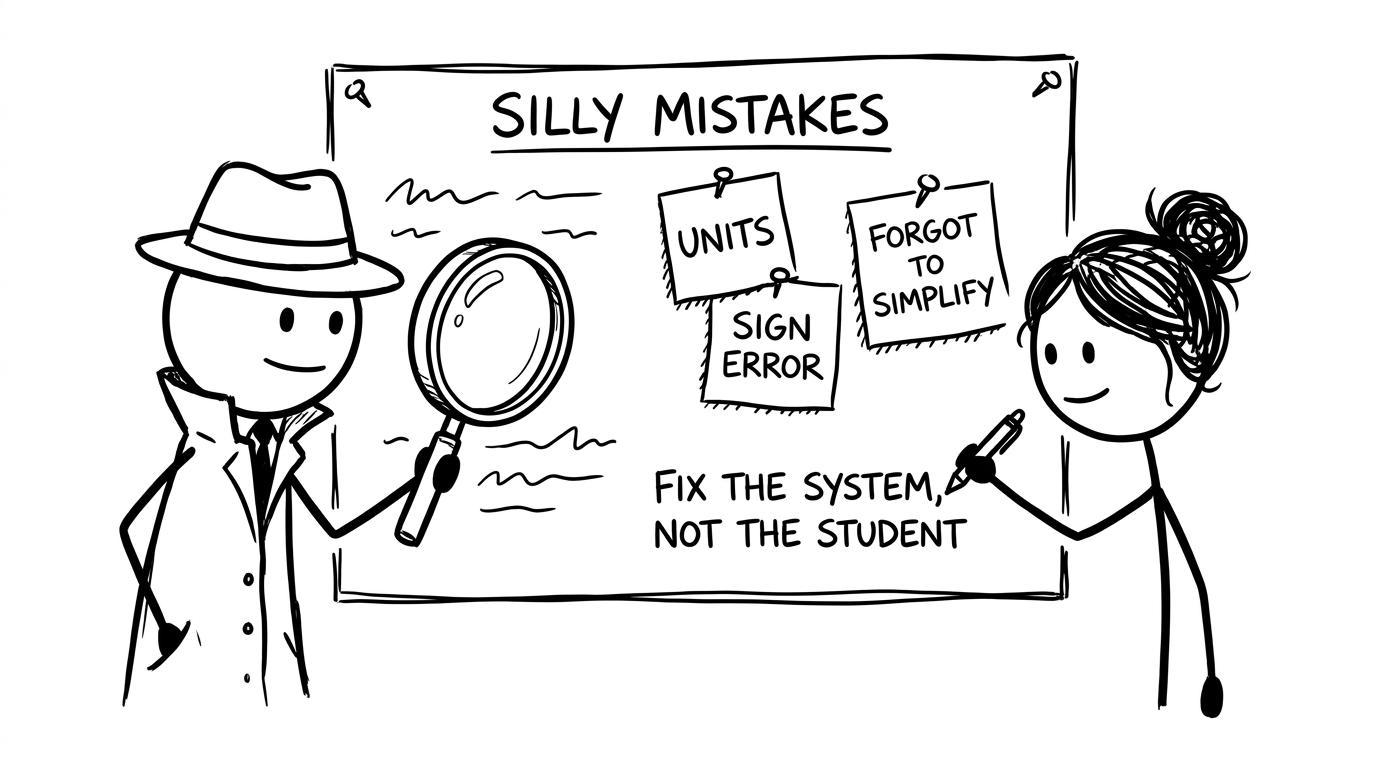 Detective investigating silly mistakes
Turning Biology paper errors into maths improvement (cross-subject leverage)
Here’s the quiet advantage: if OCR Biology exposes a weakness in percentages, graphs, ratio, or unit conversions, fixing that weakness lifts your maths marks too.
A practical routine:
- Do an OCR Biology paper.
- Highlight every calculation/data question.
- Count how many marks were dropped due to maths.
- Choose the top one skill and practise it for 202020 minutes.
Then do the next paper.
If you’re approaching GCSE Maths as well, consider adding predicted papers closer to exam season. YesGenie’s bank is designed for exam-style practice: Edexcel GCSE Maths Predicted Papers. Even if you’re not Edexcel, the revision habit transfers: timed practice, then ruthless review.
Common mistakes when using OCR Biology past papers
- Doing papers too early, too fast: if you haven’t secured the basics, full papers become random stress. Build up.
- Marking with your memory, not the mark scheme: you can’t award yourself marks for “basically that”. GCSE marking is precise.
- Ignoring working: in calculations, missing method can lose most of the marks even when the final number is close.
- Forgetting units and conversions: mm\text{mm}mm to μm\mu\text{m}μm, seconds to minutes, cm3\text{cm}^3cm3 to dm3\text{dm}^3dm3: these are predictable traps.
- Not reattempting questions: improvement comes from return trips, not first attempts.
- Treating “data questions” as reading: they are maths questions in disguise. Read scales, quote values, calculate, then interpret.
Bringing it back to YesGenie (and your next GCSE paper)
Used properly, OCR Biology past papers aren’t just “more work”; they’re a mirror. They show you whether your GCSE performance is being limited by knowledge, by maths, or by exam technique. The win is not finishing a paper. The win is understanding why you lost marks, and building a system that stops it happening again.
If you want that system for maths, YesGenie makes it simple: start with GCSE Past papers, use your board’s hub like GCSE Maths OCR, add speed practice through Edexcel GCSE Maths Mini Tests, and sharpen exam readiness with Edexcel GCSE Maths Predicted Papers. Then use the lessons, question banks, mark schemes and video solutions to turn every mistake into a mark next time.
That’s how GCSE grades move: one honest paper, one clear fix, repeated until it’s automatic.