

GCSE Biblical Hebrew Exam Conditions Practice at Home
GCSE Biblical Hebrew exam conditions practice made realistic: set up your room, use exact timings, control materials and review each paper effectively.
The strange thing about revision at home is that it can feel productive while quietly removing everything that makes an exam difficult. You pause the clock. Check a word. Answer a message. Take an unplanned break.
Effective GCSE Biblical Hebrew exam conditions practice removes those comforts. Choose an unseen paper, follow its exact time and material rules, work in silence without assistance, and stop when time is called. Then mark the paper separately. The aim is not to make revision unpleasant. It is to make the real exam feel familiar.
Although MathsGenie specialises in free GCSE and A Level maths revision, the same disciplined routine used for a GCSE maths past paper transfers remarkably well to Biblical Hebrew: paper, timer, honest marking, targeted repair and retesting.
Your realistic practice checklist
Before starting, confirm that you have:
- the correct specification, paper and set texts for your examination year
- an unseen or mostly unfamiliar question paper
- the exact duration printed on its front cover
- only the materials that the paper permits
- black pens, spares and a clear pencil case
- a visible clock that you will not pause
- a quiet desk with notes and electronic devices removed
- a mark scheme kept out of sight until the end
- a plan for recording language, literature and timing errors
Pearson Edexcel's current GCSE Biblical Hebrew qualification has two externally examined components: Language and Literature. Each paper is worth 50%50\%50% of the qualification. The precise paper structure, prescribed material and set texts matter, so use the current specification and the instructions printed on the paper rather than relying on an old classroom routine.
Choose a paper that gives honest information
A paper can only test you properly if you do not already know its answers. Repeating familiar questions has value, but it measures recall as well as exam readiness.
Ask your teacher or tutor to reserve a recent paper, specimen assessment or suitable mock for a full simulation. If you revise independently, keep one accessible paper unopened. Download it, print it and place the mark scheme in a different room before looking through the questions.
Check three details:
- Paper: Language and Literature test different demands.
- Relevance: an older Language paper may still provide useful unseen translation practice, but an old Literature paper may examine set texts that are no longer prescribed.
- Format: use the current front-page instructions and answer-booklet arrangement wherever possible.
The current Edexcel specification lists Genesis chapters 41 to 43 and Kings chapters 4 to 7 as the set-text selections for examinations from 2026 to 2028. Confirm this against your own entry and examination year before selecting Literature material.
Maths students face a parallel choice between board, tier and calculator rules. MathsGenie's guide to using GCSE past papers properly explains why matching the real paper matters more than simply completing any available questions.
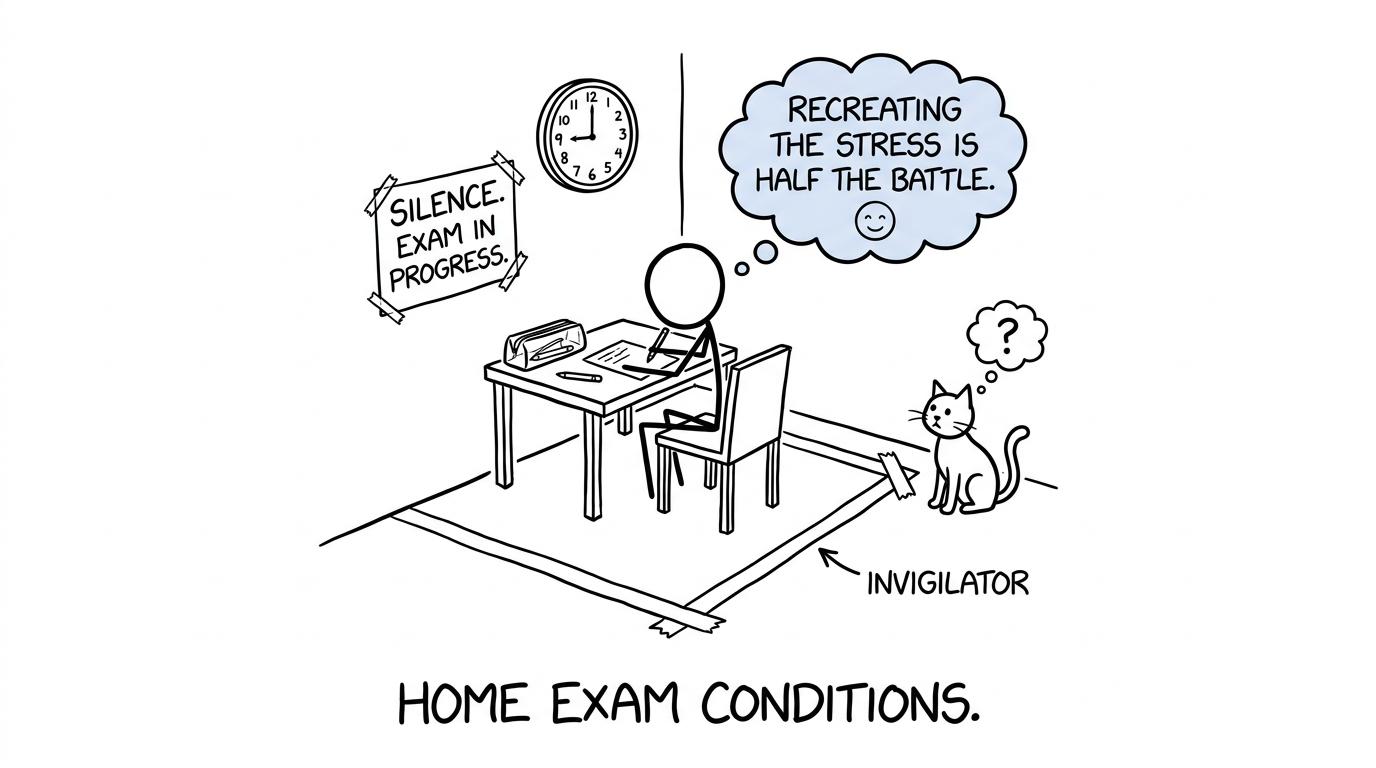 A student creates an excessively serious one-person exam hall at home while a cat acts as invigilator
Turn one room into an exam room
You do not need rows of desks or a formal invigilator. You need a controlled environment in which the normal escape routes have disappeared.
Clear the desk completely, then return only permitted equipment and the sealed paper. Remove vocabulary lists, grammar summaries, translations, set-text annotations and books. Do not assume a dictionary or edition of a set text is allowed. In a real examination, resources may be used only when the paper or specification permits them.
Put your phone, earbuds, watch and smart devices outside the room. Current JCQ instructions prohibit candidates from possessing unauthorised notes, phones, earbuds and watches in written examinations. They also require answers to be written clearly in black ink. Home practice carries no malpractice penalty, of course, but copying these restrictions builds the right habits.
Use a wall clock if possible. Write the official start and finish times on a separate instruction card before opening the paper. If somebody at home can help, ask them to announce the start and finish without answering questions or giving reminders. If you are alone, set an alarm outside the room loudly enough to hear, but do not keep the device beside you.
Tell other people in the house when you will finish. Close unnecessary browser tabs, silence notifications and place a simple notice on the door. The room need not be perfectly silent. It needs to be protected from avoidable interruptions.
Follow the exact time rather than a comfortable time
Do not use a generic two-hour session merely because it feels serious. Follow the duration printed on the current question paper, including any formally approved extra time.
Before the timer starts, reproduce the normal opening routine:
- sit down with the paper closed
- check that you have the correct component
- read the front-page instructions
- write your candidate details on a practice cover if appropriate
- start only at the agreed time
Once the session begins, do not pause for a difficult translation, a drink refill or a doorbell. If a genuine emergency interrupts the attempt, record the interruption and treat the result as a practice session rather than a clean mock.
Students with approved access arrangements should practise using those arrangements. For example, if your centre has formally approved extra time or supervised rest breaks, ask your school how they will operate and reproduce them accurately. Do not add informal breaks or extra time simply because you sometimes receive support during lessons.
The planning principle is simple. If the paper allows total time TTT and you reserve RRR minutes for checking, the time available for answering is:
T−R T-R T−RAllocate that time using the marks and demands of the actual sections. Avoid a rigid rule that treats every mark identically: translation, comprehension and extended literary analysis require different kinds of thought. Your first simulation should reveal where time is genuinely being lost.
Recreate the mental demands of Biblical Hebrew
Realism is not only about furniture and clocks. It is about making the same decisions that the examination requires.
Work without invisible assistance
Do not check vocabulary, parsing, translations or class notes. When a word is uncertain, use its form, syntax and context, make the best defensible decision, and continue. That uncertainty is useful evidence. It shows what needs attention later.
Write complete answers by hand
Typing a response does not reproduce handwriting speed, right-to-left script formation or the space available in an answer booklet. Use black pen throughout and keep your writing legible. Where a Hebrew response is required, make letters and pointing, if used, sufficiently distinct for a marker to read.
Move on deliberately
One difficult phrase can consume time that belongs to several accessible questions. Mark the location unobtrusively, leave enough space where appropriate and return later. Practising this choice is part of examination technique, not an admission that you cannot answer.
Stay seated until time ends
Finishing early is not the same as finishing well. Use remaining time to check omitted questions, mistranscribed details, unclear English, verb forms, agreement and whether longer Literature answers actually address the wording of the question.
A repeatable timetable helps these sessions happen rather than remain good intentions. The planning ideas in the GCSE maths revision timetable and one-month GCSE revision plan can be adapted around your Biblical Hebrew commitments.
Mark the paper as a diagnosis
Take a proper break before opening the mark scheme. This creates a clean boundary between performance and review.
Mark strictly, but do not stop at the total. For every lost mark, record one cause:
- Knowledge: vocabulary, morphology, syntax or set-text knowledge was missing.
- Interpretation: you knew the material but misunderstood the question or passage.
- Evidence: a Literature response lacked precise support or explanation.
- Technique: the answer was incomplete, unclear or insufficiently focused.
- Timing: you could have earned the mark but did not reach or finish the question.
Official assessment objectives give useful context. Across GCSE ancient languages, language knowledge and understanding accounts for 50%50\%50%, while literature knowledge and understanding accounts for 25%25\%25%, and analysis, evaluation and response account for the remaining 25%25\%25%. Your review should therefore look beyond translation accuracy alone.
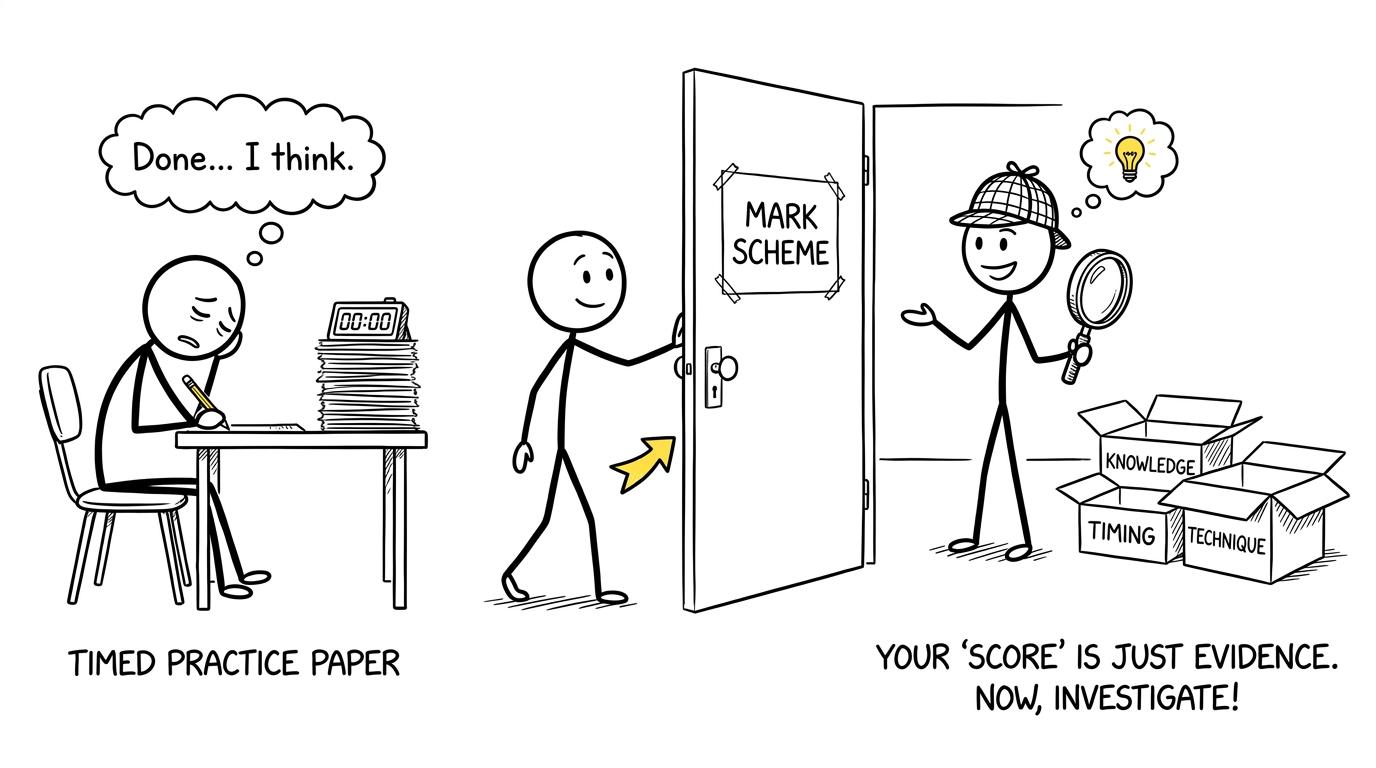 A friendly mark-scheme detective sorts errors into knowledge, timing and technique
A score is a snapshot. The error pattern is the plan. Choose two recurring weaknesses, revise them using your course materials, complete targeted questions, and retest them several days later. Then schedule another full simulation.
That is also how MathsGenie's free GCSE maths revision hub connects revision lessons, practice questions and papers. Its Past Papers feature places papers, official mark schemes, timers and selected worked solutions together, making the same paper, mark, repair cycle easier for Edexcel, AQA, OCR, Eduqas and other maths specifications.
Common mistakes in home exam practice
Looking at the paper before the timer starts
Even a quick scan removes some of the pressure of interpreting unfamiliar questions. Keep the paper closed until the start.
Using a phone as a visible timer
A phone creates notifications, temptation and an unrealistic examination environment. Use a wall clock and remove the phone.
Allowing small, unrecorded pauses
Stopping for thirty seconds can become several minutes across a paper. A valid timed result requires one continuous session unless you have an approved break arrangement.
Practising Literature with obsolete set texts
Old papers can still teach question style, but their prescribed passages may not match your examination year. Check the current specification before treating the score as representative.
Giving yourself hints
A vocabulary check may rescue one answer while hiding the knowledge gap that needs revision. Mark the uncertainty and continue without assistance.
Treating the final mark as the entire lesson
Two students with the same mark may need completely different revision. One may lack vocabulary; another may know the content but run out of time. Classify each lost mark before deciding what to practise.
Make exam conditions feel ordinary
A realistic mock should not be a one-off act of courage. Begin with timed sections if a complete paper currently feels overwhelming, then progress to full components. Keep the conditions stable so that changes in your performance mean something.
The deeper lesson applies across GCSE subjects. Confidence rarely arrives before practice. It grows when the setting, clock and decisions stop being surprising.
For Biblical Hebrew, use the current specification, official papers and mark schemes supplied by your examination board or teacher. For maths, make MathsGenie your free revision base: explore GCSE past papers, revision lessons, mini tests, predicted papers, practice questions, mark schemes and video solutions. Choose one paper, protect the time, sit it honestly and turn every lost mark into the next clear action.










