GCSE Bengali Switch Tier: Can You Move Up?
GCSE Bengali switch tier guidance: learn when moving from foundation to higher is possible, likely school deadlines, risks and what to ask next.
The uncomfortable part of tier decisions is that progress rarely arrives on schedule. You may begin GCSE Bengali on foundation tier, improve sharply during Year 11, then wonder whether the grade 555 ceiling still makes sense. If you are considering a GCSE Bengali switch tier, the short answer is yes: your school can normally move your AQA entry from foundation to higher before the relevant exam-entry arrangements are finalised.
But you cannot change the entry yourself, and there is no single national date by which every school must approve the request. Schools often set an internal deadline earlier than AQA's administrative deadline. Speak to your Bengali teacher and exams officer as soon as possible rather than waiting for the final mock or speaking assessment.
The answer at a glance
For AQA GCSE Bengali, the important facts are:
- Foundation tier offers grades 111 to 555.
- Higher tier principally offers grades 444 to 999.
- A narrow allowed grade 333 can be awarded on higher tier when a student falls just below grade 444.
- All four papers must be taken at the same tier and in the same exam series.
- Your school or exam centre controls the official entry.
- A tier can be amended after the original entry, but deadlines, fees and practical restrictions apply.
- Most sensible decisions use evidence from all four skills: listening, speaking, reading and writing.
The central question is therefore not simply, “Can the entry be changed?” It is, “Does the evidence show that higher tier gives me a better chance of achieving my intended grade?”
Check which Bengali qualification you are taking
Before discussing a change, confirm the exact qualification and exam board. The tiered GCSE discussed here is AQA GCSE Bengali, specification 8638. Its entry codes distinguish foundation and higher tier.
Do not assume that every qualification called Bengali, Bangla or International GCSE works in the same way. Pearson Edexcel International GCSE Bangla is a different qualification with a different assessment structure. Advice about switching AQA GCSE Bengali tiers should not automatically be applied to it.
Ask your teacher or exams officer for these three details:
- the full qualification title;
- the exam board and specification code;
- the tier currently recorded against your entry.
That small check prevents a surprisingly large administrative misunderstanding.
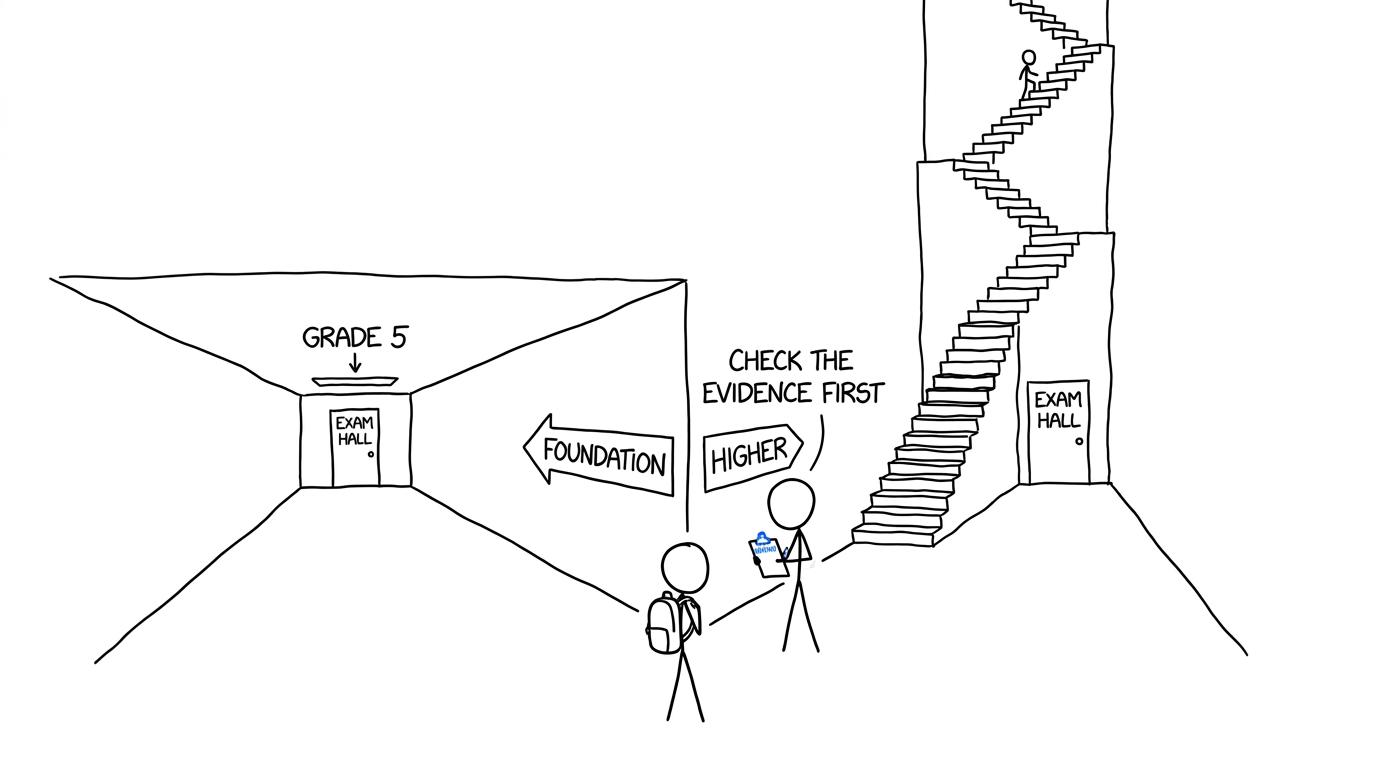 A student choosing between foundation and higher routes while a teacher checks the evidence
When can a GCSE Bengali switch tier happen?
A tier is an exam-entry choice, not a permanent label attached to you at the start of the course. Moving from foundation to higher partway through Year 10 or Year 11 is therefore possible if your school agrees that it is appropriate.
AQA advises centres to choose the most likely tier initially and amend it later if necessary. Tier changes can be made without an amendment fee before the board's published amendment deadline. Changes after that point may attract a fee and become progressively more difficult to organise.
For the June 2027 series, AQA's published calendar places the main entry deadline in February, followed by a later amendment stage in April. Dates can change, and the administrative deadline is not a promise that your school will accept a last-minute request. Your exams officer should check the current series guide rather than relying on a date remembered from a previous year.
Why your school's deadline may be earlier
An exam board deadline tells centres when an entry can be submitted or amended. A school deadline tells students when the school is prepared to make that decision. They are not necessarily the same.
Schools need time to review mock evidence, discuss the choice with teachers, order or manage the correct assessment materials and check every candidate's entry. Bengali also includes a speaking assessment. Because all four skills must be entered at one tier, a late change becomes especially problematic once assessment arrangements are under way.
There is no published national rule saying that every school allows switching until a particular week. In practice, a school may finalise tiers around its winter mocks, its February entries process or an earlier internal deadline. Some centres may review borderline cases later, but students should never assume that an April amendment remains available simply because the exam board's system technically permits changes.
What changes when you move to higher tier?
Higher tier is not merely foundation tier with a few harder questions added at the end. It targets a different grade range and expects stronger performance across the qualification.
AQA GCSE Bengali has four equally weighted skills:
- listening;
- speaking;
- reading;
- writing.
Each contributes approximately 25%25\%25% of the qualification, with marks scaled to a total of 240240240. You must take every component at the same tier. You cannot, for example, enter higher reading and writing while keeping foundation listening and speaking.
Higher-tier listening and reading assessments also give candidates more time because their demands are greater. The issue is not simply whether you can understand challenging vocabulary. You need enough control, accuracy, fluency and exam technique across all four skills to make the higher entry worthwhile.
Foundation grade 555 or higher tier?
Foundation tier is not a lesser qualification. A grade 444 or 555 achieved on foundation has the same value as the corresponding grade achieved on higher tier, and the certificate does not display the tier taken.
Foundation may be the sounder choice when your priority is securing a grade 444 or 555 and your performance varies significantly between skills. Higher tier becomes necessary if you have a realistic target above grade 555, because foundation cannot award grades 666 to 999.
The risk sits at the bottom of higher tier. AQA principally awards grades 444 to 999 on higher, with only a restricted grade 333 safety net for a candidate narrowly below grade 444. Falling below that narrow range results in an unclassified outcome. Higher is therefore not automatically the ambitious or brave option. Sometimes the more ambitious decision is choosing the tier on which your knowledge can be demonstrated most reliably.
You can inspect previous outcomes using the AQA GCSE Bengali grade boundaries on MathsGenie. Historical boundaries provide context, but they are not advance promises: boundaries are set for each exam series after the assessments have been taken.
Evidence your teacher is likely to consider
One excellent vocabulary test is not enough. Nor is one disappointing mock necessarily the end of the discussion. A strong decision looks for a pattern.
Useful evidence includes:
- recent full or substantial mock assessments;
- performance on questions shared across the two tiers;
- consistency across listening, speaking, reading and writing;
- the quality and accuracy of extended responses;
- your ability to cope with unfamiliar language under time pressure;
- whether your target genuinely requires a grade above 555;
- attendance, preparation and willingness to complete higher-tier practice.
The logic is similar to choosing a GCSE maths tier. A single difficult topic should not determine the whole entry; teachers look at performance across the specification. Maths students can see how this evidence-led process works through the GCSE Maths revision hub and the guide to GCSE maths marks and tier limits.
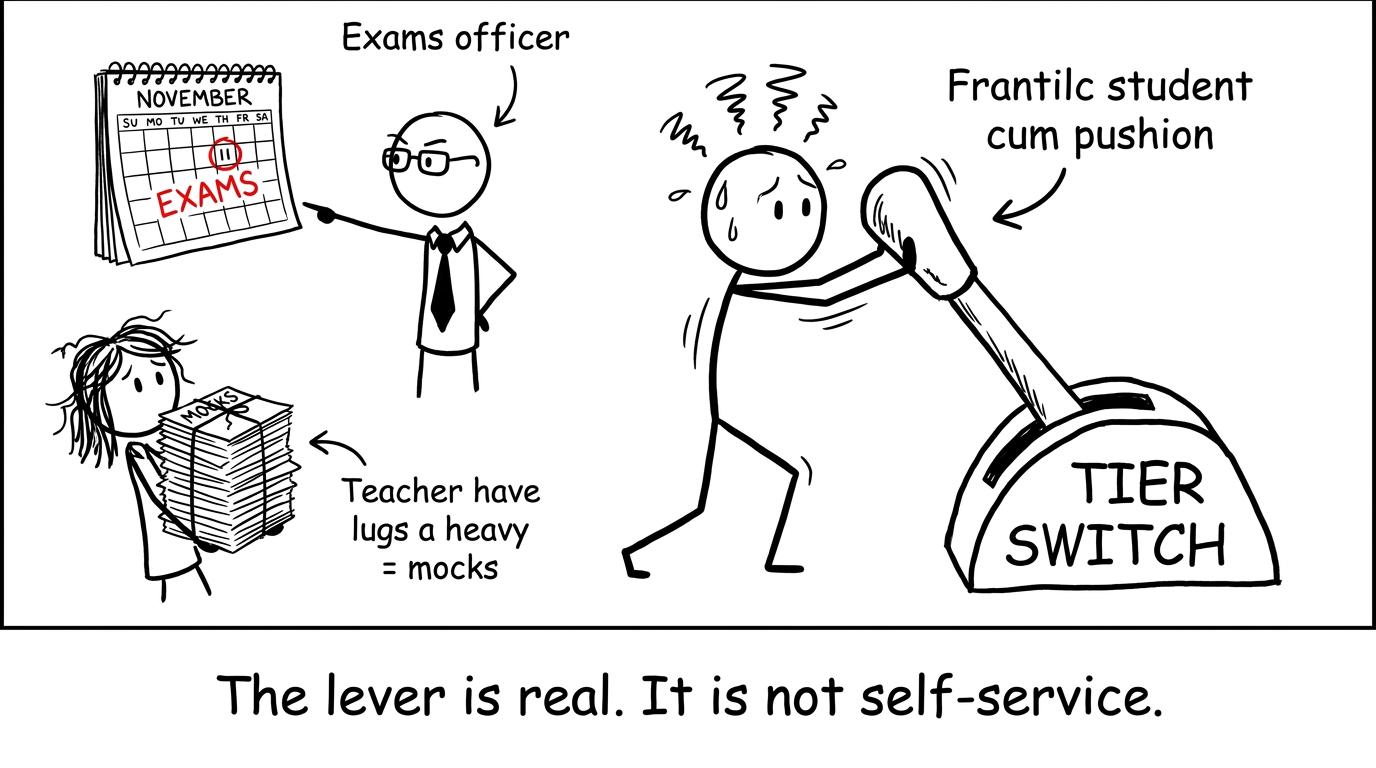 A student discovers that the tier-switch lever is controlled by the exams office
How to ask your school about switching
Ask early and ask specifically. A vague question such as “Can I do higher?” can produce a vague answer. A better conversation covers evidence, timing and next steps.
Use this checklist:
- Confirm your current tier and exact qualification.
- Ask for the school's internal deadline for tier changes.
- Request feedback from each assessed skill, not just an overall predicted grade.
- Ask what performance would justify a move to higher.
- Find out whether another mock or higher-tier assessment can be completed.
- Agree on a review date and record the decision.
- Ask the exams officer to confirm the final entry once it has been changed.
Parents or carers can support the conversation, but the school remains responsible for making the exam entry. If you are a private candidate, the centre through which you are entered performs this role, so contact it directly and ask about its own deadlines and charges.
Preparing if the school agrees
A late move should lead to a change in practice, not just a change in the letter attached to your entry. Obtain the higher-tier specification requirements and practise the correct task formats across all four components.
Use a simple revision cycle:
- attempt a timed task;
- mark it against the relevant criteria or mark scheme;
- identify one precise weakness;
- practise that skill;
- retest it using unfamiliar material.
MathsGenie's free resources can support the rest of your GCSE timetable while Bengali requires extra attention. Use the GCSE maths mini tests for short diagnostic sessions, follow a realistic one-month maths revision plan, and learn when to begin using past papers. Keeping maths revision organised creates more room for focused Bengali preparation.
Common mistakes when requesting a tier change
Waiting until the speaking assessment
Bengali is a four-skill qualification, and every component must use the same tier. Once assessment arrangements have begun, a switch can be administratively or practically impossible. Ask well before the speaking window.
Treating the board deadline as a personal deadline
The exam board may permit amendments later than your school does. Your school's internal cut-off is the date that matters to you.
Choosing higher only because it sounds better
Higher tier opens grades above 555, but it also introduces the risk of an unclassified result below the narrow grade 333 safety net. The choice should follow evidence and your target grade.
Judging readiness from one skill
Being a confident speaker does not guarantee equally strong listening, reading and writing. All four skills carry substantial weight and must be taken at the same tier.
Assuming the change has been completed
A teacher may support the idea without the official entry having been amended. Ask for confirmation from the exams office before the deadline.
Using old grade boundaries as targets
Past boundaries help you interpret previous performance, but future boundaries are not known in advance. Concentrate on improving the quality of your responses rather than chasing one historical total.
Make the decision while there is still time
Yes, moving from foundation to higher partway through AQA GCSE Bengali is possible. The safest route is to raise the question early, confirm your school's internal deadline and use evidence from listening, speaking, reading and writing. If higher tier is right for you, the decision should feel supported by sustained performance rather than hope alone.
Then protect the rest of your GCSE preparation. Use MathsGenie as your free maths revision base: start with efficient GCSE maths revision guidance, work through revision lessons and practice questions, and build towards past papers, predicted papers, mark schemes, video solutions and mini tests. A good tier decision opens the door. A calm, repeatable revision routine is what helps you walk through it.