

GCSE Astronomy Predicted Grades Accuracy Explained
GCSE astronomy predicted grades accuracy explained: discover how forecasts are set, why final results differ and how focused revision can close the gap.
A predicted grade can feel strangely permanent. One number appears on a report, and suddenly it seems to describe both your past work and your future result. It does neither perfectly.
The short answer on GCSE astronomy predicted grades accuracy is that a prediction can be a useful estimate, especially when it draws on several recent assessments, but it is not a dependable promise of your final grade. There is no current published accuracy rate specifically for GCSE Astronomy. Wider Ofqual evidence on teacher forecasts suggests that exact predictions are difficult, although most have historically fallen within one grade of the eventual result.
Your prediction is best treated as a starting position: evidence of where you are now, not a limit on where you can finish.
The quick accuracy checklist
A GCSE Astronomy prediction is more informative when:
- it uses several timed assessments rather than one mock;
- both astronomy papers have been represented;
- questions have covered knowledge, calculations, data and evaluation;
- the mock was marked consistently using a suitable mark scheme;
- your teacher has considered the difficulty of the paper;
- you completed it under realistic exam conditions;
- the estimate uses recent performance rather than work from months ago.
Be more cautious if the prediction comes from one short test, an incomplete paper or an old grade boundary applied without considering the paper's difficulty.
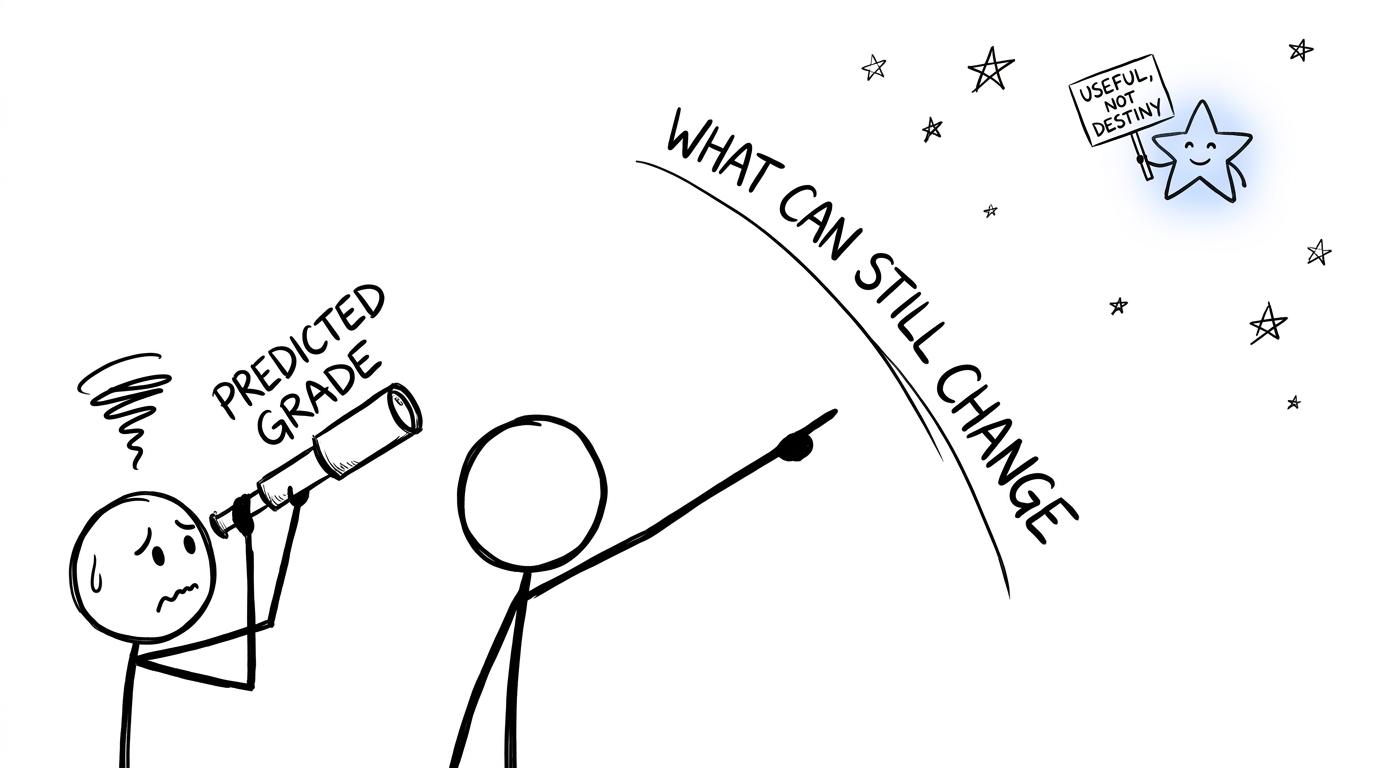 A predicted grade is a telescope, not the whole sky
How reliable are GCSE Astronomy predicted grades?
For an individual student, the honest answer is reasonably informative but not precisely reliable.
An Ofqual literature review reported that studies of teacher grade predictions across qualifications commonly found exact accuracy of approximately 42%42\%42% to 52%52\%52%. When accuracy was widened to include one grade above or below, it was at least 85%85\%85% in the studies reviewed. Separate historical research into OCR GCSE forecasts across subjects found roughly 43%43\%43% were exactly correct and 87%87\%87% were within one grade.
These figures are useful context, but they are not a current GCSE Astronomy accuracy statistic. They cover other subjects, exam series and prediction systems. It would therefore be misleading to claim that a particular percentage of Astronomy predictions will be correct.
A sensible personal interpretation is to think in terms of a range:
working range=predicted grade±1\text{working range} = \text{predicted grade} \pm 1working range=predicted grade±1That is not an exam-board rule or a guarantee. It is simply a calmer way to recognise uncertainty. A predicted grade 666, for instance, signals that your present performance may be around that standard; it does not prove that grades 555 or 777 are out of reach.
What GCSE Astronomy predictions are based on
Schools set predicted grades according to their own assessment policies. There is no single national formula that every teacher must follow. Evidence may include:
- mock examination marks;
- end-of-topic assessments;
- classwork and homework;
- performance on past-paper questions;
- mathematical and observational skills;
- improvement over time;
- professional judgement about likely performance.
The strongest prediction combines several sources. One unusually good mock can overstate consistency. One difficult paper, illness or poor day can understate what you normally know.
Predictions may also serve different purposes. A report grade might describe current attainment, while a target grade describes an intended destination. A school forecast may estimate likely summer performance. Ask your teacher which meaning applies before comparing the number with anyone else's.
Why Astronomy is particularly difficult to predict
GCSE Astronomy is currently offered by Pearson Edexcel. Unlike GCSE Maths, it is not divided into foundation and higher tier: all candidates take the same two papers.
The qualification is assessed through two externally examined papers:
- Paper 111, Naked-eye Astronomy, lasts 111 hour 454545 minutes and is worth 100100100 marks;
- Paper 222, Telescopic Astronomy, lasts 111 hour 454545 minutes and is worth 100100100 marks.
Each contributes 50%50\%50% of the qualification. Students must also complete at least one aided and one unaided observation. The observations themselves do not contribute a coursework mark, but knowledge and application of observational skills are assessed in the written papers.
At least 20%20\%20% of the qualification's marks reward mathematical skills, while at least 15%15\%15% assess knowledge and understanding of observational work. That breadth matters. A student who remembers astronomical facts well may still lose marks on graphs, calculations, units or evaluating a procedure.
Maths Genie’s GCSE Maths revision hub can help strengthen the transferable number, algebra, graph and data skills behind those questions. The Edexcel GCSE Statistics revision resources are also useful when interpreting information, spotting trends and judging conclusions.
Why the final grade can be lower than predicted
The prediction used optimistic evidence
Teacher predictions have historically been more likely to be optimistic than pessimistic when they differ from achieved grades. This does not mean teachers are careless. Predictions sometimes reflect what a student could achieve in positive circumstances, while results day records performance in specific examinations on specific days.
Grade boundaries change
A raw mark does not carry a permanent grade. Boundaries are set for each exam series after the papers have been taken and marked, accounting for the demand of that assessment.
Recent GCSE Astronomy grade boundaries show why an estimate based mechanically on the previous year can mislead:
| Exam series | Grade 999 | Grade 777 | Grade 444 |
|---|---|---|---|
| June 202420242024 | 156156156 | 124124124 | 808080 |
| June 202520252025 | 162162162 | 133133133 | 888888 |
The maximum qualification mark was 200200200 in both series, yet these selected thresholds rose by between 666 and 999 marks. This does not mean one year was simply easier or harder in every respect. It shows why last year's boundary is a guide, not a promise about the next series.
The mock did not represent the full course
A mock may omit later topics or contain a different balance of calculations and extended responses. If it tested your strongest content, the resulting grade may be generous. If important material had not yet been taught, it may be unduly low.
Exam technique reduced the available marks
Running out of time, omitting units, rounding too early, misreading a graph or giving an unsupported conclusion can create a gap between knowledge and marks. Use past papers with mark schemes to practise producing answers under pressure, not merely recognising material in your notes.
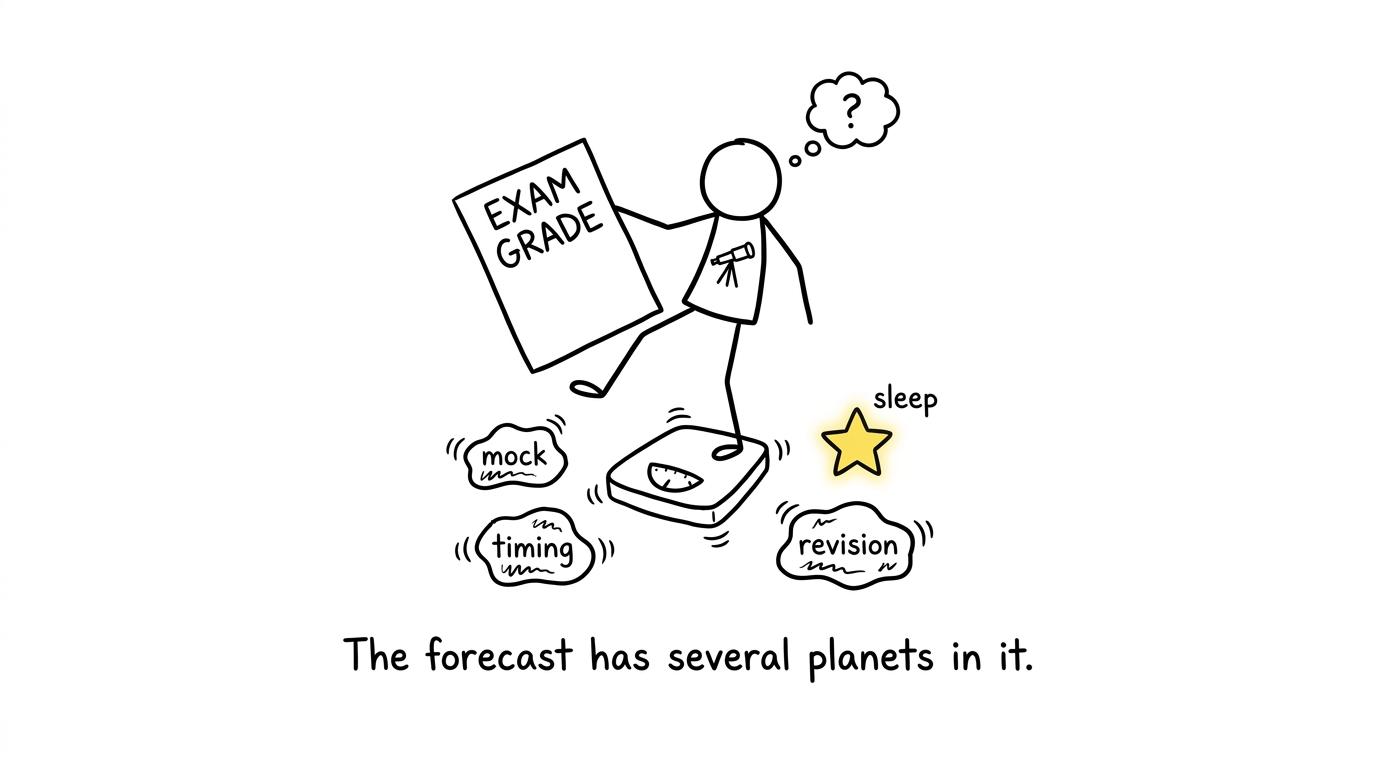 Several factors wobble around a predicted grade
Why the final grade can be higher than predicted
Predictions can lag behind improvement. This is especially likely when they were set early, based heavily on an older mock or produced before the course was complete.
Your result may rise because:
- missing topics are now secure;
- your mathematical fluency has improved;
- repeated paper practice has made timing more automatic;
- you understand what command words require;
- you check units, significant figures and graphs more carefully;
- the final papers suit your knowledge better than the mock did.
Improvement is often quiet before it becomes visible. Correcting one recurring calculator error may save several marks across two papers. Learning to support an evaluation with evidence can improve multiple extended answers.
Maths Genie’s guide to the best order for learning GCSE Maths topics can help you rebuild weak foundations logically. If the exam is approaching, use the one-week GCSE maths revision plan to organise short, focused sessions rather than trying to revise everything at once.
Turn the prediction into a useful revision decision
A predicted grade becomes valuable when it leads to a specific action. The number alone tells you very little. The lost marks tell you what to do next.
After each timed assessment, classify errors under four headings:
- Knowledge: a fact, definition or process was missing.
- Mathematics: the astronomy was understood, but the calculation failed.
- Application: familiar knowledge was not transferred to an unfamiliar context.
- Exam technique: time, wording, units or checking cost marks.
Then repair the largest category first. If mathematics is the problem, return to focused revision lessons and practice questions. If timing is the issue, complete timed sections. If extended responses are weak, compare your answer closely with the mark scheme and identify the missing reasoning.
Do not wait until you feel completely ready for past papers. The best time to encounter mistakes is while there is still time to fix them. Maths Genie’s guide to when to start GCSE past papers explains how to move from short sections to full timed attempts.
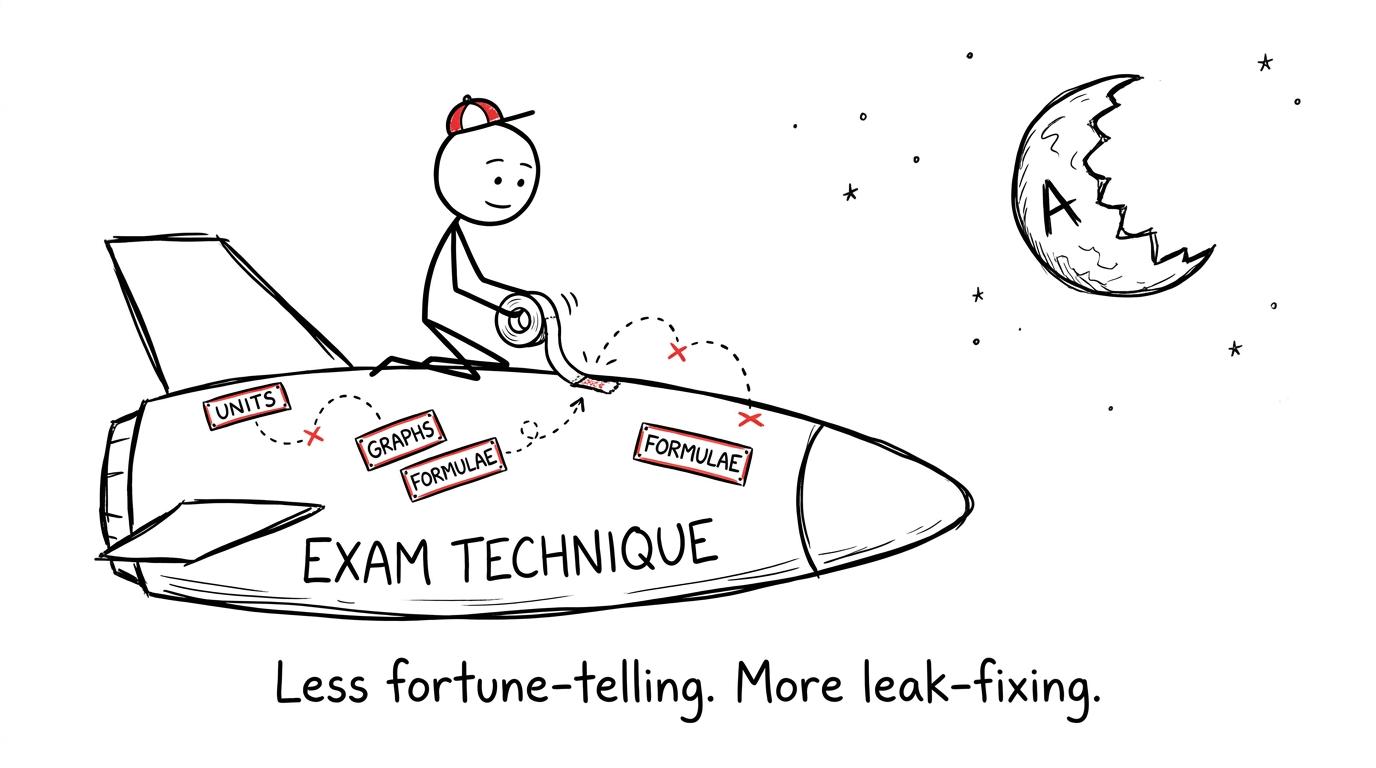 A student repairs the small leaks in exam technique
Common mistakes when interpreting predicted grades
Treating the grade as a ceiling
A prediction records an estimate at a particular time. It cannot include revision you have not yet completed or improvements you have not yet demonstrated.
Comparing predictions across schools
Schools may use different mocks, boundaries and policies. Two identical predicted grades may have been produced from very different evidence.
Revising only to cross an old boundary
Historical boundaries help you understand previous series, but the next boundary is unknown before results day. Build a mark buffer rather than aiming for the exact minimum from last year.
Ignoring the mark profile
The same total can hide different weaknesses. One student may lose calculation marks; another may struggle with observational evaluation. Their revision plans should not be identical.
Repeating papers without analysing errors
Completing more questions is not automatically progress. Mark carefully, record why each mark was lost, revisit the relevant lesson and attempt a fresh question. The process should be attempt, diagnose, repair and retest.
Your predicted grade is a forecast, not an orbit
GCSE Astronomy predicted grades tend to be useful as broad indicators, particularly when they come from several recent, representative assessments. They are much less reliable as exact promises. Changing boundaries, paper coverage, exam-day performance and genuine improvement can all move the final result higher or lower.
So keep the prediction in perspective. Look beyond the grade to the marks you can still recover.
Use Maths Genie as your free revision base: strengthen transferable skills through GCSE Maths revision, learn from mark schemes and video solutions, and test your progress with practice questions, mini tests, past papers and predicted papers. One forecast cannot determine results day. The work you do after receiving it still matters.











