

GCSE Astronomy Note Taking You'll Actually Use
GCSE astronomy note taking that creates usable recall prompts, calculation cues and an honest review system for stronger, more focused exam revision.
GCSE astronomy note taking can easily become a performance: pages of careful handwriting, neat diagrams and enough colour coding to resemble a stellar classification chart. Yet the real test arrives weeks later, when you need to explain a lunar eclipse or interpret observational data without the page open.
The solution is to make notes for future retrieval, not present-day decoration. Each page should help you recall an idea, apply it to an unfamiliar question and discover what still needs attention. This guide gives you a practical system for doing exactly that, while strengthening the mathematical skills astronomy questions require.
The note-taking system at a glance
Use this checklist for every GCSE Astronomy topic:
- Match the page to the current Pearson Edexcel specification.
- Divide content into knowledge, application and evaluation.
- Write questions and prompts, not only summaries.
- Record equations with meanings, units and rearrangement cues.
- Keep diagrams simple enough to reproduce from memory.
- Add observational methods, limitations and improvements.
- Close the notes and retrieve what you know.
- Mark gaps honestly and schedule another review.
- Connect recurring mathematical weaknesses to focused practice.
A useful note is not necessarily a beautiful one. It is a page that tells you what to do next.
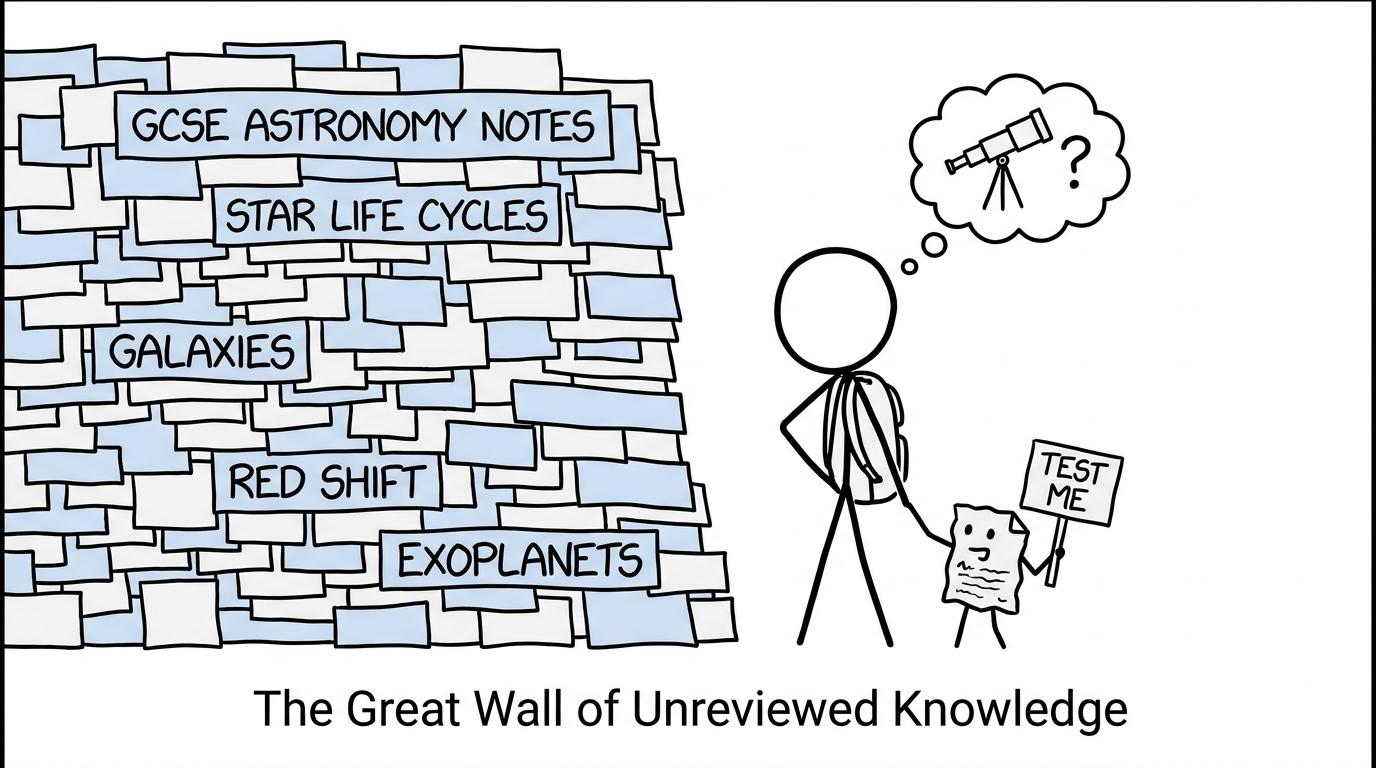 A student notices that the tiny test-me card is more useful than a towering wall of decorative notes
Start with the GCSE Astronomy assessment
GCSE Astronomy in England is currently offered through Pearson Edexcel under specification 1AS01\mathrm{AS}01AS0. It is an untiered qualification, so the foundation and higher distinction used in GCSE Maths does not apply.
The course contains 161616 topics. Paper 111, Naked-eye Astronomy, covers Topics 111 to 888. Paper 222, Telescopic Astronomy, covers Topics 999 to 161616. Each written paper lasts 111 hour 454545 minutes, carries 100100100 marks and contributes 50%50\%50% of the qualification.
Both papers can include multiple-choice, short-answer, calculation, graphical and extended open-response questions. Students must also complete observational work during the course. That breadth matters because a notebook containing definitions alone cannot prepare you for the whole assessment.
The assessment objectives offer a better structure:
- AO1: knowledge and understanding, weighted at 40%40\%40%.
- AO2: application of knowledge and understanding, weighted at 40%40\%40%.
- AO3: analysis, interpretation and evaluation, weighted at 20%20\%20%.
For every subtopic, create three labelled areas: Know, Apply and Evaluate. A note on telescopes, for instance, should separate factual knowledge from decisions about selecting equipment and evaluating an observational method. This keeps your revision aligned with what the examination actually rewards.
Build notes around questions, not paragraphs
Copying a paragraph creates a record of what your teacher said. It does not necessarily create a route back into your memory.
Turn each specification statement into a question. Instead of placing a heading such as “Stellar evolution” above a block of prose, use prompts such as:
- What determines the life cycle of a star?
- How do the later stages differ for stars of different initial mass?
- What evidence could an astronomer observe?
- Which stages are commonly confused?
Write a concise answer beneath each prompt, then cover it during review. This converts the notebook into a self-testing resource without requiring a separate stack of materials.
Research on retrieval practice consistently finds benefits when learners actively recall information rather than relying only on rereading. The important word is actively. Looking at an answer and thinking “I knew that” is recognition, not retrieval.
After a lesson, close the source and write what you remember for a few minutes. Reopen it, check the details and add corrections in another colour. Your first attempt reveals the memory you actually built; the corrections reveal where to focus next.
MathsGenie's guide to the best order for learning GCSE maths topics uses the same principle: learn, practise, revisit and then move towards examination technique.
Use a repeatable page layout
Consistency reduces the effort needed to decide how every new page should look. Use one sheet or digital page for each manageable specification point.
The top section: the retrieval test
Place three to five questions at the top. These should include a factual question, an application prompt and, where relevant, an evaluation prompt.
Leave enough space to answer from memory. Do not hide the questions inside decorative boxes that you will never use again.
The middle section: the minimum useful explanation
Summarise the idea in short statements. Include essential vocabulary, linked causes and effects, and a small reproducible diagram where it genuinely clarifies the relationship.
Astronomy contains many processes that are easy to recognise but harder to explain. Your notes should preserve the chain of reasoning. Arrows are useful only when every arrow has a meaning such as “causes”, “increases” or “is observed as”.
The bottom section: exam and review cues
Finish with:
- one likely source of confusion;
- one mathematical skill connected to the topic;
- one observational or data-based question;
- the date of your next review;
- a confidence rating based on recall, not appearance.
Use a simple status system: secure, uncertain or relearn. A long numerical scale can create false precision. You mainly need to know which action follows.
Make mathematical astronomy notes operational
At least 20%20\%20% of the marks across GCSE Astronomy must reward mathematical skills. The current Pearson specification says the minimum mathematical demand is equivalent to Key Stage 333, but questions can require several connected decisions: selecting information, rearranging, substituting, handling units, plotting data and interpreting a result.
The examination papers provide the specified formulae and data sheet. That does not remove the need to understand each relationship. Your equation notes should show:
- what every symbol represents;
- the expected units;
- which quantity is the subject;
- common rearrangements;
- conditions or definitions attached to the equation;
- a reasonableness check for the final answer.
For example, the formulae sheet includes relationships such as telescope magnification,
magnification=fofe,\text{magnification}=\frac{f_o}{f_e},magnification=fefo,redshift,
λ−λ0λ0=vc,\frac{\lambda-\lambda_0}{\lambda_0}=\frac{v}{c},λ0λ−λ0=cv,and Hubble's law,
v=H0d.v=H_0d.v=H0d.Do not fill your page with repeated numerical examples. Instead, annotate the structure: identify numerator and denominator, note where units must agree, and write a prompt asking what the result means astronomically.
Standard form, substitution, rearranging formulae, graphs, ratios, angles and unit conversions all deserve links in your notes to the corresponding maths skill. The GCSE Maths revision hub provides free revision lessons, practice questions, videos and exam resources for these foundations.
If you are unsure how those skills fit into your wider course, use the GCSE Maths topics by exam board and tier guide. Edexcel, AQA, OCR and Eduqas organise GCSE Maths differently, so use resources matching your maths board and your foundation or higher entry. GCSE Astronomy itself remains untiered.
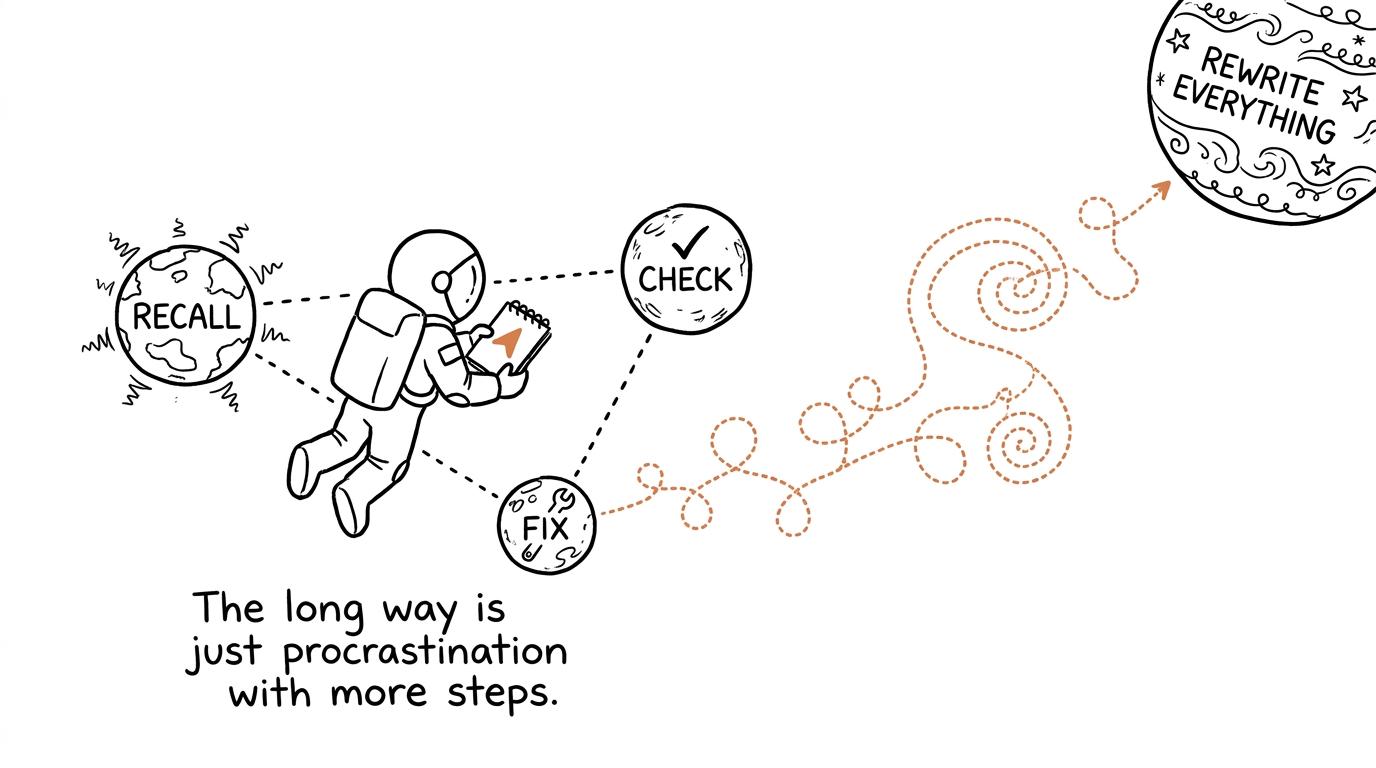 A student astronaut chooses the short route through recall, checking and fixing rather than orbiting rewrite-everything
Treat diagrams as retrieval tools
Astronomy diagrams often look obvious while visible. Remove the labels and the difficulty changes.
For systems such as lunar phases, eclipses, celestial coordinates or telescope arrangements, create two versions:
- a compact reference diagram with accurate labels;
- a blank outline that you can reconstruct or label from memory.
Keep spatial relationships accurate and avoid adding artistic detail that has no explanatory purpose. Beside the diagram, include prompts about viewpoint, direction, relative position and what an observer would see. A diagram earns its place when it helps you explain rather than merely identify.
When angle facts, scale or graphical interpretation become the obstacle, diagnose that as a maths issue rather than repeatedly rewriting astronomy content. MathsGenie's guide to GCSE topics that come up regularly helps identify the core number, algebra, geometry and graph skills worth maintaining.
Keep observational notes separate and specific
Observational astronomy requires more than remembering objects in the night sky. Students need to understand planning, safe and skilful methods, data collection, analysis, limitations and possible improvements.
For each observation, keep a structured record containing:
- the aim;
- equipment and method;
- location, date, time and relevant conditions;
- raw observations or measurements;
- processing and presentation decisions;
- uncertainty or limitations;
- conclusions supported by the evidence;
- realistic improvements.
Avoid vague evaluation phrases such as “be more accurate”. State what would change and why: use a more suitable interval, repeat observations, reduce an identified source of stray light or choose conditions better matched to the aim.
Your course requires both unaided and aided observational work, so follow your teacher's instructions and the current Pearson guidance. Note taking supports that work, but it does not replace completing it.
Turn review into a short cycle
A notebook becomes useful through repeated contact. After creating a page, follow this cycle:
- Recall: answer its questions without looking.
- Check: compare your response with the source.
- Correct: add only the missing or inaccurate detail.
- Apply: attempt an unfamiliar question or interpret data.
- Schedule: return after a delay rather than immediately rewriting.
A weekly plan should mix new astronomy content with older retrieval. The GCSE one-month revision plan offers a useful model for balancing focused lessons, recall and timed practice. Adapt its rhythm to Astronomy rather than copying its maths topic list.
Past questions then reveal whether your notes transfer to examination conditions. Follow the process in how to use GCSE past papers properly: attempt, mark, diagnose, repair and retest. Use official Astronomy materials supplied by Pearson or your school for Astronomy-specific practice.
For your connected maths preparation, MathsGenie's Edexcel GCSE Maths predicted papers can test whether formula work, graphs and numerical accuracy survive under pressure. If Edexcel is not your maths board, select the appropriate board from the main revision hub.
Create an error log that changes your notes
Every marked question should leave a trace. Record the topic, the precise error, the lost mark and the action required. Useful categories include:
- knowledge gap;
- incorrect application;
- weak evaluation;
- mathematical method;
- unit or rounding error;
- misread command word;
- incomplete conclusion.
Then alter the original note. Add a retrieval question, clarify a definition or link to maths practice. Without that repair, an error log becomes another document you own but do not use.
The advice in should you redo GCSE past papers? is valuable here: mark and diagnose first, repair the weakness, then retest. Immediate repetition may measure familiarity with the page rather than durable understanding.
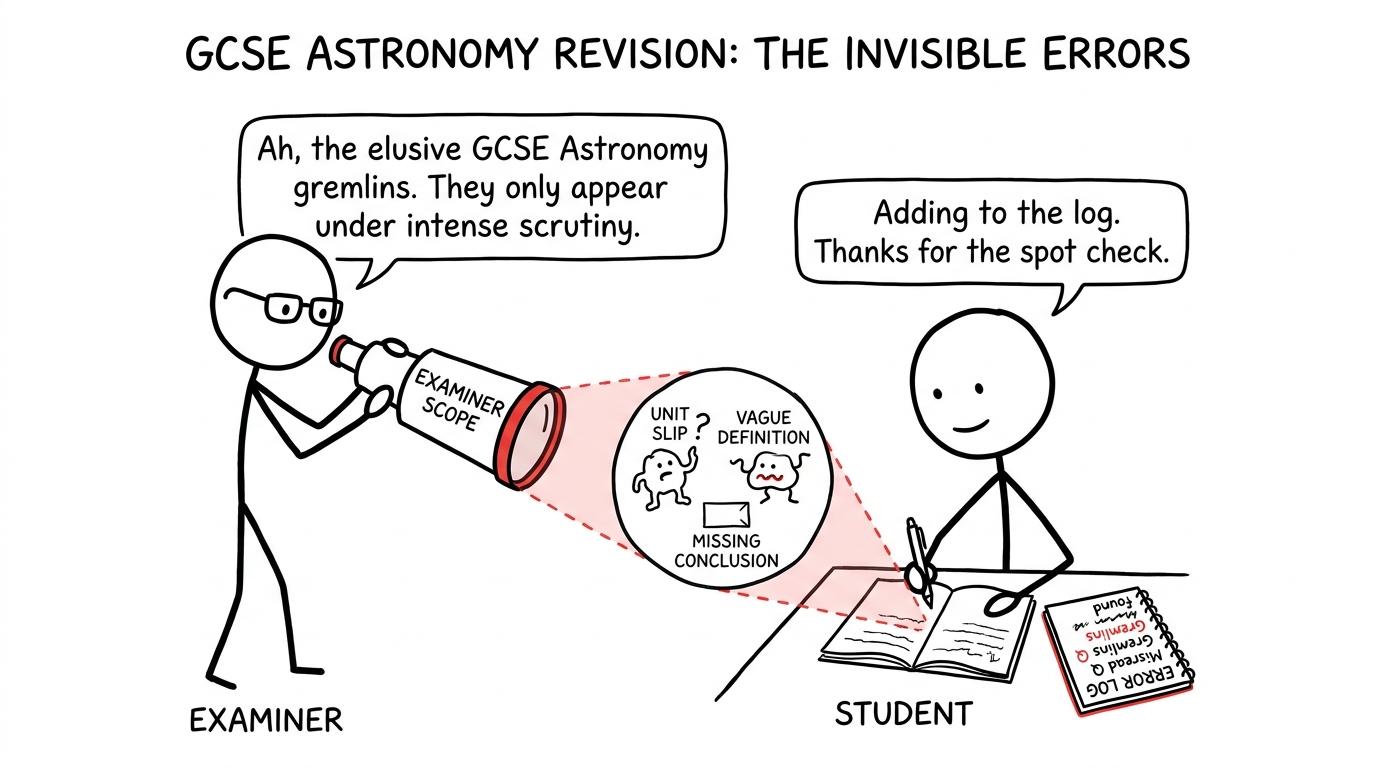 A telescope reveals unit slips and vague definitions hiding in notes before they are moved into an error log
Common GCSE astronomy note-taking mistakes
Copying before thinking
Writing continuously can feel productive because the page fills quickly. Pause first, retrieve the idea, then check and correct it. The struggle is useful information.
Giving every fact equal space
Specification language, difficult relationships, observations and recurring errors deserve more attention than facts you already recall securely.
Recording equations without meanings or units
An equation copied perfectly can still be unusable. Record symbols, units, rearrangement cues and what the output tells you.
Making diagrams too elaborate to reproduce
Your examination diagram needs clarity, not artwork. Practise drawing a simplified version from memory.
Revising definitions but ignoring AO2 and AO3
Knowledge is only part of the assessment. Add application, data interpretation and evaluation prompts to every suitable page.
Treating highlighting as review
Highlighting can organise a source, but it does not prove recall. Close the page and answer a question instead.
Rewriting an entire notebook near the examination
This consumes time without targeting weaknesses. Use questions, error logs, mini tests and marked papers to decide which pages need repair.
Make every page earn its place
The best GCSE astronomy note taking system is not the one with the most pages. It is the one you can reopen, test yourself with and improve after making a mistake.
Begin with one topic. Turn its specification statements into questions, add concise explanations, connect the required mathematical skills and schedule a closed-book review. Then let questions and mark schemes expose what needs changing.
For the maths underneath Astronomy, make MathsGenie your free revision base. Use the GCSE Maths revision resources for lessons, practice questions, mini tests, past papers, mark schemes and video solutions. Build these into a realistic revision plan, then use predicted papers to test whether the methods remain available when the notes are closed. That is when a notebook stops looking busy and starts doing useful work.











