

GCSE Astronomy Grade and Sixth Form Entry
GCSE astronomy grade sixth form entry explained: learn when the subject counts, what matters more, and how to check each provider's admissions rules.
A results sheet can make every subject look equally important. Admissions decisions rarely work that way. If you are searching for GCSE astronomy grade sixth form entry guidance, the short answer is reassuring: sixth forms and colleges may count Astronomy as one of your GCSEs, but they usually place more weight on your overall results, GCSE Maths and English, and the subjects connected to your chosen course.
GCSE Astronomy is a recognised full-course GCSE. However, there is no single national sixth form entry formula. One provider may include Astronomy among your best GCSE grades, while another may count only specified subjects. Your first task is therefore not to guess how impressive the grade looks. It is to read the admissions policy for each place you are considering.
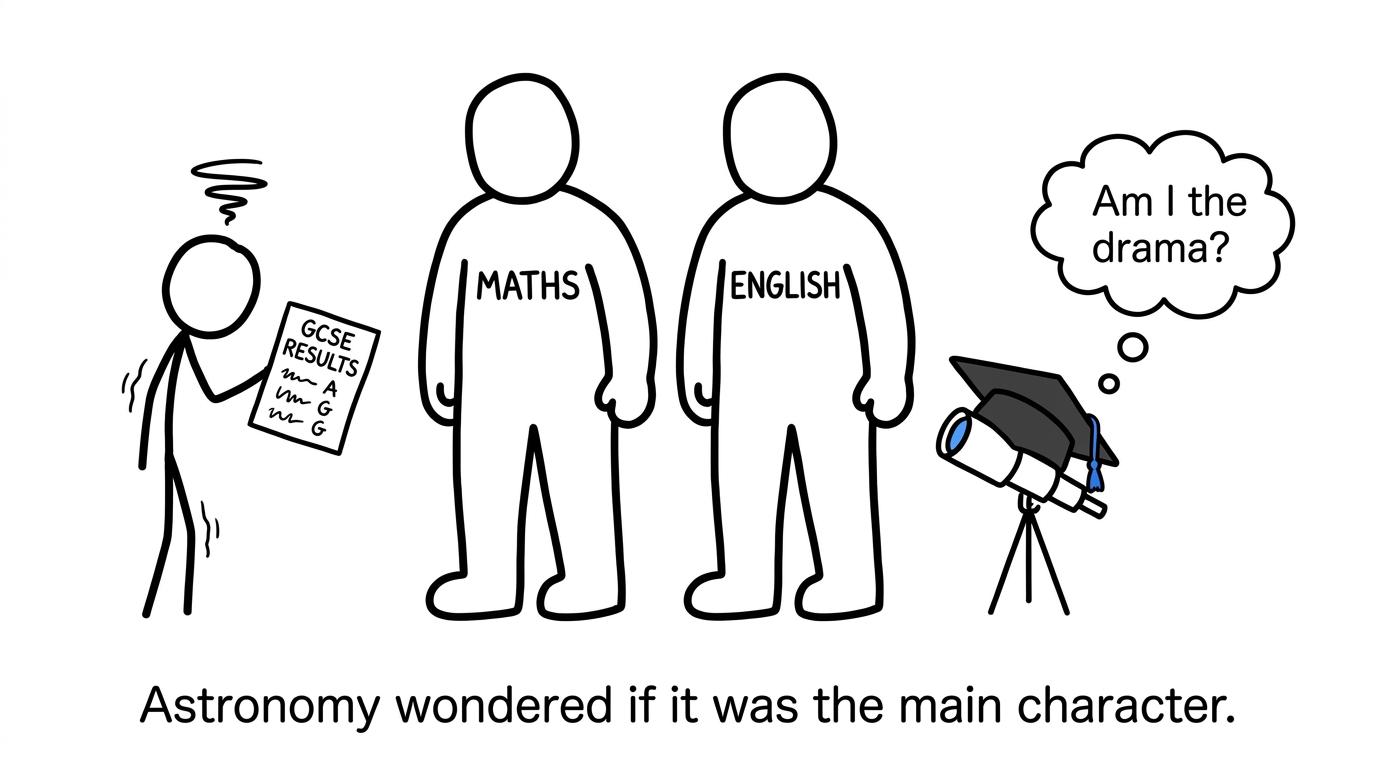 A small telescope waits behind Maths and English in an admissions queue
The quick answer
Use this checklist to understand how much your Astronomy result is likely to matter:
- It is a genuine GCSE: Pearson Edexcel GCSE Astronomy is a regulated full-course qualification graded 999 to 111.
- It can contribute to an overall GCSE total: this may help where a provider asks for a certain number of GCSEs or uses a best-888 score.
- It is rarely a headline entry requirement: GCSE Maths, English and relevant sciences usually receive more attention.
- It does not normally replace GCSE Physics or Combined Science: this matters when applying for A Level Physics or another science course.
- Some providers restrict which GCSEs they count: Astronomy may be excluded from a particular admissions calculation even though it is a recognised GCSE.
- The provider's published policy decides: check the current prospectus, course pages and admissions policy rather than relying on a general rule.
How much weight does a sixth form actually give Astronomy?
For most applicants, the grade has supporting weight rather than decisive weight. It can strengthen your overall academic profile, particularly if it is one of your higher results. It is much less likely to override a missed requirement in Maths, English or a subject directly linked to your intended A Levels.
This becomes clearer when entry requirements are separated into three layers.
| Admissions layer | Likely importance of GCSE Astronomy |
|---|---|
| General sixth form entry | It may count towards the required number of GCSE passes or an overall grade score. |
| Subject-specific entry | It usually matters less than GCSE Maths, Physics, Combined Science or the GCSE version of your chosen subject. |
| Wider academic profile | A strong grade can support evidence of scientific curiosity, independent learning and data-handling experience. |
Many current sixth form policies ask for a minimum collection of grades, such as five or six GCSEs within a stated range. Others calculate a total or average from a student's best 888 subjects. A generic average may be written as:
Average GCSE score=sum of included GCSE grade valuesnumber of included GCSEs.\text{Average GCSE score}=\frac{\text{sum of included GCSE grade values}}{\text{number of included GCSEs}}.Average GCSE score=number of included GCSEssum of included GCSE grade values.Astronomy helps only if that provider includes it in the calculation. Some admissions policies accept full-course GCSEs broadly. Others publish a restricted list of subjects. That small piece of wording can completely change the weight given to the same result.
Why Maths and English usually matter more
GCSE Maths and English commonly appear in general entry requirements because they support progress across a wide range of Level 333 courses. A provider might also require a higher Maths grade for A Level Maths, Further Maths, Physics, Economics or Computer Science.
Astronomy contains useful mathematical and scientific thinking, but an Astronomy grade does not normally substitute for the required GCSE Maths grade. A student applying for A Level Maths should therefore treat their Maths result as the priority.
That is one reason a focused revision plan matters. Start by identifying weaknesses with the free MathsGenie GCSE and A Level revision resources, then organise your week using a realistic GCSE maths revision timetable. Improving a core requirement can alter which courses are available to you more directly than moving an optional subject up by one grade.
Does GCSE Astronomy count as a science for entry?
This is where students need to be careful with language. GCSE Astronomy is a recognised qualification with substantial scientific content. That does not automatically mean it satisfies an admissions requirement written as “GCSE Science”, “GCSE Physics” or “Combined Science”.
For A Level Physics, providers commonly specify a grade in Physics or Combined Science alongside a particular GCSE Maths grade. Unless the admissions policy explicitly names Astronomy as an accepted alternative, do not assume that it replaces either requirement.
There is also a difference between being a recognised GCSE and meeting the science component of the English Baccalaureate performance measure. Government guidance treats Astronomy as an additional qualification rather than one of the individual sciences used to complete the EBacc science pillar. This technical rule does not make Astronomy less valid. It simply shows why the phrase “counts as a science” needs context.
If anything is unclear, ask the admissions team a precise question: “Will my full-course GCSE Astronomy result be included in the general GCSE total, and can it satisfy any subject-specific science requirement?” A precise question is more likely to receive a useful answer.
 A student points a telescope towards an entry requirements sign
When your Astronomy grade can make a real difference
It enters a best-grade calculation
Suppose a sixth form calculates eligibility from your best 888 full-course GCSEs. If Astronomy is accepted and is one of your strongest grades, it may replace a lower result in the calculation. In that situation, it has direct numerical value.
Do not assume every best-888 policy uses the same subjects. Read the definitions and exclusions beneath the headline requirement.
You are close to the general threshold
Where entry depends on achieving a minimum number of GCSEs at certain grades, Astronomy may provide one of those qualifying results. A grade in an additional full-course GCSE can therefore be useful even when it is unrelated to your intended A Levels.
It supports a science-focused application
A good Astronomy grade can show sustained interest in observation, scientific models and quantitative reasoning. This may give you useful material for an application conversation, especially if you are considering Physics, Maths or another STEM pathway.
Interest is not the same as eligibility, however. A thoughtful discussion of Astronomy cannot cancel a published minimum grade. It adds context after the essential requirements have been checked.
The provider considers applicants holistically
Some providers consider wider evidence such as school references, attendance, commitment or suitability alongside results. The exact approach varies. Where broader evidence is considered, Astronomy may help tell a coherent academic story, but you should never invent achievements or exaggerate what the course involved.
When it is unlikely to change the decision
An Astronomy grade is unlikely to carry much extra weight when:
- you have not met the provider's minimum GCSE Maths or English requirement;
- your chosen A Level has a specific requirement in another GCSE;
- Astronomy is absent from a restricted list of accepted subjects;
- only a fixed collection of core or relevant GCSEs is used;
- the grade falls outside the best results used in an average or total.
For example, A Level Maths commonly requires a strong grade in GCSE Maths. A Level Physics often requires specified results in Maths and Physics or Combined Science. In these cases, Astronomy can complement the required grades but does not normally replace them.
This is the hierarchy worth remembering: meet the general requirements, meet each course requirement, then consider the strength of the wider profile.
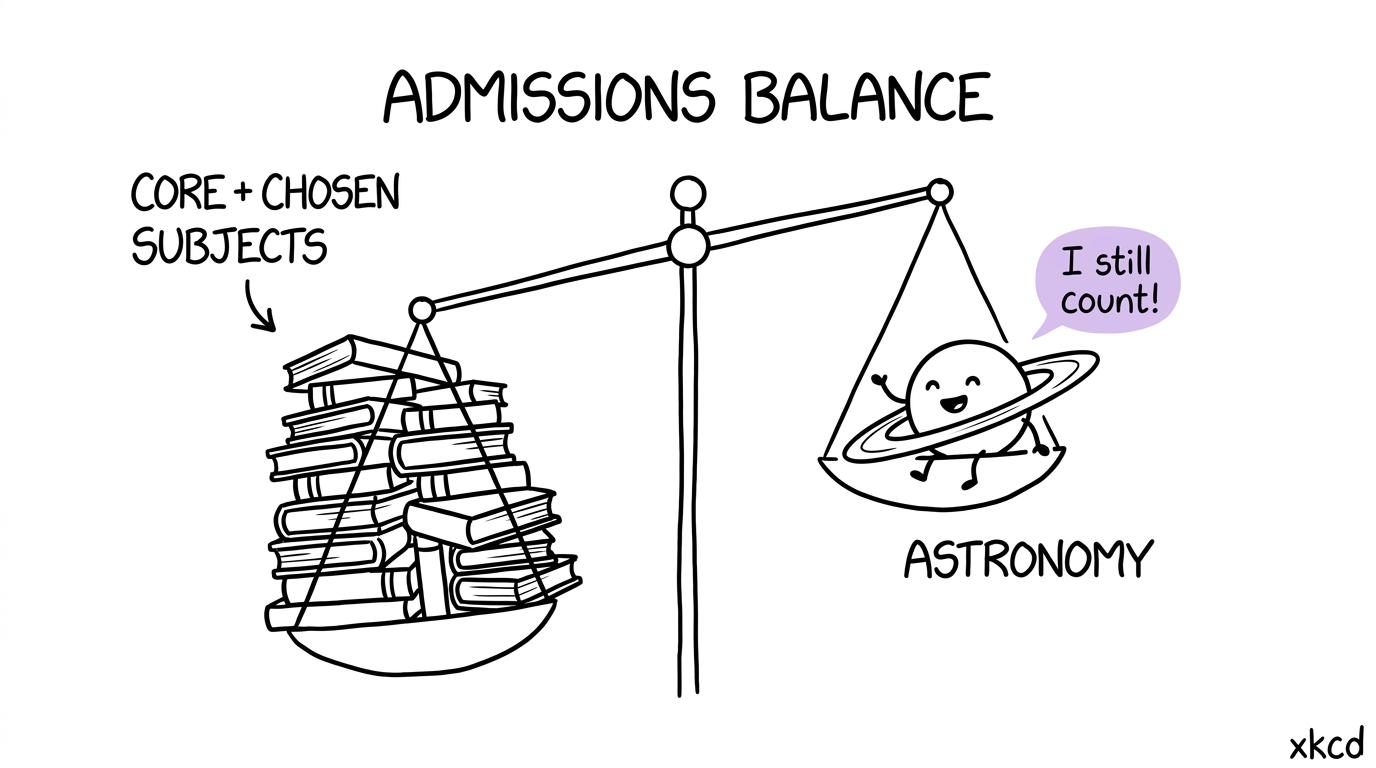 Astronomy cheerfully insists that it still counts beside heavier core subjects
How to check your own sixth form or college
Admissions rules change between providers and entry years, so use current documents. Work through these steps for every application:
Read the general entry criteria
Look for the minimum number of GCSEs, the permitted grade range and compulsory results in Maths and English. Check whether the policy refers to all full-course GCSEs, the best 666 or best 888, an average score, or a named list.
Check every intended course separately
General entry does not guarantee access to each A Level. Record the required GCSE subject and grade beside every course you want to take. Pay particular attention to Maths, Further Maths and Physics.
Search for exclusions and definitions
Small-print terms such as “approved subjects”, “full-course GCSEs” and “subjects completed at school” matter. If Astronomy is not mentioned, contact admissions rather than interpreting silence in your favour.
Recheck before enrolment
Applications may initially use predicted grades, while final enrolment commonly depends on achieved results. Policies and course availability can also change. Save the relevant policy and confirm the requirements again before results day.
Protect the grades carrying the most admissions weight
Once you know the requirements, revision becomes less emotional. You are no longer trying to make every grade perfect. You are protecting the results that open the door while improving the rest of your profile.
For GCSE Maths, begin with short diagnostic practice rather than repeatedly reading notes. The one-month GCSE maths revision plan offers a structured route through targeted practice and timed papers. You can also use the guide to when you should start GCSE past papers to match paper practice to your stage of revision.
As exams approach, use Edexcel GCSE Maths predicted papers alongside past papers, never instead of them. Mark each attempt, identify the topics losing marks and return to the relevant revision lesson. The aim is not to predict a boundary or question perfectly. It is to make your method reliable.
Historical GCSE and A Level grade boundaries can provide context, but boundaries vary between exam series. If you take Edexcel Maths, the dedicated Edexcel GCSE Maths grade boundaries page lets you compare like with like. Treat previous figures as reference information, not a guaranteed target.
Common mistakes when judging an Astronomy grade
Assuming every GCSE receives equal weight
A grade may count towards your total while still being less important than a mandatory Maths, English or science result. “Counts” and “decides” are not the same thing.
Treating Astronomy as an automatic Physics substitute
The subjects overlap in places, but admissions teams follow their published criteria. If the requirement says Physics or Combined Science, assume that wording applies unless the provider confirms otherwise.
Reading only the general requirement
You can qualify for the sixth form overall and still miss the threshold for one of your chosen courses. Always check both levels.
Using an old prospectus
A previous year's requirements may no longer apply. Check the entry year shown on the document and confirm any uncertainty directly.
Letting one result dominate your revision decisions
A lower predicted Astronomy grade can feel urgent because it is unusual and memorable. But urgency is not the same as admissions weight. Compare every revision priority with the actual requirements for your intended pathway.
Your next move
Your GCSE Astronomy grade can matter, particularly when it contributes to a minimum GCSE total or a best-grade calculation. But for most sixth form and college applications, it sits behind three larger questions: have you met the general entry standard, have you secured the required Maths and English grades, and have you met the criteria for your chosen subjects?
Check each provider's policy, ask direct questions where the wording is unclear, and then put your energy where it can change the outcome. MathsGenie gives you the free tools to do that: revision lessons, practice questions, mini tests, past papers, predicted papers, mark schemes, video solutions and a revision planner. Choose your weakest high-priority topic today, practise it under exam conditions, and turn uncertainty about entry requirements into a revision plan you can control.











