

GCSE Art and Design February Half-Term Revision
GCSE art and design February half-term revision plan to develop your exam project, cover each assessment objective and protect time for GCSE maths.
February half-term can create a peculiar kind of pressure. Your GCSE Art and Design sketchbook seems to contain weeks of unfinished possibilities, while maths, science and English are quietly asking for revision time too. The temptation is to let art consume the holiday because creative work rarely has an obvious stopping point.
A good GCSE art and design February half-term revision plan does the opposite. It gives art a defined purpose: strengthen your preparatory work, resolve uncertainties and decide what needs to happen next. Then it stops. This protects enough time for maths practice, other subjects and genuine rest.
The aim is not to produce a perfect project in one week. It is to return to school with clearer intentions, stronger evidence and fewer decisions left unresolved.
Your half-term plan at a glance
Use this checklist before filling every day with tasks:
- Confirm your exam board, chosen starting point and school deadlines.
- Review your work against all four assessment objectives.
- Identify the two weakest parts of your current project.
- Complete purposeful research, recording or experimentation.
- Refine one promising direction rather than starting several new ones.
- Discuss any uncertainty about permitted work with your teacher.
- Protect short, regular sessions for GCSE maths.
- Leave at least one substantial period completely free.
That final point matters. Rest is not time stolen from revision. It prevents a focused week from turning into seven blurred days of low-quality work.
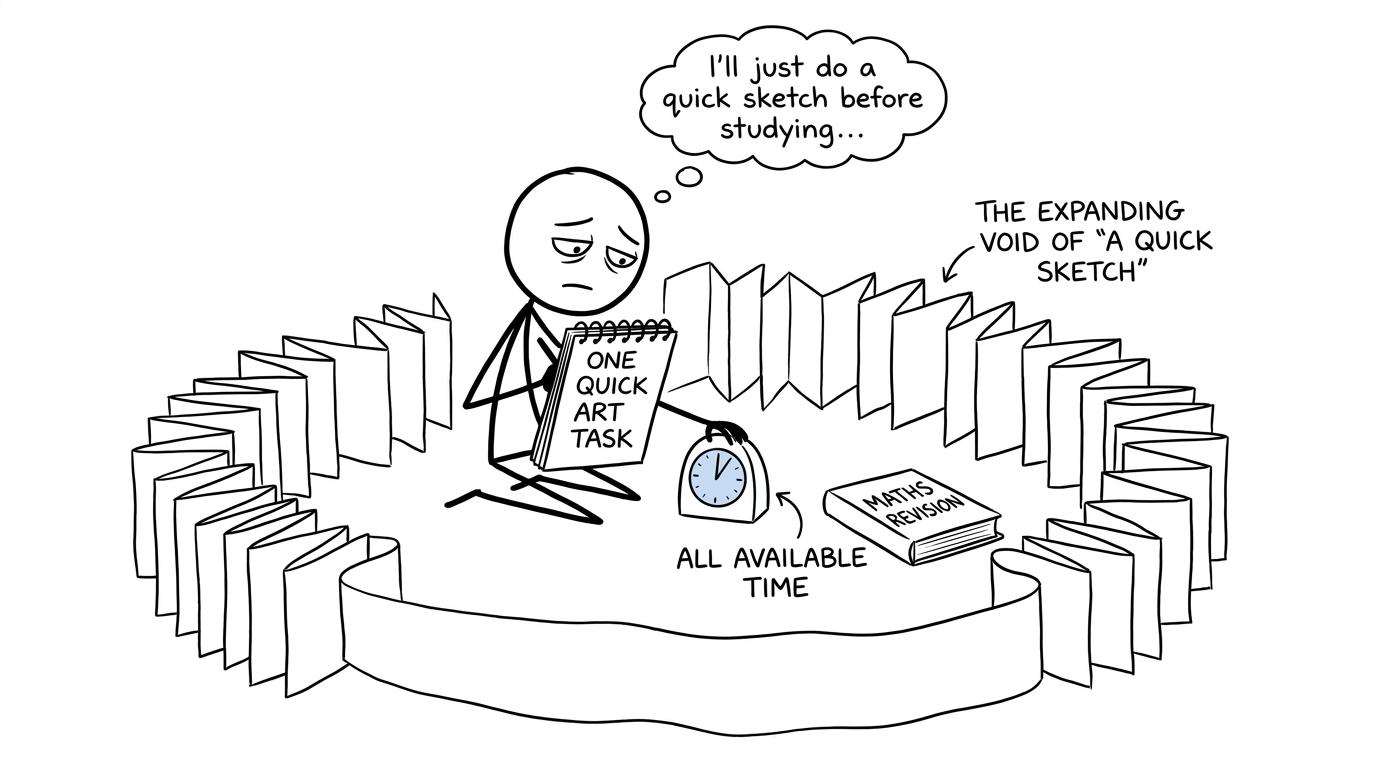 A GCSE art task expanding across the room while a timer protects maths revision
Understand what your GCSE Art and Design work must show
Across GCSE Art and Design qualifications in England, assessment is organised around four equally weighted objectives. Each contributes 25%25\%25%:
| Assessment objective | What your evidence should communicate |
|---|---|
| AO1 | You have investigated relevant sources and developed ideas with critical understanding. |
| AO2 | You have experimented with materials, techniques and processes, then refined your work. |
| AO3 | You have recorded relevant observations, ideas and insights as the project develops. |
| AO4 | You can present a personal, meaningful response that realises your intentions. |
The usual GCSE structure is a portfolio worth 60%60\%60% and an externally set component worth 40%40\%40%. For major boards including AQA, Pearson Edexcel, OCR and Eduqas, the externally set component leads to 101010 hours of supervised work. Detailed rules, starting points and session arrangements vary, so your specification and your teacher's instructions take priority.
The important lesson is that February is generally part of the preparation journey, not simply a race to make a polished final piece. Research without development is incomplete. Experiments without evaluation are just samples. A final idea with no visible path towards it can appear disconnected.
Your sketchbook or supporting studies should make the thinking visible.
Audit the project before making more work
Students often respond to pressure by producing another page. Sometimes the better move is to stop and inspect what already exists.
Set out your preparatory work and ask four questions:
- Sources: Have I investigated artists, designers, craftspeople, cultures or visual references that genuinely affect my ideas?
- Experiments: Can someone see how I tested and refined media, scale, composition, surface or process?
- Recording: Do I have relevant first-hand photographs, drawings, observations or design studies?
- Intentions: Is there a clear connection between my starting point, development and possible outcome?
Label each area as secure, developing or missing. Your half-term priorities should come from the missing evidence, not from whichever task feels easiest.
This is similar to diagnosing a weak maths topic. A comfortable page of work may feel productive, just as repeating easy questions does, but it may not address the real gap. MathsGenie's guide to finding your weakest GCSE maths topics uses the same principle: gather evidence, identify the weakness and repair it deliberately.
Build a focused five-day art plan
A useful plan gives each session a distinct job. It should also remain flexible enough to follow your teacher's project guidance.
Day one: review and choose priorities
Spend no more than 454545 minutes auditing your work against AO1 to AO4. Write a short list containing:
- one gap that could limit your development;
- one promising idea worth pursuing;
- one practical uncertainty to ask your teacher about.
Then organise photographs, source details and loose work. Organisation is not glamorous, but losing a useful primary image or forgetting where a source came from creates avoidable problems later.
Day two: strengthen relevant investigation
Choose a source because it can move your work forward, not because it is famous or easy to copy. Examine decisions such as composition, material, colour, texture, scale, context and meaning.
Record what you notice and, more importantly, what you might test in your own response. A useful annotation explains influence and intention. Biography alone rarely reveals how your ideas developed.
Day three: record from first-hand sources
If your project allows it, create your own photographs, observational drawings, studies, measurements or collected visual material. Primary recording makes the response more personal and gives you source material that can be cropped, rearranged and developed.
Choose quality over volume. A smaller collection of relevant images is more useful than hundreds of photographs that you never analyse.
Day four: experiment and refine
Test a controlled range of materials or processes linked to your intentions. Change one meaningful feature at a time, such as scale, arrangement, colour palette, surface or technique. Record what succeeded, what failed and what you would alter.
Failure can be useful evidence when it produces a decision. An unexplained experiment shows activity; a considered experiment shows refinement.
Day five: connect the journey
Review the week and create a clear bridge towards your next stage. This could involve composition studies, a maquette, design variations, material tests or a more resolved plan, depending on your specialism and your teacher's instructions.
Do not assume you should produce the externally assessed final outcome during half-term. The supervised outcome belongs within your board and centre's required conditions. Your job now is to make the preparatory thinking coherent and useful.
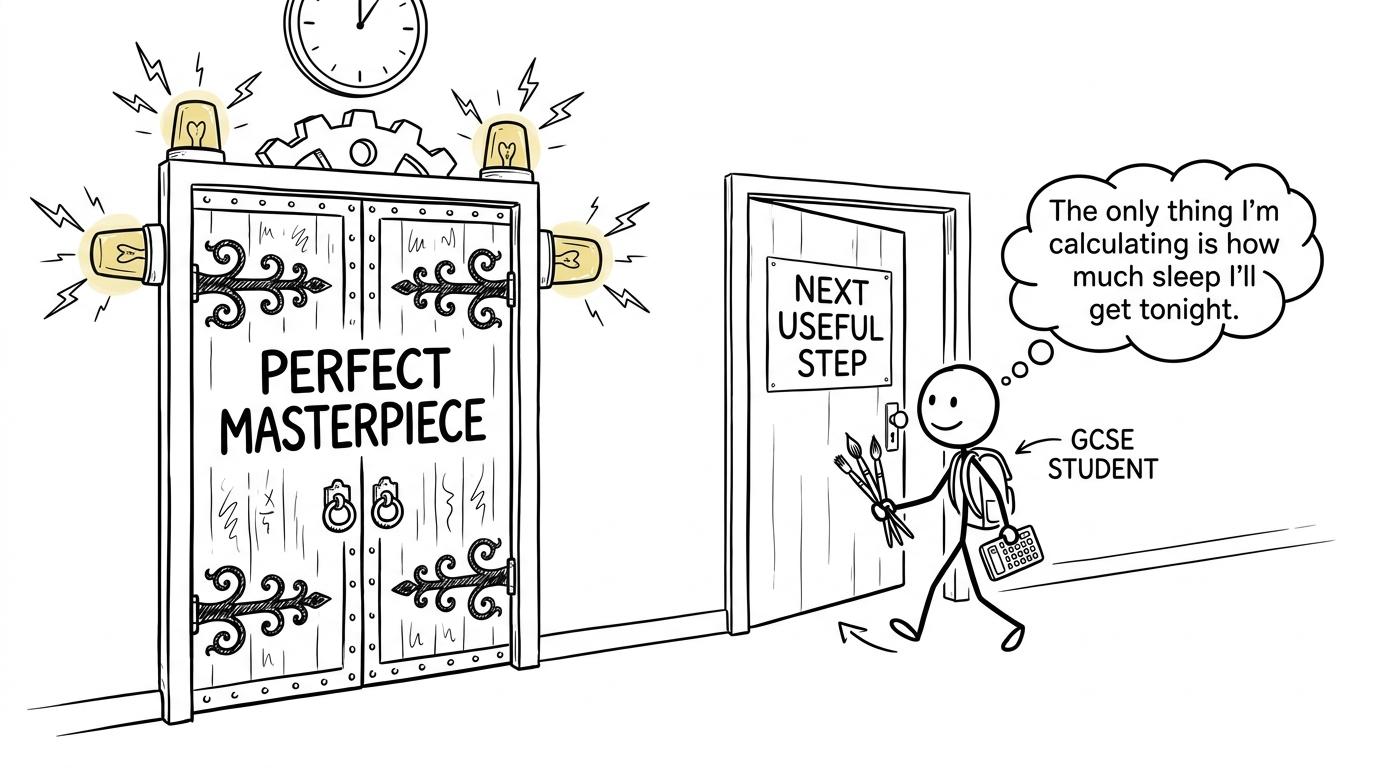 A student choosing the next useful step rather than chasing a perfect masterpiece
Keep art from becoming your only revision window
Art expands because there is always another detail to improve. The answer is not to care less. It is to place boundaries around the work.
Use defined sessions of roughly 606060 to 909090 minutes, followed by a break. Decide the output before beginning: one contact sheet with selections, one set of material trials or one annotated composition study. Stop when that purpose has been met.
Avoid vague instructions such as “work on art all afternoon”. A task without an edge tends to occupy every available hour.
A balanced half-term might include three longer art sessions, several compact maths sessions and time for other subjects. If your school has set an urgent art deadline, adjust the balance, but do it consciously rather than allowing one project to claim the entire week.
MathsGenie's GCSE maths revision timetable guide can help you build a repeatable schedule. If your days are crowded, the twenty-minute GCSE maths revision routine provides a realistic minimum.
Protect your GCSE maths momentum
Half-term does not need to become a full maths boot camp. It does need enough retrieval and practice to stop familiar methods becoming fragile.
Choose one short maths task on most days:
- revisit one weak topic using a revision lesson;
- answer a focused set of practice questions;
- complete a short timed test;
- mark previous work and correct errors;
- reattempt questions that previously cost marks.
Students on foundation and higher tier should work at the level of their actual entry. If you are unsure what belongs on your course, use the GCSE maths topics by exam board and tier guide before choosing tasks.
Short practice is particularly useful beside an intensive creative project. The Edexcel GCSE Maths mini tests provide contained sessions with answers and solutions. Students following another board should choose resources that match their own specification and paper format.
Past papers and predicted papers have different jobs. Official past papers provide the most reliable experience of established exam style. Predicted papers offer additional practice but should not be treated as a promise about what will appear. MathsGenie's Edexcel predicted papers include mark schemes and worked solutions for focused preparation.
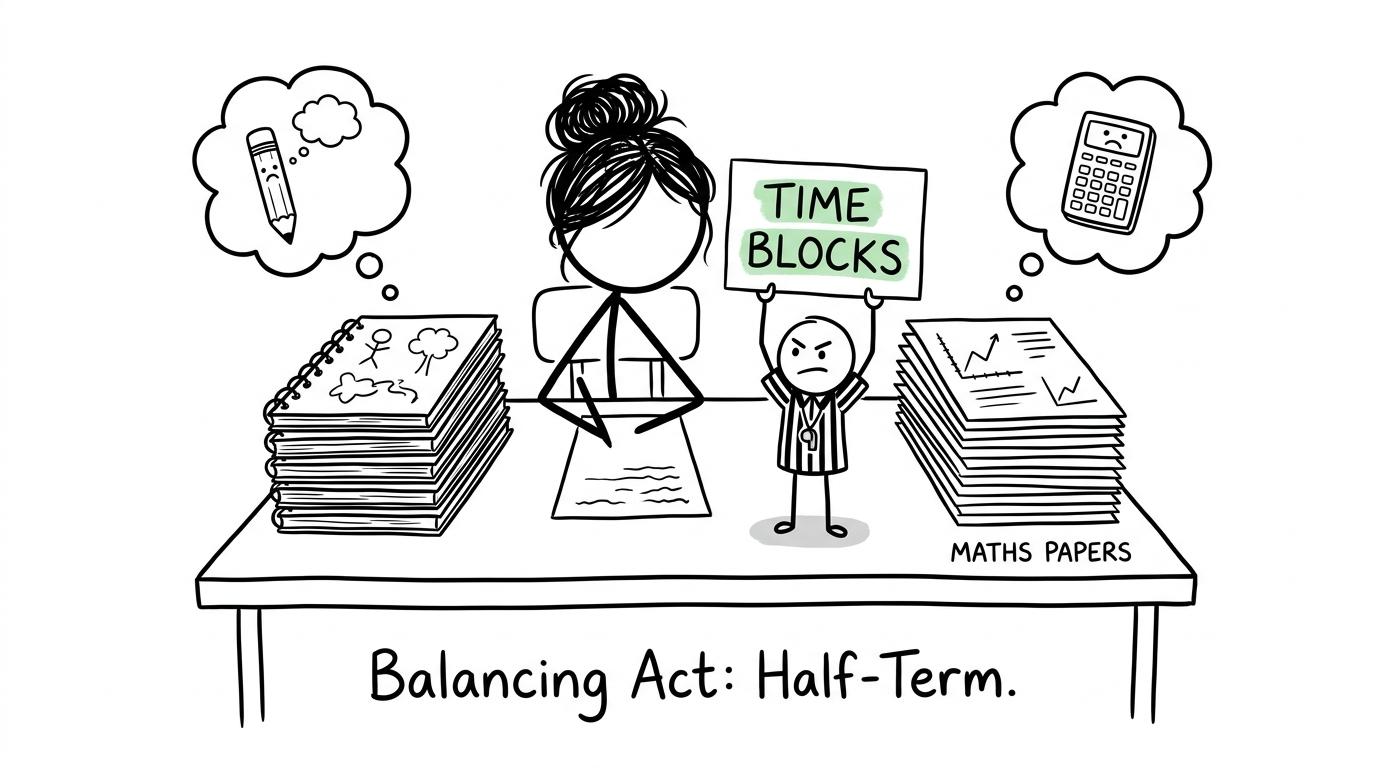 A tiny referee using time blocks to keep art and maths revision in balance
Common February half-term mistakes
Trying to complete everything
A week cannot repair every page, master every technique and revise the whole maths specification. Choose the work with the greatest effect on your next stage.
Producing decoration instead of evidence
Presentation matters, but elaborate backgrounds and headings do not replace investigation, experimentation, recording or development. Ask what each page proves about your decisions.
Copying a source without explaining its influence
A study can help you understand a technique, but the project must move beyond imitation. Explain what you learnt and show how that learning changed your own ideas.
Leaving experiments unexplained
Record why you tested a process, what happened and what you will do next. Reflection turns practical activity into visible refinement.
Ignoring controlled-assessment rules
Do not guess what can be completed at home or altered after supervised work begins. Requirements differ in detail between boards and centres. Follow the assignment paper and ask your teacher whenever you are uncertain.
Letting maths disappear for the week
A long gap makes the first week back harder. Even a mini test, marked carefully, keeps methods accessible. The wider GCSE one-month maths revision plan shows how short topic sessions can lead towards timed papers.
Finish half-term with direction, not exhaustion
The best half-term outcome is not the thickest sketchbook. It is a project with a clearer line of thought: relevant sources, purposeful recording, tested materials, visible refinement and a believable route towards a personal response.
Give art serious attention, but give it boundaries. Keep maths alive through short lessons, practice questions and mini tests. Then return to school with useful questions for your art teacher and an honest list of maths topics to revisit.
Use MathsGenie's free GCSE and A Level revision resources to maintain that balance. Build your plan with revision lessons and practice questions, check progress through mini tests, and move towards past papers, predicted papers, mark schemes and video solutions as the exams approach. Half-term should create momentum, not use all of it up.










