

GCSE Art and Design Coursework Deadlines Guide
GCSE art and design coursework deadlines made manageable. Plan your portfolio, protect maths revision time and avoid a stressful final-night rush.
The frightening thing about an art deadline is rarely the date itself. It is the moment you realise that several unfinished pages, photographs, annotations and experiments have quietly become one enormous task.
The safest way to manage GCSE art and design coursework deadlines is to confirm your school's internal dates, work backwards from them and complete small, visible outcomes each week. Your school's deadline matters more to you than an exam board's later mark-submission date. Ask your art teacher for the exact portfolio hand-in date, the start of supervised work and the point after which preparatory work cannot be changed.
This matters especially when you are also preparing for maths exams. Art can expand to fill every available evening. A clear plan gives both subjects protected time.
Your deadline checklist
Before making a timetable, collect the facts:
- Confirm your exam board: AQA, Pearson Edexcel, OCR or Eduqas.
- Write down your school's portfolio deadline.
- Record the dates of your externally set assignment and supervised sessions.
- Ask when preparatory work will be collected or locked away.
- List every incomplete practical task, annotation and photograph.
- Divide the remaining work into weekly milestones.
- Protect regular maths revision slots in advance.
- Add a catch-up block before the final week.
- Stop treating the night before as usable production time.
Use the MathsGenie revision planner to place your maths sessions around these commitments rather than hoping spare time will appear.
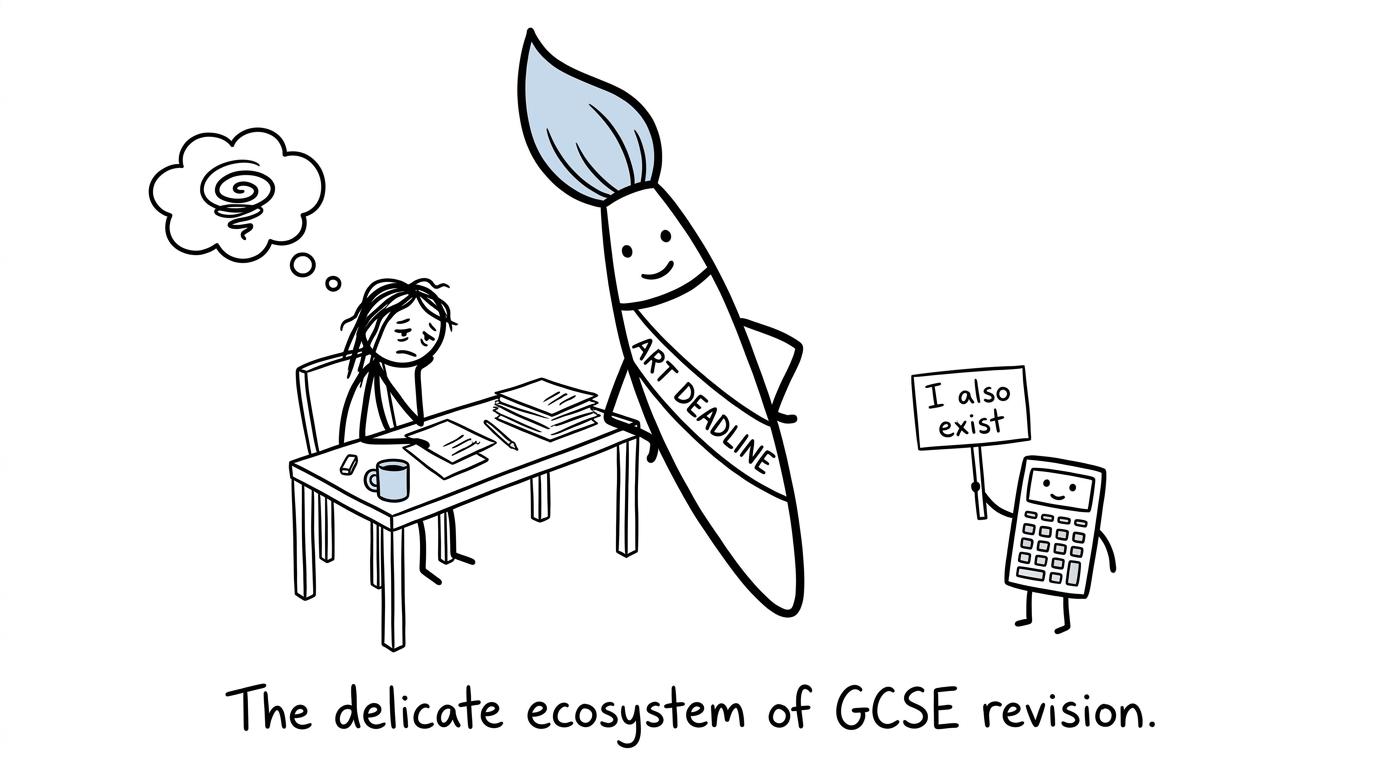 A giant art deadline interrupts a student while a calculator asks to be remembered
What GCSE Art and Design deadlines actually mean
GCSE Art and Design is assessed differently from a conventional written GCSE. In England, the qualification is divided into a centre-set portfolio worth 60%60\%60% and an externally set assignment worth 40%40\%40%. Both are non-exam assessments, although the externally set component includes 101010 hours of supervised sustained work.
The work is assessed against four equally weighted assessment objectives. Broadly, these reward your ability to:
- develop ideas through investigation and understanding of sources;
- refine work by experimenting with media, materials and processes;
- record ideas, observations and insights as the work develops;
- present a personal and meaningful response that realises your intentions.
Each objective contributes 25%25\%25% of the assessment-objective weighting. That is why a beautiful final outcome cannot automatically rescue a project with little investigation, experimentation or recording.
The exam board date is not necessarily your deadline
AQA, Edexcel, OCR and Eduqas qualifications follow the same overall 60%60\%60% portfolio and 40%40\%40% externally set structure, but centres organise their courses and internal deadlines differently. Externally set material cannot be released before 2 January in the assessment year. Schools then schedule preparation and supervised work within the relevant exam-board rules.
Published board dates often tell schools when marks must be submitted for moderation. They are not permission for a student to keep working until that day. Teachers need time to authenticate, assess, standardise and prepare work for moderation, so your internal deadline may be considerably earlier.
Write the date supplied by your teacher into your planner. If two documents appear to disagree, ask rather than choosing the later one.
Work backwards from the real hand-in date
A deadline becomes manageable when it stops being one large finish line and becomes a sequence of smaller commitments.
Let DDD be the number of workable days remaining and TTT the number of clearly defined tasks. Your average daily load is:
daily task load=TD\text{daily task load}=\frac{T}{D}daily task load=DTThis is not an invitation to divide everything equally. A photograph may take minutes, while refining a composition may require several sessions. The calculation simply reveals whether your list is realistic.
Start by creating a complete task inventory. Avoid vague entries such as "finish sketchbook". Use actions that can be completed and checked:
- photograph the latest experiment;
- annotate why a material was rejected;
- complete a tonal study;
- compare two relevant artists or designers;
- test an alternative composition;
- mount and label selected work;
- check that sources are acknowledged;
- prepare materials for the next lesson.
Estimate each task in focused sessions rather than perfect hours. Then reserve roughly 20%20\%20% of your available sessions as contingency time. Materials fail, printers stop cooperating and some ideas need another attempt. A plan with no spare capacity is only a wish written neatly.
Pace the portfolio in three passes
Trying to perfect every page immediately is slow. A better approach is to move through the project in three deliberate passes.
Secure the evidence
First, make sure the journey exists. Gather photographs, studies, source material, experiments, observations and unfinished annotations. Identify obvious gaps against the four assessment objectives.
Do not spend an entire evening decorating a title page while important development is missing. Presentation matters, but evidence comes first.
Improve the thinking
Next, strengthen the links between pieces of work. Explain what you noticed, what changed and why the next decision followed. Useful annotation is specific. It should reveal artistic judgement rather than merely describe what can already be seen.
Focus on development and refinement. Ask whether your experiments genuinely influenced your intentions or simply sit beside the final response without a clear connection.
Polish selectively
Only after the evidence and thinking are secure should you tidy layouts, retake unclear photographs, correct labels and improve presentation. Selective polishing is valuable. Endless cosmetic adjustment is not.
This order protects you from producing a visually polished submission that leaves assessment evidence difficult to find.
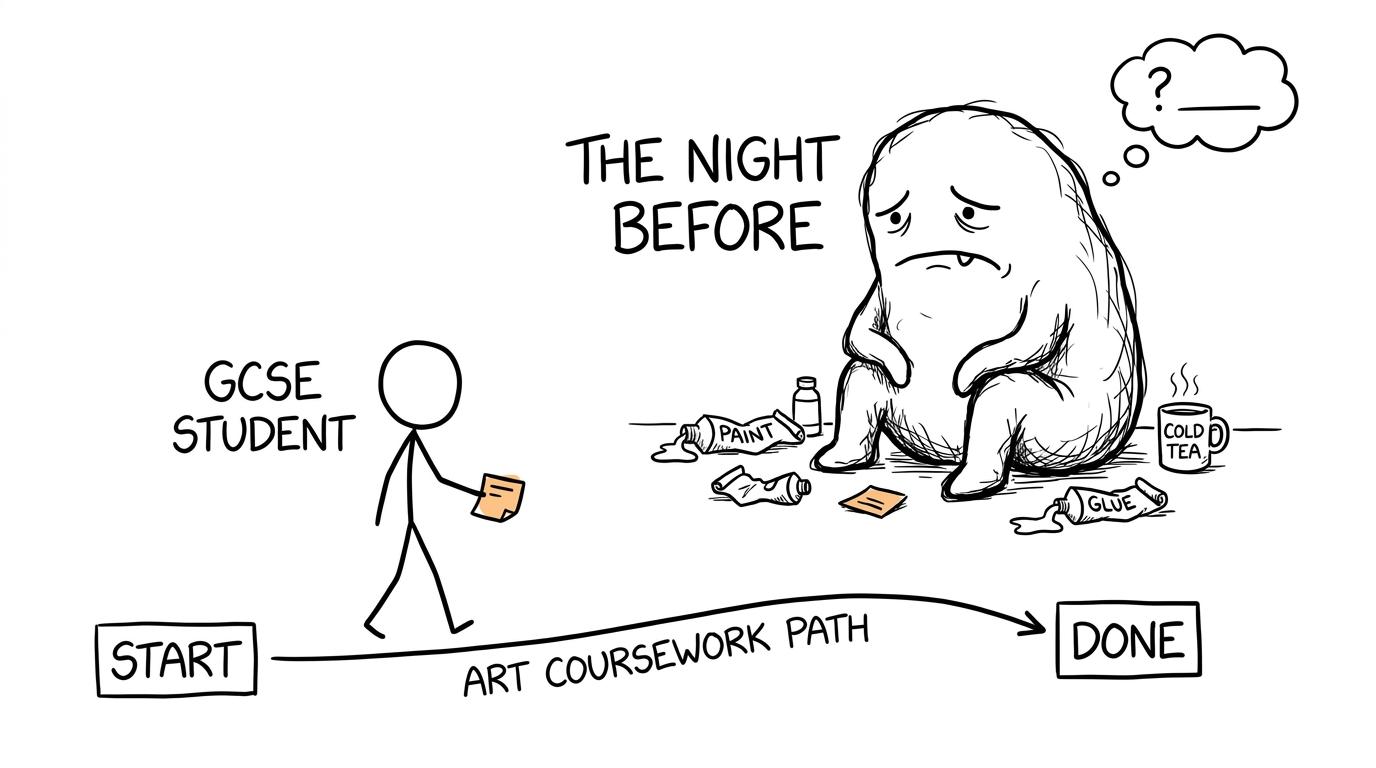 A student calmly escapes the night-before deadline monster by moving small tasks towards done
Build a weekly rhythm that leaves room for maths
Art and maths demand different kinds of attention. Art often needs longer blocks for setting up materials and developing an idea. Maths can remain effective in shorter, tightly defined sessions.
Plan those differences rather than making the subjects compete.
Use longer blocks for practical art
Place practical work in sessions where you have enough time to begin, concentrate and clear away properly. Decide the intended output before starting. "Work on art" is not a plan; "complete and photograph two composition trials" is.
Keep lower-energy tasks, such as organising images or checking labels, for shorter periods. Do not use your best concentration on administration if important creative decisions remain.
Keep maths alive with short sessions
During a demanding coursework week, consistency matters more than heroic revision. A focused 202020-minute session can preserve momentum if it has one clear purpose.
The GCSE Maths revision hub lets you choose your exam board and find free revision lessons, practice questions, worksheets and papers. On crowded days, follow the 20-minute maths revision routine: retrieve one method, answer a small set of questions, mark them and record the next action.
Short GCSE maths mini tests are particularly useful when a full paper would be unrealistic. If you have more time at the weekend, use GCSE maths past papers with mark schemes and worked solutions where available.
The aim is not to force equal time every day. It is to prevent art from taking every day.
Use a visible progress system
A project feels endless when progress is hidden. Keep three short lists:
- Now: the one task currently being completed.
- Next: the next two or three tasks.
- Later: everything that does not need attention yet.
Move finished work into a visible "done" list. This is not decorative productivity. It prevents you from repeatedly checking the whole project and wasting energy deciding what to do.
At the end of each week, ask:
- What evidence did I add?
- Which assessment objective is currently least visible?
- What feedback have I acted on?
- What must be completed before the next lesson?
- Did I preserve my planned maths sessions?
For a broader subject schedule, adapt the structure in the GCSE revision timetable guide. Keep tasks specific and include catch-up time, because a timetable should survive an imperfect week.
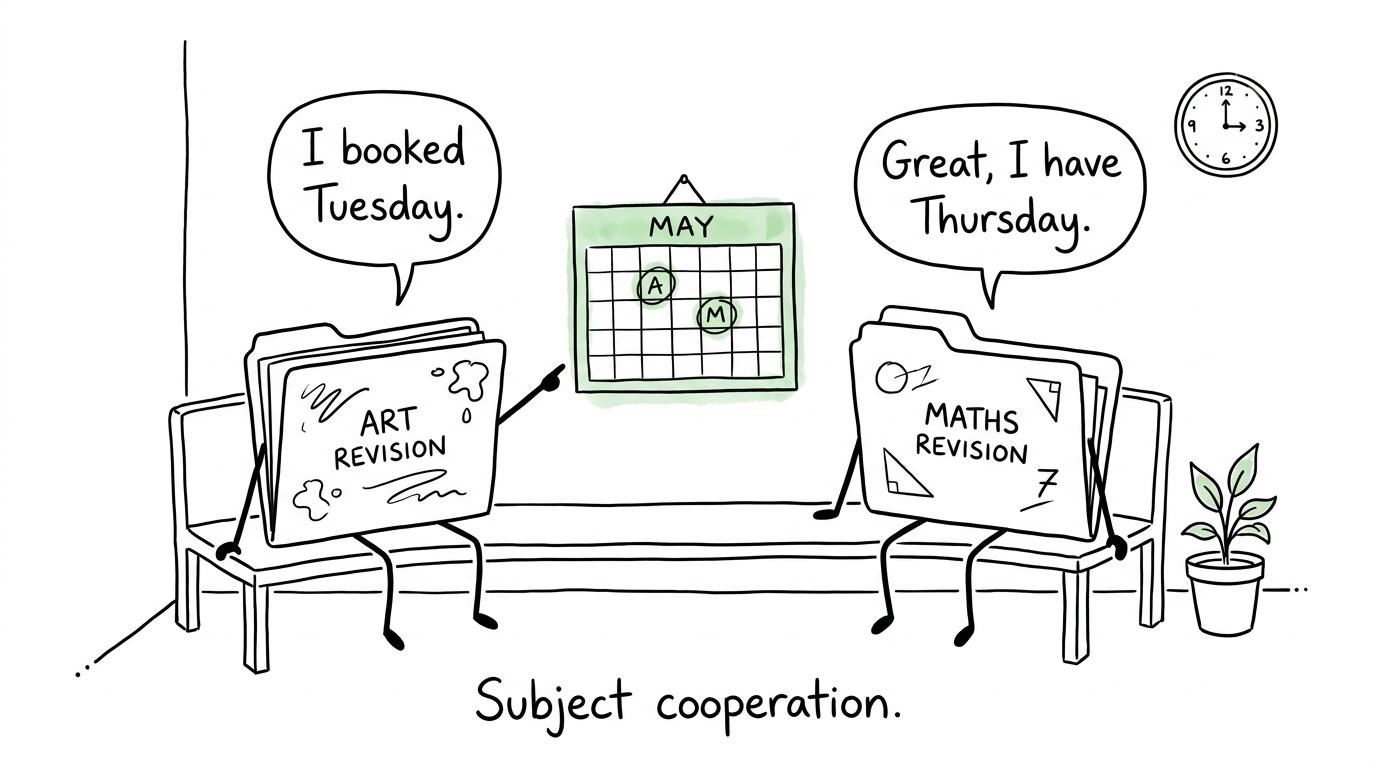 Art and maths folders calmly negotiate their places on a shared calendar
What to do when you are already behind
First, tell your teacher. Do not hide the problem until the deadline arrives. Your teacher can clarify what is compulsory, what is already sufficient and which missing evidence deserves priority. They can also explain the assessment conditions that apply at your current stage.
Then triage the work:
- Essential: missing evidence, unfinished required work and tasks specifically identified in feedback.
- Valuable: improvements that strengthen development, refinement or communication.
- Optional: decorative additions and repeated experiments that add little new evidence.
Complete essential tasks first. Do not start a major new direction simply because your current project feels imperfect. Late reinvention often creates more unfinished evidence rather than a stronger submission.
Reduce maths sessions temporarily if necessary, but do not erase them. Use one lesson and a few practice questions on a weak topic, or a mini test followed by careful marking. The MathsGenie one-month maths revision plan shows how short topic blocks, retrieval and paper practice can fit together when time is limited.
Common mistakes around art coursework deadlines
Assuming the public board date is your hand-in date
Your school usually needs the work earlier for marking and moderation preparation. Follow the internal date given by your teacher.
Measuring progress by time rather than output
Spending three hours at a desk does not guarantee three hours of useful progress. Define the piece of evidence you intend to finish before beginning.
Perfecting one page while leaving major gaps
A single polished page cannot demonstrate the complete project journey. Secure broad evidence across the assessment objectives before polishing selectively.
Treating annotation as an afterthought
Leaving all written explanation until the end makes it harder to reconstruct your decisions accurately. Add concise annotation while the reasoning is still fresh.
Planning every available hour
A timetable filled to 100%100\%100% has no defence against illness, technical problems or work that takes longer than expected. Keep contingency sessions.
Abandoning maths until art is submitted
Several weeks without retrieval practice can make familiar methods feel distant. Short, regular sessions are enough to maintain contact. When paper practice becomes appropriate, the guide to when to start GCSE past papers can help you choose between topic questions, mini tests and full papers.
Working through the final night
Late-night work encourages rushed decisions, poor presentation and missing materials the next morning. Finish production early enough to perform a final evidence check, then stop at a sensible time.
Finish calmly and protect your wider GCSE preparation
The best deadline plan is not the one with the most colour-coded boxes. It is the one that tells you what to do next, leaves room for disruption and protects the rest of your GCSEs.
Confirm the real date. Break the portfolio into visible evidence. Work in three passes. Keep a buffer. Most importantly, preserve small maths sessions so that one deadline does not create another crisis later.
Make MathsGenie your free maths revision base while art is busy. Use the revision planner to reserve time, revision lessons and practice questions to maintain individual skills, mini tests to check recall, and past papers or predicted papers to build exam readiness. Mark your work with the available mark schemes and use video solutions when a method needs rebuilding. Start with one manageable session today, not the night before everything is due.











