

GCSE Art and Design Grade 6 Meaning Explained
GCSE art and design grade 6 meaning explained: discover the ability it represents, how assessment works and how it compares with old letter-grade scales.
A result can look precise while still feeling vague. You open the envelope, see a grade 6 beside Art and Design, and immediately wonder what it says about your actual ability. Is it good? Is it a B? Does it mean your final piece was strong, or that your portfolio was consistent?
The gcse art and design grade 6 meaning is best understood as a strong result above the recognised grade 4 standard pass and grade 5 strong pass benchmarks. It broadly occupies the territory associated with a high B under the old system, although the numerical and letter scales are not directly interchangeable. In practical terms, it usually reflects secure and purposeful creative work across research, development, experimentation, recording and presentation.
For students balancing art deadlines with GCSE maths revision, there is another useful message: a grade records the overall evidence submitted. It does not define your creative ceiling, nor does it predict what you can achieve in another subject.
Grade 6 at a glance
Here is the short version:
- Grade 6 is a strong GCSE result.
- It is above grade 4, the standard pass, and grade 5, the strong pass.
- It is commonly compared with a high B, but this is only an approximation.
- GCSE Art and Design has no foundation or higher tier.
- Your grade is based on the combined assessment of your portfolio and externally set assignment.
- Examiners assess the development of your work, not only the appearance of the final outcome.
- Entry requirements for A Level Art and Design vary, so check the precise rules used by your school or college.
What does a grade 6 represent in terms of artistic ability?
A grade 6 suggests that you can do considerably more than produce an attractive final image. GCSE Art and Design assesses how you investigate, make decisions, test materials, record observations and develop a personal response.
At this level, the evidence will generally show a secure creative process. That may include relevant research into artists, designers or craftspeople; purposeful experimentation; visible refinement of ideas; and a final response connected to the journey recorded in the portfolio.
The word secure matters. A grade 6 does not require flawless work or professional technical skill. It indicates that important abilities are present with enough quality and consistency to produce a strong overall result. Some pages or experiments may be more convincing than others. One assessment objective may also be stronger than another.
This is why a grade cannot be reduced to statements such as “good at drawing” or “made an excellent final piece”. Drawing can be important, but photography, textiles, graphic communication, digital media, sculpture, annotation and other forms of recording may also provide valid evidence, depending on the chosen title and specification.
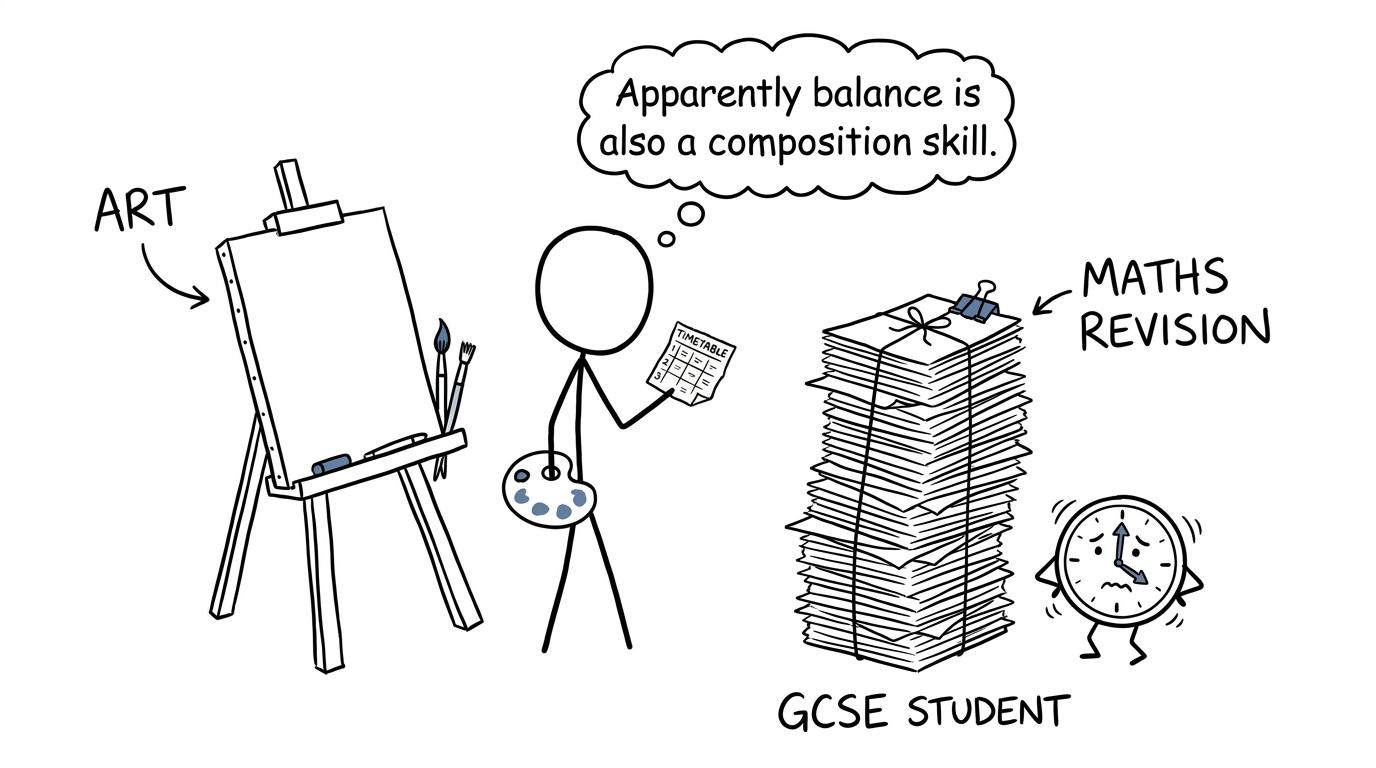 A student tries to balance art and maths revision with a tiny timetable
How GCSE Art and Design is assessed
Across the main GCSE Art and Design specifications used in England, including AQA, Edexcel, OCR and Eduqas, students are assessed through two components. The terminology varies slightly between boards, but the usual structure is:
| Component | Typical weighting | What it assesses |
|---|---|---|
| Portfolio or personal portfolio | 60%60\%60% | Sustained development across the course, including supporting studies and personal outcomes |
| Externally set assignment or task | 40%40\%40% | A response to an exam-board starting point, with preparation followed by supervised work |
Both components are normally internally marked by the school or college and externally moderated. The externally set component includes preparatory work and a supervised period, commonly lasting 101010 hours. It is classed as non-exam assessment rather than a conventional written examination.
Your total result can be thought of as a weighted combination:
overall assessment=0.6(portfolio)+0.4(externally set component)\text{overall assessment} = 0.6(\text{portfolio}) + 0.4(\text{externally set component})overall assessment=0.6(portfolio)+0.4(externally set component)That does not mean a weak portfolio can always be rescued by one impressive final session. The portfolio carries the larger weighting, and both components must provide evidence against the assessment objectives.
The four assessment objectives
The four assessment objectives are set nationally and used across the specifications:
- AO1: Develop: investigate relevant sources and use critical understanding to develop ideas.
- AO2: Refine: explore, select and experiment with suitable media, materials, techniques and processes.
- AO3: Record: record ideas, observations and insights that connect to your intentions as the work progresses.
- AO4: Present: produce a personal and meaningful response that realises intentions and demonstrates visual understanding.
Each objective contributes 25%25\%25% of the overall assessment. A grade 6 therefore represents a combined performance across all four, rather than a separate grade awarded to the final piece.
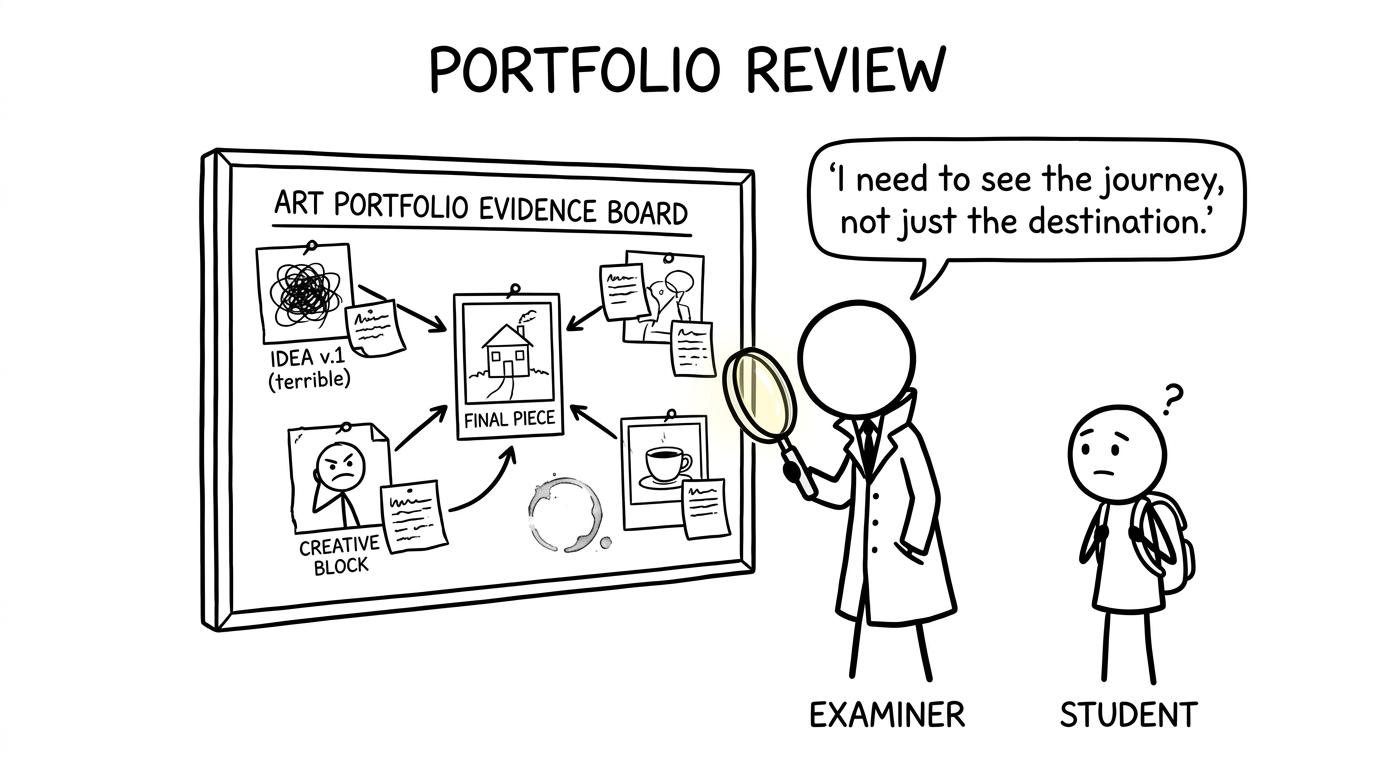 An examiner investigates an art portfolio like a detective searching for the creative journey
Why the creative journey matters as much as the outcome
Art assessment can feel strange because the strongest-looking final outcome is not automatically the highest-marked submission. Examiners need evidence of how the outcome emerged.
A polished piece with little recorded development may leave important questions unanswered. Where did the idea come from? Which sources influenced it? What changed after experimentation? Why was one material selected instead of another? How did observation affect composition, colour or form?
A grade 6 portfolio will usually answer many of these questions through visual evidence and concise, relevant annotation. It should show decisions rather than a collection of disconnected tasks. Experiments are most valuable when they influence what happens next.
This principle is familiar in maths. An unsupported answer may be correct, but clear working can show the method and earn marks. Art uses a different visual language, yet the underlying idea is similar: make your thinking visible.
How grade 6 compares with the old letter grades
The safest comparison is that grade 6 is broadly similar to a high B. However, it is important not to treat the new scale as a simple relabelling exercise.
Ofqual formally established three main comparison points:
| Current GCSE scale | Old letter scale comparison |
|---|---|
| Bottom of grade 7 | Comparable with the bottom of grade A |
| Bottom of grade 4 | Comparable with the bottom of grade C |
| Bottom of grade 1 | Comparable with the bottom of grade G |
There is no official one-to-one statement that every grade 6 equals one precise version of a B. Grades 4, 5 and 6 divide the broad territory previously occupied by grades B and C more finely. Calling grade 6 a high B is therefore a useful shorthand, not an exact conversion.
The new scale also creates more differentiation at the top: grades 7, 8 and 9 cover the area previously associated with A and A*. That context helps explain why grade 6 sits immediately below the grade 7 comparison point.
Does a grade 6 mean you can take A Level Art?
Potentially, yes. A grade 6 provides strong evidence that you have the creative and organisational foundations needed for further study. However, individual sixth forms and colleges set their own entry requirements.
Some may ask for a particular GCSE grade. Others may consider a portfolio, an interview, your wider results or the exact Art and Design title you studied. Check the published course requirements and ask whether your existing portfolio needs to be presented.
A Level Art and Design usually demands greater independence, depth and sustained development. The relevant question is therefore not only whether grade 6 permits entry. Ask whether you enjoyed investigating ideas, revisiting work and managing long creative projects. Those habits matter when the course becomes more demanding.
Balancing art coursework with GCSE maths revision
Art deadlines expand to fill the time available. Maths revision can do the same. Without a plan, both subjects can feel permanently unfinished.
Separate the work by type. Art may need longer sessions for practical development, photography or refinement. Maths benefits from frequent, focused retrieval and question practice. The MathsGenie GCSE Maths revision hub lets you choose resources by exam board and target the topics that actually need attention.
A practical weekly pattern could include:
- defined art sessions with one visible outcome, such as completing observational studies or testing a material;
- short maths sessions built around one weak topic;
- a weekly timed test or paper section;
- time to mark maths work and correct mistakes;
- a buffer before portfolio deadlines.
If your week already feels crowded, use the 20-minute maths revision routine rather than waiting for an empty evening that may never appear. For a broader structure, the GCSE maths revision timetable guide can help you balance schoolwork, rest and timed practice.
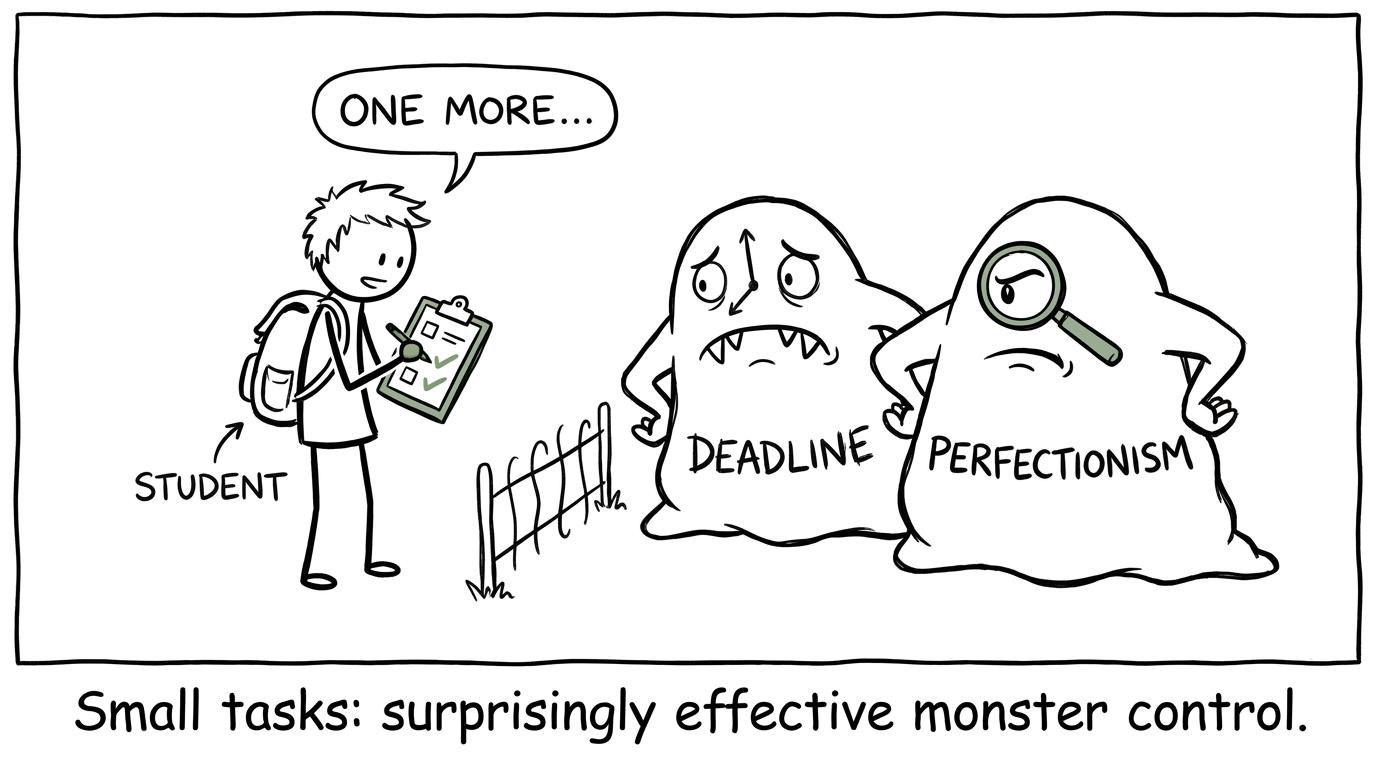 A checklist keeps the Deadline and Perfectionism monsters under control
Common mistakes when interpreting or improving a grade 6
Treating the grade as an exact percentage
Grade boundaries can change between exam series and specifications. A grade 6 is not permanently tied to one percentage, so old boundaries should not be used as a guaranteed target.
Assuming only the final outcome matters
The assessment objectives reward investigation, refinement and recording as well as presentation. A visually impressive final piece cannot provide all the required evidence by itself.
Filling a sketchbook without showing decisions
More pages do not automatically mean more marks. Repeated experiments add value when you compare them, explain their effect and use them to develop the work.
Calling grade 6 exactly equivalent to a B
“High B” is a helpful rough comparison, but the old and new grading systems do not align perfectly. The official comparisons are based on selected anchor points rather than exact conversions for every grade.
Comparing Art and Maths grades as if they measure the same ability
A grade 6 in Art and Design reflects performance against creative assessment objectives. A grade 6 in GCSE Maths reflects mathematical knowledge, reasoning and problem solving. Even the assessment structures differ: Art has no foundation or higher tier, while a maths grade 6 can only be achieved on higher tier.
For a subject-specific comparison, read the guide to the meaning of a grade 6 in GCSE Maths.
Revising everything instead of finding the real weakness
In maths, use evidence from a test or paper rather than guessing what needs attention. The guide to finding your weakest GCSE topics provides a simple diagnostic process. Then repair individual gaps with revision lessons and practice questions.
What to do next
If grade 6 is your final Art and Design result, recognise it for what it is: a strong achievement showing secure creative ability across several forms of evidence. If it is a predicted or mock grade, ask your teacher which assessment objectives currently limit the mark. “Improve my art” is too vague; “show clearer refinement between experiments” gives you something actionable.
Apply the same precision to maths. Start with a mini test or past paper, mark it carefully, and turn each lost mark into a topic to revisit. The guide on when to start GCSE past papers can help you introduce timed work sensibly. Edexcel students can also use GCSE Maths predicted papers after topic revision to practise under realistic conditions.
A grade is a summary, not an identity. Your next improvement comes from seeing what sits behind it. Use MathsGenie’s free revision lessons, practice questions, mini tests, past papers, predicted papers, mark schemes and video solutions to make your maths progress just as visible as the creative journey inside a strong art portfolio.











