

GCSE Art and Design Grade 5 Meaning Explained
GCSE art and design grade 5 meaning explained: discover the ability it represents, how assessment works and how it compares with old letter grades.
A results sheet can make two years of work look strangely small. Sketchbooks, experiments, annotations and final pieces are reduced to one digit. If you are searching for the GCSE art and design grade 5 meaning, the direct answer is reassuring: a grade 555 is a strong result above the grade 444 standard-pass benchmark. It broadly sits between the old grades C and B, although there is no exact one-to-one conversion.
In practical terms, it indicates that your assessed work showed a sound, reasonably consistent ability to investigate sources, develop and refine ideas, record observations and produce a personal response. It does not mean that every page or final piece was at exactly the same standard.
For students balancing a portfolio with GCSE maths revision, understanding the grade matters. It turns an unexplained number into useful information, without allowing that number to define everything you can do.
Grade 5 at a glance
- Grade 555 is commonly described as a strong pass.
- It is above grade 444, which is the official point aligned with the bottom of the old grade C.
- It broadly overlaps the upper part of an old C and the lower part of an old B.
- It reflects your overall assessed performance, not simply the quality of one final artwork.
- GCSE Art and Design assesses development, experimentation, recording and personal outcomes.
- Exact grade boundaries can change between exam series, so there is no permanent mark or percentage for a grade 555.
- Entry requirements differ between sixth forms, colleges and courses, so check the wording used by the institution you are considering.
What does a grade 5 represent in Art and Design?
A grade 555 represents secure achievement across the course rather than basic participation. Your work has generally communicated intentions, drawn upon relevant sources and shown that ideas changed through investigation and experimentation.
That distinction matters because GCSE Art and Design is not judged as a collection of attractive final pictures. Examiners and moderators assess the journey as well as the destination. A technically polished outcome cannot automatically compensate for weak research, limited experimentation or missing records of how the idea developed.
Across the main English exam boards, including AQA, Pearson Edexcel, OCR and Eduqas, the qualification uses four assessment objectives. Their precise presentation in assessment grids can differ, but the underlying objectives are shared:
- AO1: Develop: investigate relevant artists, designers, craftspeople, cultures or other sources and demonstrate critical understanding.
- AO2: Refine: explore and select suitable media, materials, techniques and processes as ideas evolve.
- AO3: Record: capture observations, ideas and insights that are relevant to your intentions.
- AO4: Present: produce a personal and meaningful response that realises your intentions and shows an understanding of visual language.
Each objective contributes 25%25\%25% of the qualification. This means a grade 555 normally reflects a reasonably balanced body of evidence. A student may be stronger in observational recording than annotation, for example, but all four objectives still matter.
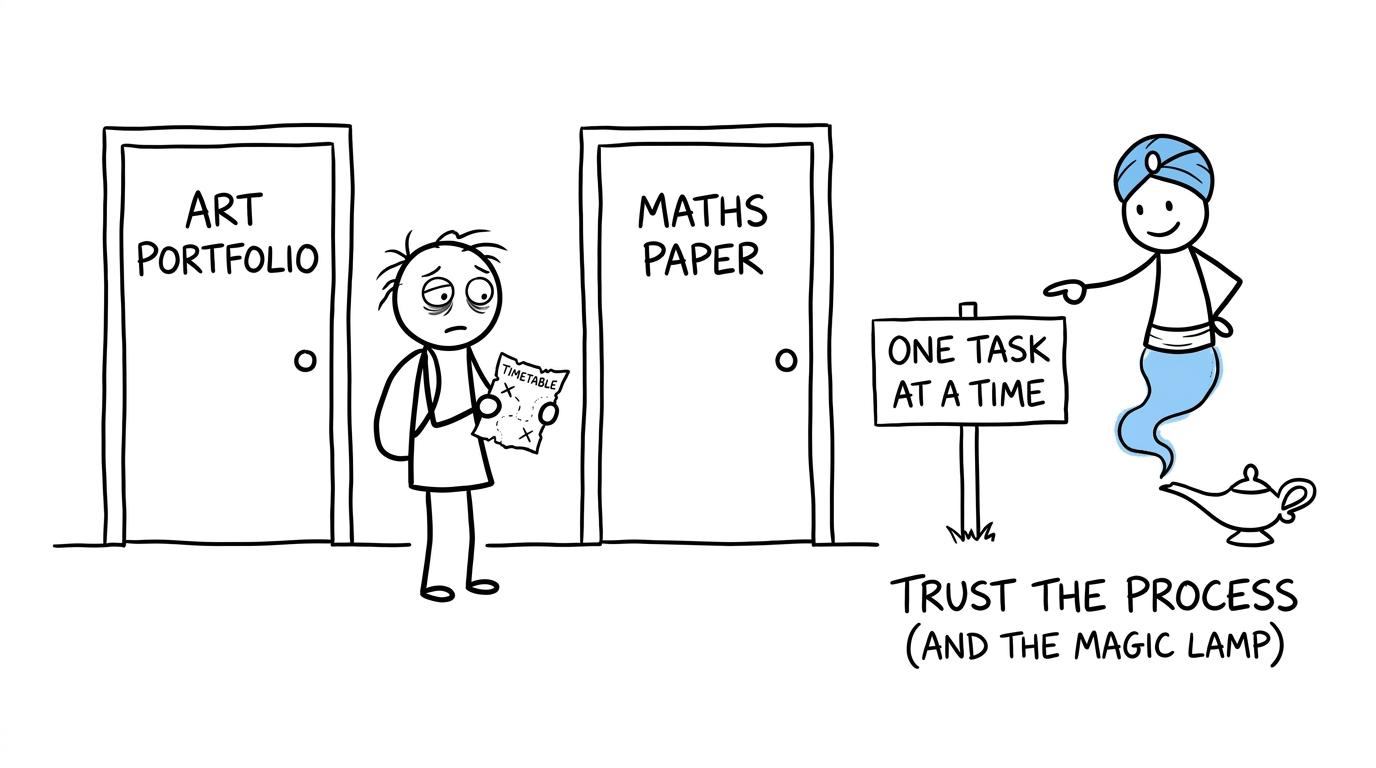 A student choosing calmly between art and maths revision tasks
How grade 5 compares with the old letter grades
The safest comparison is that grade 555 falls between the old grades C and B. It is often described informally as comparable to a high C or low B, but this is an approximation rather than an official direct replacement.
Only three points on the old and new scales are formally aligned:
| Current numerical scale | Official comparison point |
|---|---|
| Bottom of grade 777 | Bottom of old grade A |
| Bottom of grade 444 | Bottom of old grade C |
| Bottom of grade 111 | Bottom of old grade G |
There is no official statement that every grade 555 is exactly equal to a B or exactly equal to a C. The numerical scale was designed to provide more differentiation, particularly among higher-attaining students, so squeezing nine numerical grades into the old letter categories creates overlap.
The most accurate description is therefore:
A grade 555 is above the old C benchmark and broadly occupies the space between a strong C and a lower B.
This wording is more useful than claiming that 5=B5=B5=B. It also helps when reading entry requirements. If a course asks for grade 444 or above in a subject, a grade 555 exceeds that stated threshold. If it requires a grade 666, however, a grade 555 does not meet it. Always follow the published numerical requirement rather than trying to translate it into letters.
How GCSE Art and Design produces the final grade
For current GCSE Art and Design specifications in England, assessment is normally divided into two components:
- a portfolio worth 60%60\%60%;
- an externally set assignment worth 40%40\%40%.
The externally set component includes a preparatory period followed by supervised time in which students realise their response. The work is assessed against the same four objectives used for the portfolio. It is generally marked by the school or college and then externally moderated, although students should check their board's current specification and instructions.
Your overall result is based on the combined weighted mark:
Overall mark=weighted portfolio mark+weighted externally set assignment mark\text{Overall mark}=\text{weighted portfolio mark}+\text{weighted externally set assignment mark}Overall mark=weighted portfolio mark+weighted externally set assignment markThe awarding organisation then uses the grade boundaries for that examination series to convert the final mark into a grade. Those boundaries are not fixed forever. They may move because awarding bodies must account for differences in the demand of assessment material and the quality of work seen in a particular series.
That is why a teacher can estimate that a portfolio is working around grade 555, but cannot promise the final boundary months in advance. The same principle applies in maths: a raw score only becomes meaningful when it is compared with the correct board, tier and examination series. The Maths Genie guide to GCSE maths grade boundaries explains this distinction in more detail.
What grade 5 work is likely to demonstrate
There is no single visual style that earns a grade 555. Fine art, photography, textile design, graphic communication and three-dimensional design can all look entirely different. Assessment concerns the quality of the evidence, not whether the work matches one preferred aesthetic.
At this level, a body of work will commonly show several of the following qualities:
- relevant investigation of sources rather than pages of copied biographical facts;
- ideas that develop beyond the initial starting point;
- purposeful testing of materials and techniques;
- recording through drawing, photography, notes, digital processes or other suitable methods;
- annotations that explain decisions rather than merely describe actions;
- connections between research, experiments and outcomes;
- a personal response with recognisable intentions;
- enough consistency across the assessment objectives to achieve the required total mark.
This should not be read as a universal grade descriptor. Your exam board's assessment grid and your teacher's marking are the proper guides. A final grade is based on total assessed evidence, so two students can reach grade 555 through different combinations of strengths.
Is grade 5 good enough for sixth form or college?
A grade 555 is a respectable GCSE result, but whether it is sufficient depends on what you want to do next.
A sixth form or college may set a general entry profile as well as subject-specific requirements. An Art and Design A Level or vocational creative course might ask for a particular grade in Art and Design, request a portfolio, or consider both. Requirements are set by individual institutions and can change, so read the current course page or contact admissions directly.
Maths and English requirements may also be considered separately. If your next course asks for a particular maths grade, use the GCSE Maths Revision hub to select your board and tier rather than assuming that your Art and Design result changes the requirement.
A grade is evidence of performance at one stage. It is not a ceiling. Creative courses may also value curiosity, sustained effort, independence and the ability to discuss how work developed, qualities that a single digit cannot fully display.
Balancing Art coursework with GCSE maths revision
Art can expand to fill every available evening. There is always another annotation to improve or experiment to mount. Maths creates a different pressure: topics can feel invisible until a past paper exposes them.
The answer is not to revise both subjects at once. Give each task a defined finish line.
For Art and Design, a session might focus on checking whether one project contains clear evidence for a particular assessment objective. For maths, it might mean completing one lesson, answering a focused set of questions and marking the work before stopping.
A useful weekly rhythm is:
- schedule fixed portfolio sessions around school deadlines;
- reserve shorter, regular blocks for maths retrieval and practice;
- use one timed maths paper or mini test to diagnose gaps;
- correct errors with the mark scheme and video solutions;
- return to the weakest topic during the next session.
The GCSE maths revision timetable guide can help you build a realistic routine. If exams are close, the one-month GCSE maths revision plan provides a more focused structure.
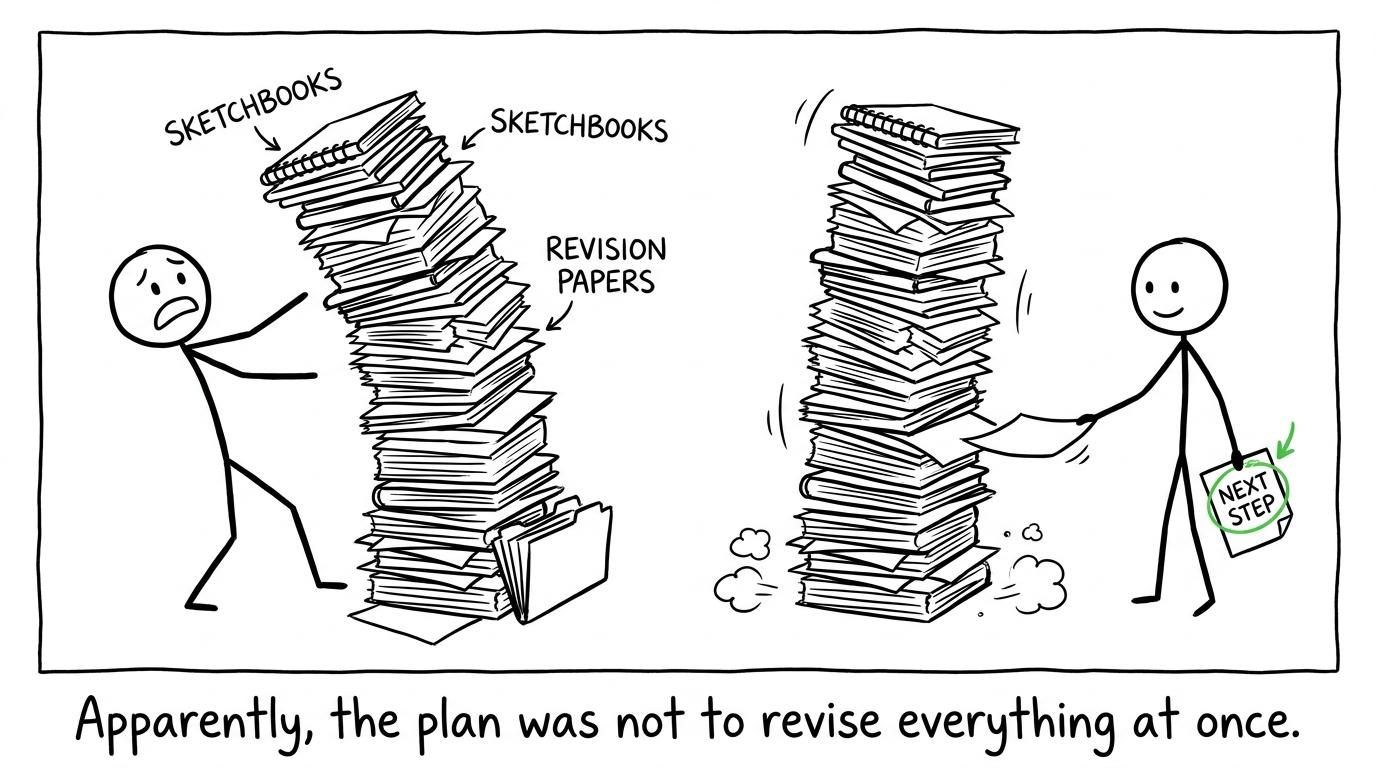 A giant revision pile becoming manageable after choosing one next step
Common mistakes when interpreting a grade 5
Treating grade 5 as exactly equivalent to an old B
The scales do not match grade for grade. A high C or low B is a useful informal description, but grade 555 has no exact old-letter equivalent.
Assuming one excellent final piece determines the grade
Final outcomes matter, but so do investigation, refinement and recording. All four assessment objectives are equally weighted across the qualification.
Looking for one permanent percentage boundary
Grade boundaries depend on the exam board, specification and series. Never use an unrelated subject's boundary or a previous year's figure as a guaranteed target.
Believing grade 5 has the same admissions value everywhere
Schools, colleges and courses set their own entry requirements. Check whether they ask for a grade in Art and Design, a portfolio, a general GCSE profile or a combination.
Letting Art deadlines remove all maths practice
A large portfolio deadline can make maths revision feel less urgent, but long gaps make methods harder to retrieve. Short, repeated practice is easier to sustain. Start with GCSE maths topics organised by exam board and tier, then decide what deserves attention.
Turn the result into a useful next step
The real GCSE art and design grade 555 meaning is not that your creativity can be measured perfectly by a number. It means your assessed portfolio and externally set work crossed a strong standard overall, demonstrating meaningful evidence across development, refinement, recording and presentation. Compared with the old scale, it sits broadly between a high C and a low B.
Once you understand the result, move from interpretation to action. If maths is your next priority, begin with the free Edexcel GCSE Maths Revision hub or choose your board from the main GCSE page. Use revision lessons and practice questions to repair weak topics, then test your progress with past papers, mini tests, mark schemes and video solutions.
As the exams approach, add Edexcel predicted papers and follow the Maths Genie exam-week checklist. One grade tells you where a piece of work landed. A clear revision process decides what happens next.











