

Is a GCSE Arabic Revision Bootcamp Worth It?
GCSE Arabic revision bootcamp costs vary. Learn what courses offer, how to judge teaching and feedback, and when a holiday course is worth paying for.
Revision courses sell something every student wants: the feeling that somebody else has organised the difficult part.
A GCSE Arabic revision bootcamp can provide useful structure, specialist teaching and realistic speaking practice. But it is only worth paying for when the course matches your exact qualification, identifies your weaknesses and gives you individual feedback. If it simply delivers several hours of general revision to a large group, free independent practice may achieve more.
That distinction matters when you are also preparing for GCSE maths. Money is limited, but so are time and concentration. The right question is not simply, “Is the course good?” It is, “Will this course improve something I cannot efficiently improve by myself?”
The quick bootcamp value checklist
Before booking, look for all or most of the following:
- teaching matched to your exact exam board, specification and tier
- separate practice for listening, speaking, reading and writing
- a diagnostic task before or at the start of the course
- individual correction of written Arabic
- live speaking practice with specific feedback
- use of authentic exam-style questions and mark schemes
- a clearly stated class size and number of taught hours
- materials you can keep and revisit
- a plan for what to practise after the course
- transparent cancellation, absence and refund terms
If the provider cannot answer basic questions about these points, the course description may be selling intensity rather than improvement.
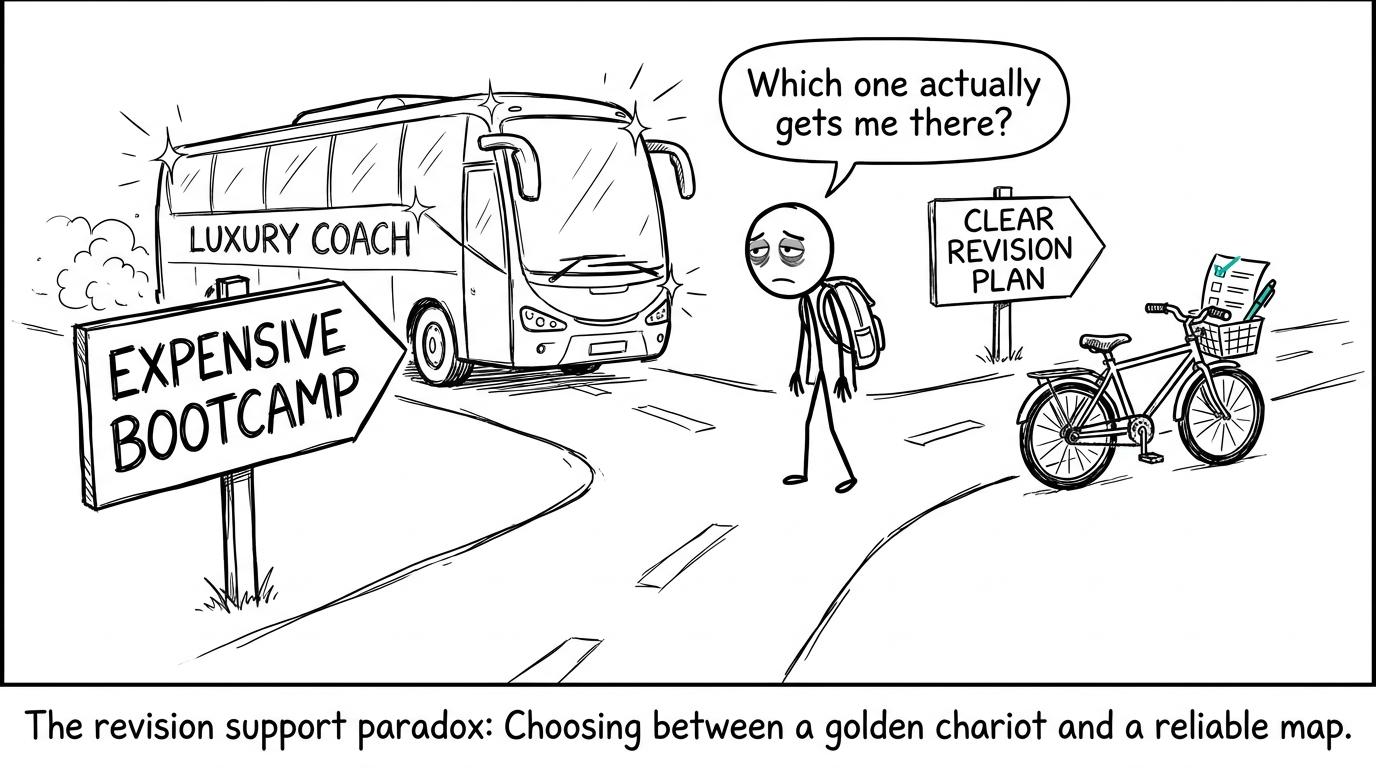 A student choosing between an expensive bootcamp and a clear revision plan
What GCSE Arabic actually assesses
The current Pearson Edexcel GCSE Arabic qualification assesses four skills: listening, speaking, reading and writing. Each contributes 25%25\%25% of the qualification. Students enter either foundation or higher tier across all four papers rather than mixing tiers.
The assessment includes more than knowing vocabulary. Students must understand spoken standard Arabic, respond to written material, communicate orally, write for different purposes and translate between Arabic and English. Dictionaries are not permitted in the assessments, including the preparation period for speaking.
Speaking is conducted by the school or centre and externally assessed. Under the current specification, it includes a role play, a picture-based task and a conversation. Reading includes translation from Arabic into English, while writing includes translation into Arabic.
This has two implications for choosing a holiday course.
First, a course devoted almost entirely to vocabulary worksheets is not comprehensive GCSE Arabic revision. Secondly, a student who speaks Arabic confidently at home may still need explicit support with formal writing, standard Arabic, translation and examination technique.
Always ask the provider to name the qualification code and assessment structure it teaches. “GCSE Arabic” is sometimes used loosely in advertising for courses connected to International GCSE, first-language qualifications or general Arabic tuition. Those courses may still be useful, but they are not automatically preparation for Pearson Edexcel GCSE Arabic.
What a GCSE Arabic revision bootcamp usually offers
The word “bootcamp” is not a regulated description. It can refer to a single intensive day, several online sessions, an Easter holiday programme or a longer small-group course. The label tells you little about the quality.
Condensed specification coverage
Most courses move quickly across themes such as identity and culture, local and global issues, school, future study and employment. This can help a student see how vocabulary and grammar connect across the specification.
However, covering a topic is not the same as learning it. A crowded timetable may create the reassuring sense that everything has been mentioned while leaving little time for retrieval, correction or repeated practice.
Speaking rehearsal
Live speaking practice is one of the strongest reasons to consider paying. It is difficult to recreate a responsive conversation alone, particularly when you need feedback on pronunciation, accuracy, development and spontaneity.
A worthwhile course should give every student meaningful speaking time. Ask whether practice includes the correct task types and whether feedback is individual. In a large class, “speaking practice” can mean listening to other students for most of the session.
Writing and translation feedback
Written Arabic needs careful correction. Generic model answers may show what a strong response looks like, but they do not reveal your repeated errors with agreement, tense, spelling, sentence construction or register.
The best courses include marked work followed by an opportunity to improve it. Feedback should lead to another attempt, not merely a page covered in corrections.
Timed exam practice
A good bootcamp should include work under realistic time pressure. It may use sections rather than complete papers, but the questions should resemble the actual assessment and be reviewed against the relevant mark scheme.
That same principle applies to maths. The MathsGenie GCSE maths revision hub organises free lessons, exam questions and papers by exam board, while the guide to finding your weakest GCSE topics explains how to turn lost marks into specific revision targets.
How much can an intensive course cost?
Prices vary substantially according to location, class size, course length, teacher experience and whether teaching is online or face to face. Current UK revision-course listings show that short group programmes can cost several hundred pounds. At the time of checking, examples in the wider GCSE revision market included around £275275275 for four hours and £350350350 for five hours, while longer holiday programmes could cost considerably more.
These examples are not a standard price for Arabic. Specialist availability may be limited, and providers can change their fees. Always obtain a current written quote showing the actual teaching hours, group size and included feedback.
A simple comparison is:
Cost per guided hour=total course costlive taught hours\text{Cost per guided hour}=\frac{\text{total course cost}}{\text{live taught hours}}Cost per guided hour=live taught hourstotal course costBut hourly cost alone is incomplete. A course with fewer hours may offer better value if those hours include marked writing and individual speaking practice. Recordings, worksheets and large-group lectures should not automatically be valued in the same way as direct teacher feedback.
Also ask what the price excludes. Travel, accommodation, examination-entry fees and textbooks can change the real total.
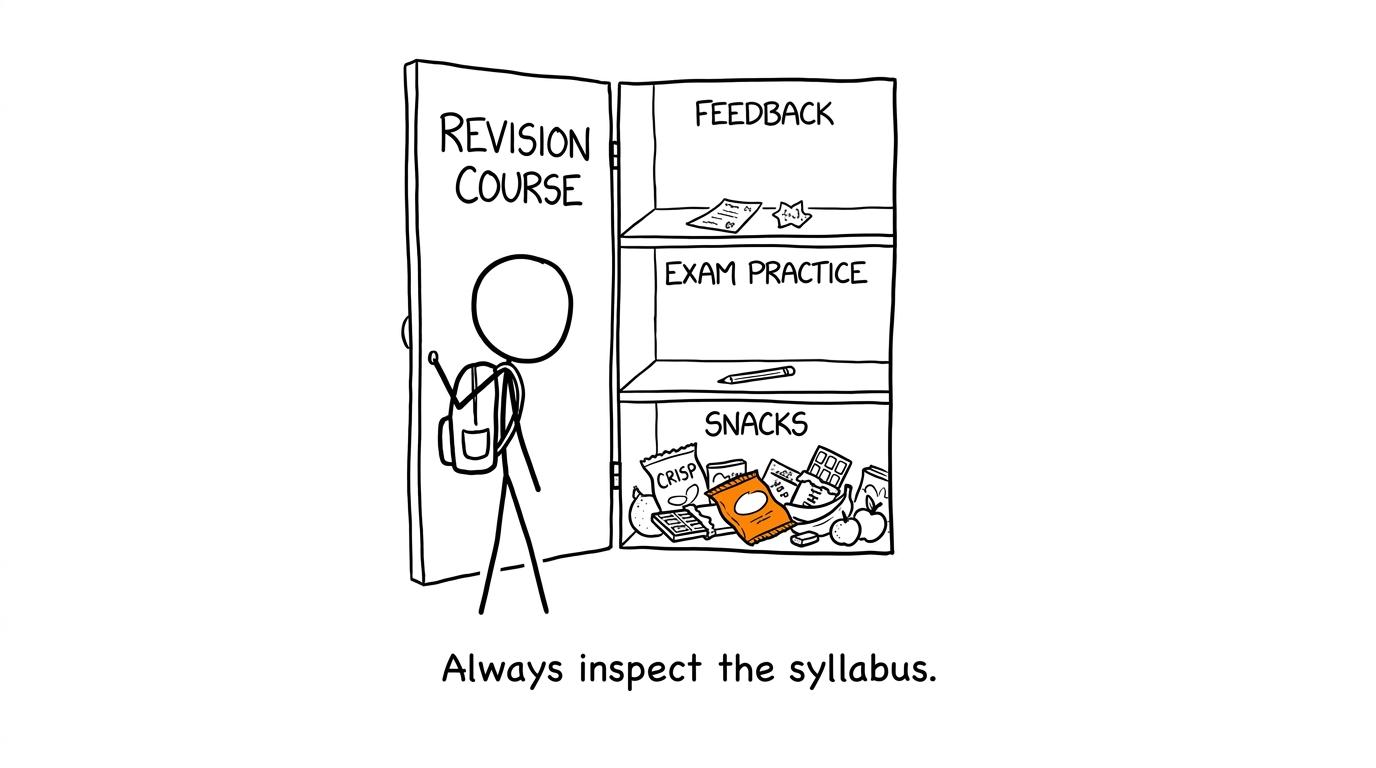 A suspiciously snack-heavy revision course cupboard
When paying is genuinely worthwhile
A GCSE Arabic revision bootcamp is most defensible when it solves a clear problem.
You have limited access to specialist teaching
Some students prepare for Arabic outside their normal school timetable or have little regular contact with a subject specialist. A carefully chosen course can provide expert correction that is otherwise difficult to obtain.
Your speaking assessment needs urgent, realistic practice
If you know the language but freeze when responding without a script, live rehearsal may be valuable. The teacher should interrupt unhelpful habits, test follow-up responses and show how to develop answers naturally.
Your written Arabic is not being corrected
Independent revision works best when feedback is available. If nobody is checking your writing, the same errors can become more familiar rather than less frequent.
You need a deadline and external structure
Some students know what to do but struggle to begin. A booked course creates a fixed commitment. That structure has value, although it should not be confused with subject expertise. You may be able to create similar accountability through a teacher, family member or revision plan.
For maths, the free MathsGenie revision planner can turn a vague intention into scheduled tasks. If time is tight, the twenty-minute GCSE maths routine provides a manageable alternative to marathon sessions.
When a bootcamp is probably not worth the cost
Do not pay simply because the examination is close. Urgency makes almost any organised product feel necessary.
A course may offer poor value when:
- you have not confirmed that it matches your qualification
- the class is too large for individual speaking or writing feedback
- most of the day consists of lectures and note-taking
- there is no diagnostic assessment
- the provider promises a particular grade
- you already receive strong specialist feedback at school
- the course clashes with higher-priority revision in maths or other subjects
- the cost creates pressure without solving a defined weakness
No responsible provider can guarantee a grade. Results depend on prior knowledge, subsequent practice, performance across all four skills and the actual assessments.
Compare the course with the best alternative
The true cost is not only the fee. It is also the revision you give up.
A full holiday day spent on Arabic may mean losing a timed maths paper, recovery time or focused work on a weak higher-tier topic. That does not make the Arabic course a bad choice. It means the decision should be made across your whole GCSE timetable.
Before paying, run a short trial week:
- complete one Arabic task in each skill
- mark what can be marked and request teacher feedback where possible
- identify the two weakest skills
- follow a structured plan for seven days
- review whether the problem is knowledge, feedback, confidence or consistency
Apply the same diagnostic approach to maths. Use Edexcel GCSE maths past papers if that is your board, or select the correct board through the main GCSE hub. Shorter Edexcel GCSE maths mini tests can reveal gaps without taking over an evening.
If independent revision works, you may not need a bootcamp. If progress stalls because you cannot evaluate your speaking or writing, targeted tuition or a small specialist course becomes easier to justify.
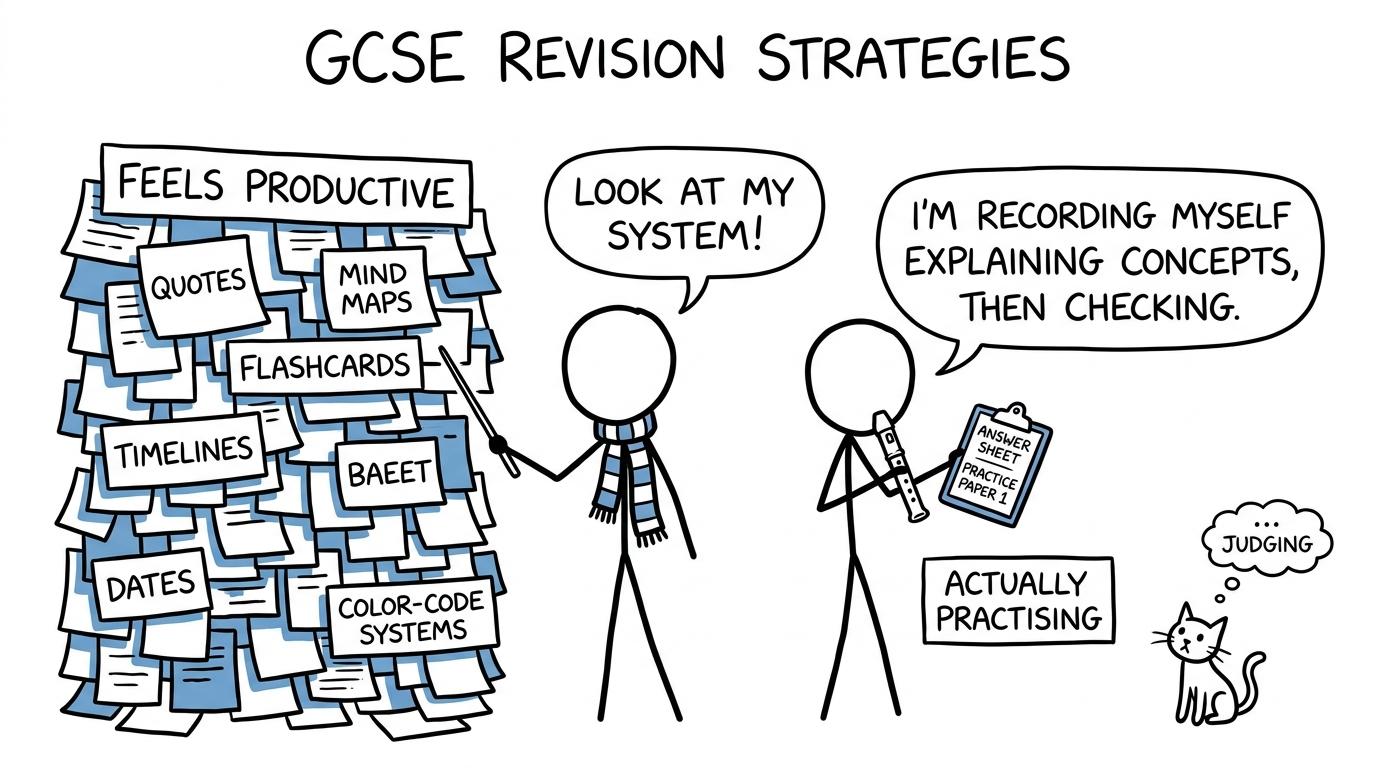 One student building notes while another actually practises
Questions to ask before booking
Contact the provider and ask direct questions:
- Which specification and qualification code do you teach?
- Is the course suitable for foundation, higher or both?
- How many students are expected?
- How much individual speaking time will each student receive?
- Will written answers be marked by an Arabic specialist?
- Are exam-style tasks completed under timed conditions?
- What resources can students keep?
- What happens if the tutor changes or a session is cancelled?
- Is there a follow-up revision plan?
Clear providers tend to give clear answers. If the reply focuses mainly on motivation, confidence or “covering the whole course”, ask again about feedback and assessment.
Common mistakes when choosing a revision course
Confusing fluency with exam readiness
Speaking Arabic at home is a major strength, but GCSE assessment also rewards formal reading, accurate writing, translation and performance within specific task formats.
Choosing by total hours
More hours can mean more fatigue. Value comes from useful practice and correction, not simply remaining in a classroom for longer.
Paying before diagnosing the problem
A student with weak listening needs different support from one who cannot structure written responses. Diagnose first, then buy the smallest intervention that addresses the gap.
Ignoring the rest of the GCSE timetable
Arabic revision should sit alongside maths, English and other subjects. Use a realistic schedule rather than allowing one intensive course to consume the week. MathsGenie’s one-month GCSE maths plan can help protect regular maths practice around other commitments.
Treating attendance as completion
The course is the beginning of a revision cycle, not the end. Notes and feedback only become useful when you retrieve, practise, correct and revisit them.
The final verdict
A GCSE Arabic revision bootcamp can be worth the cost when specialist feedback is scarce, the group is small and the teaching closely matches the Pearson Edexcel assessment. Speaking rehearsal and corrected writing are usually the hardest benefits to reproduce alone.
It is less convincing when the course offers broad content coverage without individual practice, or when the same money and time could be directed towards a narrower weakness.
Make the decision as you would approach a difficult exam question: identify what is known, find what is missing and choose the method that addresses that gap. Then protect your wider revision plan.
For maths, start free with GCSE predicted papers, revision lessons, practice questions, mini tests and past papers. Mark your work using the mark schemes, use video solutions where available, and return to the precise topics costing you marks. A paid course may provide a useful push in Arabic. MathsGenie can keep the rest of your GCSE maths revision moving every day.











