GCSE Arabic: Revise Every Day or Rest?
GCSE Arabic revise every day or rest? Learn how spacing, retrieval, sleep and planned breaks improve retention without derailing your maths revision.

The difficult part of revision is not always starting. Sometimes it is knowing when to stop. If you have searched “gcse arabic revise every day or rest”, the practical answer is this: use frequent, short Arabic sessions, but include planned rest and avoid treating every day as a demanding revision day.
You do not need an exhausting Arabic session seven days a week. Retention is generally stronger when learning is spread across time and combined with active retrieval. Sleep and quiet rest also support memory consolidation. A sensible plan therefore alternates focused practice, lighter contact and genuine rest while leaving enough energy for GCSE maths and your other subjects.
The quick revision checklist
- Revise Arabic regularly, rather than saving everything for one long session.
- Retrieve vocabulary and grammar from memory before checking notes.
- Revisit the same material on different days.
- Rotate listening, speaking, reading and writing.
- Keep at least one lower-pressure or complete rest day each week.
- Protect sleep, especially after demanding revision.
- Adjust the timetable when concentration or accuracy starts falling.
- Keep maths active with short topic sessions and exam questions.
The goal is not to collect the largest number of revision hours. It is to remember more of what you have revised.
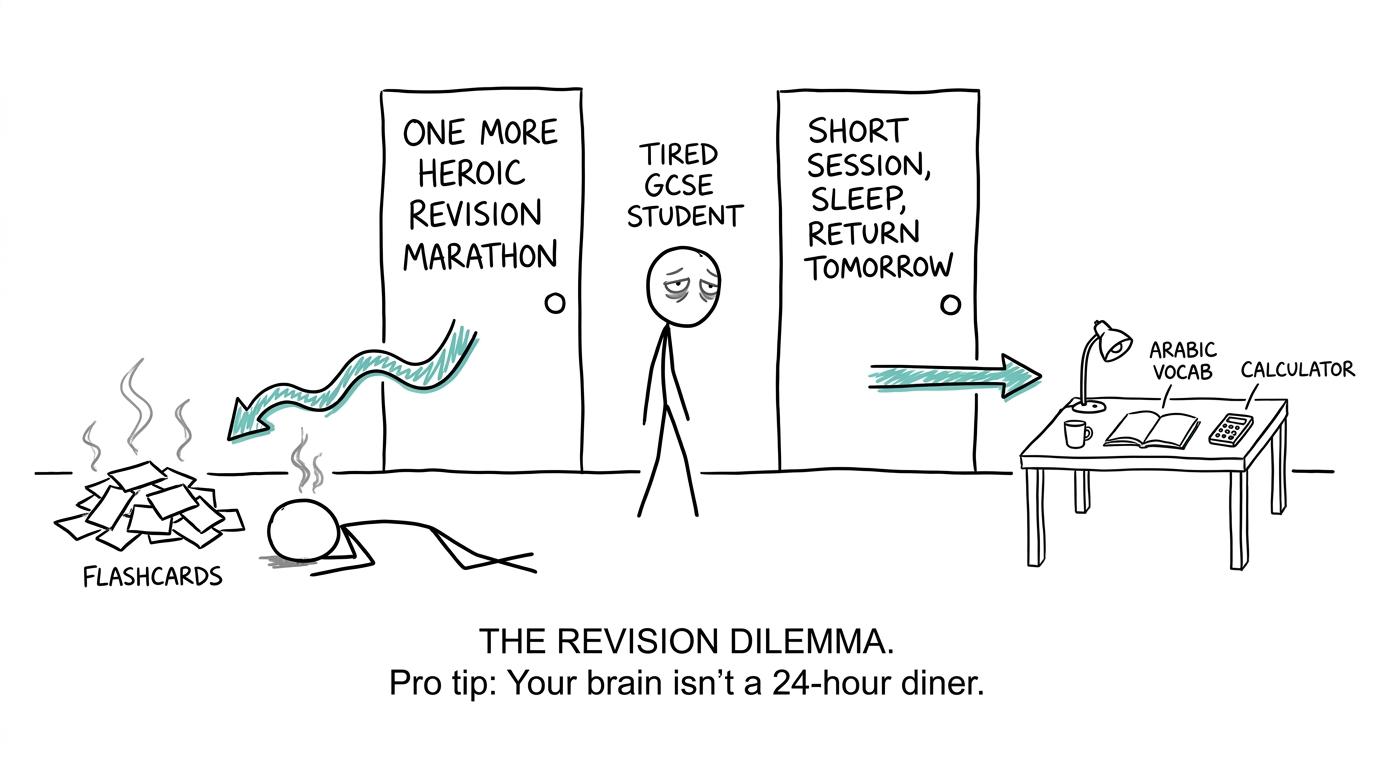 A student choosing between a revision marathon and a short session followed by sleep
Should you revise GCSE Arabic every day?
Daily contact with Arabic can be helpful, particularly for vocabulary, pronunciation and recognition of common structures. But daily contact is not the same as completing a full revision session every day.
A five-minute vocabulary recall, a short listening clip or mentally rehearsing answers to speaking questions can maintain familiarity. These activities are quite different from completing a timed writing task, analysing a reading paper or practising an extended conversation.
That distinction matters. A student may benefit from seeing or using Arabic on most days while reserving demanding work for fewer, better-planned sessions. This keeps the language familiar without allowing it to consume the time needed for maths, English, science and other GCSE subjects.
For Pearson Edexcel GCSE Arabic, listening, speaking, reading and writing each contribute 25%25\%25% of the qualification. All four skills therefore need attention, although your immediate priorities should reflect your own weaknesses and the order of your assessments. Confirm your current specification, tier and assessment arrangements with your school.
Why spacing improves retention
Memory is not strengthened simply because two hours have been spent looking at a page. It becomes more reliable when information must be recalled after some forgetting has occurred.
Research into the spacing effect consistently finds that repeated learning opportunities spread across time support longer-term retention better than the same practice compressed into one sitting. Retrieval practice adds another useful layer: instead of rereading a vocabulary list, you try to produce the meaning, spelling or phrase before revealing the answer.
That moment of effort matters. It shows whether the knowledge is genuinely available without support.
For Arabic, spaced retrieval might mean returning to the same vocabulary group on several separate days. For maths, it means returning to a method after the original lesson rather than assuming that one successful worksheet has secured it permanently. MathsGenie’s guide to stopping yourself forgetting GCSE maths content explains how to use the same principle with exam questions.
Spacing does not require a perfect sequence of intervals. There is no universally correct GCSE timetable because students differ in prior knowledge, available time and exam dates. The reliable principle is simpler: revisit important material after a gap, retrieve it actively and use the result to decide when it needs another appearance.
What rest actually does for learning
Rest is often treated as the opposite of revision. In reality, it can be one of the conditions that makes revision useful.
Sleep has an established role in memory consolidation, although the strength of the effect varies with the material, task and learner. Research also suggests that quiet wakeful rest after learning can support memory in some circumstances. This does not mean that a break automatically memorises vocabulary for you. It means that learning continues to be processed after the visible work has stopped.
Late-night revision can therefore create a poor trade: more material is covered, but concentration, sleep and next-day recall may suffer. Stopping at a planned time is not laziness. It is a decision to protect tomorrow’s attention.
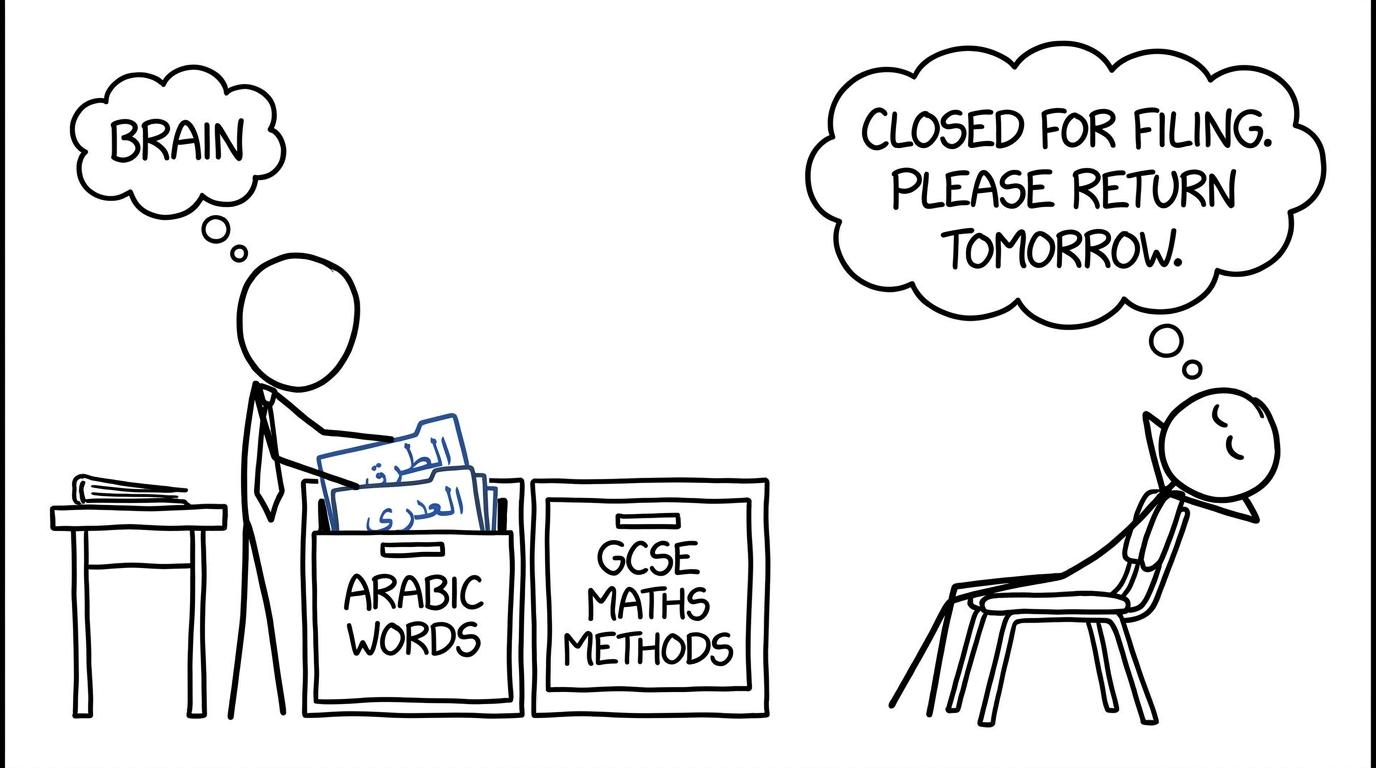 A stick-figure brain filing Arabic words while a student sleeps
A rest day can take two forms:
- Complete rest: no planned Arabic revision, particularly after a demanding school week or mock examination.
- Light contact: a few minutes of easy recall, listening or speaking without a formal written task.
Choose complete rest when you are mentally depleted. Choose light contact when it feels easy and helps you maintain familiarity. Neither option should become a source of guilt.
A balanced GCSE Arabic and maths revision rhythm
A strong week usually contains different levels of effort rather than seven identical days. You might use three focused Arabic sessions, two very short retrieval sessions and one or two rest days. This is a flexible model, not a scientific prescription.
Focused Arabic sessions
Use focused sessions for work requiring concentration:
- timed reading or listening questions;
- extended writing and translation;
- speaking tasks without a prepared script;
- grammar practice based on recurring errors;
- marking and correcting previous work.
Rotate the four assessed skills rather than revising only vocabulary. Vocabulary supports every paper, but vocabulary recognition alone does not train you to understand extended speech, sustain a conversation or organise accurate writing.
Light retrieval sessions
A lighter day might contain ten minutes of closed-book recall. Test meanings in both directions, say phrases aloud or reconstruct a short speaking response from prompts. Check afterwards and record only the items that were uncertain.
Rereading can feel smooth because the answer is visible. Retrieval feels harder because it reveals gaps. The harder feeling is often the more useful one.
Maths sessions alongside Arabic
Maths requires its own repeated contact. It is difficult to rebuild algebraic fluency or exam timing through reading alone, so protect several question-based maths sessions each week.
Start from the GCSE maths revision hub, choose the correct board and tier, then work on a specific weakness. If school days are crowded, the twenty-minute GCSE maths revision routine offers a manageable structure.
A useful division of labour is:
- Arabic retrieval on some shorter weekdays;
- focused Arabic skill practice on selected days;
- maths topic questions on separate days or before a clear break;
- one longer timed maths session when you are rested;
- at least one period with no demanding revision.
A realistic GCSE maths revision timetable can help you organise these commitments without allowing one subject to absorb every available evening.
How to decide whether you need a rest day
Your timetable should respond to evidence, not guilt. Consider reducing the workload when:
- you repeatedly read the same sentence without processing it;
- recall becomes worse throughout the session;
- errors increase because you are rushing or tired;
- you are sacrificing sleep to complete an arbitrary target;
- irritation is replacing purposeful effort;
- the next task is being chosen only to keep a revision streak alive.
Not every difficult session means you should stop immediately. Retrieval practice is supposed to require effort. The key distinction is between productive difficulty, where you can still think and learn from feedback, and unproductive fatigue, where attention has largely disappeared.
When unsure, take a proper break and retest yourself later. If performance recovers, fatigue was probably part of the problem. If the same gap remains, schedule a focused session on that material.
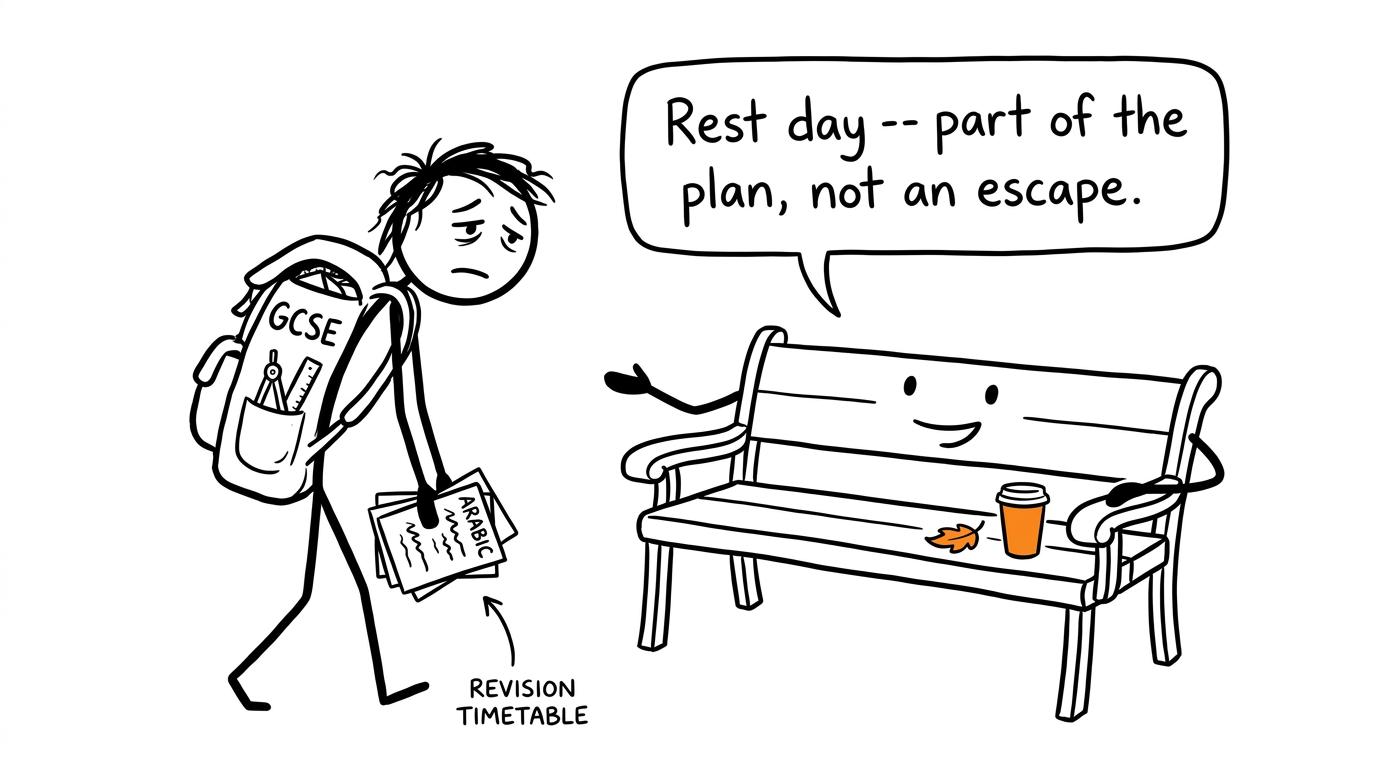 A revision timetable offering an exhausted student a planned rest
Make each revision session earn its place
A short session needs a clear purpose. Before beginning, decide what you will retrieve, practise and check.
For Arabic, that might mean one speaking theme or one group of commonly confused words. For maths, choose a precise skill rather than the broad instruction to “do algebra”. MathsGenie’s GCSE maths topics by board and tier can help narrow the choice.
Finish with feedback. In Arabic, compare your response with teacher guidance, an approved mark scheme or a reliable model, then record the specific language error. In maths, use the mark scheme to identify whether a lost mark came from the method, accuracy or interpretation. The guide to using GCSE mark schemes as a revision coach develops this process.
The next session should begin with the previous error. That creates a loop:
retrieve, attempt, check, correct, rest, retrieve again.
Common mistakes when planning Arabic revision
Believing more days automatically mean more learning
A seven-day streak can hide low-quality revision. Judge the plan by what you can recall and apply after a delay, not by the number of boxes ticked.
Repeating the same vocabulary list in one sitting
Immediate repetition creates familiarity, but familiarity can disappear quickly. Spread later retrieval across separate days and mix old words with newer material.
Revising only the most comfortable skill
Students who enjoy reading may avoid speaking; confident speakers may neglect written accuracy. Your timetable should cover all four assessed skills and give extra attention to weaknesses.
Turning a rest day into anxious passive revision
Scrolling through notes while feeling guilty is neither proper rest nor focused learning. Decide in advance whether the day contains light contact or complete rest, then follow that decision.
Allowing Arabic to displace maths practice
Language revision can be divided into convenient small tasks, which makes it easy to keep adding more. Protect maths time explicitly. Use GCSE maths mini tests for focused timed practice and Edexcel GCSE maths past papers when you are ready to build full-paper stamina.
Using predicted material as a substitute for broad preparation
Predicted papers are useful practice, not certainty about what will appear. Use MathsGenie’s GCSE predicted papers after building secure topic knowledge, and learn from the accompanying mark schemes and video solutions where available.
The best answer is a rhythm you can sustain
So, should you revise GCSE Arabic every day or take rest days? Aim for regular contact, not relentless intensity. Short retrieval on several days, focused practice across all four skills and planned rest will usually create a more sustainable approach than either weekly cramming or seven demanding sessions.
A good timetable leaves you able to return. That is the quiet advantage of rest: it protects the quality of the next attempt.
Keep Arabic moving through spaced retrieval, then use MathsGenie to make your maths revision equally deliberate. Choose a free revision lesson, complete targeted practice questions, check the mark scheme and return later with a mini test. As the examinations approach, build confidence with past papers, predicted papers and video solutions. Start with the MathsGenie GCSE maths revision hub and plan a week that includes both purposeful practice and permission to stop.