GCSE Arabic Predicted Grade Process Explained
GCSE Arabic predicted grade process explained: learn how teachers use mocks, classwork, speaking evidence, past boundaries and professional judgement fairly.
A predicted grade can feel strangely permanent. One number appears on a report, and suddenly it seems to describe everything you can do. Yet the GCSE Arabic predicted grade process is not supposed to be a snap judgement or a promise about your final result. It is an evidence-based estimate of the grade your teacher believes you are likely to achieve, usually using mock examinations, assessments across all four language skills, classwork, progress over time and professional judgement.
There is no national formula that every school must follow. Your school or Arabic department may have its own assessment policy, but a sound prediction should draw on several pieces of relevant evidence rather than one unusually strong or weak lesson.
The predicted grade checklist
Teachers will usually consider some combination of:
- performance in timed mock examinations
- listening, speaking, reading and writing assessments
- how closely tasks match the GCSE specification
- marks awarded using exam-board criteria or mark schemes
- previous assessment results and recent progress
- consistency across different topics and conditions
- foundation or higher-tier entry
- historical grade boundaries, used cautiously
- moderation by another teacher or the head of department
The important phrase is some combination. There is no official rule saying that one mock must contribute a fixed percentage of your prediction.
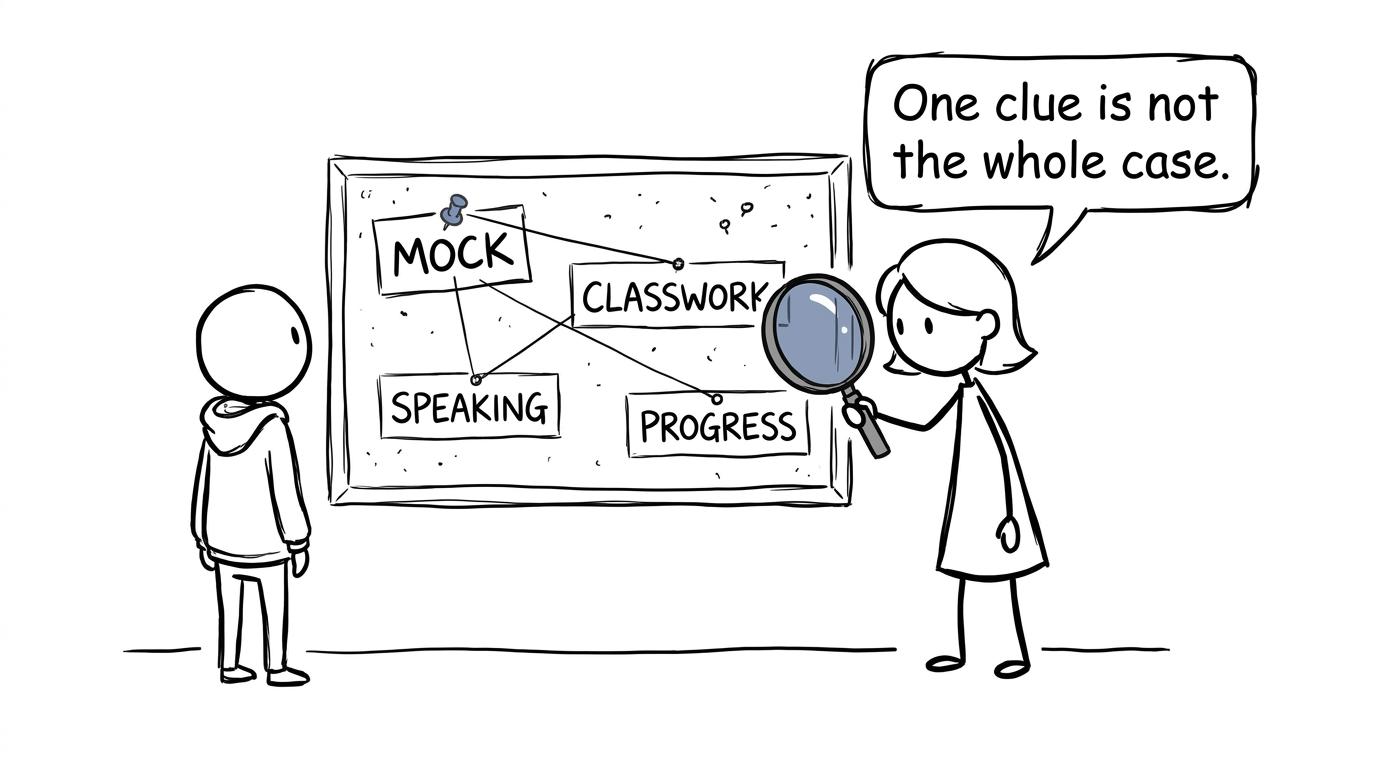 A teacher investigates mock, classwork, speaking and progress evidence rather than relying on one clue
What a GCSE Arabic predicted grade actually means
A predicted grade is your school’s current estimate. It may help with reports, sixth-form applications, intervention decisions or conversations about tier entry. It is different from several labels students often hear:
- A target grade may be generated from prior attainment or school data and describes an expected destination.
- A working-at grade describes the standard shown in recent work.
- A predicted grade estimates the likely final outcome based on the available evidence.
- Your final grade is awarded after the official examinations have been marked and grade boundaries have been set.
Teachers do not award the final GCSE grade, and the exam board does not simply accept the prediction. The official result is determined from your examination performance.
Predictions can also change. If later assessments provide stronger evidence, a school may update its estimate according to its reporting policy. Equally, a prediction is not an automatic entitlement to a particular final grade.
How teachers build the evidence
They begin with the correct specification and tier
The current Pearson Edexcel GCSE Arabic qualification assesses listening, speaking, reading and writing. Each assessment objective contributes 25%25\%25% of the qualification, so a balanced judgement needs evidence from all four skills.
The qualification is available at foundation and higher tier. Foundation offers grades 111 to 555. Higher principally offers grades 444 to 999, with grade 333 available as a safety-net outcome when a candidate falls narrowly below the grade 444 boundary.
Tier matters because the papers have different demands and available grades. A high mark on a foundation assessment cannot automatically be treated as evidence for a high higher-tier grade. Before interpreting any result, the teacher needs to know whether the task, timing and question style genuinely reflect the paper the student is expected to sit.
Students can check the latest historical figures on MathsGenie’s Edexcel GCSE Arabic grade boundaries page. These figures provide context, not a guaranteed boundary for the next examination series.
Timed mocks provide important evidence
A well-designed mock is often one of the strongest pieces of evidence because it samples a broad section of the course under controlled conditions. It can reveal whether a student can recall vocabulary, interpret unfamiliar material and manage time without notes or prompts.
But one mock remains one performance on one day. Illness, incomplete course coverage or an unrepresentative paper can affect the result. A responsible prediction therefore considers whether the mock agrees with other assessments.
The same principle applies in maths. A timed paper is informative because it tests performance, not just familiarity. MathsGenie’s guide to using GCSE past papers properly explains how to sit, mark and learn from a paper rather than treating its score as a verdict.
Teachers look across all four language skills
A student may speak Arabic confidently at home but find formal reading or extended writing more difficult. Another may write accurately yet lose marks when listening at examination speed. Neither profile can be represented properly by looking at only one skill.
Teachers may therefore use:
- listening tests completed under timed conditions
- reading papers containing familiar and unfamiliar language
- speaking tasks assessed against the relevant criteria
- writing assessments completed independently
- translation tasks where required by the specification
The speaking assessment deserves particular care. Confidence and fluency matter, but exam-board criteria also reward communication, development, interaction, linguistic range and accuracy where applicable. Everyday conversational ability is valuable, but it is not automatically the same as meeting every GCSE assessment requirement.
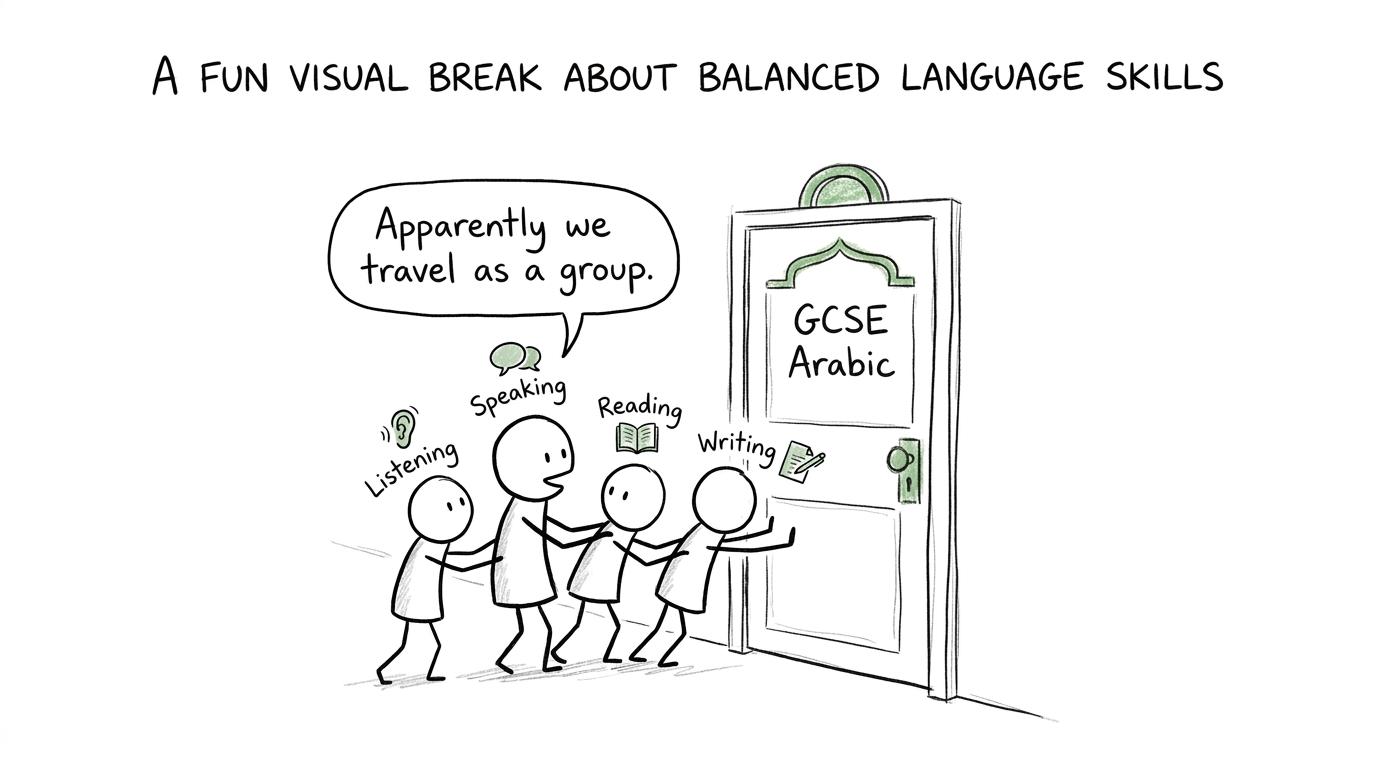 Listening, speaking, reading and writing arrive together for GCSE Arabic
Mark schemes turn impressions into evidence
“Good at Arabic” is an impression. A marked response tied to published criteria is evidence.
Teachers compare work with the assessment objectives, levels-based descriptors and mark schemes. For writing and speaking, this means considering the quality of communication as well as features such as range, accuracy and development. For listening and reading, marks come from what the student has understood and communicated in the required form.
Classwork can support the judgement, particularly when it shows a consistent standard over time. However, work completed with vocabulary lists, teacher feedback or unlimited time is not directly comparable with an independent examination. Teachers should recognise those differences rather than treating every mark as equally reliable.
How marks become a predicted grade
After gathering evidence, the department needs to translate performance into a grade estimate. This commonly involves four stages.
Comparing marks with historical boundaries
Past grade boundaries show the minimum total mark that received each grade in a completed series. They can help teachers interpret mock totals, especially when the mock uses genuine or closely matched exam-board material.
However, final boundaries are not fixed before the live examinations. Exam boards set them after marking is nearly complete, using statistical evidence and expert review of student work. Boundaries may rise or fall because papers cannot be made exactly equal in difficulty every year.
MathsGenie’s guide to how GCSE grade boundaries work explains why a previous boundary is useful evidence but not a prediction of the next one.
Considering the quality of the assessment
A raw mark means little without context. Teachers ask whether the assessment:
- covered enough of the specification
- used realistic question types
- was completed independently
- matched the correct tier
- included all relevant skills
- was marked consistently
A short vocabulary quiz may demonstrate useful knowledge, but it cannot carry the same weight as a broad, timed assessment.
Looking at consistency and direction of travel
Predictions look forward, so teachers may consider whether performance is stable, improving or declining. Recent evidence may deserve more attention when it reflects newly taught content and current capability.
Progress alone does not guarantee an extra grade. The improvement must appear in assessable work. A calm way to think about this is that effort creates opportunities, while completed assessments provide the evidence.
Moderating the judgement
Where staffing allows, departments may compare marking, review borderline scripts or ask a head of department to check predictions. Moderation reduces the risk that one teacher is unusually generous or severe.
School policy remains important. If you want to know precisely how your prediction was produced, ask which assessments were used, how each skill was represented and whether the grade was moderated. Those questions seek evidence rather than bargaining for a number.
What matters most near a grade boundary
Predictions become less certain near a boundary. A small mark difference in one mock may move the reported grade even though the underlying performances are very similar.
This is why teachers may look beyond the headline total. They may review whether dropped marks came from a repeated knowledge gap, weak examination technique or one unusual error. They may also consider whether results across several assessments support the same conclusion.
Historical boundaries should never become a comfort target. A safer aim is to build a margin above the previous threshold by improving weaker skills. The principle is familiar in maths: rather than guessing the minimum required, use GCSE Maths revision resources to raise the mark you can reliably produce.
How to improve the evidence behind your prediction
You cannot improve a prediction by repeatedly staring at it. You improve the work from which the prediction is made.
Ask your teacher for three specific details:
- Which skill is currently limiting the grade?
- Which assessment provides the strongest evidence?
- What would higher-grade performance look like in the next task?
Then create a short cycle: practise the weakest skill, complete an independent assessment, mark or review it carefully, and repeat. Keep dated work so that progress is visible. For speaking, practise responding without a complete script. For writing, work within a time limit. For listening and reading, review why an answer was missed rather than merely recording the mark.
The same evidence-building habit can strengthen your maths preparation. Use MathsGenie’s GCSE revision timetable guide to organise regular practice, then test yourself with Edexcel GCSE Maths past papers and official mark schemes.
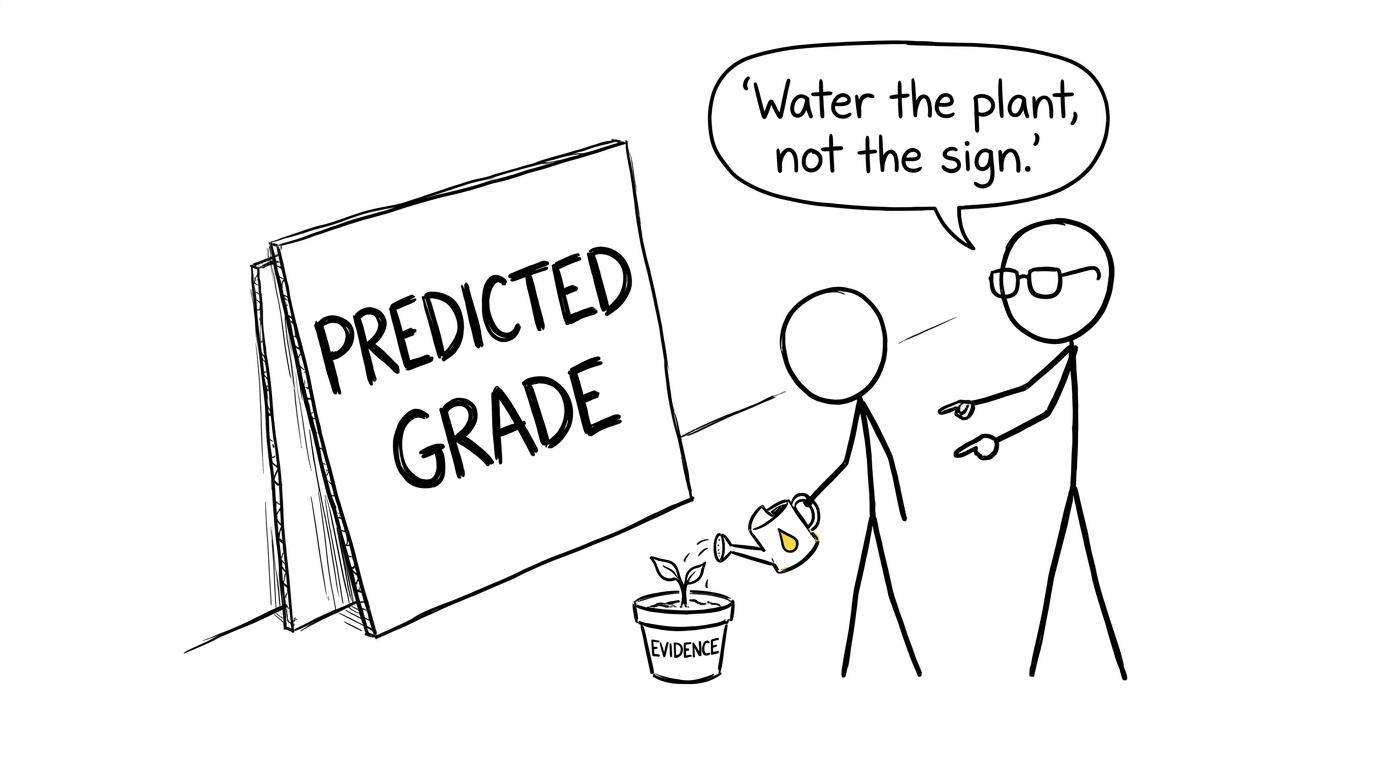 A student waters evidence instead of staring at a predicted-grade sign
Common mistakes when interpreting predicted grades
Treating one mock as the entire process
A mock can be influential, but it should be interpreted alongside its coverage, conditions and the wider evidence available.
Assuming past boundaries will repeat
Past boundaries are reference points. The next official boundaries will be set only after the examination papers have been taken and marked.
Comparing raw marks from different tiers or papers
Marks are meaningful only when the tier, maximum mark, skill and assessment conditions are comparable.
Focusing only on the strongest skill
A strong speaking performance cannot erase substantial gaps in reading, listening or writing. The qualification assesses all four skills equally by assessment-objective weighting.
Confusing effort with assessed performance
Effort matters enormously because it drives improvement. Predictions, however, need demonstrable evidence that the required standard is being reached.
Asking for a higher prediction without new evidence
A more productive request is to ask for another appropriate opportunity to demonstrate improvement under agreed conditions.
Build the evidence, not the anxiety
The GCSE Arabic predicted grade process is best understood as a careful estimate: teachers gather relevant work, compare it with specification standards, interpret marks cautiously, consider progress and apply professional judgement. No single quiz should define you, and no prediction can guarantee your final result.
Your most useful next step is to identify what evidence would change the judgement. Then produce it.
For maths revision, MathsGenie gives you the same practical route from uncertainty to evidence. Start with free revision lessons and practice questions, test yourself using past papers and mini tests, check your work against mark schemes and video solutions, and use predicted papers when you need fresh exam-style practice. The number on a report may attract your attention, but the repeated cycle of practice, feedback and correction is what moves it.