How Much GCSE Arabic Grammar Do You Need?
GCSE Arabic grammar needed for exam success: learn which rules matter most, what Higher tier adds and where small mistakes need not derail your marks.
The grammar list can make GCSE Arabic feel larger than it really is. You open the specification, see cases, pronouns, verb patterns, agreement and sentence structures, and wonder whether every rule must become automatic before you can earn a strong grade.
The short answer is no. The GCSE Arabic grammar needed for exam success is the grammar that helps you understand messages and communicate clearly across different timeframes. You need secure control of frequent structures, not university-level mastery of every detail. At Higher tier, greater variety and accuracy matter, but meaningful communication still comes before grammatical perfection.
This guide focuses on Pearson Edexcel GCSE Arabic, the principal GCSE qualification in the subject. If you are taking an International GCSE or another qualification, check its current specification because the papers and grammar demands may differ.
Your GCSE Arabic grammar priority checklist
Build your revision around these layers:
- Essential: pronouns, common verb forms, negation, questions, gender and basic agreement.
- High value: past, present and future reference, possessive structures, adjective agreement, connectives and comparisons.
- Important for Higher tier: a wider range of sentence patterns, confident manipulation of language and more complex verb and noun forms.
- Mostly receptive in some contexts: structures that the specification expects you to recognise rather than produce freely.
- Lower priority: rare exceptions and elaborate case endings that do not materially improve your message.
Your official specification remains the final authority. A useful revision habit is to treat it like a checklist rather than a textbook: identify what you can recognise, what you can use and what repeatedly causes mistakes.
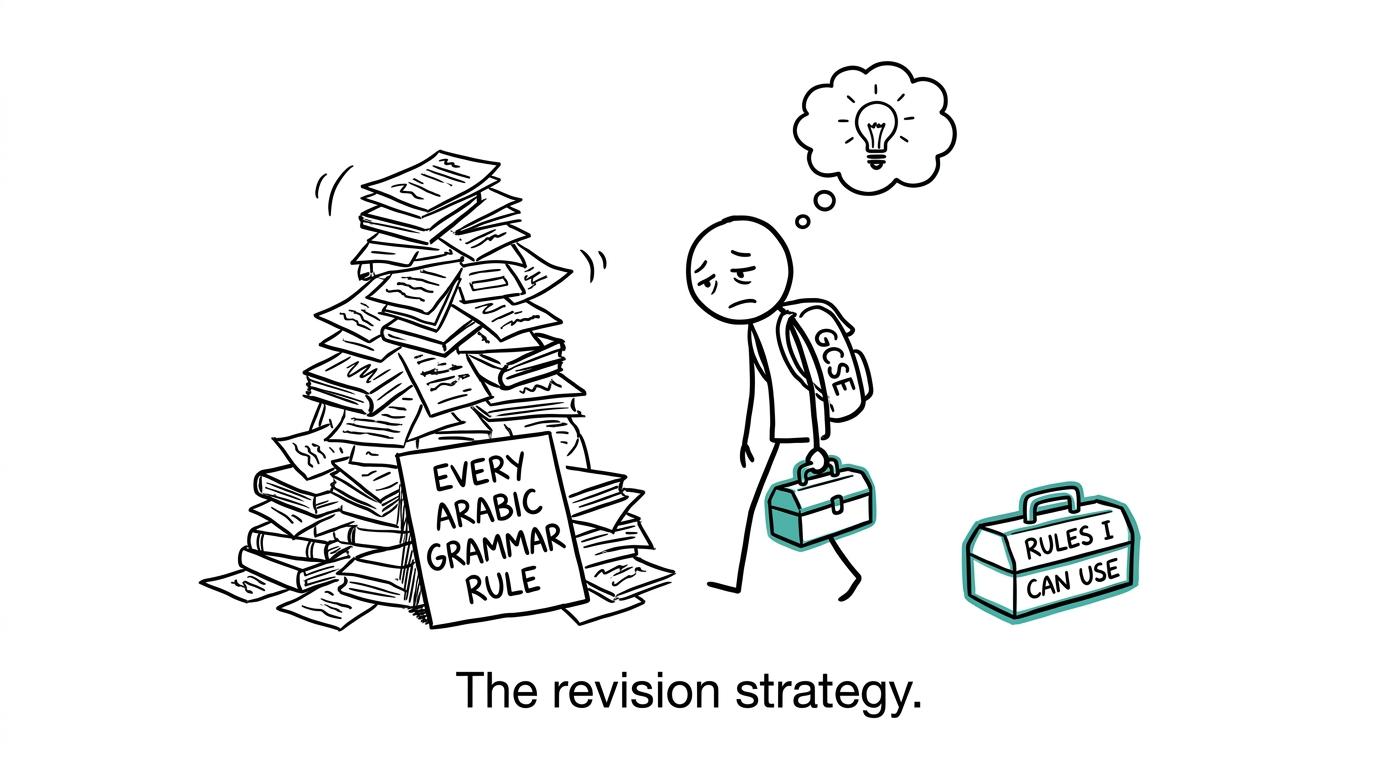 A student chooses a useful grammar toolbox instead of carrying every rule
What the GCSE Arabic exam is actually assessing
The current Edexcel GCSE Arabic qualification has four externally examined skills: listening, speaking, reading and writing. Each contributes 25%25\%25% of the qualification. Grammar therefore matters throughout, but it appears in different ways.
In listening and reading, grammar helps you identify who did something, when it happened, whether an idea is negative and how details relate. In speaking and writing, you must select and apply structures yourself.
The official mark grids reward communication as well as linguistic knowledge and accuracy. Higher performance requires a suitable range of vocabulary and grammatical structures, increasingly accurate manipulation of language, and successful reference to different timeframes. Recent Pearson guidance for the top writing band refers to successful use of three timeframes, while the band below can be reached with at least two.
That leads to an important distinction: knowing the name of a rule is not the same as being able to use it. The exam is not asking for an English explanation of Arabic grammar. It is asking you to understand Arabic and produce Arabic that conveys your intended message.
The grammar points that genuinely matter
Subject pronouns and attached pronouns
You need to recognise and use subject pronouns confidently because Arabic verbs and adjectives change according to the person, gender and sometimes number involved. Attached pronouns also matter for possession and objects.
If you confuse “I”, “we”, “he”, “she” and “they”, the meaning can change completely. This is not decorative accuracy. It affects the central message, so it belongs near the top of your revision list.
Prioritise the forms you can use across familiar GCSE themes such as family, school, holidays, technology, future plans and the environment. Learn each form inside useful phrases rather than memorising a disconnected chart.
Past, present and future reference
Timeframes are among the highest-value areas of GCSE Arabic grammar. You should be able to communicate what normally happens, what happened and what will happen. You must also recognise these shifts in listening and reading.
You do not need to force all three timeframes into every response. You do need enough control to respond to the task and show range where appropriate. A reliable past sentence, a clear present opinion and an accurate future intention are more valuable than several complicated forms you cannot control.
Create three columns in your revision notes: past, present and future. Add reusable verbs and time markers, then test yourself without looking. This follows the same active-recall principle used in effective GCSE revision planning: retrieve first, check second, and schedule another attempt.
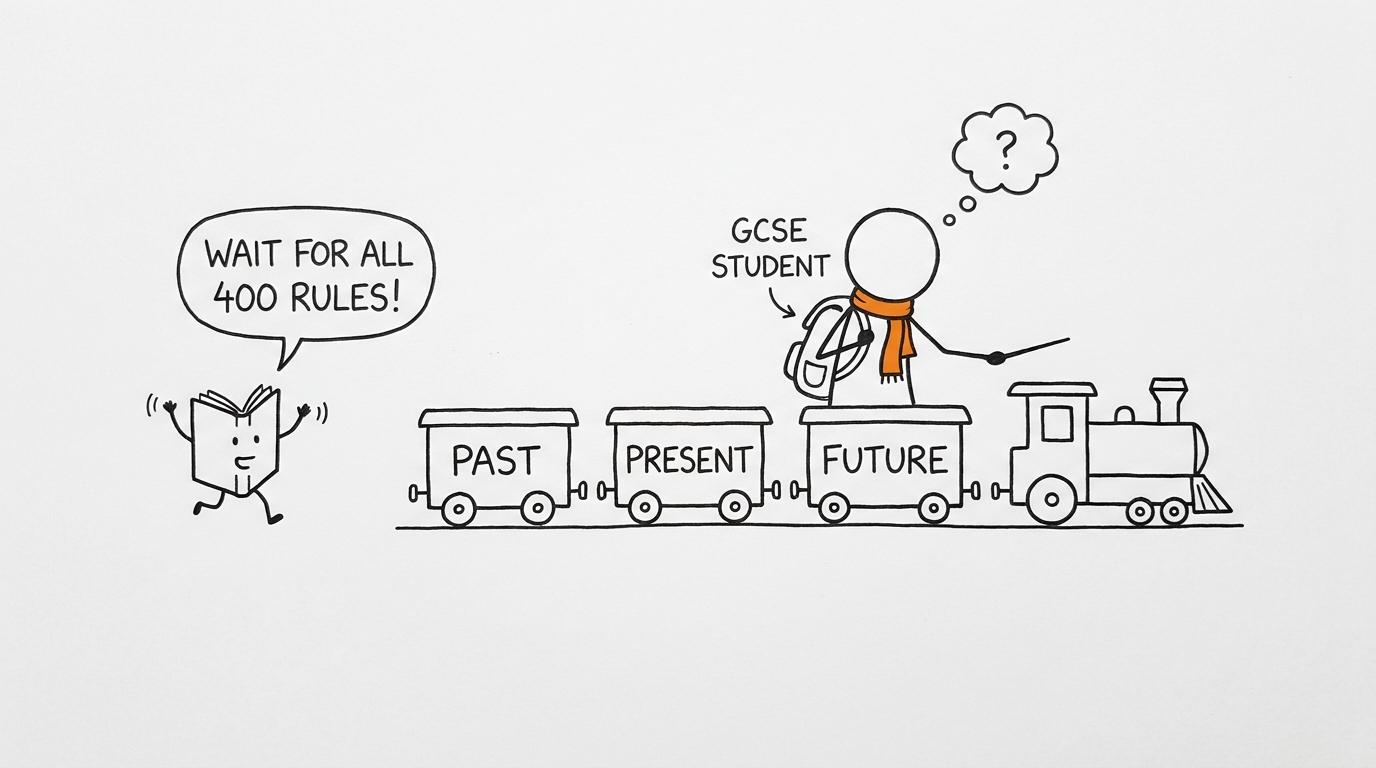 A three-carriage timeframe train escapes an enormous grammar book
Gender and adjective agreement
Arabic requires agreement between nouns and adjectives. Gender and number therefore influence the form you choose. Frequent agreement mistakes may make language sound insecure, and occasionally they obscure who or what is being described.
Start with predictable, high-frequency combinations. Check whether the noun is masculine or feminine, whether it is singular or plural, and whether the adjective follows it correctly. Non-human plural agreement deserves attention because it does not always behave as an English-speaking learner might expect.
Do not spend an entire session copying every exception. Secure agreement in the phrases you are most likely to use, then widen your range gradually.
Negatives and questions
Negation can reverse the meaning of a sentence, while question words determine what information is being requested. Both are essential for receptive and productive skills.
Learn the common negative patterns alongside the verb forms they accompany. Likewise, recognise question words for who, what, when, where, why, how and how much. In the speaking examination, misunderstanding the question often causes more damage than a small ending error in the answer.
Possession and the construct structure
Possession appears constantly in GCSE topics: family members, school facilities, local areas, personal belongings and future ambitions. You should understand common attached possessive forms and the Arabic construct structure, often called the idafa.
This is a high-return topic because it helps you create natural noun phrases without relying on repetitive sentence frames. Concentrate on correct word order, definiteness and the combinations you genuinely use.
Connectives, opinions and reasons
A response made entirely from separate short statements can communicate, but it offers limited range. Connectives let you join ideas, contrast viewpoints and explain reasons. Opinion phrases help you move from naming facts to answering the question personally.
Secure a small bank for addition, contrast, cause and consequence. The goal is not to insert an impressive connective into every sentence. It is to build a logical response in which each idea leads to the next.
This resembles strong mathematical working: an examiner should be able to follow the chain. MathsGenie’s guide to using GCSE mark schemes properly explains the same feedback principle; inspect what earned credit, identify the gap and correct it deliberately.
What Higher tier students need beyond the basics
Higher tier includes the Foundation grammar and adds further structures. The specification identifies areas such as weak nouns and a broader range of language for recognition and use. Higher-tier mark grids also expect students to manipulate vocabulary and structures with increasing accuracy and fluency.
In practice, that means you should be able to:
- move between timeframes without relying entirely on memorised paragraphs;
- adapt familiar verbs to a new person or context;
- vary sentence openings and link clauses;
- use comparisons and more developed opinions;
- recognise less familiar forms while reading or listening;
- maintain clarity when attempting more complex language.
Complexity only helps when it remains understandable. A long sentence with broken agreement, an incorrect verb and no clear message is not automatically better than two controlled sentences.
What can you afford to be shaky on?
You can be less secure on rare forms and still perform well, provided your core language is reliable. In particular, students commonly give too much revision time to exhaustive case-ending theory, uncommon broken plurals and exceptions that appear infrequently in their own communication.
The Edexcel grammar list includes the case system, while some vocalisation knowledge is marked as receptive. That does not mean endings are irrelevant. It means you should distinguish between recognition and confident production, and follow the exact expectations stated for your tier.
You can usually tolerate occasional slips when:
- the intended person and timeframe remain clear;
- the mistake does not reverse or obscure the message;
- most straightforward structures are accurate;
- you still answer every part of the task;
- errors become less frequent in familiar language.
You cannot safely ignore a rule when the error repeatedly changes meaning. Incorrect negatives, uncertain pronouns and muddled timeframes deserve attention before subtle stylistic refinements.
A practical way to revise Arabic grammar
Use a short learn-practise-check-retest cycle. It is more effective than rereading a grammar table and hoping familiarity becomes recall.
Build a personal error list
After a speaking task, translation or writing exercise, label each mistake. Useful labels include verb, timeframe, agreement, pronoun, possession, word order and spelling. When one label appears repeatedly, it becomes your next revision target.
This diagnostic approach is also central to finding weak GCSE topics. The subject may differ, but the logic does not: evidence should decide what you revise next.
Practise grammar inside exam tasks
Isolated drills help establish a form, but exam readiness requires retrieval inside a message. After revising a structure, use it in a brief speaking response, a translation sentence or a short paragraph related to a specification theme.
Then mark it against reliable teacher feedback, an official mark scheme or a model response. The MathsGenie guide to starting past papers offers a useful cross-subject lesson: begin with smaller sections, analyse mistakes and build towards full timed practice.
Revisit rather than cram
Return to the same grammar after a gap. A simple pattern is first practice, a short check two days later, and another retrieval attempt the following week. The GCSE one-month revision plan shows how spaced practice can sit alongside lessons and exam preparation without turning every evening into a marathon.
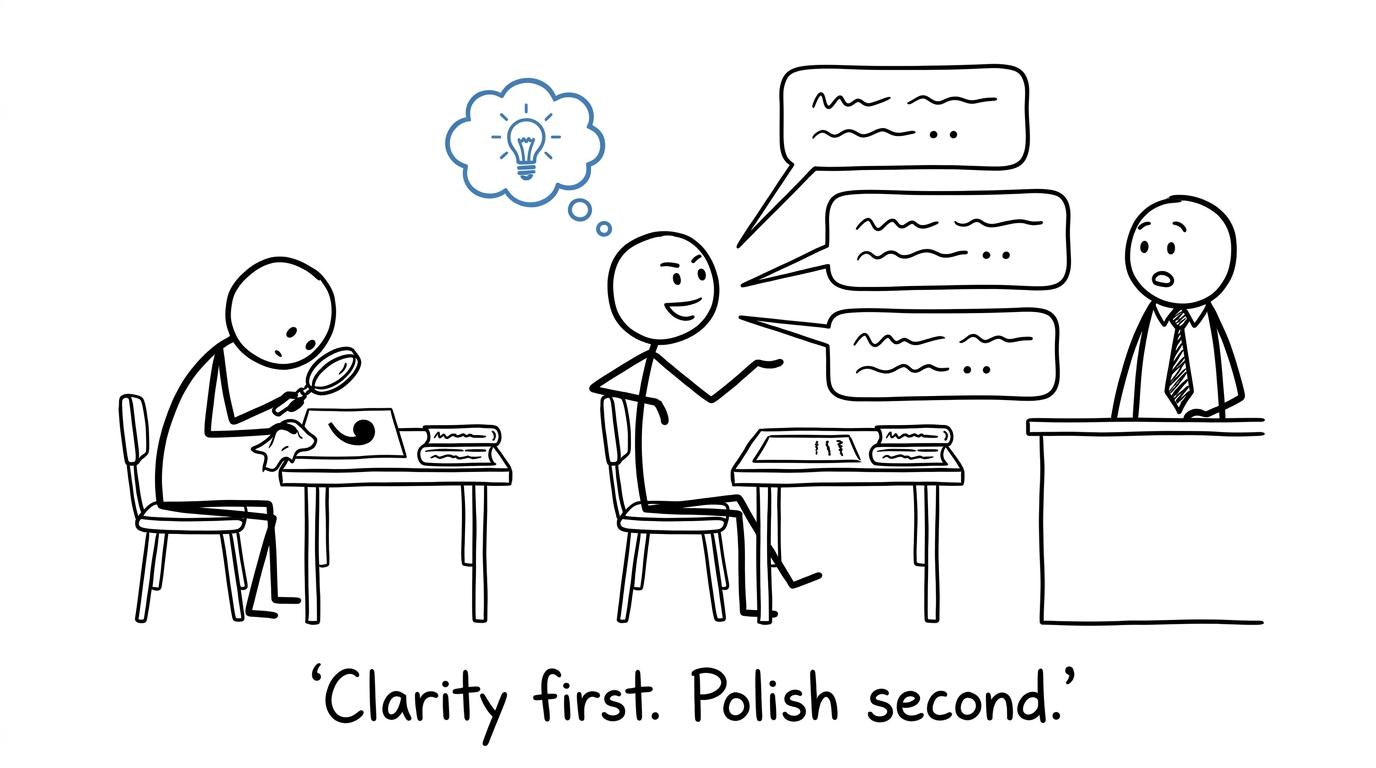 One student polishes a tiny detail while another communicates clearly
Common GCSE Arabic grammar mistakes
Memorising paragraphs without understanding them
A memorised answer may collapse when the question changes. Learn reusable sentence components and practise adapting person, tense, place and opinion.
Attempting complexity before securing meaning
Students sometimes add a difficult structure because it appears impressive. If it causes several errors, it may reduce clarity. Build from controlled language and expand only when the foundation is stable.
Revising every rule equally
Grammar is not a flat list. Pronouns, verbs, negation, timeframes and agreement affect many more responses than rare exceptions. Allocate time according to frequency, impact and your own error record.
Ignoring receptive grammar
A structure you do not plan to use may still appear in a reading or listening text. Mark receptive items separately and practise recognising the clues they provide.
Confusing GCSE with International GCSE
Pearson Edexcel GCSE Arabic and International GCSE Arabic are different qualifications. International GCSE Arabic First Language includes a distinct grammar assessment structure. Confirm the qualification code, specification and paper format with your school before using any checklist.
Focus on grammar that carries meaning
The right goal is not flawless Arabic. It is dependable Arabic: language that answers the task, moves across relevant timeframes and remains clear even when a few imperfections appear.
Secure pronouns, common verbs, negatives, questions, agreement and possession first. Add connectives and flexible structures next. If you take Higher tier, develop range and manipulation without sacrificing control. Leave rare exceptions until the grammar that repeatedly earns or loses marks is stable.
For your wider exam preparation, use MathsGenie’s free GCSE maths revision hub to combine revision lessons, practice questions, mini tests, past papers, predicted papers, mark schemes and video solutions. If Edexcel maths is also on your timetable, the Edexcel GCSE maths past papers make the same improvement loop easy: attempt, mark, diagnose, repair and retest. Good revision is rarely about learning everything at once. It is about finding the next useful weakness and fixing it properly.