

GCSE Arabic Extracurricular Club: Does It Help?
GCSE Arabic extracurricular club benefits explained: discover when group practice may improve exam skills, confidence and revision without harming maths.
There is a familiar revision problem that rarely appears on a timetable. You understand Arabic when someone else speaks, yet the words disappear when it is your turn. Or you know the vocabulary at home, but cannot retrieve it under pressure.
A GCSE Arabic extracurricular club can help with this problem, particularly by creating regular opportunities to speak, listen and receive feedback. But joining one does not automatically improve your grade. The benefit comes from what you repeatedly do there, and whether those activities match the skills assessed in your examination.
For students balancing Arabic with GCSE maths, the practical question is not simply whether the club is useful. It is whether the value of each session justifies the time it takes from other revision.
The short answer
A well-run GCSE Arabic club is likely to support your progress when it provides:
- frequent speaking and listening practice
- structured role plays and conversations
- exposure to unfamiliar voices and questions
- useful correction from a knowledgeable teacher or fluent speaker
- vocabulary retrieval rather than passive copying
- activities connected to your specification
- a welcoming environment in which mistakes are treated as feedback
It is less likely to affect your grade when sessions are mainly social, poorly attended or unrelated to the examination. A club should complement lessons, independent revision and past-paper practice. It cannot replace them.
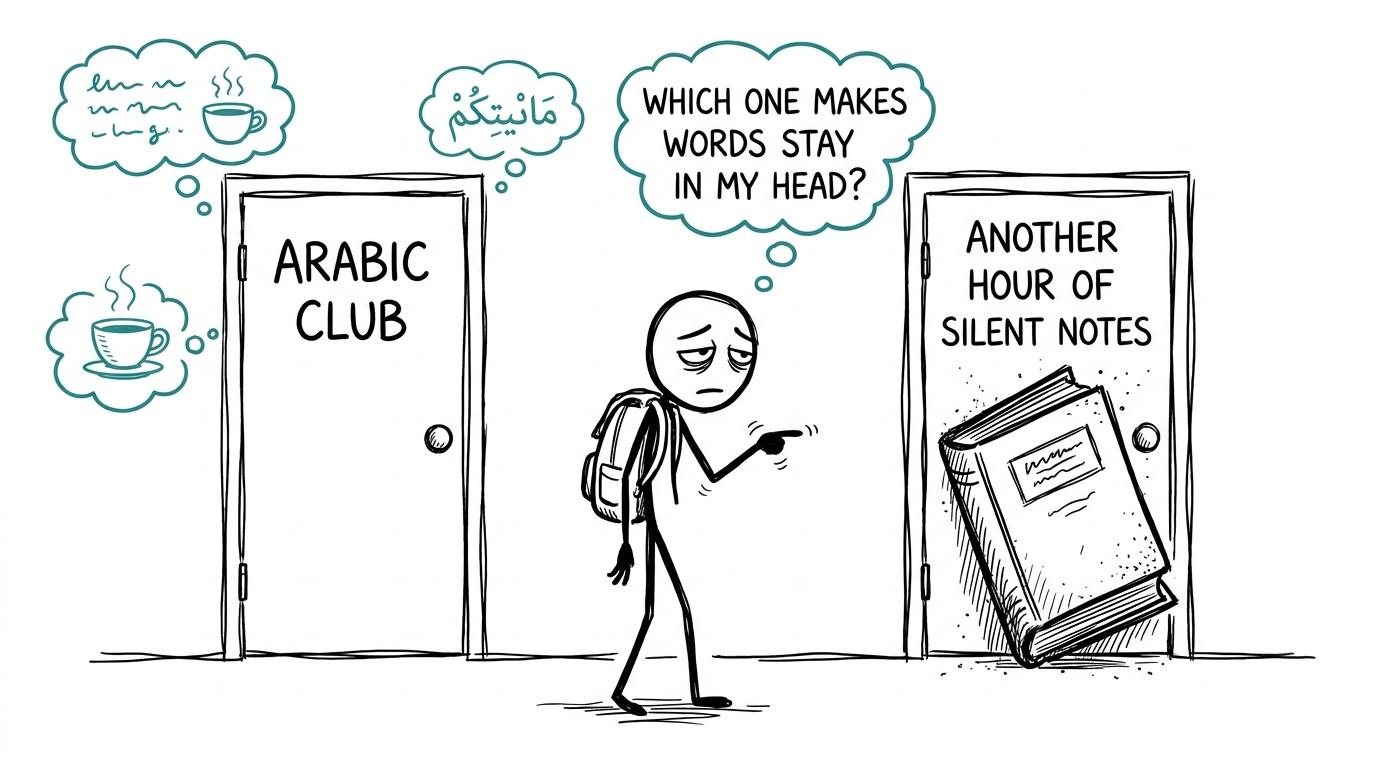 A student choosing between an Arabic club and another hour of silent notes
Why an Arabic club may improve exam performance
The strongest reason is simple: language needs to be retrieved and used. Reading a vocabulary list can make words feel familiar, but recognising a word is not the same as producing it during a conversation.
Research into extracurricular language learning, mostly involving learners of English rather than GCSE Arabic candidates, suggests that conversation clubs can provide additional speaking practice, peer interaction and opportunities to build confidence. Some studies report improved speaking performance, while others find that club membership alone does not create a statistically significant reduction in speaking anxiety.
That distinction matters. The evidence supports clubs as a potentially useful learning environment, not as a guaranteed route to a particular grade. Research from different languages, qualifications and age groups cannot prove that an Arabic club will raise every GCSE student's result.
It increases active language use
A productive club asks you to respond without scripting every sentence first. You might discuss school, family, travel or future plans; describe a picture; ask follow-up questions; or react to an unfamiliar statement.
These activities force you to retrieve vocabulary, select grammatical structures and communicate meaning in real time. That is more demanding than highlighting notes, but the difficulty is part of its value.
It can make speaking feel more normal
Speaking assessments can feel unusually exposed. You are not just remembering information; you are producing language while another person listens closely.
Regular low-stakes conversation may make this process less unfamiliar. A supportive club gives you repeated contact with pauses, forgotten words, corrections and follow-up questions. Confidence then grows from evidence: you have handled similar moments before.
However, attendance is not enough. A quiet student who listens throughout every meeting may gain useful comprehension practice but little improvement in spontaneous speaking. Participation is the mechanism.
It gives listening practice a human shape
Recorded listening exercises are essential, but live conversation adds something different. Speakers vary their speed, pronunciation and phrasing. You may need to infer meaning, ask for clarification or continue despite missing one word.
That ability to tolerate partial understanding is valuable. Students sometimes stop listening mentally after an unfamiliar phrase. Club conversation can teach a calmer response: hold on to what you understand and reconstruct the wider meaning.
Match the club to the GCSE Arabic assessment
Before judging any club, check your exact qualification and specification. GCSE Arabic is not identical to International GCSE Arabic, including first-language qualifications, and assessment arrangements can change. Your teacher and awarding body's current specification should be the final reference.
For Pearson Edexcel GCSE Arabic, the qualification assesses listening, speaking, reading and writing through four papers. Each skill contributes 25%25\%25% of the qualification, and candidates enter either foundation or higher tier across the papers.
The speaking assessment includes a role play, questions connected to a picture stimulus and a conversation. That means a club built around purposeful interaction has a clear connection to assessed skills. Yet speaking alone represents only part of the qualification. Reading, writing, translation, grammar and vocabulary still require deliberate revision.
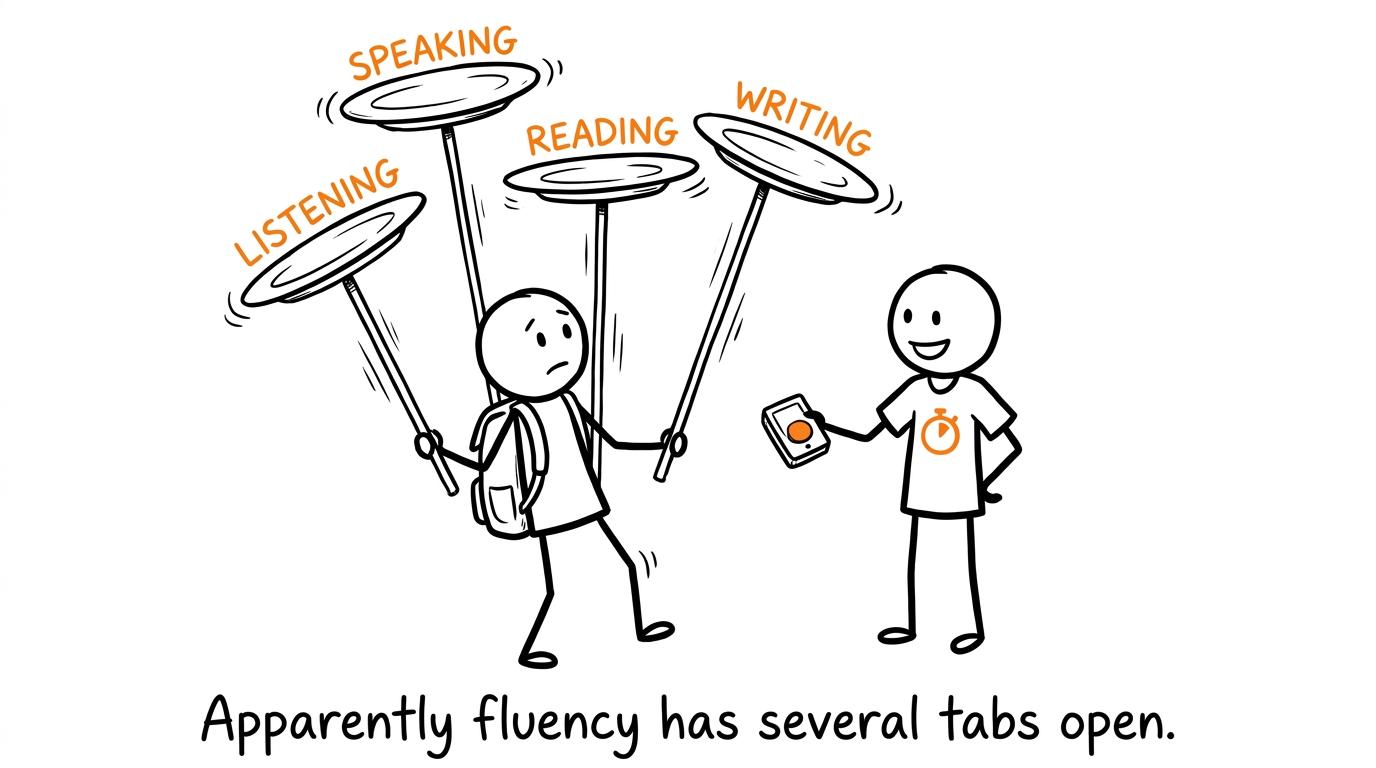 A student balancing listening, speaking, reading and writing
Questions to ask before joining
Use this checklist to decide whether a particular club is worth your time:
- Does it practise the Arabic qualification you are actually taking?
- Are activities linked to specification themes and speaking tasks?
- Will every student speak regularly?
- Is accurate, constructive feedback available?
- Are reading and writing included occasionally?
- Can you attend consistently without losing essential revision elsewhere?
- Does the atmosphere make thoughtful risk-taking possible?
A club does not need to resemble another formal lesson. Games, debates and cultural activities can make language memorable. But there should still be a bridge between participation and the skills you need in the exam.
Turn attendance into measurable progress
The grade benefit depends less on possessing club membership and more on using the session deliberately. Arrive with one small target, such as using a wider range of time frames, extending answers or asking follow-up questions.
Afterwards, record:
- vocabulary you tried to use but could not retrieve
- one grammatical correction
- one phrase that helped you sustain conversation
- one topic that needs independent revision
You can also track a simple speaking score over time. Rate your retrieval, accuracy, range and interaction using the same scale after comparable activities. The individual score is not an official grade; its purpose is to make improvement visible.
A useful measure is:
participation rate=sessions attended and used activelysessions available×100%\text{participation rate} = \frac{\text{sessions attended and used actively}}{\text{sessions available}} \times 100\%participation rate=sessions availablesessions attended and used actively×100%The phrase “used actively” is important. Turning up while avoiding every speaking task produces a misleading attendance figure.
Revisit club material independently
Within a day or two, retrieve the new language without looking at your notes. Say a short response aloud, write several accurate sentences or test the vocabulary in both directions. Later, apply it to an exam-style task.
This closes the loop:
club practice⟶feedback⟶independent retrieval⟶exam practice\text{club practice} \longrightarrow \text{feedback} \longrightarrow \text{independent retrieval} \longrightarrow \text{exam practice}club practice⟶feedback⟶independent retrieval⟶exam practiceWithout that final step, enjoyable conversation may remain disconnected from the accuracy and task completion rewarded by a mark scheme.
Balance Arabic club with GCSE maths revision
A weekly club creates a fixed commitment. This can be helpful because it removes the decision about when to practise Arabic, but it also reduces the time available for maths and other subjects.
Begin with the GCSE maths revision hub, where you can select resources for boards including Edexcel, AQA, OCR and Eduqas. Your Arabic qualification and maths qualification may have different awarding bodies, so check each separately rather than assuming they match.
Build the club into a realistic plan rather than placing it on top of an already full week. The GCSE revision timetable guide explains how to plan specific tasks, protect catch-up time and combine learning with questions and marking.
On busy school days, a shorter session can preserve maths momentum. The 20-minute maths revision routine is useful when club attendance leaves little energy for a full paper. One focused topic, immediate marking and a clear correction are better than an ambitious session that never begins.
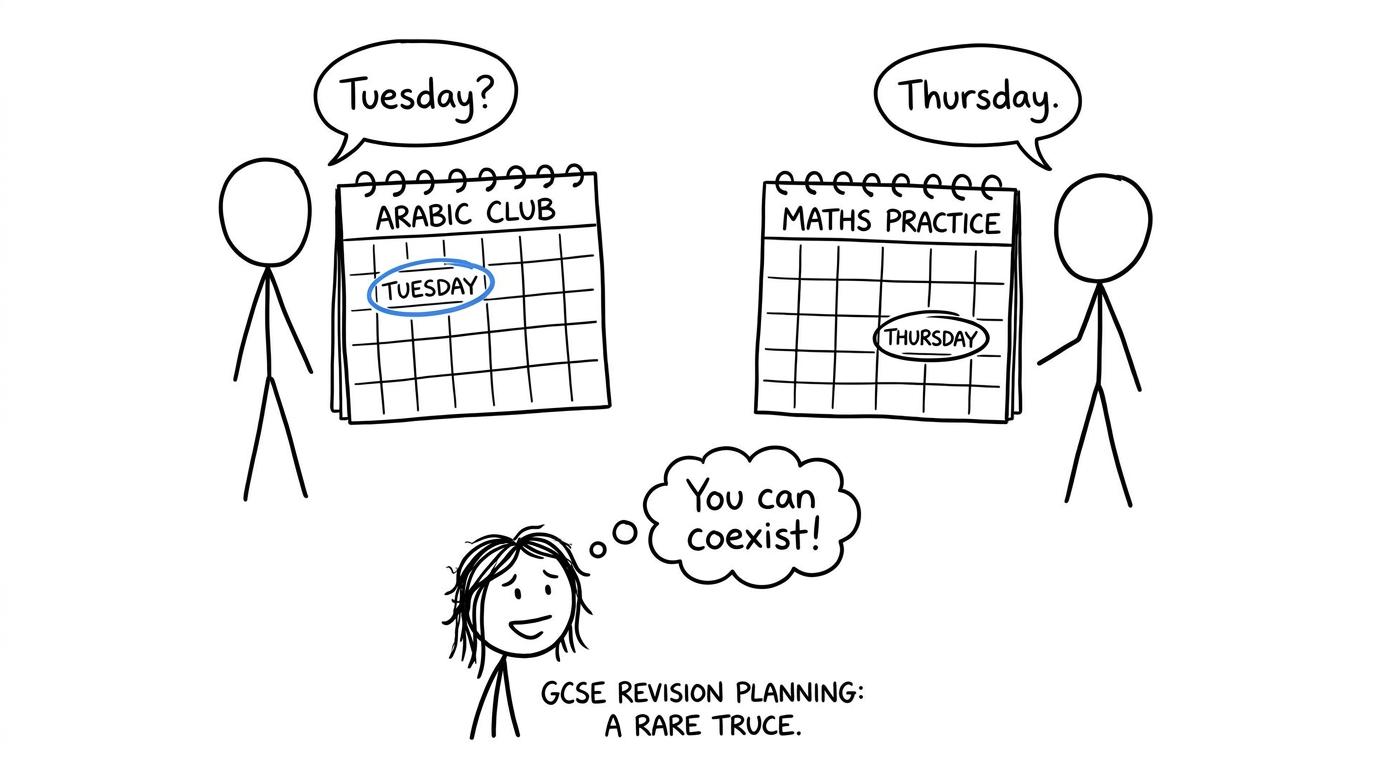 Arabic club and maths revision discovering that they can share a calendar
Protect the subjects where marks are being lost
Do not divide revision time equally merely because equality feels tidy. Use evidence. Complete suitable maths assessments, mark them carefully and identify where marks disappear. The guide to finding your weakest GCSE topics provides a practical diagnostic process.
If a club session causes you to miss essential foundation or higher-tier maths practice every week, reconsider the timetable. You might attend less frequently, shorten travel time by creating a school-based conversation group, or protect a maths session elsewhere.
The aim is not to choose between Arabic and maths. It is to give each subject the kind of practice it needs.
When a GCSE Arabic extracurricular club may not help
A club may offer limited academic value if:
- most meetings happen in English
- confident speakers dominate every activity
- correction is absent or unreliable
- tasks are disconnected from the specification
- you attend irregularly
- it replaces reading, writing and past-paper practice
- the timetable creates exhaustion or persistent missed work
There is also an opportunity-cost question. During the months closest to the exams, an unstructured club session may be less valuable than a carefully chosen past-paper task. This does not make the club bad. It means the best use of time changes as the examination approaches.
Common mistakes when using a language club for revision
Assuming membership earns marks
An examiner cannot award marks for attendance. Marks come from demonstrated listening, speaking, reading and writing. Treat each meeting as practice, not proof of progress.
Speaking only with close friends
Comfort helps participation, but always using the same partner makes conversation predictable. Rotate partners where possible and practise responding to different voices and question styles.
Avoiding correction to protect confidence
Encouragement matters, but repeated errors can become habits. Ask for focused correction rather than correction of every sentence. One recurring grammar issue per session is manageable.
Neglecting the non-speaking papers
Conversation is valuable, but it does not replace reading comprehension, translation or extended writing. Keep a balanced plan based on your current specification and teacher feedback.
Letting the club disrupt maths practice
Do not respond to a busy week by abandoning maths completely. Use a mini test, targeted questions or a short revision lesson. When you move to complete papers, follow the past-paper revision process: sit the paper, mark it, diagnose errors, repair topics and retest.
The verdict: join for practice, not for the label
A GCSE Arabic extracurricular club can genuinely support your grade when it creates regular, active and specification-relevant practice. Its clearest advantages are likely to be additional speaking, listening, feedback and confidence through familiarity. But no responsible conclusion can promise a grade increase from membership alone.
Choose the club if it improves the quality of your Arabic practice without displacing more urgent work. Participate actively, record corrections and connect each session to independent exam preparation.
Then keep your maths revision equally deliberate. Use MathsGenie's free revision lessons and practice questions to repair individual topics, mini tests to check progress, and past papers or predicted papers to rehearse under pressure. Mark schemes and video solutions show where marks are earned, while the revision planner helps the work fit around school, Arabic club and everything else competing for your attention.
Start at the MathsGenie GCSE maths revision hub, or explore Edexcel A Level maths past papers if you are preparing for the next stage. A club can provide the conversation. A consistent revision system turns your remaining time into marks.











