

Gamify Revision GCSE Economics: Does It Work?
Gamify revision GCSE Economics effectively: discover when points, streaks and rewards support retrieval, exam practice and quantitative skills or distract you.
Revision apps are very good at celebrating activity. A cheerful badge appears. A streak survives another day. Your total rises. Yet the question that matters is quieter: could you now explain inflation, interpret the graph or calculate the percentage change without help?
If you want to gamify revision GCSE Economics, the short answer is yes; it can help you begin, persist and see progress. But points and streaks do not create learning by themselves. Gamification works best when it rewards effective revision behaviours such as retrieval, application, correction and timed exam practice. If it merely rewards opening an app or rereading notes, it becomes a pleasant distraction.
That distinction matters for students balancing Economics with GCSE Maths. Economics requires secure knowledge, extended reasoning and quantitative skills. The game should serve those demands, not replace them.
The quick verdict on gamified Economics revision
A useful system should pass this checklist:
- Points reward learning, not screen time.
- Questions require recall before notes are opened.
- Feedback follows each attempt.
- Mistakes are corrected and revisited.
- Challenges include calculations, graphs and written analysis.
- Progress means improved marks or stronger recall.
- Rewards remain small enough that revision stays the main event.
Research reviews generally find that gamification can improve motivation, participation and engagement. The effect on academic performance is more variable and depends on how the activity is designed. Recent controlled research has also found that points and progress displays can make retrieval practice feel more enjoyable without necessarily improving delayed recall.
In other words, the game can make you more willing to train. The training still has to be good.
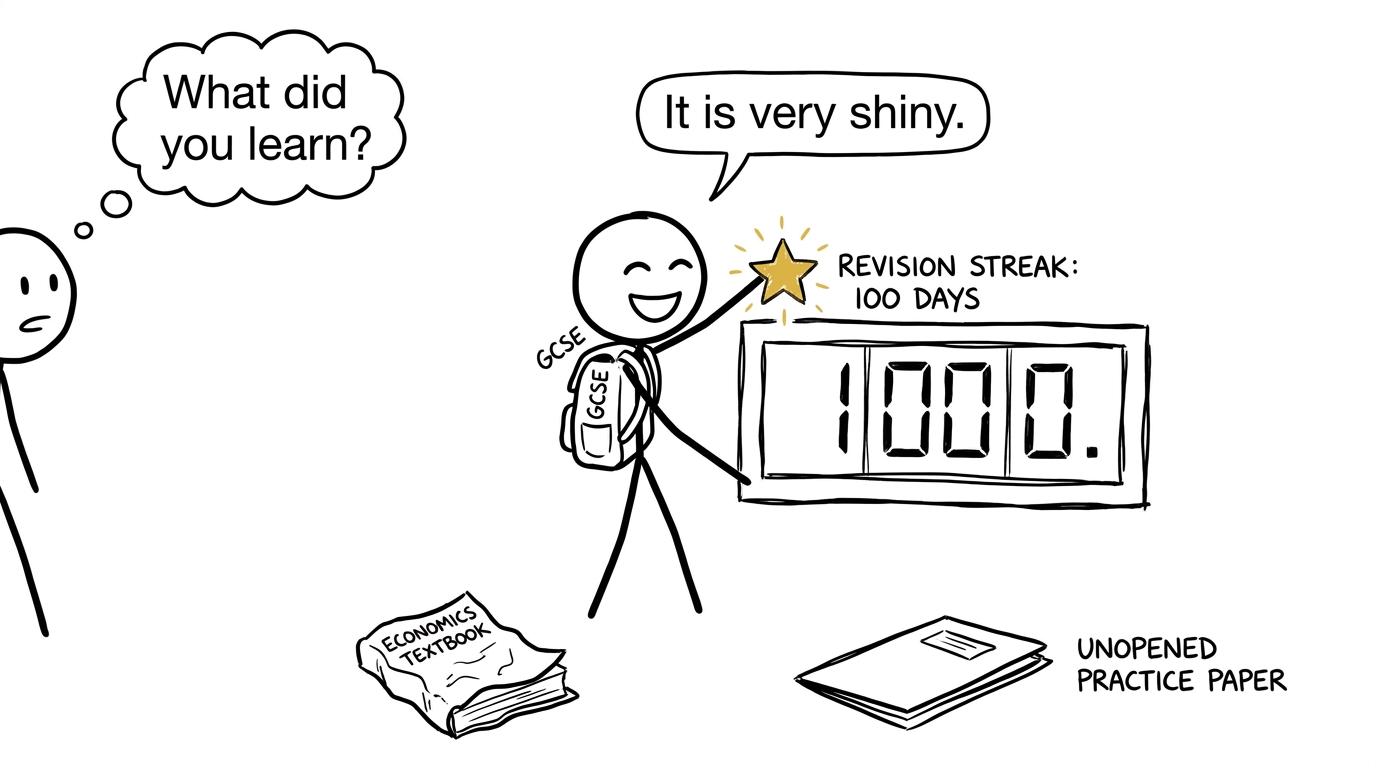 A student admires a shiny revision streak while the practice paper waits
Why points and streaks can help
Revision has a delayed reward. You complete a difficult session today, but the real benefit may not become visible until a mock exam weeks later. Games shorten that feedback loop.
A point, progress bar or completed mission gives immediate evidence that something happened. This can reduce the friction of starting, particularly when the alternative is an undefined instruction such as “revise Economics”. A challenge to retrieve ten definitions or complete one timed data-response question is clearer.
Streaks support consistency
A streak can turn revision into a regular appointment. That is useful because knowledge needs to be revisited after delays rather than encountered once in a long session.
However, streaks are measures of attendance, not mastery. Protecting a streak by answering one effortless question may preserve the symbol while doing little for your exam preparation. Define a valid day as a short but meaningful session involving recall, application and checking.
You can place these sessions into the free MathsGenie revision planner, especially if you are coordinating Economics revision with GCSE Maths practice.
Points make progress visible
Points are helpful when they represent behaviours that are otherwise easy to neglect. You might award credit for:
- answering from memory;
- using economic context in an explanation;
- interpreting evidence from a graph;
- marking a response honestly;
- correcting an error;
- returning to a weak topic after several days.
Do not give the largest reward for completing the easiest task. Otherwise, your rational response is to farm easy points. That may be excellent game strategy, but it is poor revision strategy.
Levels can organise a large specification
Economics can feel like a collection of disconnected terms until the relationships become visible. Levels can provide structure: foundational concepts first, then application, analysis and evaluation.
A topic is not “complete” because you watched a video or highlighted a page. Advancement should require evidence. Can you define the concept, apply it to a context, interpret relevant data and make a supported judgement? The level should unlock only when those skills are reasonably secure.
What GCSE Economics actually requires
Gamification must match the assessment. For AQA and OCR GCSE Economics, the assessment objectives cover knowledge and understanding, application, and analysis and evaluation. The qualifications are not divided into foundation and higher tiers as GCSE Maths is, so every student needs to develop the full range of economic reasoning required by their specification.
Official GCSE Economics requirements also state that at least 10%10\%10% of the total marks must reward quantitative skills. These include:
- percentages and percentage changes;
- averages, including average cost;
- totals such as revenue, cost and profit;
- gross and net income;
- constructing graphs from data;
- interpreting graphs, charts and economic data.
The percentage-change relationship is:
Percentage change=new value−original valueoriginal value×100%\text{Percentage change}=\frac{\text{new value}-\text{original value}}{\text{original value}}\times 100\%Percentage change=original valuenew value−original value×100%Revenue and profit require the relationships:
Total revenue=price×quantity\text{Total revenue}=\text{price}\times\text{quantity}Total revenue=price×quantity Profit=total revenue−total cost\text{Profit}=\text{total revenue}-\text{total cost}Profit=total revenue−total costKnowing the formula is only the beginning. You must select it in context, calculate accurately and interpret what the result means economically.
MathsGenie can support this quantitative foundation through its free GCSE percentages revision lesson, AQA percentage practice questions and GCSE Statistics revision hub. Always use your Economics specification and Economics past papers for the subject content and question style.
How to gamify revision GCSE Economics properly
The strongest system is simple enough to maintain and demanding enough to expose gaps.
Build missions around retrieval
Begin with closed-book recall. Define a term, sketch a causal chain, label a supply-and-demand diagram from memory or list factors that could affect a market. Open your notes only after making a genuine attempt.
Retrieval practice is supported by substantial educational evidence, but challenge and feedback matter. Questions that are permanently easy can inflate confidence. Incorrect answers left unchecked can reinforce misconceptions.
Give points for the attempt, but award completion only after checking and correcting it.
Add application and evaluation quests
Economics is not a vocabulary contest. A student may remember a definition yet struggle to apply it to a business, household or government decision.
Your missions should therefore progress through different demands:
- Recall: retrieve the concept accurately.
- Application: connect it to the information provided.
- Analysis: explain a developed chain of effects.
- Evaluation: weigh evidence, consider limitations and reach a supported conclusion.
A successful system does not let hundreds of definition points disguise weak extended responses.
Turn mistakes into the main currency
Most games punish failure. Good revision should use it.
Create a mistake log with the topic, marks lost, reason and next action. Award more credit for repairing a misconception than for repeating an already-secure question. MathsGenie’s guide to finding your weakest GCSE topics explains how lost marks can guide the next revision task.
For your supporting maths skills, the GCSE Maths self-assessment sheet can reveal whether percentages, ratio, graphs or averages need attention.
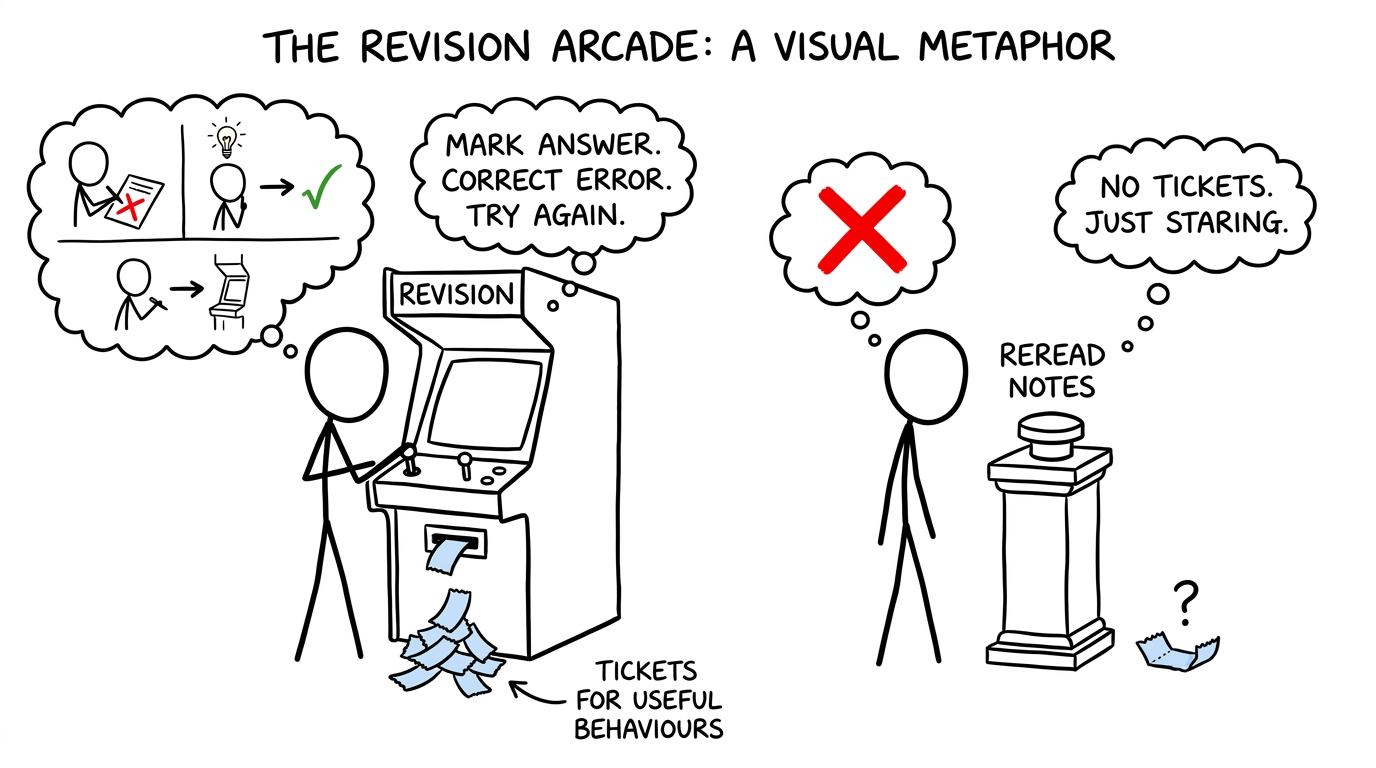 A revision arcade rewards marking, correcting and trying again
Use personal bests instead of public leaderboards
Leaderboards can motivate some students, but comparison can become the entire activity. They are also unfair when students begin from different starting points or have different amounts of available revision time.
Compete against useful personal measures instead:
- marks on comparable question sets;
- definitions accurately recalled after a delay;
- calculation accuracy;
- completed corrections;
- time used without sacrificing answer quality.
The best opponent is usually your previous performance. A practical GCSE maths revision timetable can help you schedule these checks without allowing one subject to consume the week.
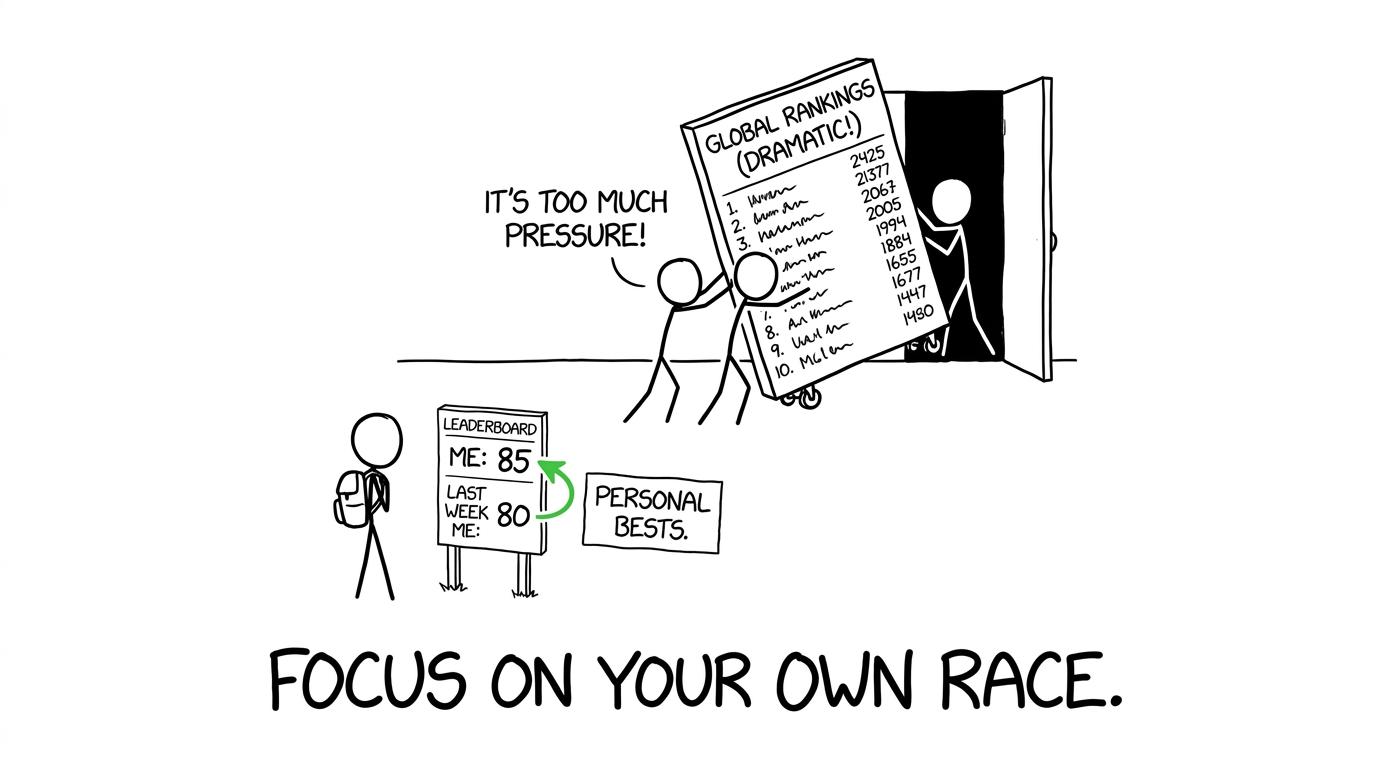 A student competes against last week's self while the public leaderboard is removed
When rewards become a distraction
Gamification fails when the visible metric replaces the real objective. Warning signs include:
- choosing only easy quizzes because they produce faster points;
- feeling unable to revise when a device or app is unavailable;
- spending more time designing the system than answering questions;
- protecting a streak with token activity;
- remembering badge names but not economic concepts;
- measuring minutes instead of improvement;
- abandoning longer written responses because they offer slower feedback.
A useful test is to remove the game layer temporarily. Complete an unseen question without hints, notes or instant celebration. If your performance has improved, the system is supporting learning. If only the points total has risen, redesign it.
Common mistakes when gamifying revision
Rewarding completion rather than quality
Finishing a quiz is not the same as understanding it. Require marking, correction and a later re-test before granting full credit.
Making every task competitive
Competition can add energy, but it can also encourage rushing and anxiety. Keep most targets private and based on mastery.
Revising only short factual questions
Quick quizzes suit definitions but cannot fully prepare you for application, analysis and evaluation. Include written responses, calculations and interpretation of economic evidence.
Ignoring the mark scheme
A score without feedback says where you finished, not how to improve. Compare your response with the mark scheme, identify the missing element and rewrite the weak section.
Creating an impossible streak
A rigid daily target can collapse during illness, school deadlines or family commitments. Use a modest minimum and a planned recovery rule. The aim is consistency over time, not perfection. If exams are close, MathsGenie’s one-month GCSE revision plan offers a practical structure that can be adapted around your Economics timetable.
Make the game answer to the exam
The useful question is not whether revision feels like a game. It is whether the game repeatedly sends you towards the work that earns marks.
Use streaks to begin. Use points to reward retrieval and correction. Use levels to organise the specification. Then test the result with closed-book questions, timed responses and honest marking. Motivation opens the door; purposeful practice moves you through it.
MathsGenie is the go-to free resource for strengthening the maths beneath GCSE Economics and preparing for GCSE and A Level Maths. Use the MathsGenie revision platform for revision lessons, practice questions, mini tests, past papers, predicted papers, mark schemes and video solutions. Build those resources into your missions, record the marks you recover and let your progress, not a decorative badge, be the reward that matters.











