Foundation or Higher GCSE Spanish: How to Choose
Foundation or higher GCSE Spanish? Compare grade ranges, current performance and exam evidence to choose the tier offering your strongest realistic result.
Choosing a tier can feel strangely final. One option looks safer; the other keeps the highest grades open. Yet the real question is not which paper sounds more impressive. It is which paper gives your current Spanish the best chance to earn the grade you need.
If you are deciding between foundation or higher GCSE Spanish, start with three facts. Foundation offers grades 111 to 555. Higher offers grades 444 to 999, with only a narrow grade 333 safety net for students who narrowly miss grade 444. You must take listening, speaking, reading and writing at the same tier. Your decision should therefore be based on repeatable performance across all four skills, not one excellent lesson or one difficult mock.
Your school makes the final entry, but you should understand the evidence behind it. That turns the conversation from “Which tier do I want?” into the more useful question: “Where am I realistically sitting now, and what can I reliably improve before the entry deadline?”
The quick decision checklist
Use this overview before looking at the detail:
- Choose Foundation if your priority is securing grades 111 to 555, your recent performance is mainly below grade 666, or Higher materials regularly prevent you from showing what you know.
- Consider Higher if you need grade 666 or above and your timed assessments show that grade 444 or 555 performance is already secure.
- Judge all four skills: listening, speaking, reading and writing.
- Use several recent assessments completed under realistic conditions.
- Check the current specification and sample materials for your actual board, such as AQA, Pearson Edexcel or Eduqas.
- Discuss your evidence, target grade and remaining revision time with your Spanish teacher.
This is similar to choosing a GCSE maths tier, although the skills being measured are different. MathsGenie’s guide to Foundation versus Higher GCSE Maths explains the same underlying principle: tier choice should follow evidence rather than pride or fear.
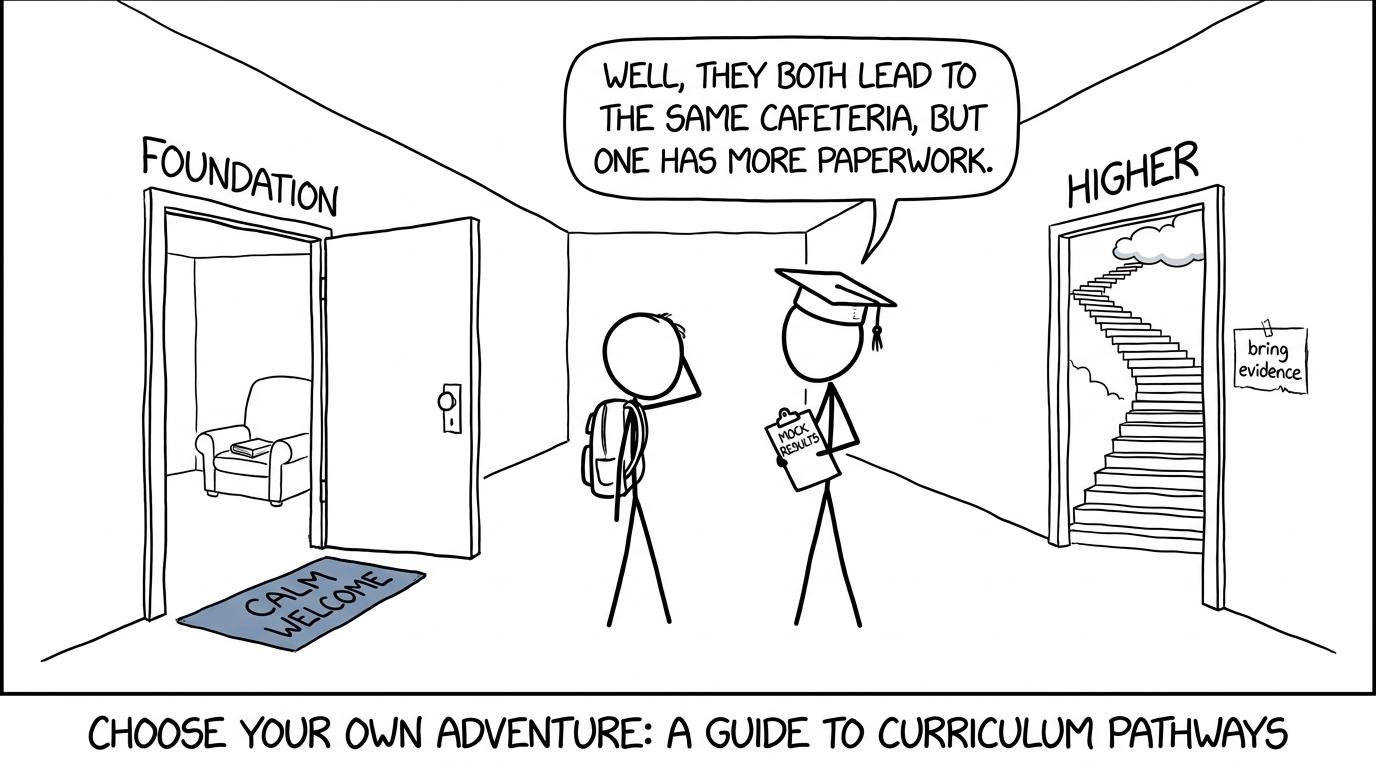 A student choosing between Foundation and Higher doors while a teacher asks for evidence
What Foundation and Higher GCSE Spanish offer
For the reformed GCSE Spanish specifications first awarded in summer 202620262026, Foundation tier makes grades 111 to 555 available. Higher tier normally makes grades 444 to 999 available. A student taking Higher who falls just below grade 444 may receive an allowed grade 333, but this is a narrow safety net. Falling below it results in an unclassified result.
That risk matters. Higher is not simply Foundation with an opportunity to collect bonus marks. It expects students to understand and produce language of greater complexity. Official subject content also specifies 1,2001{,}2001,200 lexical items for Foundation and a further 500500500 for Higher, alongside additional Higher-tier grammar.
Foundation is not a lesser qualification. A grade 555 achieved on Foundation has the same value as a grade 555 achieved on Higher, and the certificate does not show the tier entered. Ofqual also requires grades 444 and 555 to be comparable across the two tiers.
The limitation is the ceiling. If you need grade 666 or above for a sixth-form course or personal target, Foundation cannot provide it. Before treating that as a reason to choose Higher, however, confirm the entry requirements directly with the school or college concerned.
One tier covers all four skills
Current GCSE Spanish courses assess listening, speaking, reading and writing. Each skill contributes 25%25\%25% of the qualification, although the precise paper structure, timings and task styles vary between exam boards.
You cannot choose Foundation listening and Higher writing. All assessments must be entered at one tier. That means a strong speaking performance cannot, by itself, settle the decision if Higher listening and reading remain inaccessible.
Check your exact specification rather than relying on resources labelled only “GCSE Spanish”. AQA and Pearson Edexcel introduced revised specifications for first assessment in 202620262026, while students following another board or resitting an earlier specification may encounter different task formats.
Decide from where you are realistically sitting now
Tier decisions become unreliable when they are based on identity. “I am a Higher student” and “I am bad at languages” are both stories. Neither is evidence.
Build a small set of recent results instead. Include:
- a timed listening assessment;
- a timed reading assessment;
- teacher-assessed speaking evidence;
- a writing task marked against the correct criteria;
- at least one complete or substantial assessment using your board’s current materials.
Look for a pattern. One unusually high mark may reflect a familiar topic. One unusually low mark may reflect illness, panic or unfinished revision. Your realistic level is the range you reproduce, not your best or worst afternoon.
Maths students already meet this idea when using GCSE maths mini tests. A short test is useful because it diagnoses a skill; several tests reveal whether that skill is stable. Apply the same discipline to Spanish.
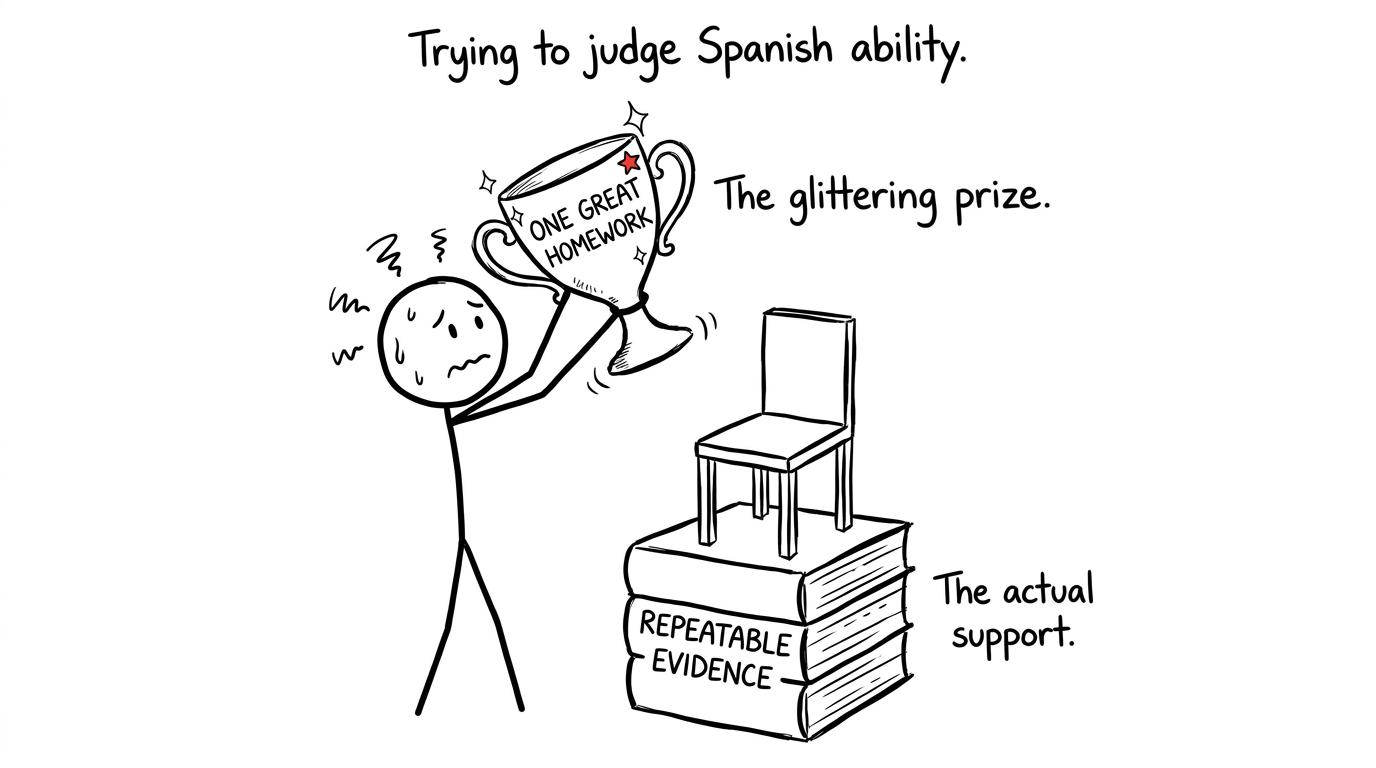 One impressive homework trophy competing with a stack of repeatable timed evidence
When Foundation is probably the better choice
Foundation is likely to be sensible when your evidence repeatedly points towards grades 111 to 555 and your main goal is to secure the strongest grade within that range.
It may also suit you if Higher listening and reading contain long stretches where you cannot identify enough language to answer, or if Higher writing prompts demand structures you cannot yet use accurately without notes. A paper that lets you attempt more questions can provide a better opportunity to demonstrate your knowledge.
Ofqual’s 202620262026 guidance says that students expected to achieve grade 444 or 555 should be entered for Foundation. This reflects the risk at the bottom of Higher and the fact that grades 444 and 555 are equally valid on either tier. Your school will still consider your trajectory, target and subject-specific evidence.
Choosing Foundation is therefore not “giving up”. It can be a rational decision to reduce unnecessary difficulty, improve completion and maximise the chance of a secure result.
When Higher is realistically justified
Higher becomes necessary if your target is grade 666 to 999. Wanting one of those grades is only the first condition, though. Your current work should also show a secure base.
Evidence for Higher might include:
- consistent grade 555 or stronger performance on current-specification assessments;
- enough comprehension to attempt most Higher listening and reading questions;
- accurate use of several time frames in speaking and writing;
- an ability to develop responses rather than relying only on memorised sentences;
- a realistic improvement plan supported by your teacher.
A student hovering around the grade 444 boundary needs particular care. Higher preserves access to grades above 555, but it also carries the possibility of a U if performance falls below the narrow grade 333 safety net. Foundation may offer a clearer route to a secure grade 444 or 555.
Use a four-skill audit rather than an overall feeling
An overall mock grade can hide the reason behind it. Break your evidence into four columns and record your current strengths, recurring errors and next action for each skill.
Listening and reading
Ask whether you can identify opinions, time references, negatives and changes of speaker. On Higher, you must cope with greater linguistic complexity. If you understand isolated words but regularly miss the overall message, record that honestly.
Speaking and writing
Check whether your answers communicate clearly and accurately without being reconstructed by the teacher. Higher performance requires more than length. Control of vocabulary, grammar and developed communication matters.
Do not let a memorised speaking answer create false confidence. Examinations include unprepared interaction, and current specifications include tasks such as reading aloud alongside conversation. Your evidence should show that you can respond when the wording or context changes.
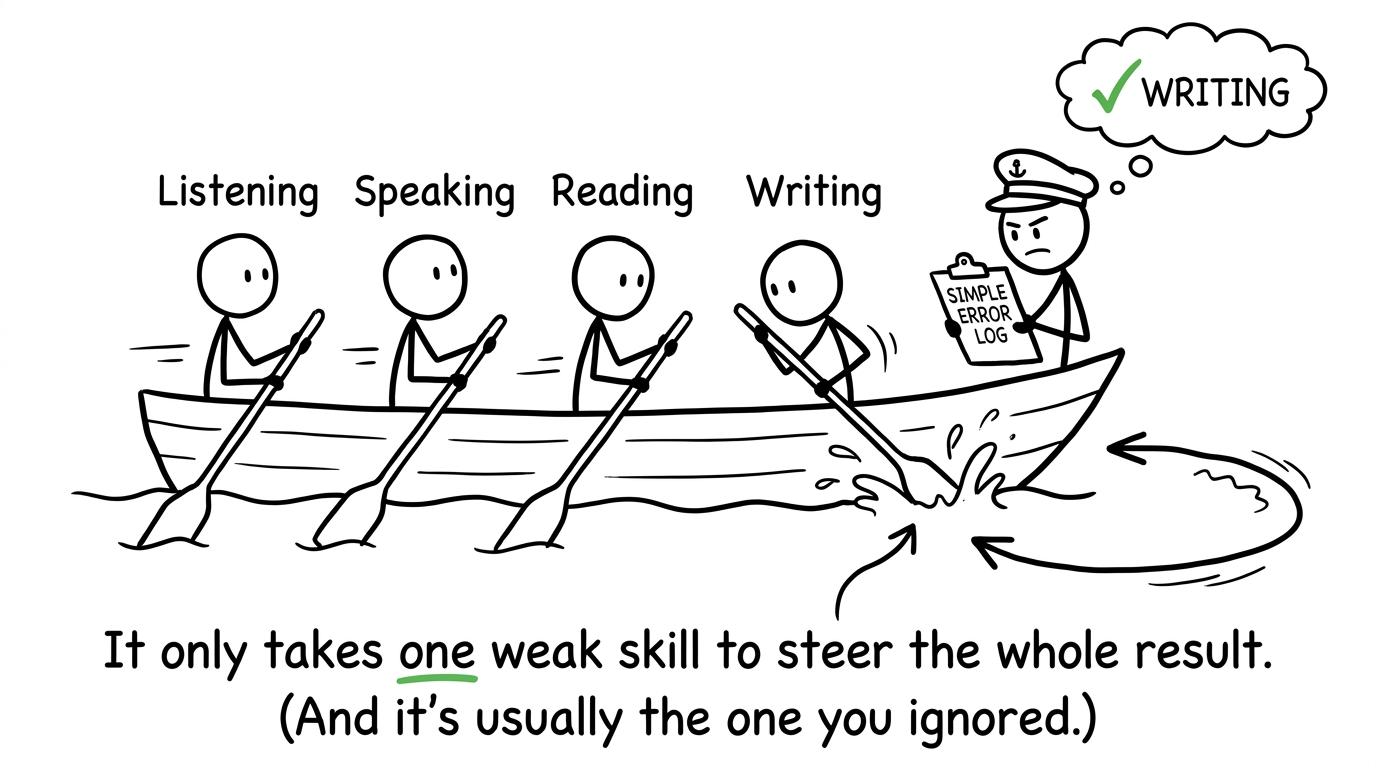 Listening, speaking, reading and writing rowing the same revision boat
Run a fair tier trial
If the decision remains close, agree a short trial period with your teacher. Use current, board-specific Foundation and Higher materials, under similar conditions, over more than one sitting.
Do not compare raw marks from unrelated papers as though they have identical difficulty. Grade boundaries vary by board, tier and examination series, and future boundaries are not known before the papers are marked. MathsGenie’s Eduqas GCSE Spanish grade boundaries illustrate how historical boundaries can change; they provide context, not a guaranteed target for a future series.
After each trial, record:
- questions left blank;
- mistakes caused by missing vocabulary;
- mistakes caused by grammar;
- misunderstood instructions;
- timing problems;
- marks that could realistically be recovered.
Then ask a practical question: does Higher reveal skills that are nearly secure, or does it consume time without producing enough successful responses? The answer is more useful than the percentage alone.
The broader paper-review method in how to use past papers properly is written for maths, but its diagnose / fix / retest cycle transfers well to language revision. You can also use the phased approach in when to start GCSE past papers to avoid using every complete assessment too early.
Common mistakes when choosing a Spanish tier
Choosing Higher because it sounds more impressive
Your certificate does not record the tier. A secure grade 555 from Foundation is not worth less than grade 555 from Higher.
Choosing Foundation because one Higher paper felt difficult
Higher papers are supposed to contain demanding material. One uncomfortable assessment does not settle the decision. Look for repeated outcomes across several tasks.
Using old or mismatched papers without checking
Specifications and task formats change. Confirm the exam board, specification and assessment year before treating a result as diagnostic evidence.
Looking only at the total mark
A similar total can conceal very different problems. Missing vocabulary needs a different response from poor timing or inaccurate verb formation.
Treating grade boundaries as fixed targets
Boundaries are set for each examination series. Historical figures help you interpret performance, but they cannot tell you exactly what a future grade will require.
Ignoring the remaining time
A gap that is manageable early in the course may be unrealistic shortly before the speaking assessment. Use a dated plan rather than an optimistic promise. MathsGenie’s one-month GCSE revision plan offers a useful model for turning weaknesses into scheduled, measurable actions.
Make the decision, then revise for the paper you will sit
Once your tier is confirmed, stop revising for an imaginary alternative. Use the vocabulary, grammar and task formats specified for your board. Practise all four skills, mark work carefully and return to errors after a short gap.
The principle is familiar from MathsGenie’s GCSE revision hub: learn the required content, answer appropriate questions, inspect the mark scheme and retest the weaknesses that cost marks. For maths revision, you can then build confidence with GCSE predicted papers, past papers, revision lessons, practice questions and video solutions.
Your Spanish tier should not be chosen by ego, panic or a single score. Choose it from your current evidence, the grade you genuinely need and the progress you can realistically make. Speak to your teacher with that evidence in front of you. Then commit to the decision and prepare deliberately.
For your GCSE maths alongside Spanish, start with MathsGenie’s free revision lessons and practice questions, use mini tests to expose gaps, and finish with past papers, mark schemes, video solutions and predicted papers. The subject changes. The reliable revision habit does not.