Foundation or Higher GCSE Russian: How to Choose
Foundation or higher GCSE Russian? Use mock evidence, grade aims and skill-by-skill results to choose the tier that fits your current level realistically.
Choosing a tier can feel strangely personal. Higher sounds ambitious; Foundation can sound cautious. Yet the question foundation or higher GCSE Russian is not really about confidence, status or what your friends are doing. It is about where your Russian is reliably sitting now.
The short answer is this: choose Foundation if your realistic aim is grades 111 to 555 and Higher if you have consistent evidence that you can secure at least grade 444 while working towards grade 666 or above. If you are hovering around grades 444 or 555, Foundation is often the safer entry because those grades are designed to be comparable across both tiers.
Your school makes the final entry, so discuss the evidence with your Russian teacher before the deadline. But you should understand that evidence too.
Your tier decision checklist
Before choosing, ask:
- What grade do I repeatedly achieve under timed conditions?
- Is my target above grade 555?
- Are listening, speaking, reading and writing reasonably balanced?
- Can I cope with Higher material without leaving large parts unanswered?
- Was my latest result typical, or unusually good or bad?
- What does my teacher recommend after seeing several assessments?
- How much focused revision time remains before the entry decision?
The same discipline helps when choosing between Foundation and Higher GCSE Maths: use repeated evidence, not the emotional afterglow of one mock.
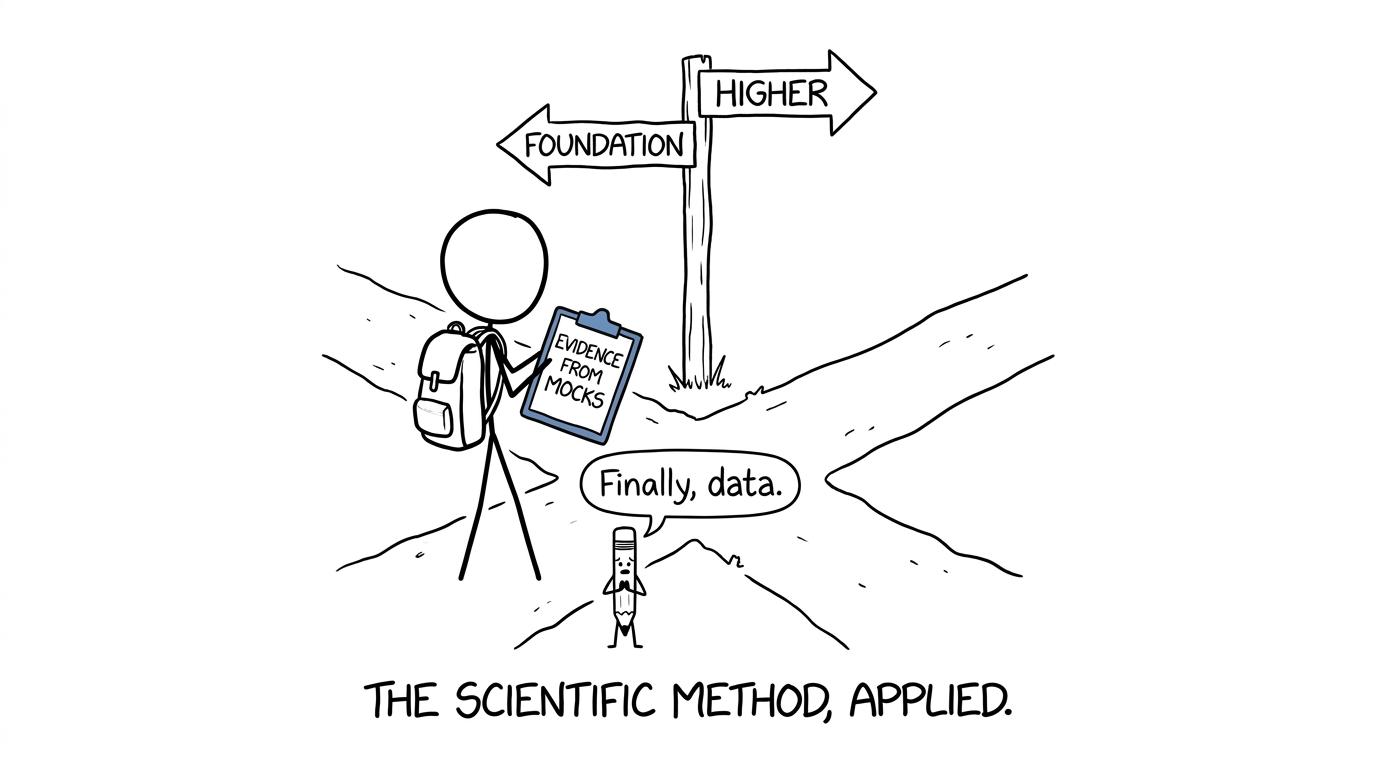 A student choosing between Foundation and Higher using evidence from mocks
What Foundation and Higher mean in GCSE Russian
The current Pearson Edexcel GCSE Russian qualification, specification code 1RU0, has four assessed skills:
- listening and understanding;
- speaking;
- reading and understanding;
- writing.
Each contributes 25%25\%25% of the qualification. You must take one tier across all four papers; you cannot, for example, sit Foundation listening and Higher writing. Dictionaries are not permitted, including during preparation for the speaking assessment.
Foundation targets grades 111 to 555. Higher targets grades 444 to 999, with a narrow grade 333 safety net for students who fall only slightly below the grade 444 boundary. It is not a guaranteed fallback. Below that limited range, the result is unclassified.
A grade 444 or 555 has the same value whether it is earned on Foundation or Higher, and the certificate does not display the tier. Foundation is therefore not a lesser qualification. It is a different route through the same qualification, designed around a different range of attainment.
The tiers also differ in demand and assessment time. Under the Pearson specification, Foundation listening lasts 353535 minutes and Higher listening 454545 minutes, including reading time. Foundation speaking lasts 777 to 999 minutes, while Higher speaking lasts 101010 to 121212 minutes, with preparation time for both. Foundation reading lasts 505050 minutes and Higher reading lasts 111 hour 555 minutes. Check the current specification and your centre's information because administrative details can change.
Decide from where you are realistically sitting now
A target grade matters, but current performance matters first. Wanting grade 888 does not itself make Higher suitable. Equally, one difficult mock does not prove that Foundation is necessary.
Look for a repeatable grade range
Use at least two or three properly timed assessments if they are available. Your most useful result is not your highest mark. It is the range you can reproduce when the vocabulary, topics and question order change.
This means:
- completing papers without notes or a dictionary;
- following the correct time limit;
- marking against the relevant mark scheme;
- recording results by skill, not just as one total;
- asking your teacher to interpret grade boundaries and speaking marks.
Grade boundaries change between exam series, so do not assume that a percentage from one year guarantees the same grade in another. Foundation and Higher papers also have different demands, making raw percentages across tiers an unreliable direct comparison.
A calm diagnostic routine is more useful: assess, mark, identify the weakness, practise, then assess again. Maths students can develop this habit using AQA GCSE Maths past papers or the wider MathsGenie GCSE and A Level revision platform. The subject is different, but the principle is identical.
Compare your evidence with the grade ceiling
Foundation is likely to be appropriate if:
- your results usually fall within grades 111 to 444;
- grade 444 or 555 would meet your next-step requirement;
- Higher questions regularly prevent you from showing what you know;
- your performance is inconsistent across several skills;
- securing a recognised grade matters more than accessing grades 666 to 999.
Higher is likely to be appropriate if:
- you need grade 666 or above, which Foundation cannot award;
- you are repeatedly secure at grade 555 or above in Higher assessments;
- unfamiliar language does not cause entire sections to collapse;
- you can communicate with sufficient accuracy, range and spontaneity;
- your teacher believes your evidence supports the additional demand.
If your results sit around grades 444 to 555, the decision deserves particular care. Ofqual's guidance indicates that students expected to achieve grade 444 or 555 should generally be entered for Foundation. Higher may still be considered when there is convincing evidence of progress towards grade 666, but it should not be chosen merely to keep the possibility open.
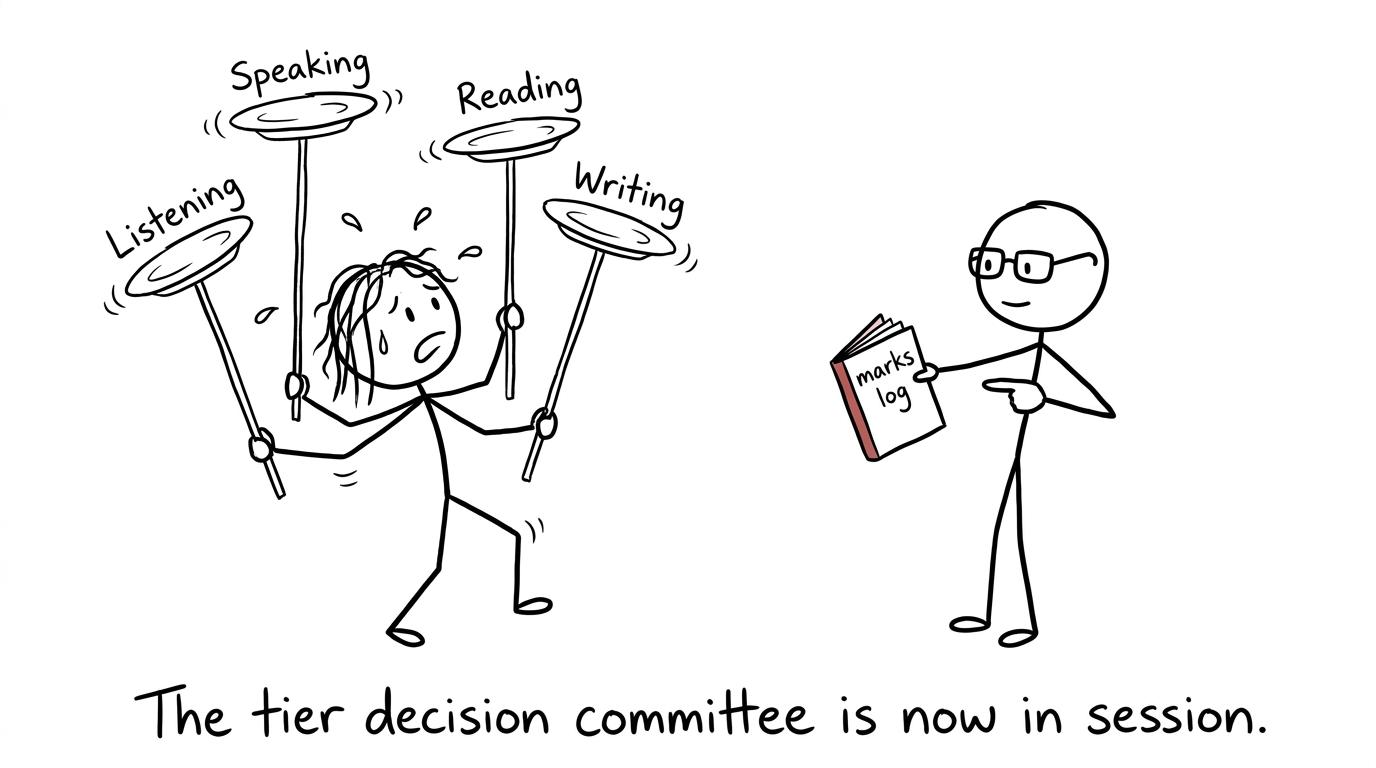 A student balancing the four GCSE Russian skills
Judge all four Russian skills separately
An overall grade can hide an important problem. Because listening, speaking, reading and writing each carry 25%25\%25%, a severe weakness in one area cannot simply be ignored.
Create a four-column record after each assessment. For every skill, note:
- the mark and teacher feedback;
- whether timing affected the result;
- vocabulary or grammar gaps;
- mistakes caused by misunderstanding the task;
- whether the performance is improving across several attempts.
Listening often reveals how well you process unfamiliar speech under pressure. Reading tests whether you can extract meaning rather than recognise isolated words. Writing demands communication, accuracy and range. Speaking adds interaction and spontaneity.
Higher should be supported by enough evidence across the complete qualification. A strong speaking performance alone does not remove the risk created by persistently weak reading or writing.
Use the right paper for your diagnosis
Practising an easier paper can make you feel ready without testing Higher demand. Practising only very difficult material can create the opposite illusion and make solid Foundation-level knowledge feel worthless.
Use materials that match the exact Pearson Edexcel Russian specification and intended tier. Your teacher can provide secure or authorised assessment material and explain how speaking tasks are marked. Do not rely on a random worksheet whose board, tier or date is unclear.
For maths revision, the same board-and-tier matching is built into resources such as the Edexcel GCSE Maths revision hub and OCR GCSE Maths revision hub. They do not teach Russian, but they demonstrate a useful revision habit: always practise the assessment you will actually sit.
Build a short evidence plan before deciding
If the entry decision is not yet fixed, agree a review period with your teacher. A practical plan might include:
- one timed listening and reading assessment;
- one writing task completed without support;
- a speaking assessment under realistic conditions;
- focused revision on the weakest skill;
- a second assessment using fresh material;
- a final conversation about the pattern of results.
Record the sessions in the free MathsGenie revision planner, alongside your maths revision. Keep each task specific: “Higher reading assessment” is more useful than “revise Russian”.
The aim is not to produce one heroic result. It is to find out what survives changing questions and exam pressure.
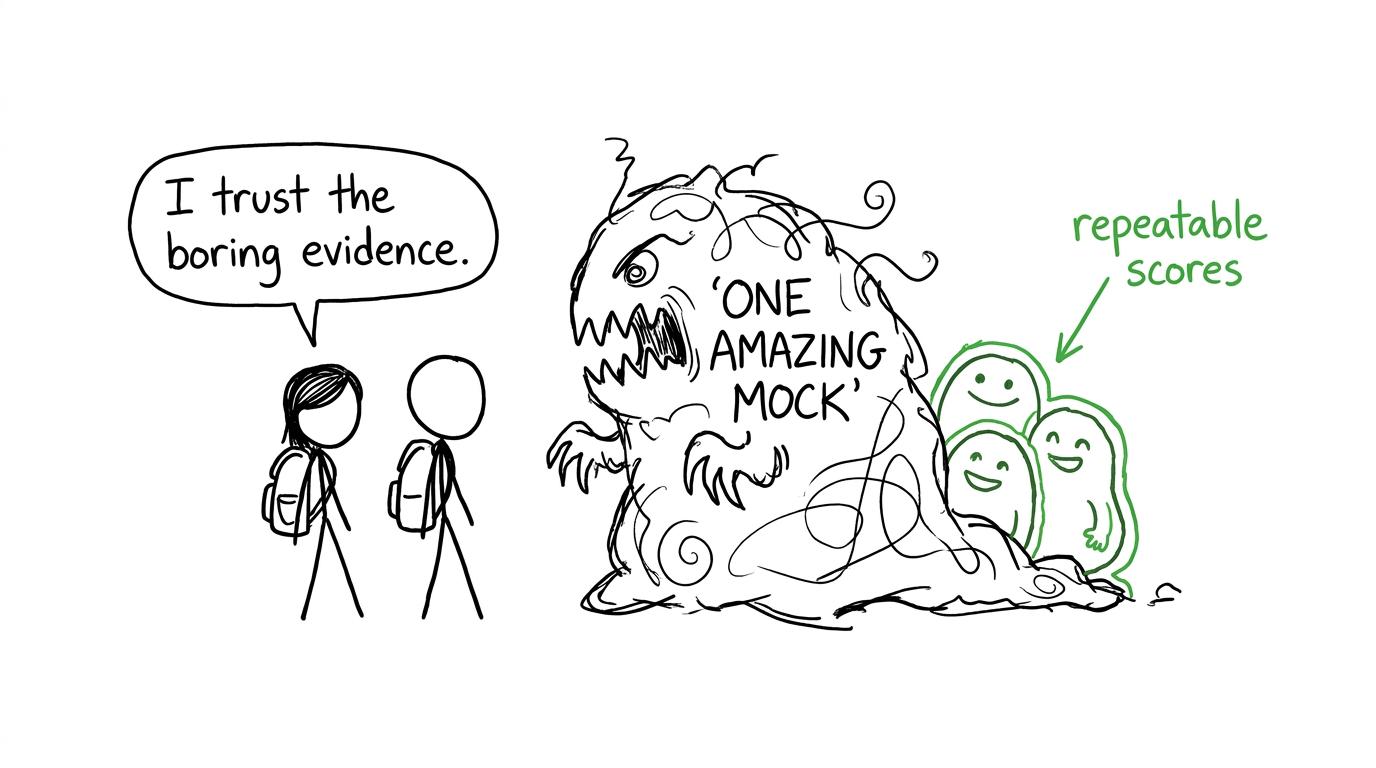 A student trusting repeatable scores rather than one amazing mock
Common mistakes when choosing a GCSE Russian tier
Choosing Higher because it sounds better
Higher offers grades 666 to 999, but access to those grades only matters if your present evidence makes at least grade 444 secure. Ambition works best when it is attached to a realistic route.
Treating Foundation as an automatic failure
Foundation can award grade 555. For a student seeking a secure pass, it may provide the most appropriate questions and the best opportunity to demonstrate knowledge.
Relying on one mock
One paper can be distorted by familiar topics, illness, timing or nerves. Use a pattern of assessments across all four skills. Guidance on when to begin past-paper practice explains why diagnosis and review matter more than simply collecting paper totals.
Assuming Higher guarantees grade 333
The Higher grade 333 is only a narrow safety net immediately below the grade 444 boundary. It should never be treated as the normal minimum grade.
Comparing raw percentages across tiers
The papers target different ranges of demand, and grade boundaries are set for each exam series. Ask your teacher to interpret results using the correct tier and assessment materials.
Revising without correcting mistakes
Practice only becomes evidence when it is marked and reviewed. The useful loop is simple: attempt, mark, diagnose, repair and retest. Maths students can apply it through Edexcel predicted papers, mark schemes and video solutions, while using teacher-approved Russian materials for the language itself.
Make the decision calm, not dramatic
A tier is an assessment route, not a label for your intelligence. Foundation can be the intelligent choice for a secure grade 444 or 555. Higher is necessary if your realistic goal is grade 666 or above, but the word “realistic” should be supported by timed, repeatable evidence.
Talk to your teacher, examine all four skills and ask what your marks show today. Then create a plan for what can genuinely improve before the final entry decision.
MathsGenie does not provide GCSE Russian lessons, but it can organise the other half of your GCSE workload. Use its free revision lessons, practice questions, mini tests, past papers, predicted papers, mark schemes and video solutions to make maths revision more efficient. A structured one-month GCSE maths revision plan can free your attention for Russian while keeping both subjects moving forward: one honest piece of evidence at a time.