

Foundation or Higher GCSE Bengali: How to Choose
Foundation or higher GCSE Bengali? Use recent evidence across all four skills to choose a realistic tier, protect your grade and plan revision confidently.
Choosing a tier can feel like predicting your future from one mock paper. It is not. If you are deciding between foundation or higher GCSE Bengali, the best answer comes from recent evidence across listening, speaking, reading and writing, not pride, panic or one unusually good result.
For the current AQA GCSE Bengali specification, Foundation gives access to grades 111 to 555. Higher gives access to grades 444 to 999, with an allowed grade 333 available only when a candidate narrowly misses grade 444. Choose Foundation when your present performance points towards grades 111 to 555 and the Higher papers remain consistently insecure. Choose Higher when your evidence is securely around grade 555 or above, you need access to grades 666 to 999, and all four skills can withstand the extra demand.
That is the short answer. The important word is securely.
Your tier decision checklist
Before agreeing to a tier, check that you have:
- confirmed that you are taking AQA GCSE Bengali 863886388638, rather than a separate International GCSE Bangla qualification
- completed recent papers or controlled assessments at the proposed tier
- reviewed listening, speaking, reading and writing separately
- compared results with the correct official grade boundaries and mark schemes
- looked for a pattern across several assessments, not one score
- considered the grade you realistically need
- discussed the evidence with your Bengali teacher and exams officer
The logic resembles choosing a tier in maths. The specifications are different, but the decision should still be based on demonstrated performance. MathsGenie’s guide to GCSE Maths topics by exam board and tier shows why checking the exact board and tier must come before planning revision.
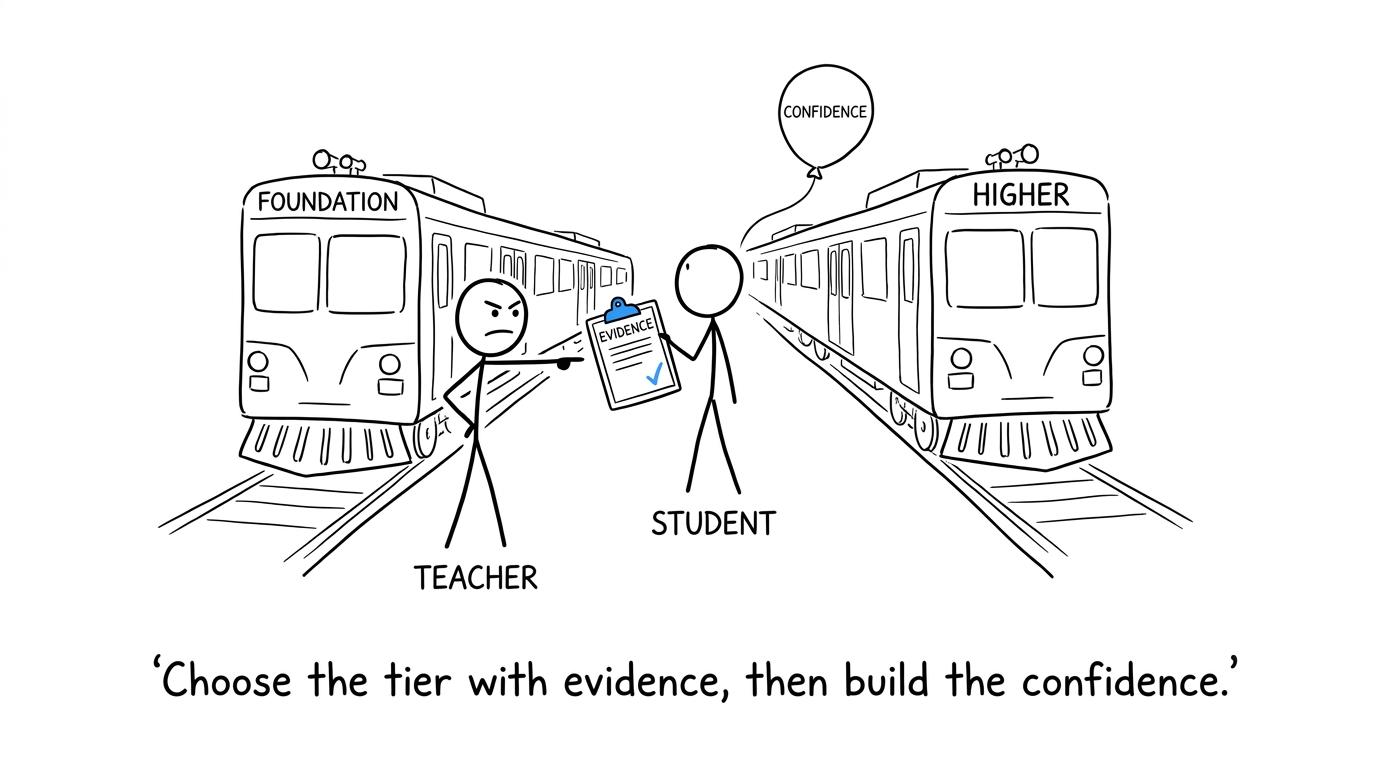 A student choosing between Foundation and Higher using evidence rather than confidence
What Foundation and Higher GCSE Bengali actually mean
AQA GCSE Bengali is a linear qualification. Students complete four assessments at the end of the course:
- listening
- speaking
- reading
- writing
Each skill contributes approximately 25%25\%25% of the qualification. You must enter the same tier for all four assessments, so you cannot take Higher reading alongside Foundation listening. This matters because a strong heritage speaker may be excellent in conversation but less secure when reading unfamiliar Bengali or writing accurately under timed conditions.
| Tier | Available grades | Best suited to students who are currently... |
|---|---|---|
| Foundation | 111 to 555 | Working towards a secure pass or grade 555, with uneven performance or significant gaps at Higher level |
| Higher | 444 to 999, with a narrow grade 333 safety allowance | Consistently secure around grade 555 or above and ready for more demanding language across all four skills |
Foundation is not an easier route to a lesser qualification. Grades 444 and 555 are intended to represent comparable attainment across the overlapping tiers. Foundation simply presents demand targeted at grades 111 to 555 and caps the final grade at 555.
Higher opens the route to grades 666 to 999, but it also carries greater downside when a student is not yet secure. The allowed grade 333 is a narrow safety provision, not a reliable fallback. A Higher candidate who falls below that limited range receives a U.
Decide from where you are realistically sitting now
A tier should reflect your current repeatable performance, with reasonable allowance for the progress you can make before entries are finalised. It should not be based entirely on a distant target grade.
Use several recent assessments
Collect results from recent class assessments, mock papers and official past-paper tasks. Whenever possible, use work completed under appropriate time limits without notes, dictionaries or outside help.
A single result is noisy. You may know the topics, guess several answers correctly or have an unusually difficult day. Several results reveal the underlying pattern.
Record for each assessment:
- the paper and tier
- the date
- the raw mark
- the official boundary for that examination series, where applicable
- the skill assessed
- whether timing affected the result
- the main reasons marks were lost
Do not invent a universal percentage such as “you need 60%60\%60% for Higher”. Grade boundaries can change between examination series because paper demand changes. Compare each past paper with the boundary published for that specific series, then look for consistency.
The same evidence-first habit improves maths revision. MathsGenie’s guide to finding your weakest GCSE topics explains how to turn marked work into a useful diagnosis rather than simply recording a score.
Judge all four skills, not your favourite one
Ask four separate questions:
- Can I follow spoken Bengali at examination pace without relying on every word?
- Can I speak with enough range, accuracy and spontaneity for the proposed tier?
- Can I understand unfamiliar written material and infer meaning from context?
- Can I write accurately, address every task requirement and manage the required length?
Your weakest skill matters because all four components have equal overall weighting. Higher may be sensible when one skill is slightly behind but improving. It becomes much riskier when two or more skills repeatedly fall below the Higher overlap range.
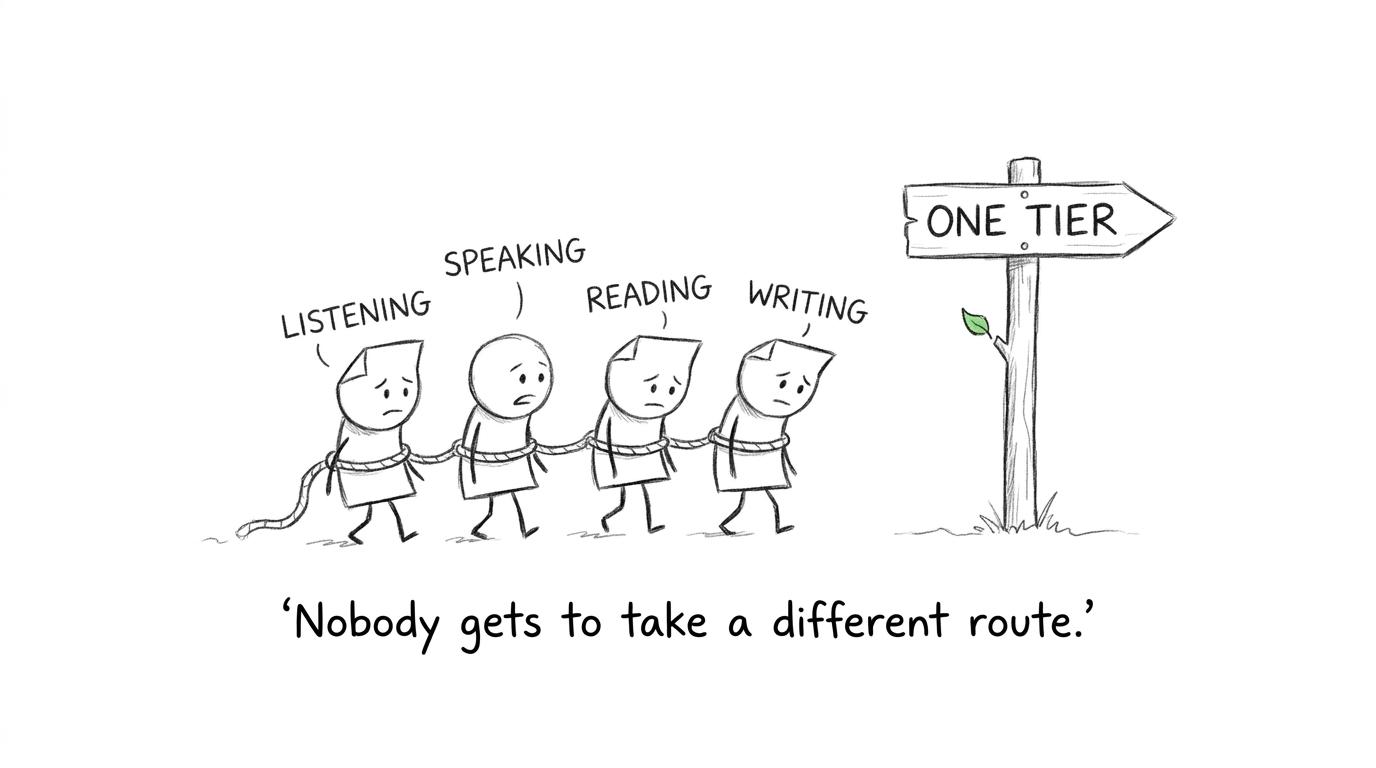 Listening, speaking, reading and writing taking the same tier route
Separate fluency from exam readiness
Speaking Bengali at home is valuable, but conversational fluency and examination performance are not identical. GCSE assessment also rewards accurate grammar, appropriate register, precise reading, translation, task completion and controlled writing.
The reverse can also be true. A student may feel hesitant in casual conversation yet perform well because they understand the specification, prepare themes carefully and respond accurately to examination tasks.
Do not use the label “native speaker” or “heritage speaker” as a tier decision. Use marked evidence.
Consider the grade you actually need
If your next step requires a grade above 555, Foundation cannot provide it. Higher is therefore necessary; but necessity does not automatically create readiness. It creates a revision target.
If your priority is securing grades 444 or 555, Foundation may offer a better match when Higher performance is unstable. Entering Higher merely because it sounds more ambitious can expose you to unnecessary risk.
This is also the central lesson in MathsGenie’s guide to moving from Foundation to Higher GCSE Maths: aspiration matters, but evidence must support the move.
A practical way to make the decision
Arrange a tier review with your teacher rather than relying on a corridor conversation. Bring your recent evidence and ask:
- Which grade range do my latest assessments indicate?
- Is that judgement consistent across all four skills?
- Which Higher demands are currently costing me marks?
- How much time remains before the school must finalise my entry?
- What specific evidence would justify changing tier?
Then agree a review period. During that period, practise the weakest skill, complete another appropriate assessment and compare the outcome. The goal is not to prove that you “deserve” Higher. It is to discover which paper gives you the strongest realistic outcome.
A useful revision loop is:
- attempt a timed task
- mark it against the official criteria
- categorise each lost mark
- practise the underlying weakness
- retest under similar conditions
This is the same disciplined process described in MathsGenie’s guide to efficient GCSE Maths revision. Different subject, same principle: feedback should determine what happens next.
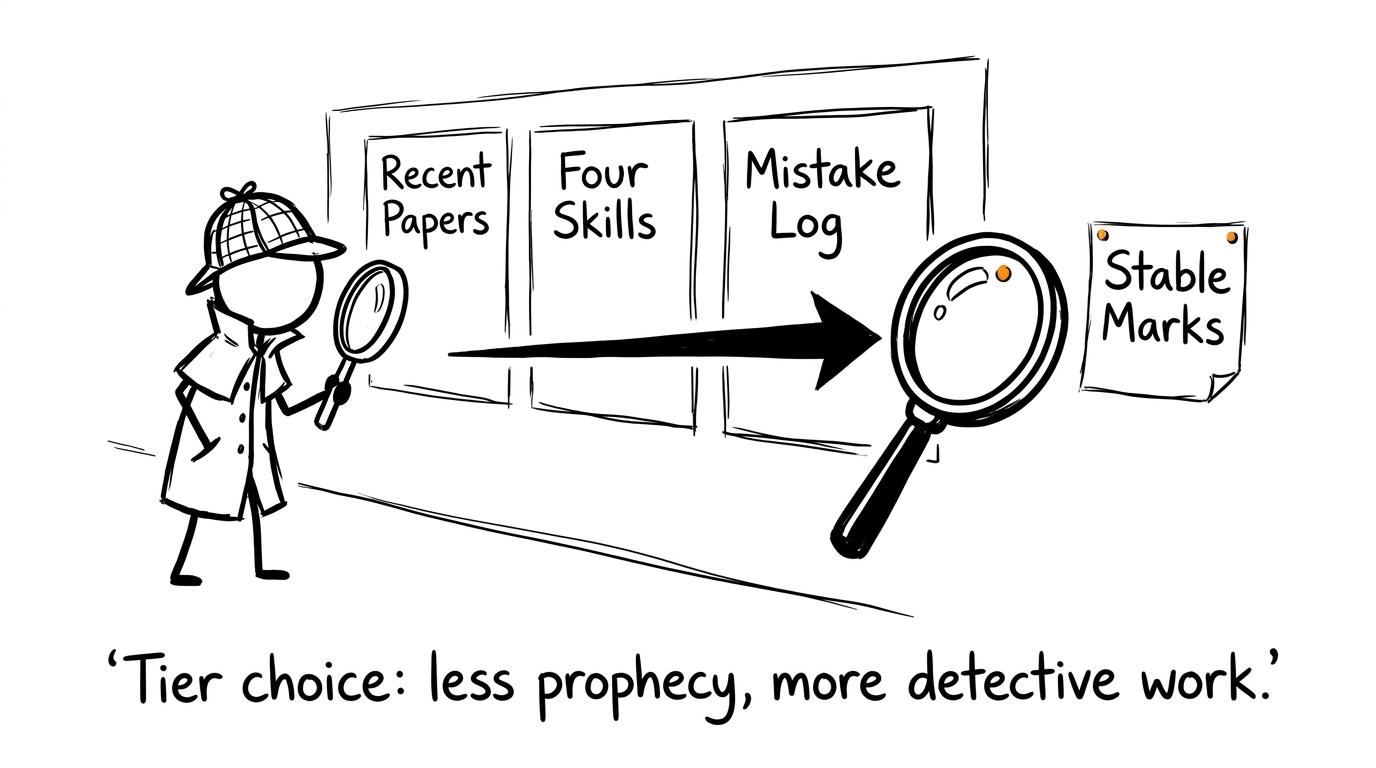 A student detective investigating recent papers, four skills and stable marks
When Foundation is probably the realistic choice
Foundation is likely to be appropriate when:
- your current evidence is mainly within grades 111 to 555
- your priority is securing grade 444 or 555
- Higher listening or reading regularly becomes inaccessible
- timed writing remains incomplete or inaccurate at Higher demand
- performance varies sharply between the four skills
- Higher assessments repeatedly place you at risk of falling below the narrow grade 333 allowance
Choosing Foundation is not giving up. It is choosing the assessment that best matches your present attainment. A secure grade 555 is more valuable than entering Higher for symbolic reasons and losing access to a classified grade.
When Higher is probably the realistic choice
Higher is likely to be appropriate when:
- you need access to grades 666 to 999
- several recent assessments place you securely around grade 555 or above
- performance is reasonably balanced across all four skills
- you can complete Higher tasks within the available time
- your teacher’s assessment supports the move
- mistakes are increasingly about refinement rather than fundamental comprehension
Being capable of answering occasional Higher questions is not enough. Readiness means sustaining performance across a full assessment series.
Common tier-choice mistakes
Choosing Higher because friends are doing it
Your friends’ language backgrounds, targets and assessment records are irrelevant to your entry. Tiering is an individual risk decision.
Treating Foundation as failure
Foundation still offers grades up to 555, including the standard pass range. The appropriate tier is the one most likely to convert your present knowledge into the best secure grade.
Looking only at the total mark
A total can hide a serious weakness. Break performance down by skill and identify whether marks were lost through vocabulary, grammar, comprehension, timing or incomplete responses.
Using the wrong qualification information
AQA GCSE Bengali and International GCSE Bangla are separate qualifications with different assessment structures. Confirm the exact title and code shown by your school before using specifications or papers.
Revising without retesting
Reading vocabulary lists can feel productive without proving improvement. Timed reassessment is what tells you whether the tier decision has changed. The MathsGenie guide on when to start GCSE past papers offers a useful model for moving from diagnosis to timed performance.
Make the tier a decision, not an identity
Foundation and Higher are paper routes, not descriptions of intelligence. The sensible choice is the one supported by your latest repeatable evidence across listening, speaking, reading and writing.
Confirm your qualification, examine several recent results, identify your weakest skill and speak to your teacher before the entry is finalised. If Higher is realistic, build the consistency needed to make it worthwhile. If Foundation gives you the safer route to your best likely grade, take it without embarrassment.
MathsGenie focuses on free GCSE and A Level maths revision rather than Bengali, but the same evidence-led habits can strengthen your wider exam preparation. Start at the GCSE Maths revision hub, learn weak topics through revision lessons, practise exam questions, and test your progress with mini tests, past papers, predicted papers, mark schemes and video solutions. Use the resources to replace guesswork with proof, one marked paper at a time.










