

Exam Countdown GCSE Design and Technology: Help?
Exam countdown GCSE Design and Technology advice: see when a timer motivates revision, when it adds pressure, and how to make a calm, useful plan today.
A countdown can look harmless: a number on your phone, falling by one each morning. Yet the same number can produce two completely different reactions. One student sees time they can use. Another sees time escaping.
An exam countdown GCSE Design and Technology timer helps when it turns the exam date into specific, manageable actions. It adds pressure when you check it repeatedly, treat every day as equally productive or let the number replace an actual revision plan. The best countdown is not a threat. It is a planning tool that tells you what to do next, while leaving room for maths, other GCSE subjects, sleep and ordinary life.
The quick countdown checklist
Before putting a countdown on your home screen, ask:
- Have I confirmed the date with my school and exam board?
- Does the countdown lead to a task, rather than just display a number?
- Have I included Design and Technology, maths and my other exams?
- Is there catch-up time for difficult or disrupted days?
- Am I still sleeping, taking breaks and spending time away from revision?
- Would checking the countdown once a week feel better than seeing it hourly?
If the timer helps you answer, "What shall I do today?", keep it. If it mostly makes you think, "I am running out of time", change how you use it or remove it.
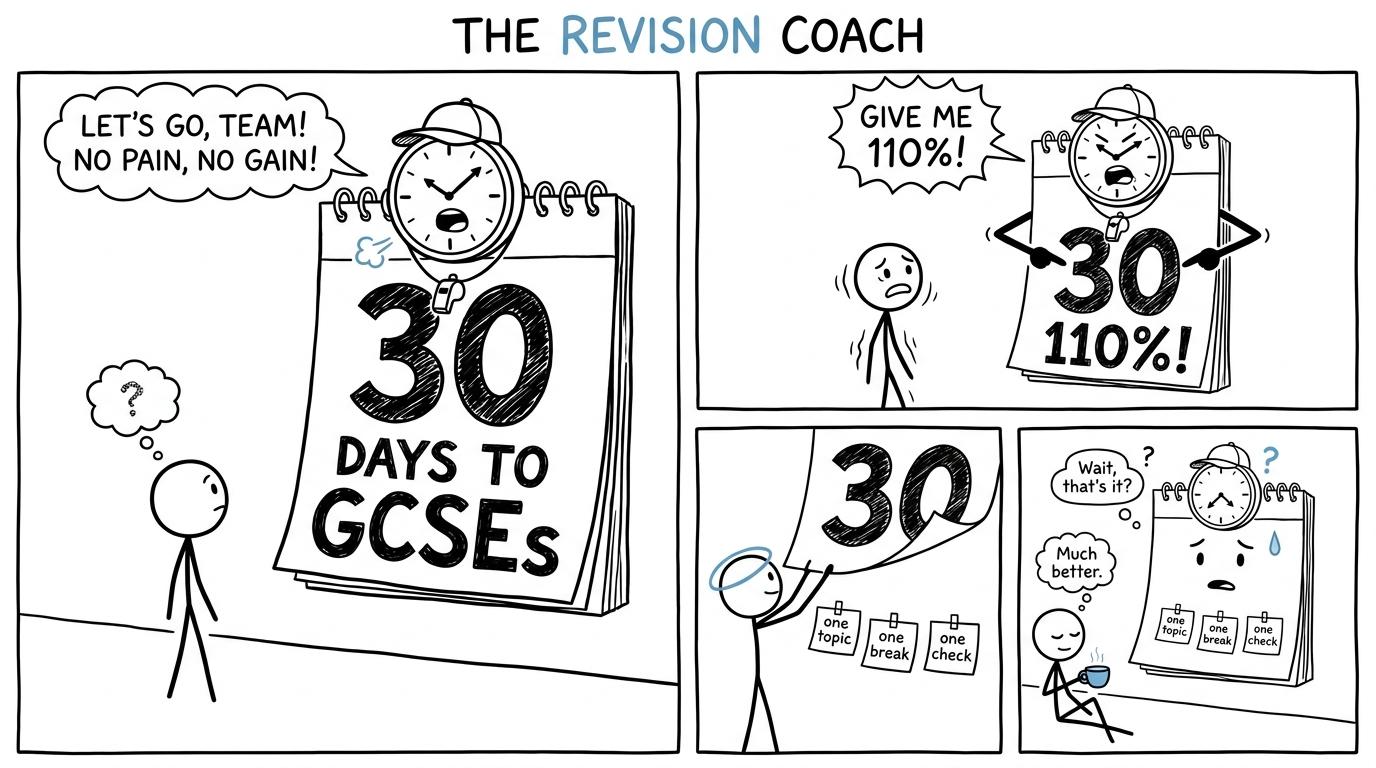 A student turns an alarming exam countdown into three manageable revision notes
Why an exam countdown can help
A distant exam is easy to treat as someone else's problem. A countdown makes the deadline visible. That can reduce procrastination, but only if the remaining time is translated into small commitments.
Official UK guidance on exam pressure recommends breaking revision into manageable topics, setting short-term targets, testing yourself and reviewing progress. NHS advice similarly encourages a realistic schedule, past-paper practice and regular breaks. Neither approach suggests staring at a timer. The useful element is the structure built around it.
It turns intention into a decision
"I need to revise Design and Technology" is an intention. "After school on Thursday, I will complete a materials recall task and check it" is a decision.
Research into implementation intentions suggests that specifying when, where and how an action will happen can help people follow through on goals. Evidence is not a guarantee that a countdown will improve a GCSE result, and much depends on the student and context. Still, the principle is useful: connect the date to an action.
For maths, that might mean opening the GCSE maths revision hub, choosing one weak topic and completing its practice questions. For Design and Technology, it could mean retrieving properties of materials, reviewing manufacturing processes or planning a timed response appropriate to your specification.
It reveals your real capacity
The number of days remaining is not the same as the number of useful revision sessions remaining. School, other exams, weekends, commitments and rest all affect capacity.
You can express the basic distinction as:
revision capacity=available sessions×realistic session length\text{revision capacity} = \text{available sessions} \times \text{realistic session length}revision capacity=available sessions×realistic session lengthThis is more useful than measuring time in days alone. Ten calendar days containing five focused sessions may offer less revision time than a longer countdown initially suggests.
A balanced planner should also recognise that Design and Technology is not your only subject. Use the GCSE maths revision timetable guide to organise maths around the rest of your exam schedule rather than allowing whichever exam feels most frightening to consume every evening.
It can make progress visible
A countdown only moves in one direction. Your preparation can move in the other.
Alongside days remaining, track completed tasks, topics recalled accurately and questions reviewed. This changes the story from "there are fewer days" to "there are fewer gaps". A simple revision planner, checklist or error log is enough.
In maths, the guide to finding your weakest GCSE topics shows how to use evidence from questions rather than choosing revision by mood. The same principle transfers to Design and Technology: let mistakes and uncertain topics shape the next session.
When the countdown adds pressure
A deadline can organise attention, but constant exposure can turn useful urgency into background alarm. The warning signs are practical, not mysterious.
You may find yourself checking the number without starting revision. You may abandon breaks because the countdown makes rest feel undeserved. Or you may spend so long rebuilding a perfect timetable that no work is completed.
The number becomes a judgement
"Twenty days remain" is a fact. "I should be much further ahead" is an interpretation.
The countdown does not know about illness, lessons, coursework, family responsibilities or the progress you have already made. When it begins to feel like a daily score of your worth or ability, it has stopped being useful.
Try reducing visibility. Check it during a weekly planning session instead of placing it on your lock screen. You still retain the deadline, but you remove the repeated prompt.
It encourages rushed, passive revision
Pressure often makes familiar tasks attractive. Rereading notes and highlighting pages can feel busy without showing whether you can retrieve or apply the knowledge.
Replace vague blocks such as "revise D&T" or "do maths" with observable outputs:
- answer a short set of questions without notes;
- mark a timed paper section;
- create recall prompts from the specification;
- correct mistakes and revisit them later;
- explain a process clearly from memory.
For a compact maths option, follow the twenty-minute GCSE maths revision routine. A short session completed and checked is more valuable than an ambitious session repeatedly postponed.
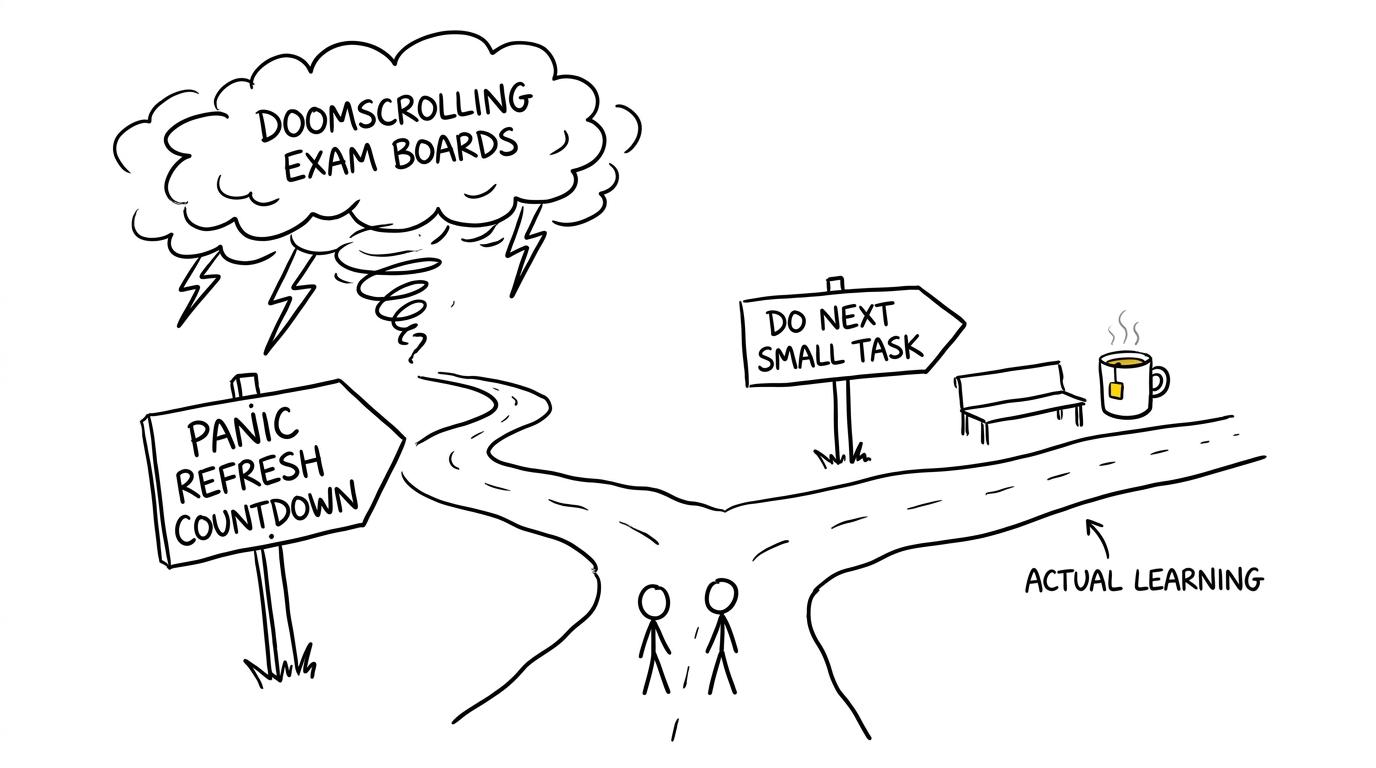 Two revision routes lead towards panic-refreshing or the next small task
Build a countdown that supports revision
The aim is to convert one large deadline into a sequence you can live with.
Confirm the correct examination date
Do not rely on a generic online timer or a date copied from social media. Check your board: AQA, Pearson Edexcel, OCR or Eduqas, and confirm the details with your school.
As of August 2026, timetable publication status for summer 2027 varies between awarding organisations, and provisional timetables can change before becoming final. Your school's examination timetable should therefore be your practical reference. Check the date, session, paper code and any instructions rather than assuming all boards share the same arrangement.
Plan backwards in phases
Divide the remaining preparation into three broad phases:
- Build knowledge: identify specification gaps and relearn uncertain content.
- Apply knowledge: answer exam-style questions and study how marks are awarded.
- Rehearse performance: complete timed sections, review errors and practise recovering when stuck.
Keep one catch-up slot each week. A plan with no spare capacity works only in a week where nothing goes wrong, which is rarely a sensible assumption.
For maths, MathsGenie's active recall guide explains how to move from reading notes to retrieving methods and answering questions. Use the same transition in Design and Technology: learn first, then close the notes and produce an answer.
Give every countdown check a next action
Whenever you view the remaining time, choose one task. It should be small enough to begin immediately and clear enough to finish.
A useful session follows this rhythm:
- choose one gap;
- retrieve what you know;
- review the missing knowledge;
- answer a question;
- check the answer or mark scheme;
- record the next improvement.
This keeps the countdown connected to behaviour. It also prevents the entire specification from competing for your attention at once.
Keep maths alive beside Design and Technology
An approaching D&T examination should change your priorities, but it should not erase maths from the timetable. Short maintenance sessions can protect methods and confidence until maths becomes the next main focus.
Use MathsGenie's guide to using past papers properly to build a cycle of attempt, mark, fix and retest. Nearer your maths papers, the Edexcel GCSE predicted papers can provide fresh timed practice alongside official past papers. Predicted papers should supplement past papers, not replace them.
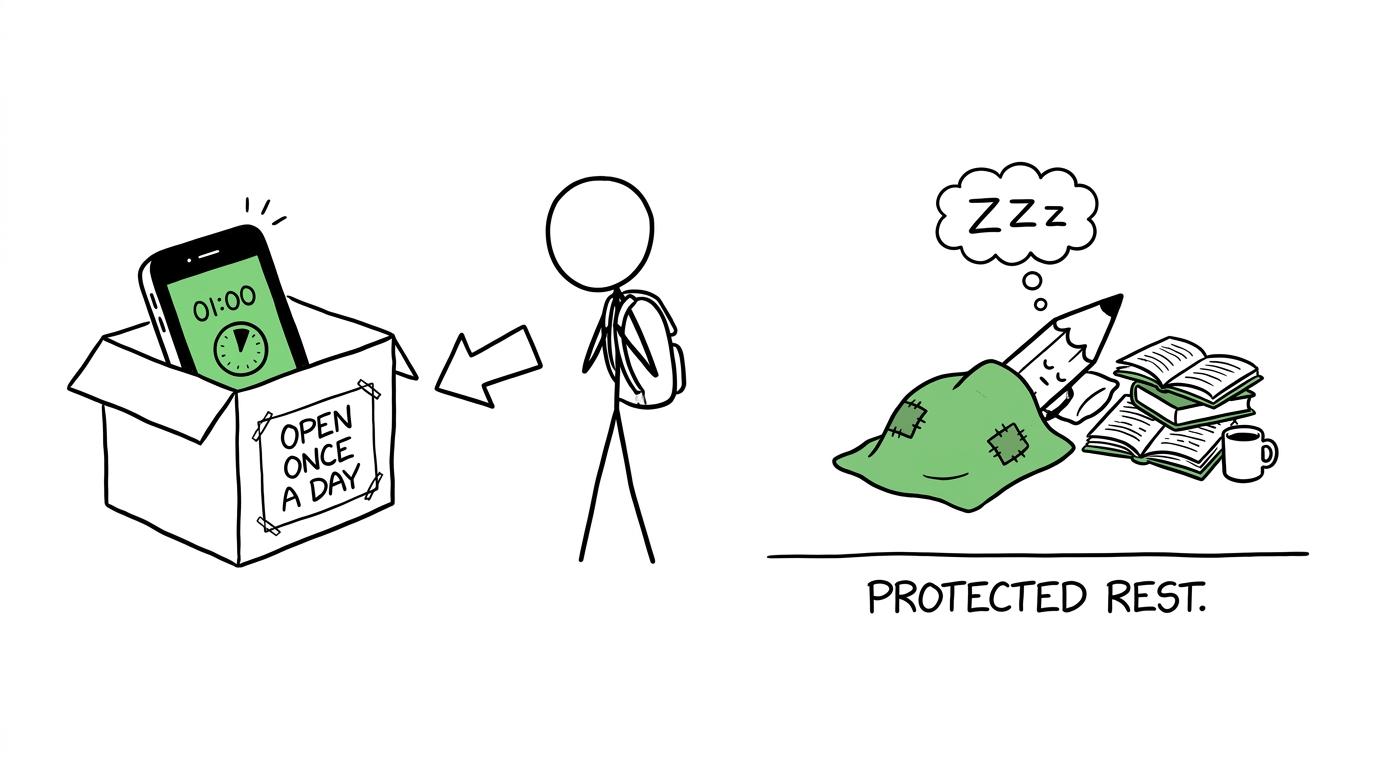 A student contains a ticking phone and allows a revision pencil to rest
Common countdown mistakes
Counting days instead of planning sessions
A calendar day is not automatically available revision time. Mark school hours, other examinations, rest and commitments first. Plan with the time that genuinely remains.
Making every day equally demanding
Energy and workload vary. Use lighter tasks on busy days and reserve timed practice for periods when you can concentrate. Consistency does not require identical sessions.
Revising only the nearest exam
The closest paper deserves attention, but later subjects still need maintenance. Keep small maths sessions in the plan so previously secure topics do not become unfamiliar.
Using the timer as punishment
Removing breaks, exercise or sleep does not make a countdown more productive. Authoritative exam-wellbeing guidance consistently recommends balance, manageable planning and asking for support when pressure becomes difficult to handle.
Trusting the date without checking it
Confirm the final timetable with your school. Make sure you know your awarding organisation, paper and session. A beautifully organised countdown to the wrong date is still wrong.
Make the next day useful, not frightening
A countdown cannot tell you whether you are ready. It can only measure the distance to a date. Readiness comes from smaller evidence: knowledge retrieved without notes, questions attempted, mistakes corrected and timed practice reviewed.
If your exam countdown creates action, perspective and a balanced plan, it is helping. If it causes repeated checking, guilt or panic, hide it and plan by weekly tasks instead. The deadline remains the same, but your relationship with it can change.
Keep your maths preparation moving with MathsGenie's free revision lessons, practice questions, mini tests and revision planner. Then use past papers, predicted papers, mark schemes and video solutions to turn each remaining session into evidence of progress. Start at the MathsGenie GCSE maths revision area, choose one manageable task and let today's action matter more than tomorrow's number.










