Exam Anxiety GCSE Sociology: A Practical Guide
Exam anxiety GCSE sociology advice: use paper-specific revision, essay plans and timed practice to feel calmer, think clearly and protect marks on exam day.
The hardest part of a Sociology exam is not always remembering the content. Sometimes it is sitting down, seeing an extended-response question and feeling as though every sociologist you revised has quietly left the room.
If exam anxiety GCSE Sociology searches brought you here, start with this: anxiety becomes more manageable when you make the exam familiar. Learn the structure of your board's papers, practise retrieving precise evidence, plan answers under time pressure and prepare a short routine for moments when your mind goes blank. The aim is not to eliminate every nerve. It is to stop those nerves controlling what you write.
This guide focuses on the pressures particular to GCSE Sociology: remembering theories and studies, applying evidence, evaluating arguments and managing extended responses. If you are balancing Sociology with maths, it also shows how to keep your wider GCSE revision realistic rather than letting one anxious subject consume the timetable.
Your GCSE Sociology anxiety checklist
Before changing your entire revision plan, check these five things:
- Know your exam board. GCSE Sociology is offered by boards including AQA and Eduqas, whose paper structures and question tariffs differ.
- Identify the precise trigger. Is it forgetting names, interpreting questions, running out of time or constructing evaluations?
- Revise through retrieval. Close the book and produce an answer rather than repeatedly reading notes.
- Practise the real task gradually. Build from plans to paragraphs, timed sections and complete papers.
- Prepare a freeze routine. Decide what you will do if anxiety rises in the exam, before that moment arrives.
That final point matters. A plan made while calm is easier to follow when thinking becomes difficult.
Why GCSE Sociology creates its own kind of anxiety
Sociology can look deceptively manageable in a revision guide. There are clear topics, recognisable perspectives and memorable debates. The difficulty appears when the exam asks you to bring several layers together.
You may need to recall accurate knowledge, apply it to a question or source, compare explanations, analyse evidence and reach a supported judgement. Official AQA and Eduqas materials describe these through three assessment objectives: knowledge and understanding, application, and analysis and evaluation. The wording varies slightly, but the underlying challenge is similar.
That means a student can know a topic yet still feel anxious about turning knowledge into marks. This distinction is useful. Instead of saying, “I am bad at Sociology,” ask which part of the performance is uncertain:
- recalling concepts and named evidence;
- matching material to the question;
- explaining links rather than listing facts;
- developing counterarguments;
- reaching a reasoned conclusion;
- finishing compulsory questions within the available time.
A specific problem can be trained. A vague fear tends to grow.
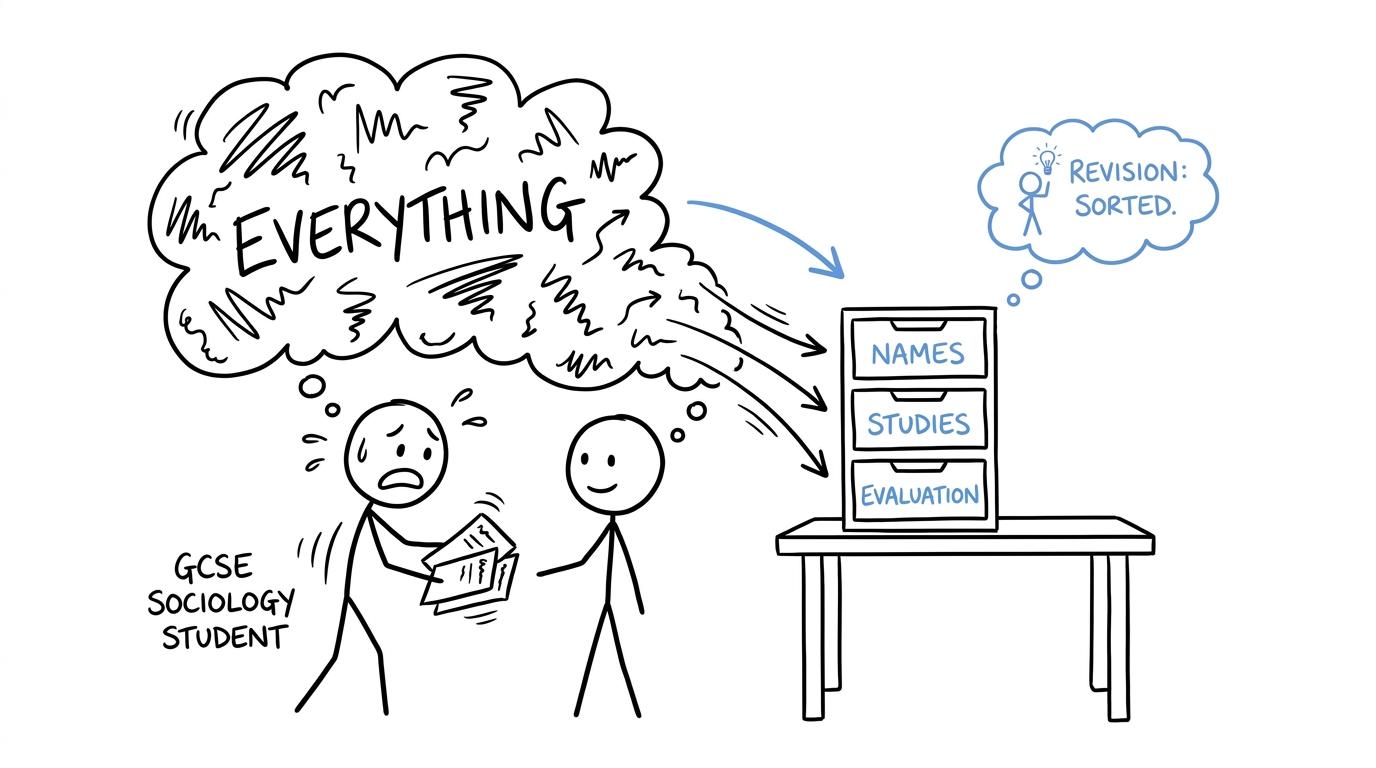 A student sorting an overwhelming Sociology revision cloud into manageable drawers
Turn the specification into a smaller map
Do not revise “all of Sociology” in one session. Start with the specification for your board and divide it into examinable areas.
For example, AQA GCSE Sociology includes families, education, crime and deviance, social stratification and sociological research methods. Its two written papers each last one hour and forty-five minutes and contribute half of the qualification. Eduqas also uses two written components, but its organisation and question styles are not identical. Check your specification, teacher guidance and recent papers rather than borrowing another board's revision list.
For each topic, build a one-page evidence map containing:
- key concepts and definitions;
- relevant perspectives;
- named sociologists or studies required by your course;
- the central argument or finding;
- one way the material could support an explanation;
- one limitation, contrast or alternative interpretation.
This reduces a chapter to material you can actually retrieve. It also prevents a common anxiety pattern: remembering a sociologist's name but not knowing why that evidence belongs in the answer.
Use evidence cards, not decorative notes
A useful evidence card has a question on the front and a concise answer on the back. Prompts might ask you to explain a concept, connect a perspective to education or evaluate a research method.
After answering, sort cards into three piles:
- secure without help;
- partly secure;
- unable to retrieve.
Revise from the final two piles. Confidence grows from evidence that recall is improving, not from making the secure pile look impressive.
Practise Sociology answers without starting with full papers
Telling an anxious student to “do more past papers” can be technically sensible but practically overwhelming. Use an exposure ladder instead.
Begin with question recognition
Take a paper and identify what each command word requires. Pay attention to the available marks and assessment objective. A short “identify” question needs a different response from an extended question asking you to discuss or evaluate.
Do not assume that one memorised paragraph structure fits every question. Use your board's mark schemes and examiner materials to understand what is rewarded.
Move to plans and single paragraphs
For an extended response, practise creating a brief plan containing:
- the argument you will make;
- relevant sociological evidence;
- a clear link to the exact question;
- analysis of why the evidence matters;
- a counterargument or limitation;
- the judgement you are moving towards.
Planning is not avoiding writing. It isolates the decision-making stage that often causes the freeze.
Next, write one paragraph under a gentle time limit. Only then progress to a complete response and, eventually, a timed paper. Familiarity should be built in steps small enough that you will repeat them.
Mark for patterns, not personal failure
When checking an answer, label each lost mark or weak section:
- missing knowledge;
- inaccurate evidence;
- insufficient application;
- undeveloped analysis;
- one-sided evaluation;
- weak judgement;
- timing problem.
This is the Sociology equivalent of a marks-leak list. Maths students can use the same diagnostic approach through MathsGenie's guide to finding weak GCSE topics, where mistakes are converted into focused next actions.
Build a timetable that protects every subject
Anxiety often persuades students to spend an entire evening on the subject they fear most. That can feel responsible while quietly damaging revision elsewhere.
Give Sociology sessions one closed objective, such as retrieving education evidence, planning two families questions or completing a timed research-methods section. A finished task gives your brain a clear stopping point.
You can adapt the structure in the GCSE maths revision timetable: short topic sessions during the week, followed by a longer timed and marked task. MathsGenie's one-month revision plan also demonstrates how diagnosis, retrieval, paper practice and rest can coexist.
If maths is another source of pressure, use the GCSE Maths revision hub to select your exam board and keep sessions contained. One lesson, one practice set and one correction is more manageable than an undefined instruction to “revise maths”.
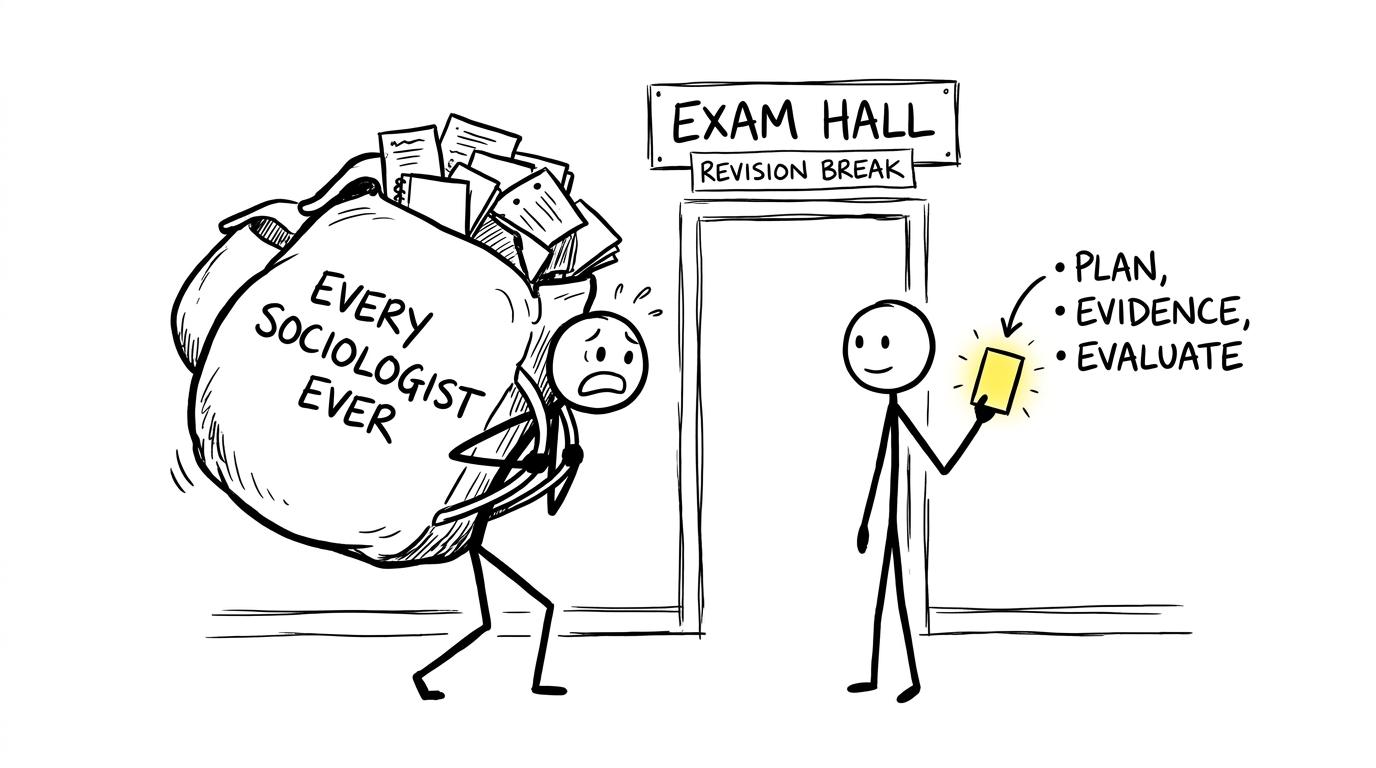 A calm student carries a small exam plan while another brings every sociologist ever
What to do when anxiety rises in the exam
Prepare a simple sequence and rehearse it during timed practice.
Pause and settle your breathing
Put both feet on the floor and release your grip on the pen. Breathe slowly, allowing the out-breath to last longer than the in-breath. NHS exam guidance recommends breathing exercises when students feel overwhelmed. The purpose is not to achieve perfect calm; it is to create enough space to make the next decision.
Reduce the question to instructions
Underline the command word, topic and any required context. Note the mark tariff. Ask yourself:
- What claim could answer this directly?
- Which concept, perspective or study supports it?
- What alternative explanation could challenge it?
Write a few planning words if permitted. Beginning with a small, relevant action is better than waiting for a complete essay to appear in your head.
Move on strategically
If you cannot begin, mark the question clearly and continue, provided the paper instructions allow questions to be attempted in that order. Return after banking marks elsewhere. Check that you answer every compulsory question before time ends.
If anxiety repeatedly disrupts mocks, revision, sleep or everyday life, tell a parent, carer, teacher or pastoral lead. A school's SENCo or examinations officer can explain whether support or access arrangements should be considered. These are evidence-based arrangements agreed before assessments; they are not automatically awarded because someone feels nervous. Persistent or severe anxiety also deserves support from a GP or another appropriate health professional.
The evening before Sociology
The last evening is for reducing uncertainty, not proving how long you can stay awake.
Use a short final check:
- confirm the paper, start time and required equipment;
- review your smallest set of high-value evidence cards;
- plan one or two responses without writing complete essays;
- check recurring mistakes in your answer log;
- pack your bag and set a stopping time;
- protect sleep rather than beginning a new topic late at night.
NHS guidance notes that sleep supports thinking and concentration, and that all-night cramming is usually a poor trade. For another practical model, MathsGenie's GCSE night-before plan shows how to replace panic with a short, closed routine.
Common mistakes when managing Sociology exam anxiety
Rereading instead of retrieving
Recognition can feel like knowledge. Close the notes and explain the theory, evidence and evaluation from memory.
Memorising complete essays
A rehearsed essay may not answer the wording on the paper. Memorise flexible evidence and practise adapting it to different questions.
Avoiding timed work until the final week
Waiting preserves the fear. Begin with a timed plan or paragraph, then increase the challenge gradually.
Treating every weak answer as a content problem
Sometimes the knowledge is present but the answer lacks application, analysis or evaluation. Diagnose the actual assessment skill.
Comparing answers immediately afterwards
Post-exam discussion cannot change the script and may intensify anxiety before your next subject. Note anything practically useful, then move forward.
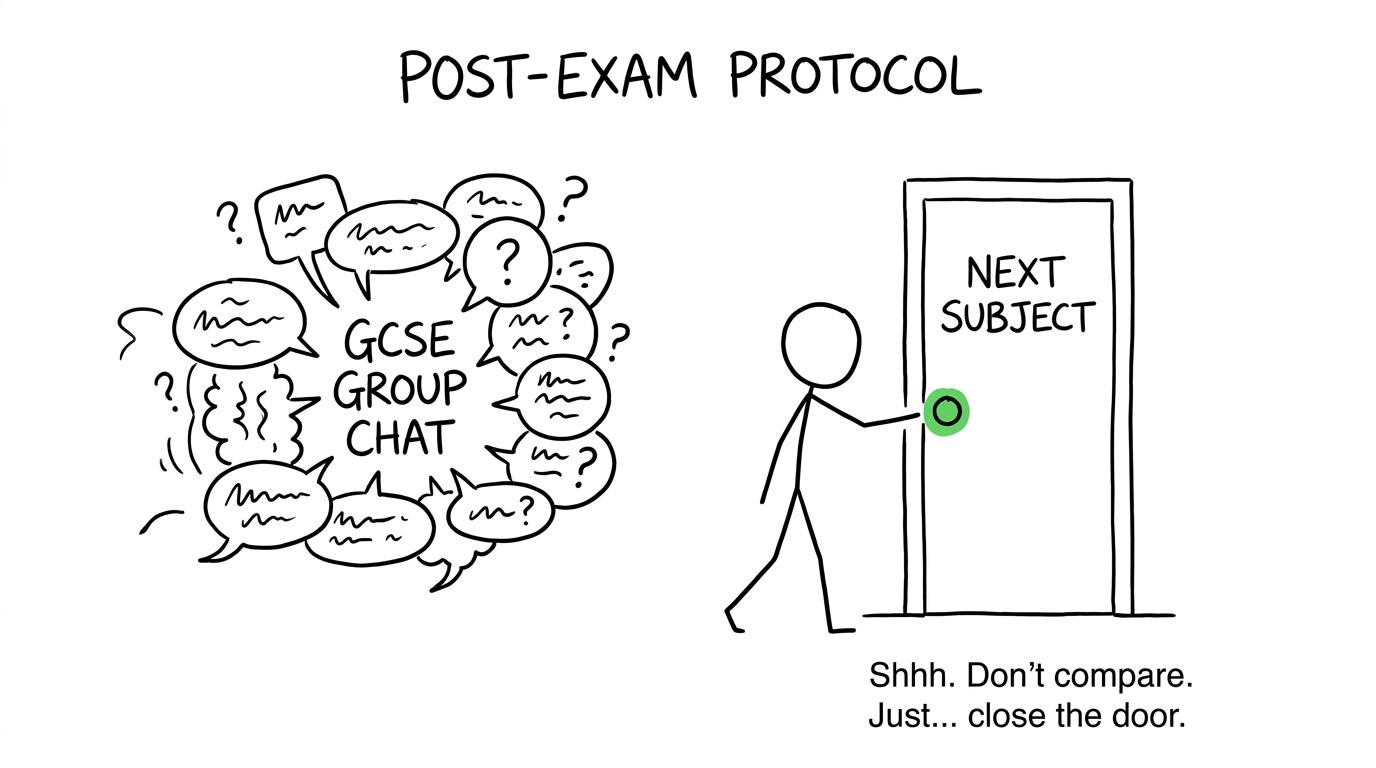 A student closes the door on a noisy post-exam group chat and turns towards the next subject
Finish with a repeatable routine
Managing exam anxiety in GCSE Sociology is less about finding one motivational phrase and more about removing uncertainty piece by piece. Know your paper. Shrink the specification into retrievable evidence. Practise plans before essays. Mark by assessment skill. Rehearse what you will do if your mind goes blank.
Then give the same calm structure to the rest of your GCSEs. MathsGenie can be your free maths revision base: begin with revision lessons and practice questions, progress to Edexcel GCSE Maths past papers or the appropriate board resources, and use GCSE predicted papers for fresh timed practice. Mark schemes, video solutions and mini tests turn worry into a next step.
You do not need to feel fearless before you begin. You need a task small enough to begin anyway.